


Why You Need a Chocolate Tempering Machine: Is Automatic Worth It?
Short answer: you can temper chocolate by hand, on a marble slab or by seeding, but every batch then depends on your hands, your room and your clock, and the cost is your time as much as your chocolate. An automatic tempering machine runs the melting, cooling and holding for you and keeps the chocolate in temper for hours, so the time you spent at the bench goes into moulding, selling and growing the business. If you temper every week, it makes sense to start with an automatic machine; below you can check the numbers with your own figures and see which of three machines fits your production.
| Your situation | Machine | Price |
|---|---|---|
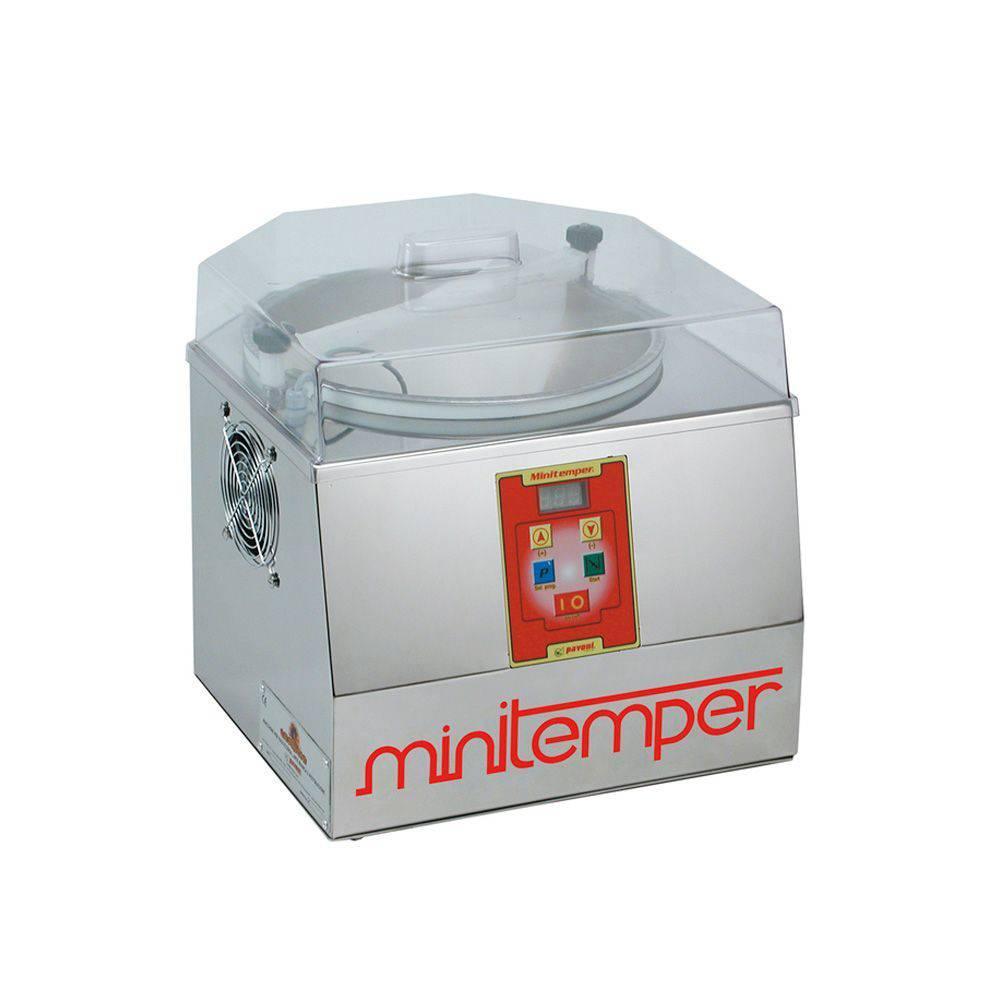
| Starting out, small batches, a standard 110 V outlet, several chocolates in rotation | Pavoni MiniTemper 110V | $3,350.00 CAD |
| Continuous tempering in a compact 5 kg tabletop machine with a removable auger | Pomati T5 | $11,650.00 CAD |
| Continuous production up to 24 kg/h, with a heated vibrating table and a pedal, ready to grow into dosing and enrobing | Bilait Adam K6 | $10,990.00 CAD |
What tempering does, and why it is hard to do by hand
Tempering makes the cocoa butter in chocolate set in one stable crystal form, called form V (β V). Cocoa butter can crystallise in six forms, with melting points from 17.3°C to 36.3°C (63–97°F); form V melts at 29–31.5°C (84–89°F) and is the one a correct tempering process produces. In a well-known definition from the scientific literature, good tempering leaves "the largest number of the smallest possible crystals" in form V. That is what gives gloss, a clean release from the mould (the chocolate contracts) and resistance to bloom.
Miss the target and you see it. Under-tempered chocolate can bloom in less than two days, with large white spots or white rings; over-tempered chocolate does not contract enough in the mould, and its surface turns grey and dull quickly.
Each chocolate has its own curve. The datasheet of our FCH 55% dark minibars, for example, gives:
| Stage | FCH 55% dark chocolate (datasheet) |
|---|---|
| Melt | 45–50°C (113–122°F) |
| Crystallise | 28–29°C (82–84°F) |
| Work (tempered) | 31–32°C (88–90°F) |
A one or two degree window, held for as long as you are working: that is the whole difficulty.
Tempering by hand on marble (tabling)
Tabling means cooling part of the melted chocolate on a marble or stone slab, working it with spatulas, and returning it to the bowl once it has cooled enough. Ewald Notter describes it as the fastest and most efficient method for smaller amounts: the stone draws the heat out and away from the chocolate.
He is just as clear about the conditions. It takes a stone slab and real hand-eye coordination; you must work quickly and keep spatulas clean or lumps form; the steps are repeated until the chocolate is cool enough to go back in the bowl; the timing changes with the size of the batch, the air temperature and the temperature of the slab; and if the chocolate gets too cold, you reheat it and start again. It is a skill that takes time to build, and it ties one skilled person to the slab for every batch.
Tempering by seeding (feeding solid chocolate)
Seeding means melting the chocolate completely and then adding chocolate that is already set and tempered, which carries stable crystals, and stirring gently so those crystals multiply. Notter melts dark chocolate to 46.1–48.8°C (115–120°F), and milk and white chocolate to 43.3–46.1°C (110–115°F), so that all crystals are gone before the seed goes in. It needs no slab and little equipment.
The science behind it: seed crystals let the rest of the cocoa butter crystallise quickly in the right form, and once the seed crystal concentration is high enough (0.5 to 2% of the total mass, in Lonchampt and Hartel's review), the chocolate can be used for moulded or coated products.
A good melter helps. The Martellato Digital Meltinchoc, for example, melts to 45°C (113°F), signals when it is time to seed, then lowers and holds the chocolate at 31°C (88°F) for dark, 29°C (84°F) for milk and 28°C (82°F) for white. But you still weigh, seed, stir and check the temper yourself, batch after batch.
The real cost of manual tempering is your time
The chocolate you lose is easy to see; the hours are not. When you temper by hand:
- Your hands are tied. While you table or seed, nobody is filling moulds, decorating, packing or talking to customers.
- The work restarts. Chocolate that drops out of temper while you work must be reheated and tempered again; on the slab, a batch that gets too cold goes back to the start.
- Results depend on the day. Batch size, room temperature and slab temperature all change the timing, and the result depends on who is at the bench.
- Mistakes reach the customer. Under-tempered pieces can bloom in less than two days, which may be after they have left your shop.
Every chocolatier who has tempered by hand knows the feeling at the end of a long day: hours of skilled work and a tray of bonbons that did not earn what the effort cost. Tempering is not where your margin is made. Your margin is made in the products, the recipes and the customers that tempering time keeps you away from.
What an automatic tempering machine changes
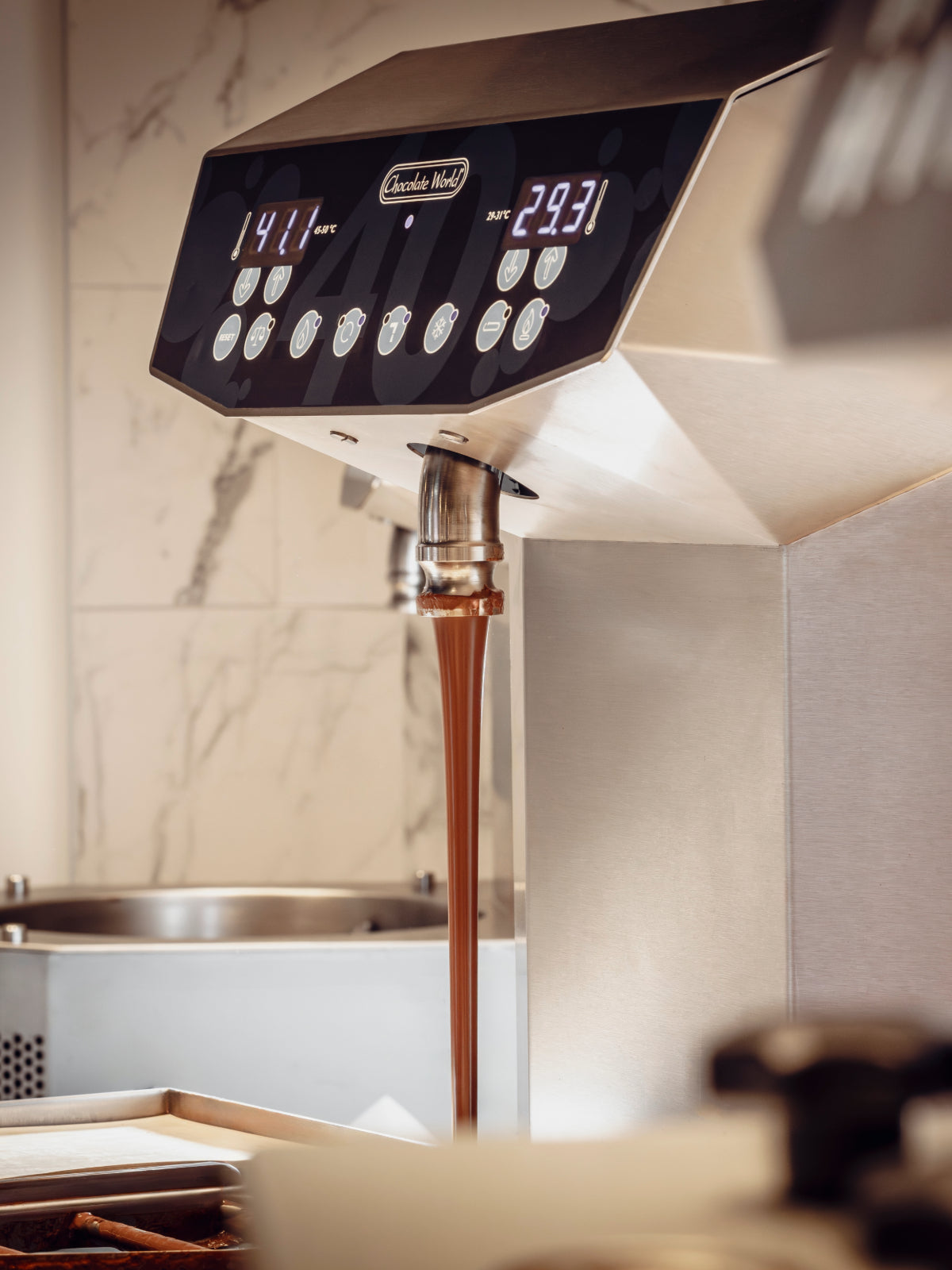
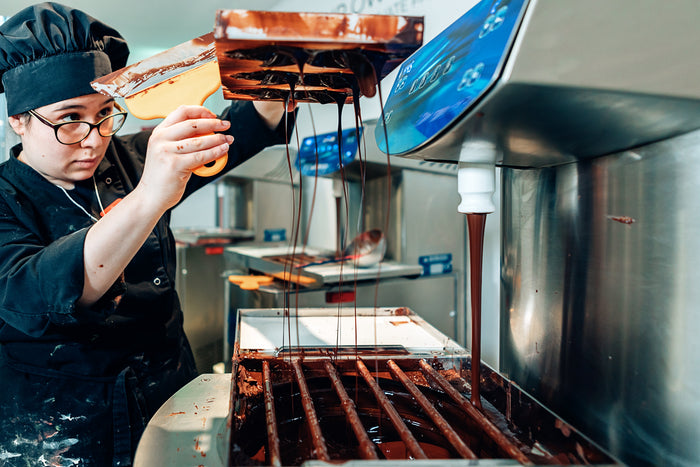
An automatic machine runs the temperature cycle for you and holds the chocolate at working temperature, so the person is free. Pavoni says the MiniTemper keeps chocolate tempered for several hours with its customisable programs. Pomati builds the T5 to melt and temper any type of chocolate with direct auger tempering. Bilait says the Adam K6 can work fully automatically, in a continuous cycle for whole days: it brings 20 kg of solid chocolate drops into temper in 4.5 hours (6 kg every hour and a half).
That last point is where seeding meets the machine: a continuous machine is fed with solid chocolate as production goes on, and it does the melting, crystallising and holding itself. Your job becomes loading, dosing and moulding.
Is it worth it? Work out your own payback
Compare what manual tempering costs you each week with the price of the machine. Use your own numbers; nobody else's apply to your kitchen.
| Line | How to work it out |
|---|---|
| A. Hours per week spent tempering and re-tempering by hand | Time it for two weeks, including reheating and cleaning the slab |
| B. Hourly cost of that person | Wage plus payroll costs, or what an hour of your own time is worth |
| C. Hours per week the machine still needs | Loading, programming and cleaning |
| D. Chocolate lost or downgraded per week | Kilograms scrapped or sold as seconds, times your cost per kilogram |
| Weekly saving | (A − C) × B + D |
| Payback in weeks | Machine price ÷ weekly saving |
Then add what the freed hours can produce: (A − C) × what you make or sell in an hour. Do not leave this line out. Also budget for the running costs: electricity, cleaning time and spare parts. Customers who buy their machine from Zucchero Canada get 15% off genuine spare parts with code PARTS15.
Three machines, three jobs
The three machines are not three versions of the same thing: each fits a different capacity, power supply and stage of a business.
| Pavoni MiniTemper 110V | Pomati T5 | Bilait Adam K6 | |
|---|---|---|---|
| Capacity | 5 L / 3 kg bowl | 5 kg tank | 6 kg tank |
| Operation | 5 programmable presets, 3 stages each | Continuous, auger | Continuous, up to 24 kg/h |
| Power supply | 110 V / 60 Hz | 240 V single-phase on Pomati's datasheet; other voltages on request | 230 V, 50/60 Hz |
| Included | Interchangeable stainless-steel bowl | Double heating circuit (tank and auger), refrigerating unit | Heated vibrating table, removable stainless-steel auger, stop & go pedal |
| Best fit | First machine, R&D, several chocolates | Steady small production in continuous | Production that will grow into dosing and enrobing |
Pavoni MiniTemper: the first automatic step
Pavoni describes the MiniTemper as a small bench tempering machine that is simple to use: 5 L / 3 kg capacity, 300 W, 16 kg, AISI 304 stainless-steel body and bowl, transparent lid. Our 110 V / 60 Hz version has five programmable presets (Pr1–Pr5), each with three stages (melt, crystallise, harden), set between 20°C and 60°C (68–140°F) in 0.5°C steps. Interchangeable bowls cut downtime when you change chocolate; an extra bowl lets you switch batches, or keep a backup bowl so production does not stop.
- View the Pavoni MiniTemper 110V → $3,350.00 CAD
- View the extra MiniTemper bowl → $299.00 CAD
Pomati T5: continuous tempering in a small footprint
Pomati calls the T5 the smallest countertop tempering machine in continuous in its range: a heated 5 kg tank, a double heating circuit for tank and auger, a refrigerating unit with forced-air cooling, high-precision thermostats and programmable switch-on and switch-off. The auger comes out for cleaning and for a quick change of chocolate, and runs in reverse to unload. It measures 480 × 450 × 390 mm. A T5 vibrating table is available as an option.
View the Pomati T5 → $11,650.00 CAD
Bilait Adam K6: the production machine that grows with you
Bilait presents the Adam K6 as the most compact machine in its category, for small workshops, pastry shops and restaurants starting with chocolate, or already working with it and wanting more capacity. The 6 kg tank produces up to 24 kg of tempered chocolate per hour; two separate motors drive the mixer and the auger; a night mode saves energy; and the machine can connect for remote support from Bilait. Included: a heated vibrating table (50 × 85 cm) that prevents chocolate buildup, a removable stainless-steel auger and a stop & go pedal for controlled dosing. Bilait's catalogue says the reversible pump allows complete cleaning in 10 minutes. It runs on 230 V, 50/60 Hz, and weighs 67 kg.
What makes it the strongest long-term choice is the line around it. Bilait's 2026 catalogue lists these optional accessories (not included):
- Automatic mould dosing heads, 7 × 3 and 8 × 3, and a customisable dispenser
- An enrober designed for the entire Adam line, including the K6 (192 mm belt, 30 kg per hour)
- Chocobox, to increase production during peak seasons
- A cooling tunnel, in modular lengths
- A handling trolley
You can start with the machine and add dosing or enrobing when the orders justify it. Ask us for the accessories you need.
View the Bilait Adam K6 → $10,990.00 CAD
For a spec-by-spec comparison of the three, read Pavoni MiniTemper vs Pomati T5 vs Bilait Adam K6.
How AI can help your production
Paste the payback table above into an AI assistant with your own hours, hourly cost and chocolate losses, and ask it to build a simple spreadsheet that shows the weekly saving and the payback period for each machine. Ask it to turn your chocolate's datasheet curve into a one-page procedure for the machine presets, and to make a daily temperature log your team can sign at every shift. When production grows, it can help you plan which products to mould on which day so the machine runs one chocolate at a time.
AI organises the information; tasting and the final decision stay with your chef.
Tempering machines at Zucchero Canada
Zucchero Canada is based in Calgary and ships across Canada. We are the exclusive distributor of Bilait in Canada and an authorized distributor of Pavoni Italia and Pomati. Start with the MiniTemper if you are testing products and work with several chocolates; choose the Pomati T5 for steady continuous work in a small space; choose the Bilait Adam K6 if you are building a production that will need dosing and enrobing.
View all chocolate tempering machines →
To go deeper into technique, Ramon Morató's reference book covers tempering, coating and glazing:
- View Chocolate, 6th Edition by Ramon Morató → $160.00 CAD
Buying for a chocolate shop, a hotel or several sites? Contact us for a recommendation based on your volume and your power supply, or call 587-774-8873 (toll free 877-741-8251).
Tempering machines | Bilait | Best tempering machines | MiniTemper vs T5 vs Adam K6 | How to temper chocolate | Tempering troubleshooting
This article is for information only. Every business is different: draw your own conclusions based on your own expectations, budget and goals, and talk to qualified experts before you decide or invest.
Sources: Pavoni Italia, Minitemper product page (pavonitalia.com) and Machines catalogue 2022; Pomati, T5 tempering machine page and datasheet (pomati.it); Bilait, Adam K6 product page (bilait.it) and Catalogue 2026 (Adam K6, Enrober, Cooling tunnel); Martellato, Digital Meltinchoc use and maintenance handbook; FCH Origins 55% dark chocolate datasheet (product page); E. Notter, The Art of the Chocolatier (Wiley, 2011), "The Tabling Method" and "The Seeding Method"; P. Lonchampt and R.W. Hartel, "Fat bloom in chocolate and compound coatings", Eur. J. Lipid Sci. Technol. 106 (2004) 241–274; V. Barišić et al., "The Chemistry behind Chocolate Production", Molecules 24 (2019) 3163.
Good to know
Frequently asked questions
Is a chocolate tempering machine worth it for a small business?
It depends on how many hours you spend tempering by hand. Add up the hours per week you spend tempering and re-tempering, subtract the time the machine still needs (loading and cleaning), multiply by the hourly cost of the person doing it, and add the chocolate you scrap or downgrade. Divide the machine price by that weekly saving to get the payback in weeks. Then count what the freed hours can produce.
Can I temper chocolate without a machine?
Yes. Tabling cools part of the melted chocolate on a marble or stone slab; seeding adds already-tempered chocolate to fully melted chocolate. Both work, but they need skill and time for every batch, and the result changes with batch size, room temperature and slab temperature. A machine runs the cycle and holds the chocolate in temper for you.
What is the difference between the Pavoni MiniTemper, the Pomati T5 and the Bilait Adam K6?
The MiniTemper (5 L / 3 kg bowl, 110 V version) works by programmable presets and suits a first machine or R&D with several chocolates. The Pomati T5 (5 kg tank) tempers in continuous with an auger in a compact footprint. The Bilait Adam K6 (6 kg tank, up to 24 kg/h, 230 V) is a continuous production machine with a heated vibrating table and pedal, and optional dosing heads and enrober.
Does the Bilait Adam K6 come with an enrober?
No. The K6 includes a heated vibrating table, a removable stainless-steel auger and a stop & go pedal. Bilait lists the enrober, the 7 × 3 and 8 × 3 automatic dosing heads, the customisable dispenser, Chocobox, the cooling tunnel and the handling trolley as optional accessories, not included. Contact us for the ones you need.
Do I need 220 V for a chocolate tempering machine?
Not for every machine. The Pavoni MiniTemper we sell is the 110 V / 60 Hz version. The Bilait Adam K6 runs on 230 V, 50/60 Hz. Pomati's datasheet lists the T5 at 240 V single-phase, with other voltages on request, so confirm the voltage with us before you order.
Do tempering machines qualify for free shipping, and are there discounts?
Machines are excluded from free shipping, which applies to selected products on orders of $300 CAD or more within Canada. Orders over $500 CAD get 5% off automatically at checkout, and customers who bought their machine from Zucchero Canada get 15% off genuine spare parts with code PARTS15.
Shop this article
Products mentioned in this guide
 Pavoni ItaliaPavoni MiniTemper 110V Chocolate Tempering Machine MINITEMPER-110V$3,350.00 CADView product →
 PomatiPomati T5 Chocolate Tempering Machine – 5 kg Tabletop$11,650.00 CADView product →
 BilaitBilait Adam K6 — 6 kg Tabletop Chocolate Tempering Machine$10,990.00 CADView product →
 Pavoni ItaliaMinitemper Extra Stainless Steel Bowl 160102034R$299.00 CADView product →
For professionals
Equipping a chocolate shop, bakery or kitchen?
Tell us what you produce and how much. We will recommend the right machine, moulds and ingredients, and send you a quote.
For home bakers
Professional tools for your own kitchen
The same European moulds, tools and ingredients the professionals use.
5% off orders over $500 CAD, applied automatically at checkout.
Keep reading

Leave a comment
All comments are moderated before being published.
This site is protected by hCaptcha and the hCaptcha Privacy Policy and Terms of Service apply.