




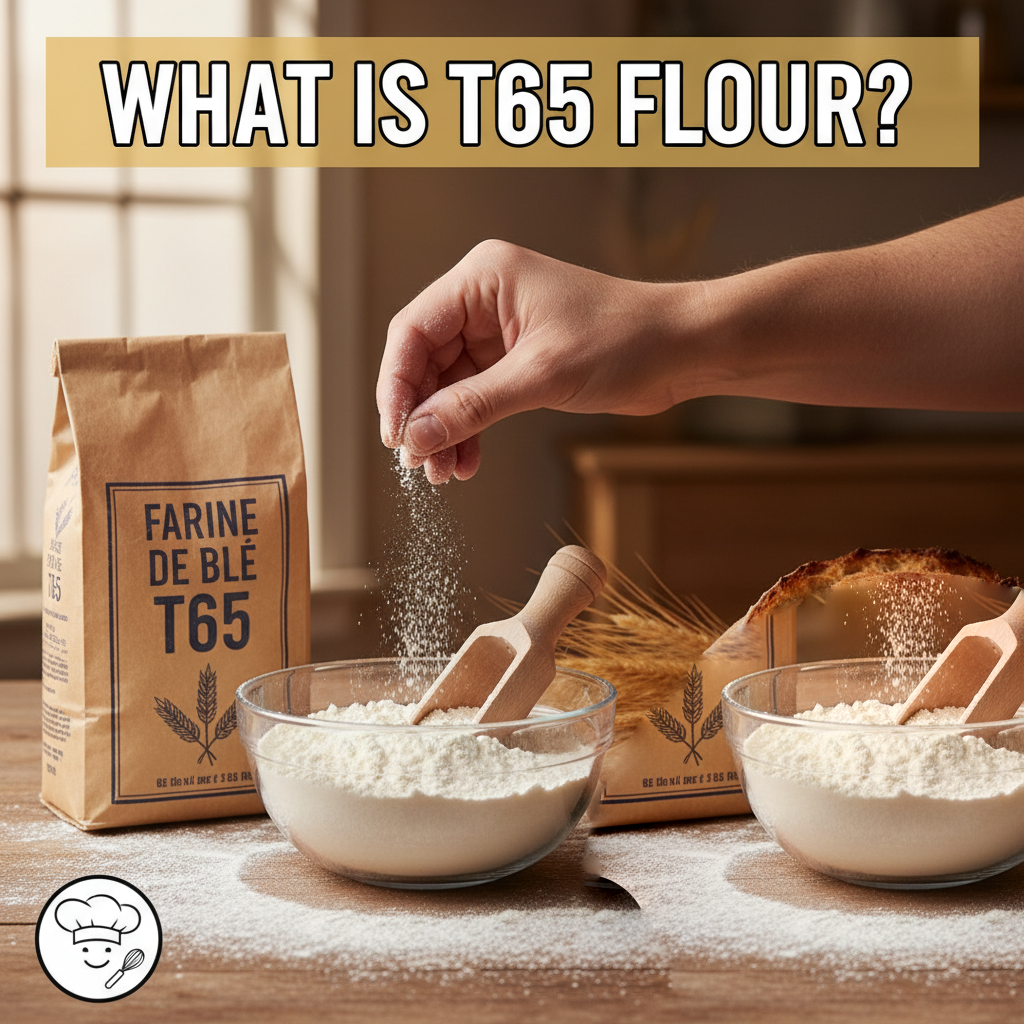
T65 is the standard bread flour in France — the classification used for baguettes, pain de campagne, levain loaves, and most artisan bread production in French boulangeries. If you've eaten a proper baguette de tradition in France, it was almost certainly made with T65. In Canada, authentic French T65 has historically been hard to source at professional volumes. At Zucchero Canada, we carry Foricher Bagatelle T65 — stocked in Calgary and shipping across Canada in 25 kg bags.
What the T-number actually measures
French flour is classified by ash content, not protein. The T-number comes from a standardized test: 5 grams of flour are incinerated at 900°C for 80 minutes, and the remaining mineral residue is measured. The number reflects grams of ash per kilogram of flour — so T65 leaves approximately 0.65g of ash per 100g of flour (0.62–0.75% range per French regulation NF V03-720).
Lower T = more refined, less bran, lighter color and flavor. Higher T = more mineral content retained, more fermentation activity, more complex flavor and darker crumb. T65 sits at the point where the flour is refined enough for a clean, open crumb but retains enough mineral content to support long fermentation and develop authentic baguette character.
T65 flour specifications
The French regulatory range for T65 is ash content between 0.62% and 0.75%. For Foricher Bagatelle T65 — the line we carry — the verified specs are:
- Flour type: T65 French wheat flour
- Protein: 11.3%
- Alveograph strength (W): 200
- Elasticity ratio (P/L): 0.7 ± 0.2
- Ash content: 0.62–0.75%
- Milling: Roller-milled from 100% French soft wheat (blé tendre)
- Wheat certification: CRC® (Contrôle Responsable de Céréales) — French certification for wheat traceability and responsible production from seed to mill
- Additives: None — no enzymes, no ascorbic acid, no bleaching agents
- Ionization: Free
- GMO: Free
- Canadian compliance: Enriched with thiamine (B1), riboflavin (B2), niacin (B3), folic acid (B9), and iron per Canadian Food and Drug Regulations — see note below
Label Rouge and CRC® — what the certifications mean
Label Rouge is a French government quality mark administered by INAO (Institut National de l'Origine et de la Qualité). It certifies that a product meets quality standards demonstrably superior to comparable products on the market. Foricher obtained Label Rouge for Bagatelle T65 in 2001 — one of the first French mills to do so for a bread flour. It is a meaningful benchmark of milling quality and consistency, and it reflects the standards to which this flour is produced at origin.
However, Label Rouge certification does not apply to the Canadian-market version of Bagatelle T65. Canadian Food and Drug Regulations require all wheat flour sold in Canada to be enriched with specific vitamins and minerals (thiamine, riboflavin, niacin, folic acid, and iron). This mandatory vitaminization means the flour as sold in Canada no longer meets the exact composition requirements of the Label Rouge specification, which certifies the flour as it leaves the French mill without modification. The certification is therefore valid in France but cannot be claimed for the Canadian product.
What this means in practice: the wheat, the milling process, the technical specs (W, P/L, ash, protein), and the absence of additives are identical to the Label Rouge version. The difference is solely the mandatory Canadian enrichment. The flour you receive is Bagatelle T65 vitaminée — same origin, same mill, same standards, compliant with Canadian law.
CRC® (Contrôle Responsable de Céréales) is a French wheat traceability certification covering the full supply chain from seed to mill — variety selection, farming practices, harvest handling, and milling. This certification is not affected by the Canadian enrichment and remains valid. Every bag of Bagatelle T65 we carry is milled from CRC®-certified French wheat.
T65 vs T55 — which one for which production
| Application | T55 Terroir | T65 Bagatelle |
| Baguette de tradition | Possible | ✓ Recommended |
| Pain de campagne | ✓ Recommended | |
| Levain / sourdough | ✓ Recommended | |
| Croissants / viennoiserie | ✓ Recommended | |
| Brioche / enriched dough | ✓ Recommended | |
| All-purpose bakery baseline | ✓ Versatile | Possible |
The key practical difference: T55 Terroir at W330 handles the mechanical stress of lamination; T65 Bagatelle at W200 is optimized for long fermentation and open crumb. Most professional bakeries running both a viennoiserie and a bread program will use both.
What W200 and P/L 0.7 mean in practice
The alveograph measures dough extensibility and elasticity. W is overall dough strength; P/L is the ratio of resistance to extensibility.
W200 is a moderate strength — strong enough to hold structure through long fermentation and shaping, but extensible enough for the classic baguette shape. P/L 0.7 means the dough is slightly more resistant than extensible — good for maintaining shape during proofing without excessive spreading. For comparison, Terroir T55 has W330 — significantly stronger and better suited for laminated viennoiserie where the dough needs to withstand repeated folding.
Working with T65 Bagatelle — practical notes
- Hydration: Works well in the 68–75% range for baguettes depending on mixing method and fermentation time. French soft wheat absorbs water differently than Canadian hard red spring wheat — start conservative and adjust.
- Fermentation tolerance: No ascorbic acid or enzymes means the dough is more sensitive to over-fermentation than additive-enhanced commercial flours. Long cold retard (10–16 hours at 4–6°C) works well.
- Mixing: Short autolyse followed by moderate development is sufficient. W200 does not need aggressive mixing — over-mixing will degrade gluten structure faster than a high-W flour.
Availability at Zucchero Canada
We carry Bagatelle T65 in 25 kg bags — the standard professional format. Stocked in Calgary, ships domestically across Canada. Priority allocation available for bakeries and food service operations running standing orders.
Questions about which Foricher flour fits your bread program? Contact our team — we work with professional bakeries, hotel bread programs, and culinary schools across Canada.







Leave a comment
All comments are moderated before being published.
This site is protected by hCaptcha and the hCaptcha Privacy Policy and Terms of Service apply.