



In professional viennoiserie, ingredient selection directly determines how the dough behaves during mixing, lamination, fermentation, and baking. Each component must be chosen not only for flavor, but for its functional performance in the process.
1. Flour: Balancing Strength and Extensibility
Flour defines the structure of croissant dough. The goal is to achieve a balance between strength (to support lamination) and extensibility (to allow smooth rolling without tearing).
- Provides the base for gluten development
- Supports repeated folding during lamination
- Controls how the dough expands during proofing and baking
In practice, flours used for viennoiserie can reach up to approximately 14% protein, offering strong structure when properly handled, while still allowing workable dough.
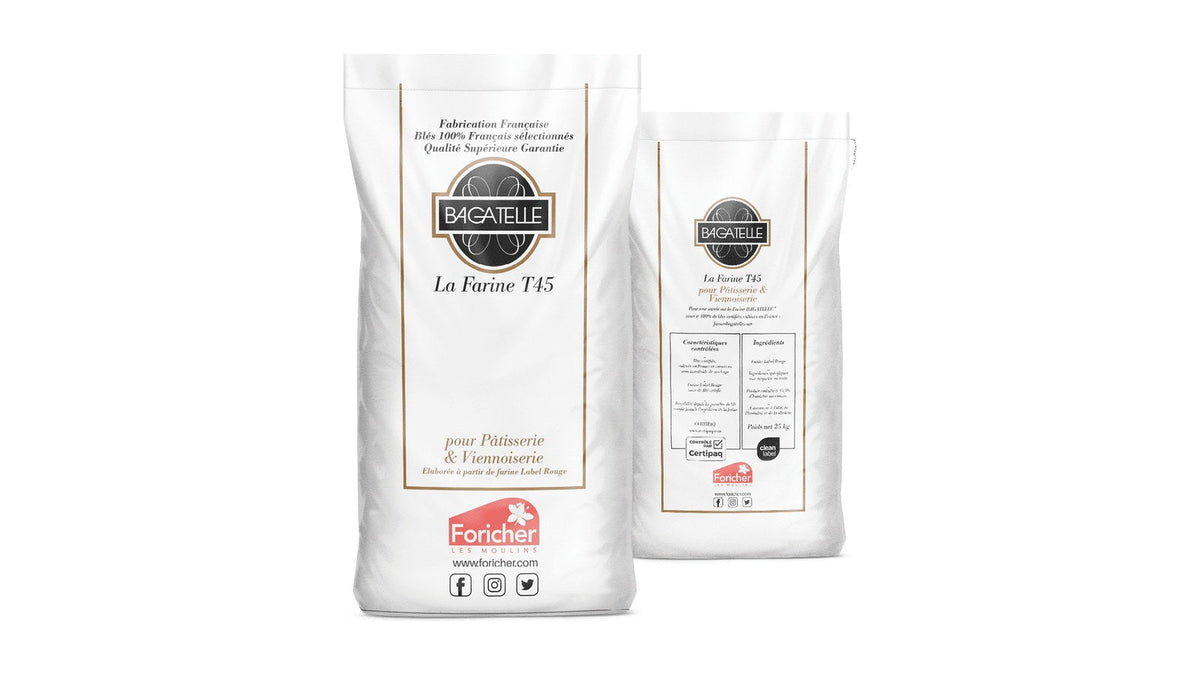
A professional reference is Foricher Bagatelle T45 French Flour , known for its consistency and ability to deliver clean lamination results.
2. Hydration & Dough Consistency
Hydration plays a critical role in dough handling and final texture. The amount of water affects how the gluten network forms and how easily the dough can be laminated.
- Lower hydration → tighter dough, more resistance
- Higher hydration → softer dough, easier to stretch
The key is achieving a dough that is soft enough to roll but structured enough to hold layers.
3. Gluten Development & Mixing Control
During mixing, gluten forms the internal structure of the dough. For croissants, full gluten development is not the goal.
- Mix to moderate development
- Avoid overmixing (creates excessive elasticity)
- Allow resting time to relax the dough
This balance ensures the dough can be rolled thin without shrinking or tearing.
4. Butter: Controlling Lamination
Butter is responsible for creating the layers. Its physical behavior must align with the dough.
- Butter must be flexible, not soft
- Dough and butter must have similar consistency
- Temperature control is essential throughout lamination
If butter is too cold, it breaks into pieces. If too warm, it blends into the dough—both affecting layer definition.
5. Fermentation Ingredients & Dough Activity
Fermentation affects both structure and flavor development. Yeast activity must be controlled to avoid over-expansion or weak structure.
- Yeast drives volume and internal structure
- Sugar supports fermentation and contributes to color
- Salt strengthens the dough and stabilizes gluten
Balanced fermentation allows controlled expansion without compromising layers.
6. Chocolate & Fillings: Stability Under Heat
For filled viennoiserie, chocolate must maintain structure during baking while delivering a clean finish.
- Should not fully liquefy during baking
- Must retain shape and texture
- Should provide a balanced flavor
High-quality options such as Bassan Sur del Lago Ancestral Criollo 71% dark chocolate offer consistent performance.
7. Cocoa-Based Ingredients in Modern Viennoiserie
Advanced applications may incorporate cocoa ingredients directly into dough or finishing elements.
- Cocoa butter improves texture and fluidity
- Cocoa powder enhances color and flavor
- Cocoa mass increases intensity and structure
Using refined ingredients such as KKO Real ensures consistency and repeatability.
8. Ingredient Consistency & Process Control
In professional production, consistency in ingredients leads to consistency in results.
- Stable ingredients = predictable dough behavior
- Controlled structure = better lamination
- Repeatable inputs = reliable output
Final Tip
In viennoiserie, technique alone is not enough. Ingredient selection must support every stage of the process, from mixing to baking, to achieve consistent layers, proper expansion, and professional results.
Precision ingredients. Controlled lamination. Consistent results.
Inspired by modern viennoiserie principles:
The New Era of Viennoiserie – Antonio Bachour







Leave a comment
All comments are moderated before being published.
This site is protected by hCaptcha and the hCaptcha Privacy Policy and Terms of Service apply.