



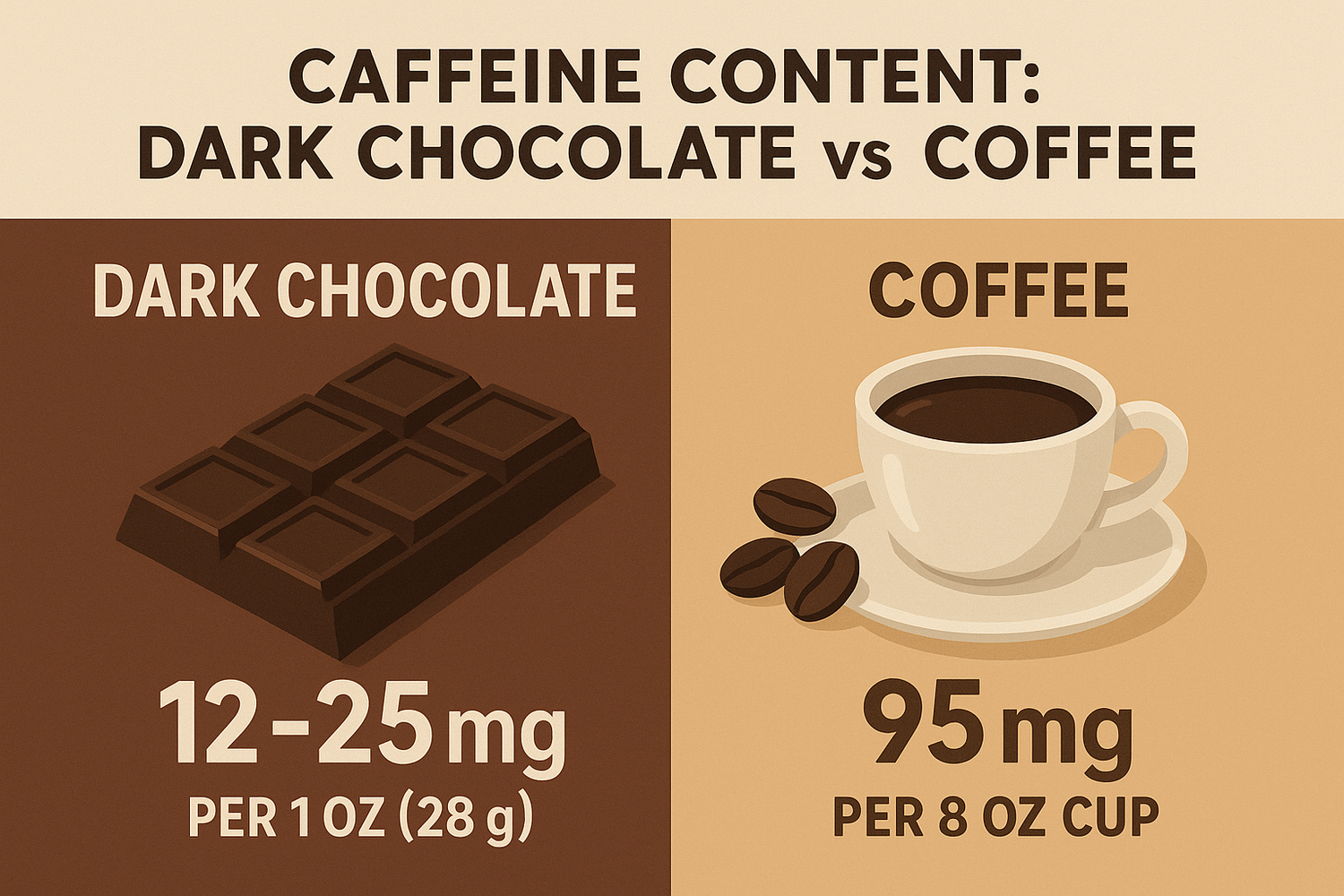
Dark chocolate contains significantly less caffeine than coffee — but that comparison misses the more important compound: theobromine. Understanding both is useful whether you're a consumer watching your caffeine intake, or a chocolatier or pastry chef building products for clients who ask about stimulant content.
The numbers: caffeine comparison
| Source | Caffeine per serving | Serving size |
| Espresso (single shot) | 60-80 mg | 30 ml |
| Drip coffee | 80-120 mg | 240 ml (8 oz) |
| Dark chocolate 70-85% | 20-30 mg | 40g (standard bar portion) |
| Milk chocolate | 5-10 mg | 40g |
| Cocoa nibs | 25-35 mg | 30g |
| Natural cocoa powder | 12-25 mg | 2 tablespoons (10g) |
| White chocolate | 0 mg | 40g (no cacao solids) |
Dark chocolate has roughly 25-35% of the caffeine in a cup of coffee per comparable serving. For most consumers, including those who are caffeine-sensitive, moderate dark chocolate consumption is well within a comfortable daily range.
Theobromine: the more significant compound
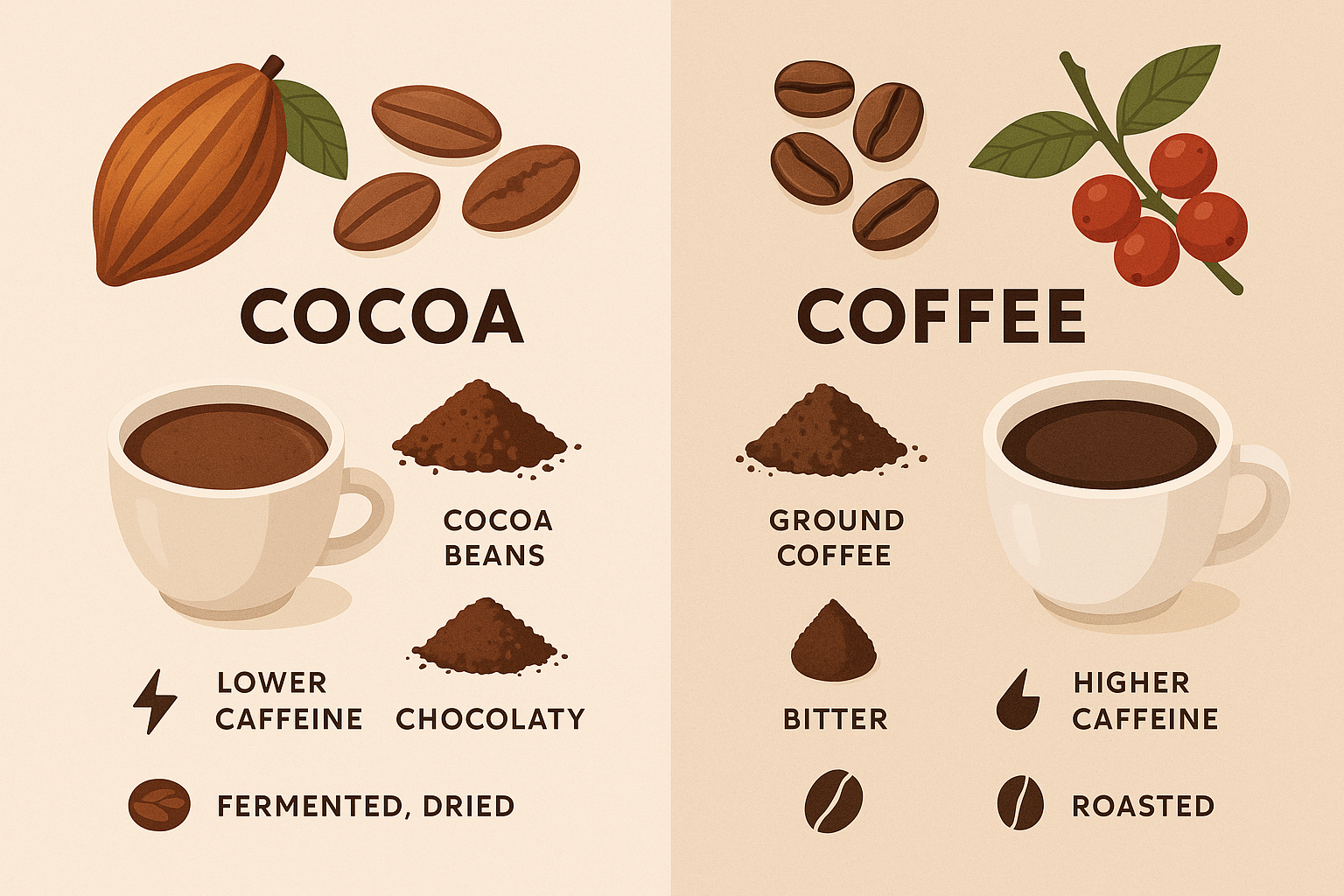
The stimulant that actually dominates in cacao is theobromine — a methylxanthine related to caffeine but with meaningfully different effects. A 40g serving of 70%+ dark chocolate contains approximately 200-300mg of theobromine, compared to 20-30mg of caffeine. That ratio of roughly 10:1 theobromine to caffeine defines the cacao experience.
Theobromine differs from caffeine in three key ways:
- Slower onset and longer half-life: Theobromine has a half-life of approximately 6-10 hours vs 3-5 hours for caffeine. This creates a gentler, more sustained energy effect without a sharp peak and crash.
- Weaker CNS stimulation: Theobromine is a less potent adenosine antagonist than caffeine — it provides mild alertness and mood lift without the intensity or anxiety response that some people experience with high-caffeine sources.
- Bronchodilatory and cardiovascular effects: Theobromine has mild bronchodilatory properties (historically used in cough treatments) and gentle vasodilatory effects that contribute to the cardiovascular benefits associated with regular dark chocolate consumption.
For chocolatiers producing products for clients who ask about stimulant content — energy bars, functional chocolate, health-positioned products — theobromine is the compound worth understanding and communicating.
How origin affects stimulant levels
Caffeine and theobromine content varies by cacao variety, origin, and processing. Criollo-dominant cacao tends to have a lower bitterness perception in part because of its alkaloid profile — the same genetic characteristic that makes Venezuelan fine-flavor cacao prized for flavor also affects its stimulant expression.
Commodity Forastero bulk cacao (the majority of global production) typically has higher theobromine and caffeine content relative to Criollo. Fine-flavor origins like Venezuelan Sur del Lago and Ocumare — both high in ancestral Criollo genetics — deliver a milder, cleaner stimulant profile alongside their complex flavor character.
This matters for product development: if you're formulating a chocolate product positioned for afternoon or evening consumption, or for clients who are stimulant-sensitive, starting with a fine-flavor Criollo-dominant origin gives you more to work with than commodity bulk cacao.
Cocoa nibs: the highest concentration form
Among cacao ingredients, cocoa nibs have the highest stimulant concentration per gram — because they're the whole cacao bean with only the shell removed, no dilution from sugar, dairy, or additives. Per 30g serving, nibs contain approximately 25-35mg of caffeine and 300-400mg of theobromine.
For chocolatiers and food producers using nibs as inclusions or for infusions, this is worth factoring into product positioning. Our Venezuelan single-origin cocoa nibs are minimally processed — roasted, cracked, no additives — and carry the same Criollo-dominant origin character as our whole beans.
For professional production: our cacao range
All Venezuelan cacao we carry is sourced through Canada Cacao Co. with Certificate of Origin and full traceability — controlled fermentation, natural drying, verified Criollo genetic content. Available for professional production volumes across Canada:
- Sur del Lago Ancestral Criollo Lineage beans — 1.5 kg to 60 kg
- OCUMARE Criollo Blood beans — 1.5 kg to 60 kg
- Venezuelan cocoa nibs — single-origin, minimally processed
- Natural Venezuelan cocoa powder — non-alkalized, maximum flavonoid and stimulant retention
- Bassan Sur del Lago Dark 71% — finished couverture from the same origin
Priority allocation for standing B2B orders. Contact our team to discuss volume and supply commitments for your production.







Leave a comment
All comments are moderated before being published.
This site is protected by hCaptcha and the hCaptcha Privacy Policy and Terms of Service apply.