

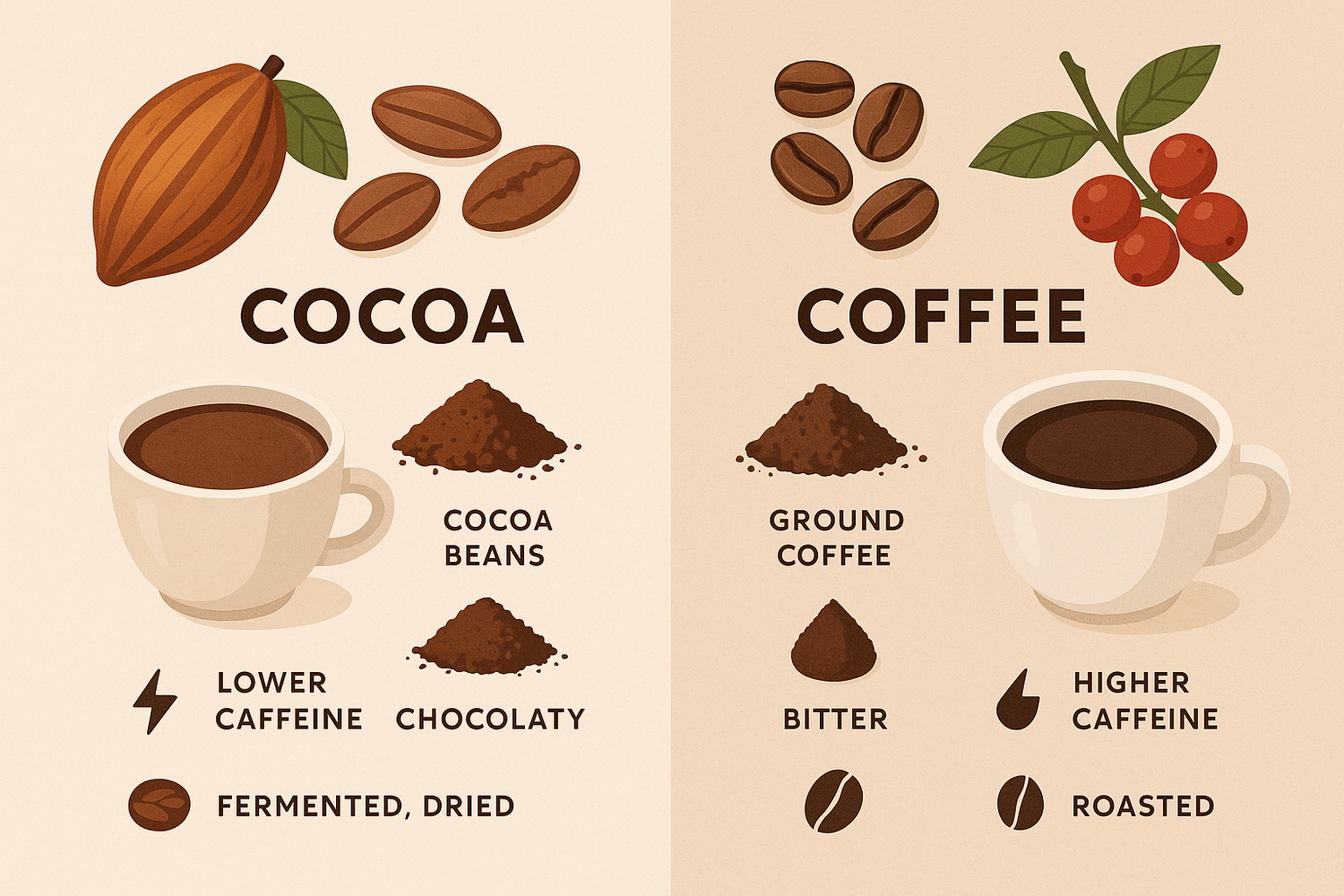
Short answer: no, coffee and chocolate do not come from the same bean or even the same plant family. Cocoa beans are the seeds of the cacao tree, Theobroma cacao (family Malvaceae), and grow inside pods; coffee beans are the seeds of the coffee cherry, from coffee plants such as Coffea arabica and Coffea canephora (family Rubiaceae). Cocoa beans are fermented, dried, roasted and ground into cocoa liquor, which is pressed into cocoa butter and cocoa powder; coffee beans are freed from the fruit, dried, roasted and brewed. Cocoa's main stimulant is theobromine with a little caffeine, while coffee carries far more caffeine: Health Canada lists 135 mg in a 237 ml cup of brewed coffee and 5 mg in an envelope of hot-cocoa mix.
This article is for general information only and is not medical or nutritional advice. Always consult your doctor, pharmacist or a registered dietitian about your own situation, especially during pregnancy or breastfeeding, or if you have diabetes, allergies or a medical condition.
Cocoa vs coffee at a glance
| Cocoa (cacao) | Coffee | |
|---|---|---|
| Plant | Theobroma cacao, family Malvaceae | Coffea arabica and Coffea canephora, family Rubiaceae |
| The "bean" | Seeds inside a pod that grows from the trunk and branches | Seeds inside the coffee cherry |
| After harvest | Beans and pulp fermented (about 2–3 days for Criollo, about 5 days for Forastero), then dried to about 7.5% moisture | Skin pulped off, sugary mucilage fermented one to two days, washed, dried to 12% moisture, hulled to green coffee |
| Main products | Cocoa nibs, cocoa liquor, cocoa butter, cocoa powder, chocolate | Roasted beans, ground coffee, instant coffee |
| Main stimulant | Theobromine, plus a small amount of caffeine | Caffeine |
| Caffeine per 100 g (USDA) | Unsweetened cocoa powder: 230 mg | Instant coffee powder: 3,142 mg |
Are coffee and chocolate made from the same bean?
No: they are two unrelated crops that both happen to be called "beans" and both get roasted. The cacao tree belongs to the genus Theobroma, Greek for "food of the gods", which the International Cocoa Organization (ICCO) traces to South America, east of the Andes. Coffee comes from plants of the genus Coffea, in a different botanical family. Coffee is not made from cocoa beans, and cocoa powder is not made from coffee.
Chocolate is made from cacao, not coffee: its main ingredients are cocoa liquor (ground cocoa beans, also called cocoa mass), cocoa butter (pressed from cocoa liquor), sugar and, for milk chocolate, milk (Barišić et al., 2019). Read more in our guide what is chocolate liquor.
Cocoa beans vs coffee beans: from fruit to bean
Both crops are seeds that only taste the way we know them after post-harvest processing and roasting, but the steps are different.
How cocoa beans are made
- Harvest: ripe pods are cut from the trunk and branches and opened to remove the wet beans and pulp (ICCO).
- Fermentation: the beans are piled or boxed so yeasts and bacteria ferment the pulp. The temperature rises to 40–45°C (104–113°F) in the first 48 hours, and the chemical changes inside the bean start the chocolate flavour and colour. Forastero beans need about 5 days, Criollo beans 2–3 days (ICCO).
- Drying: moisture falls from about 60% to about 7.5%, with bean temperatures kept no higher than 65°C (149°F) (ICCO).
- Roasting, winnowing and grinding: the roasted bean is cracked and the shell removed to leave the nib, which is ground into cocoa liquor. Roasting is usually done between 120 and 140°C (248–284°F) (Barišić et al., 2019).
- Pressing: cocoa liquor is pressed into cocoa butter and a cocoa cake, which is milled into cocoa powder (ICCO).
Want to see the roasting step in practice? Read how to roast cacao beans.
How coffee beans are made
- Pulping: the skin of the fresh cherry is removed with a pulper and water.
- Fermentation and washing: the sugary coating (mucilage) ferments for one to two days and is washed off.
- Drying and hulling: the beans are dried to 12% moisture, then hulled to remove the parchment and silver skin, giving green coffee ready for export or roasting.
Source for the coffee steps: FAO, Arabica coffee manual for Lao PDR, chapter 6, which describes the washed (wet) method.
Caffeine in cocoa vs coffee
Cocoa contains caffeine, but much less than coffee; its main natural stimulant is theobromine. A review in Molecules (Barišić et al., 2019) reports that cocoa is the main source of theobromine and contains less caffeine than coffee and tea; non-fat cocoa solids contain about 4% theobromine and 0.2% caffeine by dry weight.
| Food or drink | Serving | Caffeine |
|---|---|---|
| Brewed coffee | 237 ml (8 oz) | 135 mg |
| Instant coffee | 237 ml | 76–106 mg |
| Unsweetened baking chocolate | 28 g | 25–58 mg |
| Sweet chocolate | 28 g | 19 mg |
| Milk chocolate | 28 g | 7 mg |
| Hot-cocoa mix, one envelope | 237 ml | 5 mg |
Source: Health Canada, "Caffeine in Foods". Health Canada's maximum daily caffeine intake is 400 mg for healthy adults and 300 mg for women who are pregnant, planning a pregnancy or breastfeeding; for children and teenagers it is 2.5 mg per kilogram of body weight.
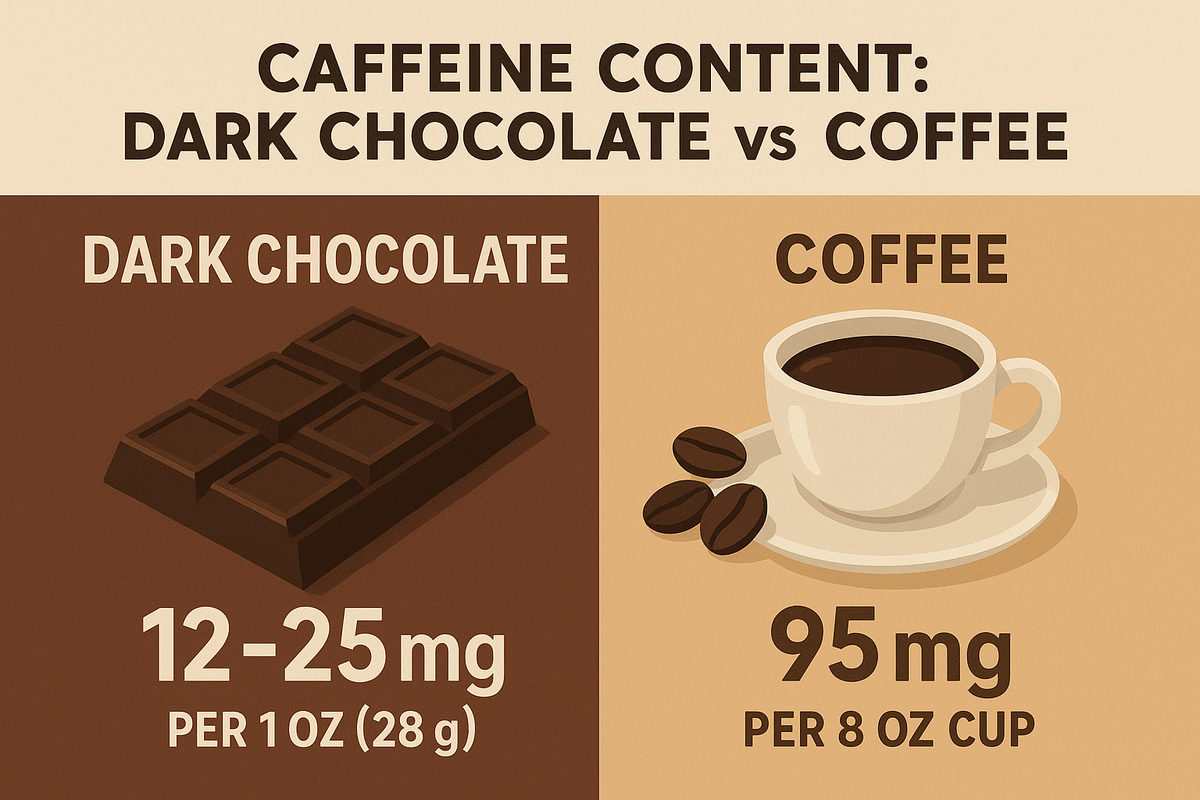
For the full comparison, including how much caffeine dark chocolate holds next to a cup of coffee, see caffeine in dark chocolate vs coffee.
Cocoa powder vs coffee powder
Cocoa powder and coffee powder are different products: cocoa powder is the milled cake left after pressing cocoa butter out of cocoa liquor (ICCO), while coffee powder is either ground roasted coffee, which you brew, or instant coffee powder.
| Per 100 g (USDA FoodData Central) | Unsweetened cocoa powder | Dutch-process cocoa powder | Instant coffee powder |
|---|---|---|---|
| Fat | 13.7 g | 13.1 g | 0.5 g |
| Caffeine | 230 mg | 78 mg | 3,142 mg |
| Theobromine | 2,057 mg | 2,634 mg | 0 mg |
In a recipe that means about 12 mg of caffeine in a 5.4 g tablespoon of natural cocoa powder, against about 31 mg in a 1 g teaspoon of instant coffee powder (our calculation from the USDA values). Dutch-process (alkalized) cocoa is treated with an alkaline solution to change its colour and flavour; the ICCO lists potassium carbonate among the compounds used, and colours from light red to charcoal black. For production, our Peruvian Dutched 20/22 cocoa powder, alkalized with potassium carbonate, comes in a 25 kg bag at $710.00.
Fine cacao vs bulk cacao: what producers should know
For a chocolatier, the comparison that changes the product is not cocoa against coffee but fine-flavour cacao against bulk cacao. The ICCO splits the market into "fine or flavour" and "bulk" or "ordinary" beans; fine or flavour cocoa is just under 5% of world production, and as a generalisation it comes from Criollo or Trinitario trees, while bulk beans come from Forastero trees (with known exceptions).
- Trinitario descends from a cross between Criollo and Forastero; its planting started in Trinidad and spread to Venezuela, then further afield (ICCO).
- Criollo dominated the market until the mid-eighteenth century; the ICCO notes that today only a few, if any, pure Criollo trees remain.
- Venezuela is on the ICCO's list of fine or flavour cocoa exporters (Annex C of the International Cocoa Agreement, revised December 2020); the ICCO panel did not set a percentage for it.
Venezuelan cacao products for producers
We broker Venezuelan cacao, so you can keep one origin from the bean to the finished chocolate. Each product has its own job:
| Need | Product | Price |
|---|---|---|
| Bean-to-bar: roast and grind your own chocolate | Sur del Lago cocoa beans, 1.5 kg GrainPro bag | $80.00 |
| Single-origin couverture for bonbons, tablets, ganache | Bassan Sur del Lago 71%, 5 kg bag | $273.00 |
| Ganache, mousse, glazes and drinks, including coffee drinks | FCH 55% dark chocolate minibars, Venezuela, 10 kg | $299.00 |
| Croissants, brioches and breads | 55% dark chocolate sticks, Venezuelan blend, 2.27 kg | $62.50 |
| Inclusions, toppings and infusions | Venezuelan cacao nibs, 1 kg bag | $69.95 |
- Sur del Lago beans come from the southern basin of Lake Maracaibo: Trinitario cacao with 10–30% ancestral Criollo lineage, fermented and sun-dried, with fruity, woody and nutty notes and low acidity and astringency. Each lot ships with a certificate of origin.
- Bassan Sur del Lago 71% is made in Canada from Venezuelan Trinitario cacao with ancestral Criollo lineage, with notes of fruit, wood and nuts.
- FCH 55% is 100% Venezuelan Trinitario cacao; its product data lists melting at 45–50°C (113–122°F), crystallisation at 28–29°C (82–84°F) and tempering at 31–32°C (88–90°F), and names hot chocolate, infusions and coffee among its beverage uses.
- Cacao nibs are made from Carenero Superior, Río Caribe Superior and Sur del Lago beans, with 54–56% fat.
We are also the exclusive distributor in Canada of KKO Real, the Venezuelan cocoa powders and cocoa butter made by Procesadora Cacao Real. Ask us about current availability.
How AI can help your production
If you sell chocolate drinks or mochas, give an AI assistant your recipes and the caffeine values above, and ask it to estimate the caffeine per serving of each drink for your menu notes. Give it your ingredient costs and ask for the cost per cup or per bonbon, scaled to your batch sizes. For bean-to-bar work, paste your roasting and fermentation notes for each lot and ask it to build a comparison sheet you can taste against.
AI organises the information; tasting and the final decision stay with your chef.
Cacao at Zucchero Canada
Zucchero Canada is the trade name of Canada Cacao Company, a Calgary importer that brokers Venezuelan cacao and supplies chocolatiers, pastry kitchens, bakeries and bean-to-bar makers across Canada. Food products ship within Canada only. For bean-to-bar makers who want a second origin, we also stock Ucayali cacao beans from Peru; the 1.5 kg bag is $80.00.
Buying beans or couverture by the case for production? Contact us for volume and standing orders, or call 587-774-8873 (toll free 877-741-8251). We work with chocolatiers across Canada to match the origin to the project — not the other way around.
Cacao | Raw cocoa beans | Cocoa powder | Caffeine in dark chocolate vs coffee | Where cocoa beans come from
This article is for information only. Every business is different: draw your own conclusions based on your own expectations, budget and goals, and talk to qualified experts before you decide or invest.
Sources: International Cocoa Organization (ICCO), "Growing Cocoa", "Harvesting & Post-harvest" and "Processing Cocoa", and ED(MEM) 1145, "Revision of Annex C of the International Cocoa Agreement, 2010" (16 December 2020); FAO, Arabica coffee manual for Lao PDR, chapter 6 "Harvesting and processing"; GBIF Backbone Taxonomy (Theobroma cacao, Coffea arabica, Coffea canephora); Health Canada, "Caffeine in Foods" (modified 2025-04-02); USDA FoodData Central, SR Legacy entries 169593, 169594 and 171893; Barišić V. et al., "The Chemistry behind Chocolate Production", Molecules 24 (2019) 3163; Zucchero Canada product data for Canada Cacao Co., Bassan Chocolate, FCH Origins and KKO Real products.





Leave a comment
All comments are moderated before being published.
This site is protected by hCaptcha and the hCaptcha Privacy Policy and Terms of Service apply.