Where Does the Cocoa Bean Come From? Origin, Growing Regions and Varieties
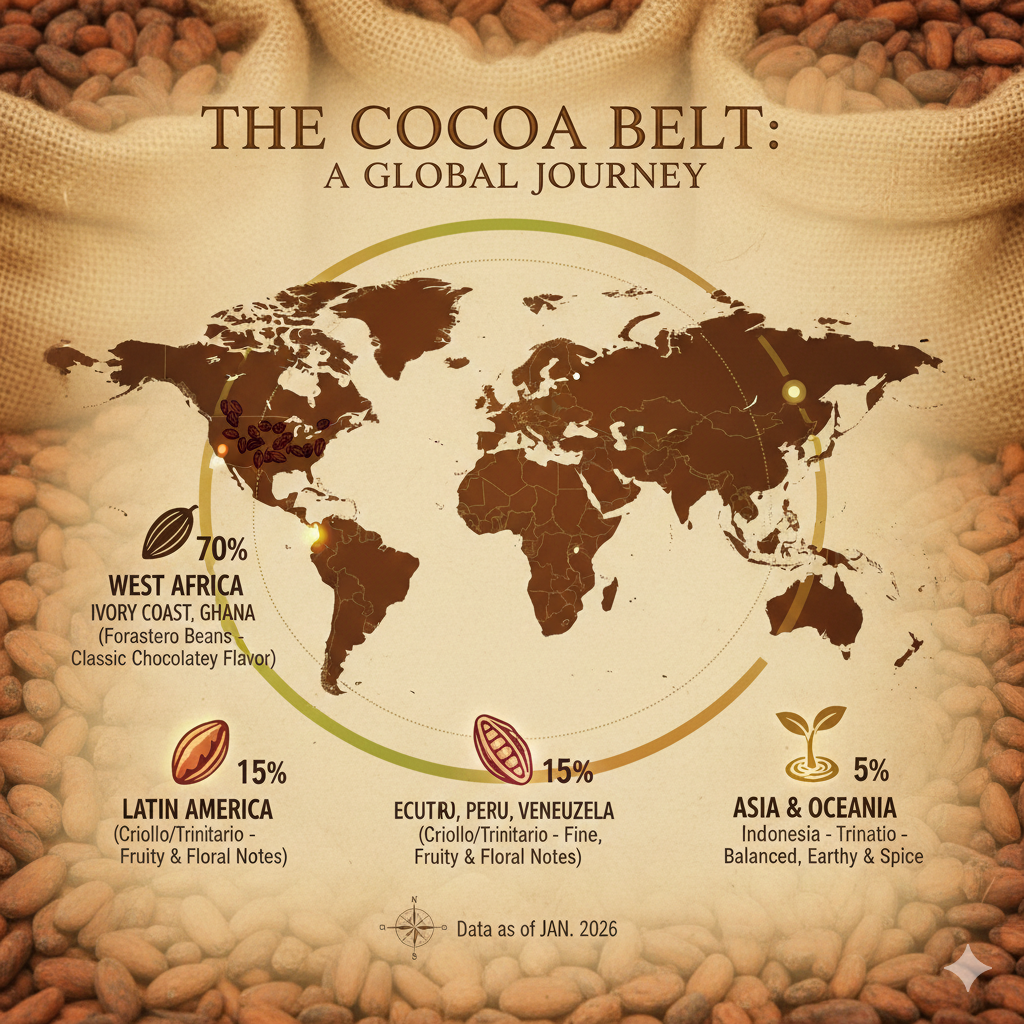
Short answer: cocoa beans are the seeds of the cacao tree, Theobroma cacao, which originated in South America, east of the Andes. Archaeological evidence from southern Ecuador shows cocoa beans were used there more than 5,300 years ago. Today cocoa is grown in a belt between 10°N and 10°S of the Equator, and the three largest producers are Côte d'Ivoire, Ghana and Ecuador; Africa supplied about 71% of the world's cocoa in the 2023/24 season, according to the International Cocoa Organization (ICCO).
Quick answer: single-origin beans for your production
| What you need | Origin and beans | Price |
|---|---|---|
| Venezuelan fine-flavour beans with Criollo lineage | Sur del Lago, Venezuela | from $80.00 CAD |
| Amazonian beans with fruit and spice notes | Ucayali, Peru | from $80.00 CAD |
| Nibs instead of whole beans, for chocolate, baking and drinks | Venezuelan cacao nibs | from $69.95 CAD |
Where cacao originated
Cacao is native to South America. The ICCO explains that the genus Theobroma, Greek for "food of the gods", originated millions of years ago in South America, east of the Andes, and that recent archaeological finds in southern Ecuador show cocoa beans were already used there more than 5,300 years ago.
Cacao seeds were later used by several pre-Columbian civilisations, including the Maya, the Incas and the Aztecs: as a food ingredient in drinks mixed with corn flour and spices, as a currency for trade and in rituals. Christopher Columbus was the first outsider to drink chocolate, in 1502; Hernán Cortés brought the Aztec chocolate drink back to Spain in 1528, and it only became popular in the European courts once sugar was added. For the full story, read our history of cacao.
How cacao spread around the world
Cacao left the Americas with the colonial powers, which explains why it now grows on three continents. The milestones the ICCO records:
- Latin America and the Caribbean: Spanish Capuchin friars grew Criollo cacao in Ecuador in about 1635. France introduced cacao to Martinique and St Lucia (1660), the Dominican Republic (1665), Brazil (1677), the Guianas (1684) and Grenada (1714); England had cacao in Jamaica by 1670.
- West Africa: Amelonado cacao from Brazil was planted in Príncipe in 1822, São Tomé in 1830 and Fernando Po in 1854, then in Nigeria in 1874 and Ghana in 1879. In Cameroon, cocoa was introduced between 1925 and 1939.
- Asia: the Spanish brought the first trees to Indonesia in the 16th century, but the sector only developed on a significant scale from 1970, mainly in Indonesia, Malaysia and Papua New Guinea.
The cocoa belt: what the tree needs
The cacao tree grows only where it is hot, humid and rainy all year, which limits commercial production to a band around the Equator. Its natural habitat is the lower storey of the evergreen rainforest, and it has traditionally been grown under shade.
| Factor | What cacao needs (ICCO) |
|---|---|
| Latitude | A belt between 10°N and 10°S of the Equator |
| Temperature | Maximum annual average 30–32°C (86–90°F); minimum average 18–21°C (64–70°F) |
| Rainfall | 1,500–2,000 mm (about 59–79 in) a year, well distributed; dry spells under 100 mm a month should not exceed three months |
| Humidity | Often up to 100% during the day, 70–80% at night |
| Shade | Indispensable in the tree's early years |
| Soil | Well drained, 1.5 m deep for the roots, pH 5.0–7.5, about 3.5% organic matter in the top 15 cm |
Rainfall matters most: the ICCO notes that year-to-year changes in yield depend more on rainfall than on any other climatic factor.
Where cocoa beans come from today
Most of the world's cocoa comes from West Africa, with Latin America second and Asia-Oceania a distant third. These are the ICCO's estimates for the 2023/24 cocoa year, as published in May 2025:
| Region / country | Production 2023/24 (thousand tonnes) | Share of world total |
|---|---|---|
| Africa | 3,114 | 71.3% |
| Côte d'Ivoire | 1,674 | about 38% |
| Ghana | 449 | about 10% |
| Nigeria | 350 | about 8% |
| Cameroon | 320 | about 7% |
| Americas | 980 | 22.4% |
| Ecuador | 419 | about 10% |
| Brazil | 182 | about 4% |
| Asia & Oceania | 275 | 6.3% |
| Indonesia | 180 | about 4% |
| Papua New Guinea | 45 | about 1% |
| World | 4,368 | 100% |
Production swings from year to year: the ICCO estimated 5,016 thousand tonnes for 2022/23; in February 2026 it revised the 2023/24 world total to 4,362 thousand tonnes, and in its August 2026 bulletin it estimated 2024/25 at 4,733 thousand tonnes, up 8.5% on the year.
Cocoa varieties: Forastero, Criollo and Trinitario
Cacao is traditionally divided into three types, and they shape what a bean can taste like. The ICCO describes them this way:
- Forastero is a large group of cultivated, semi-wild and wild populations. Its Amelonado populations are the most widely planted, covering large areas of Brazil and West Africa; Ecuador's Nacional cacao also belongs to this group.
- Criollo dominated the market until the middle of the 18th century; today only a few, if any, pure Criollo trees remain.
- Trinitario descends from a cross between Criollo and Forastero. Its planting started in Trinidad and spread to Venezuela, then to Ecuador, Cameroon, Samoa, Sri Lanka, Java and Papua New Guinea.
Researchers now propose a finer classification into ten genetic groups (Amelonado, Criollo, Nacional, Contamana, Curaray, Guiana, Iquitos, Marañón, Nanay and Purús), but the three historical names are still the ones the trade uses.
Fine-flavour versus bulk cocoa
The cocoa market separates "fine or flavour" beans from "bulk" beans, and fine-flavour cocoa is just under 5% of world production, according to the ICCO. As a rule, fine-flavour beans come from Criollo or Trinitario trees and bulk beans from Forastero, with known exceptions: Ecuador's Nacional trees, a Forastero type, produce fine-flavour cocoa, while Cameroon's Trinitario beans are classed as bulk.
The ICCO lists the countries that export fine-flavour cocoa in Annex C of the International Cocoa Agreement 2010. Its December 2020 revision includes, among others, Ecuador and Peru (75% of their cocoa exports), Papua New Guinea (70%), Madagascar and Trinidad and Tobago (100%), and Venezuela, where fine-flavour exports are recognised but the panel could not set a percentage.
From pod to bean: harvest, fermentation and drying
A cocoa bean is not ready for chocolate until it has been fermented and dried at origin. This is where much of its flavour potential is decided. The ICCO describes the steps:
- Harvest. Pods grow straight from the trunk and branches. They are cut by hand with a clean cut through the stalk, using a pole tool for pods high on the tree.
- Pod opening. Pods are opened within a week to 10 days of harvest, ideally with a wooden club so the beans are not damaged, and the wet beans are removed by hand.
- Fermentation. The beans and their pulp are piled in heaps covered with banana leaves, or in boxes. Yeasts turn the sugars in the pulp into alcohol, then bacteria turn it into acetic acid, raising the temperature to 40–45°C (104–113°F) in the first 48 hours. The bean dies by the second day, which sets off the chemical changes that develop chocolate flavour and colour. Forastero beans need about 5 days, Criollo beans 2–3 days.
- Drying. Beans are dried slowly, in the sun or in dryers, from about 60% to about 7.5% moisture. Drying too fast leaves acidic, bitter beans; too slow lets moulds and off-flavours develop. Bean temperature should not exceed 65°C (149°F).
Roasting, winnowing, grinding and conching then happen at the chocolate maker. See our guides on how to roast cacao beans and conching.
What origin means for the chocolate you make
For a chocolate maker, origin is a combination of genetics, place and post-harvest work, and the best way to judge it is the lot data that comes with the beans. Here is what the producers' data says about the origins we sell:
| Beans | Genetics and place | Post-harvest | Flavour notes |
|---|---|---|---|
| Sur del Lago, Venezuela | Trinitario with 10–30% ancestral Criollo lineage; southern basin of Lake Maracaibo (Zulia and Trujillo) | Fermented to ≥65% uniformity; sun-dried over 7 days to about 5.4% moisture; GrainPro bags | Fruity, woody and nutty; low acidity and astringency |
| Ucayali, Peru | Amazon rainforest, grown by 140 farmers at 100–1,000 m on land being reforested after mining | Fermented and sun-dried | Ripe fruit, spice and light wood; very low bitterness and astringency |
| Hacienda Victoria, Ecuador | 100% Arriba Nacional from a single estate on the Ecuadorian coast | Minimum 75% well-fermented; slowly sun-dried for 7 days; 125–130 beans per 100 g | Nutty and earthy; low acidity |
All three are raw, unroasted agricultural products that need roasting and processing before use. If you want nibs instead of whole beans, our Venezuelan cacao nibs, for chocolate making, desserts, baked goods and drinks, are made from Carenero Superior, Río Caribe Superior and Sur del Lago beans, with 54–56% fat. If you buy couverture instead of beans, our FCH 55% dark chocolate ($299.00 CAD for 10 kg) is made from 100% Venezuelan Trinitario cacao.
How AI can help your production
Give an AI assistant the lot data for each origin you buy (fermentation, moisture, bean count) and your roasting and tasting notes, and ask it to build a lot register that links every batch of chocolate to its beans. Ask it to compare origins side by side after each tasting, to turn your roast logs into a starting profile for a new lot, and to cost a bar from bean price, yield and packaging. Traceability by lot also makes it easier to tell your customers exactly where their chocolate comes from.
AI organises the information; tasting and the final decision stay with your chef.
Cocoa beans at Zucchero Canada
Zucchero Canada is the trade name of Canada Cacao Company, a Calgary importer that also brokers Venezuelan cacao. We sell beans from Venezuela, Peru and Ecuador; the Venezuelan and Peruvian beans come in 1.5 kg and 5 kg GrainPro bags, and each product page lists the formats available. Each lot of Sur del Lago beans comes with a Certificate of Origin and Authenticity, and priority allocation is available for standing B2B orders that need consistent volume and quality year-round. Food products ship within Canada only; cacao is excluded from free shipping, and orders over CAD 500 get 5% off automatically at checkout.
Building a bean-to-bar line? Browse our bean-to-bar machines and read how to start a bean-to-bar business in Canada. For volume pricing or help choosing an origin, contact us, write to sales@zuccherocanada.ca or call 587-774-8873 (toll free 877-741-8251).
Raw cocoa beans | Cocoa nibs | Bean-to-bar machines | What is single-origin chocolate | Best single-origin cocoa beans | Cocoa vs coffee
This article is for information only. Every business is different: draw your own conclusions based on your own expectations, budget and goals, and talk to qualified experts before you decide or invest.
Sources: International Cocoa Organization (ICCO), "Growing cocoa" and "Harvesting & post-harvest" (icco.org); ICCO Quarterly Bulletin of Cocoa Statistics, "Production of cocoa beans", Vol. LI No. 2 (published 30 May 2025), and the February 2026 and August 2026 bulletin summaries; ICCO, Revision of Annex C of the International Cocoa Agreement 2010, ED(MEM) 1145 (December 2020); Zucchero Canada product data for Sur del Lago, Ucayali, Hacienda Victoria, Venezuelan nibs and FCH 55%.
Good to know
Frequently asked questions
Where does the cocoa bean come from?
Cocoa beans are the seeds of the cacao tree, Theobroma cacao. The beans grow inside pods that form directly on the trunk and branches. The tree is grown in a belt between 10°N and 10°S of the Equator, mainly in West Africa, Latin America and Asia-Oceania.
Where did cocoa originate?
According to the International Cocoa Organization, the genus Theobroma originated in South America, east of the Andes, and archaeological evidence from southern Ecuador shows cocoa beans were used there more than 5,300 years ago. The Maya, Incas and Aztecs later used cacao as food, currency and in rituals.
Which country produces the most cocoa?
Côte d'Ivoire. The ICCO estimated its 2023/24 production at 1,674 thousand tonnes, about 38% of the world total of 4,368 thousand tonnes. Ghana (449) and Ecuador (419) followed.
What is the difference between Criollo, Forastero and Trinitario cocoa?
Forastero is the most widely planted group, including the Amelonado cacao of Brazil and West Africa and Ecuador's Nacional. Criollo dominated until the mid-18th century, but few if any pure Criollo trees remain. Trinitario is a cross between Criollo and Forastero that started in Trinidad and spread to Venezuela. As a rule, fine-flavour cocoa comes from Criollo or Trinitario trees, with exceptions such as Ecuador's Nacional.
Where can I buy single-origin cocoa beans in Canada?
We sell raw, fermented single-origin beans from Venezuela (Sur del Lago), Peru (Ucayali) and Ecuador (Hacienda Victoria), plus Venezuelan cacao nibs, shipped within Canada. Cacao is excluded from free shipping; orders over CAD 500 get 5% off automatically. For standing B2B volumes, contact us about priority allocation.
Shop this article
Products mentioned in this guide
 Canada Cacao Co.Sur del Lago Ancestral Criollo Lineage Cocoa Beans · VenezuelaFrom $80.00 CADView product →
 Canada Cacao Co.Ucayali Peru Raw Cacao Beans - Fine Flavor Fermented & Sun-DriedFrom $80.00 CADView product →
 Canada Cacao Co.Cacao Nibs - Single Origin "Venezuela"From $69.95 CADView product →
 FCH Origins55% DARK CHOCOLATE MINIBARS 10 kg box - Origin Venezuela$299.00 CADView product →
For professionals
Equipping a chocolate shop, bakery or kitchen?
Tell us what you produce and how much. We will recommend the right machine, moulds and ingredients, and send you a quote.
For home bakers
Professional tools for your own kitchen
The same European moulds, tools and ingredients the professionals use.
5% off orders over $500 CAD, applied automatically at checkout.
Keep reading

Leave a comment
All comments are moderated before being published.
This site is protected by hCaptcha and the hCaptcha Privacy Policy and Terms of Service apply.