



Chocolate Crystallization: Cocoa Butter Crystal Forms and How Tempering Controls Them
Short answer: chocolate crystallization is the way cocoa butter turns solid, and it can do so in six crystal forms, numbered I to VI, each with its own melting range. Only Form V gives chocolate its gloss, its snap and its resistance to fat bloom, so tempering is the process of steering the cocoa butter into Form V: melt every crystal, cool while stirring so seed crystals form, then warm slightly to melt the unstable ones. For our FCH 55% Venezuelan dark chocolate, that means melting at 45–50°C (113–122°F), crystallizing at 28–29°C (82–84°F) and working at 31–32°C (88–90°F).
Quick answer: equipment that controls crystallization
| Your need | Product | Price |
|---|---|---|
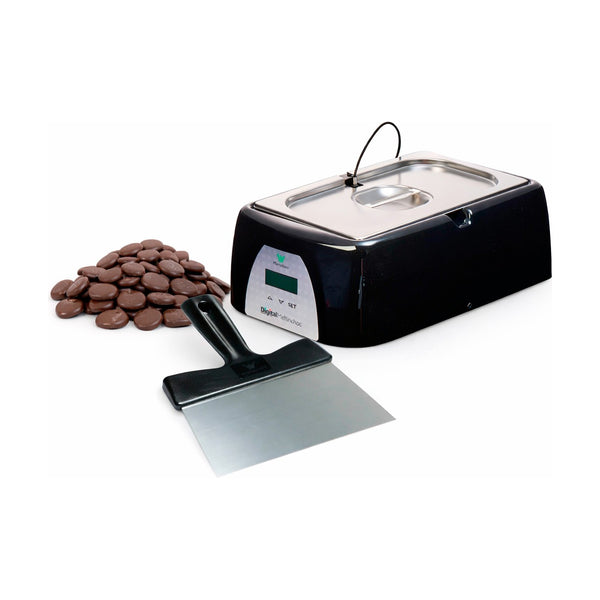
| Melt, seed and hold chocolate at a set temperature | Martellato Meltinchoc Digital 3.6 L | $1,150.00 CAD |
| Small-batch tempering with programmable curves | Pavoni MiniTemper 110V | $3,350.00 CAD |
| Production tempering, up to 45 kg a day | Bilait Adam K6 (6 kg) | $10,990.00 CAD |
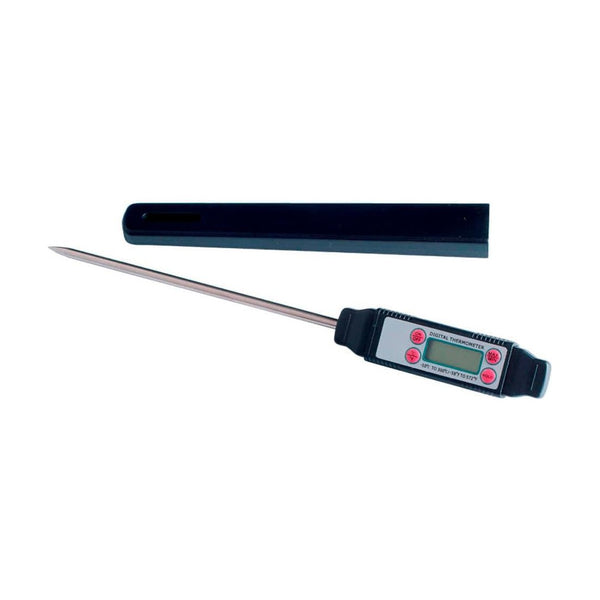
| Check the chocolate's temperature | Martellato digital thermometer 50T001 | $29.95 CAD |
| Couverture with a published tempering curve | FCH 55% dark chocolate, Venezuela, 10 kg | $299.00 CAD |
The six crystal forms of cocoa butter
Cocoa butter is polymorphic: the same fat can pack into six different crystal structures, and each one melts at a different temperature. Forms I and II are unstable and readily change into higher forms; Forms III, IV and V are metastable, stable enough to last for long periods; Form VI is the only thermodynamically stable form.
| Form | Also called | Melting range | In chocolate |
|---|---|---|---|
| I | sub-α | 13.0–18.0°C (55–64°F) | Unstable |
| II | α | 17.1–24.0°C (63–75°F) | Unstable |
| III | β′2 | 22.4–28.0°C (72–82°F) | Metastable |
| IV | β′1 | 21.0–33.0°C (70–91°F) | Metastable |
| V | β2 | 30.0–34.5°C (86–94°F) | The target of tempering |
| VI | β1 | 33.5–38.5°C (92–101°F) | Most stable; associated with fat bloom and a brittle texture |
The ranges are from the review by Ghazani, Donnelly and Marangoni (2025). Older literature often gives a single melting point per form: 17.3, 23.3, 25.5, 27.5, 33.8 and 36.3°C for Forms I to VI, as summarised by Barišić and colleagues (2019).
Why Form V is the crystal you want
Form V melts close to body temperature, at about 30.0–34.5°C (86–94°F), and it is the form that gives chocolate its characteristic snap, smooth texture and resistance to fat bloom. That is why, decades ago, it was settled that among the six forms only Form V is desirable in chocolate, and why the tempering process is designed to crystallize cocoa butter into Form V with the right number, shape and size of crystals.
Only a small part of the cocoa butter needs to crystallize. Peter Greweling, writing in Pastry Arts Magazine, describes tempering as pre-crystallizing a small quantity, about 1%, of the melted cocoa butter; Ghazani and colleagues give about 2–5% Form V crystals in a well-tempered chocolate. Those seed crystals then guide the rest of the cocoa butter into Form V as the chocolate sets.
How tempering controls crystallization
Tempering works in three temperature steps. Using dark chocolate as the example, Ghazani and colleagues describe it this way:
- Melt: heat past 50°C (122°F), often to 60°C (140°F), until every crystal is melted.
- Pre-crystallize: cool under controlled stirring to around 27–29°C (81–84°F), so seed crystals form.
- Reheat: warm gently to around 31–32°C (88–90°F), just below the melting point of Form V, to remove the unstable crystals, mainly Form IV, without melting the Form V crystals.
Adding chocolate that is already tempered, which contains Form V crystals, is called seeding: it speeds up the formation of the right crystals and makes the result more consistent. Each chocolate maker publishes its own curve, and the numbers differ slightly:
| Source | Melt | Crystallize | Work |
|---|---|---|---|
| FCH 55% dark chocolate, Venezuela (product data) | 45–50°C (113–122°F) | 28–29°C (82–84°F) | 31–32°C (88–90°F) |
| Meltinchoc Digital presets (Martellato) | 45°C (113°F) | Seeding with added chocolate | Dark 31°C (88°F), milk 29°C (84°F), white 28°C (82°F) |
| Greweling (Pastry Arts Magazine) | Not given | Not given | Dark about 32°C (90°F); milk and white about 30°C (87°F) |
Always start from the curve printed on your chocolate's technical sheet; the table shows how much it can vary from one product to another.
Machines that do the crystallizing for you
A machine holds the temperatures so your team does not have to. Each one fits a different stage of production:
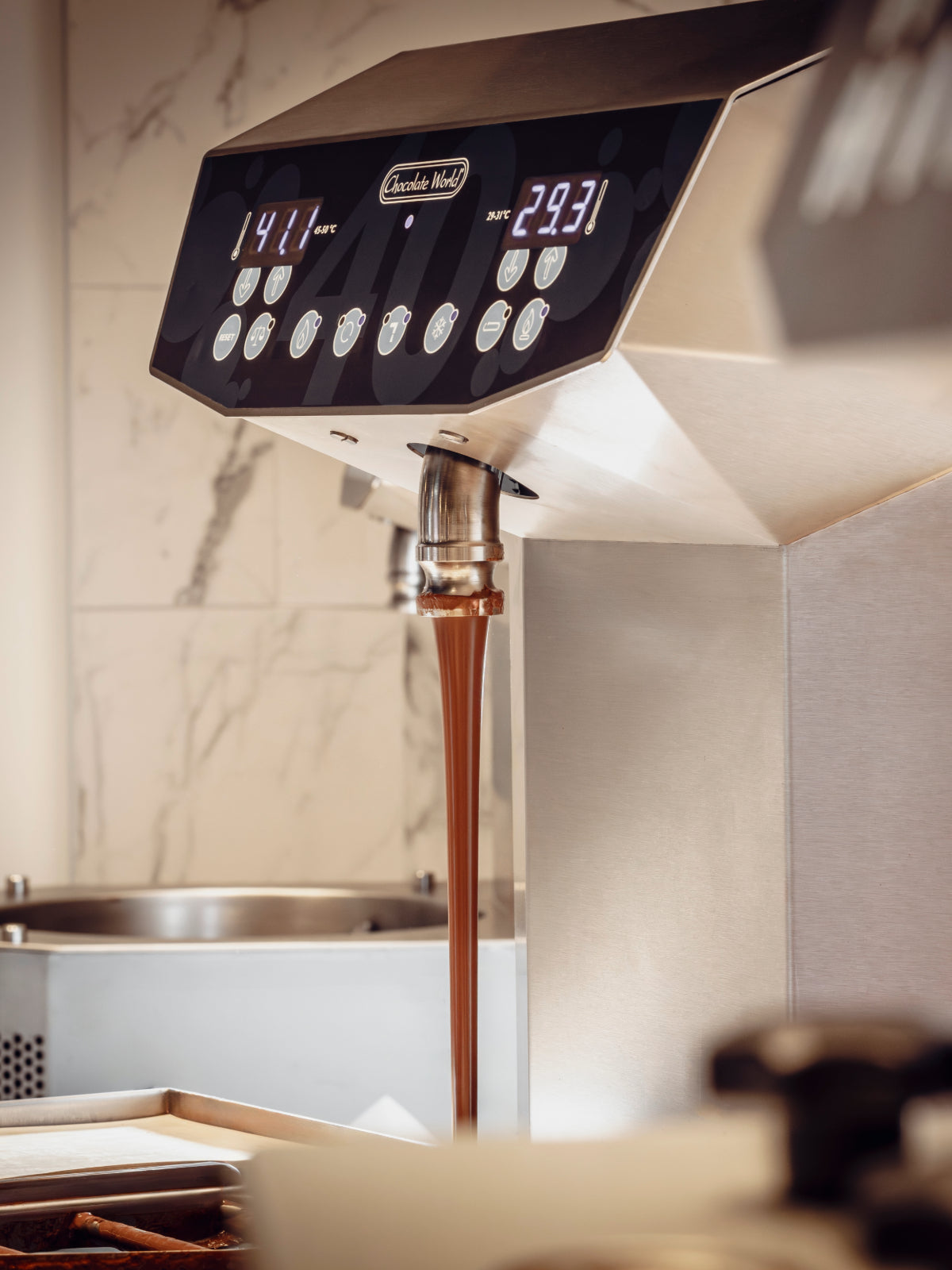
- Martellato Meltinchoc Digital: melts the chocolate to 45°C (113°F), signals when to seed it by adding more chocolate, then lowers the temperature to the tempering point of the dark, milk or white program and holds it there. It beeps every 10 minutes to remind you to stir.
- Pavoni MiniTemper: Pavoni says it keeps chocolate tempered for several hours thanks to its customisable programs. Our product data lists 5 programmable presets, a 20–60°C (68–140°F) range in 0.5°C steps, and interchangeable bowls for chocolate changes.
- Bilait Adam K6: for production, Bilait rates its 6 kg capacity at 20 kg of chocolate tempered in 4.5 hours, up to 45 kg a day, with automatic management of any type of chocolate.
- View the Meltinchoc Digital 3.6 L → $1,150.00 CAD
- View the Meltinchoc Digital 6 L → $1,259.99 CAD
- View the Pavoni MiniTemper 110V → $3,350.00 CAD
- View the Bilait Adam K6 → $10,990.00 CAD
View all tempering machines, including Bilait →
How to test that the chocolate crystallized correctly
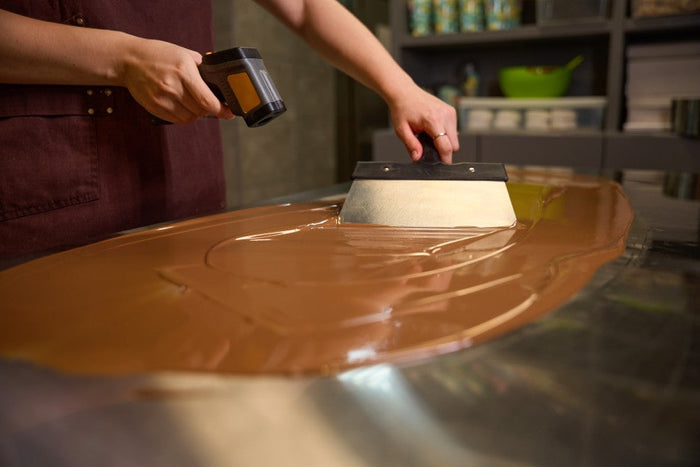
Test before you mould: a short test saves a full batch. Greweling's temper test is simple: dip a palette knife in the chocolate and watch it set. Well-tempered dark chocolate should set within about seven minutes, free of streaks or a grainy texture; milk and white chocolate take a little longer.
- If the test fails, Greweling says the problem is under-seeding: add more seed chocolate, or table a bit more. Do not warm the chocolate, because warming melts the crystals you already have.
- If the chocolate is much thicker than when it was melted, there are too many crystals: properly tempered chocolate should not be much thicker than untempered chocolate. Carefully melt some crystals out, leaving enough to seed.
An accurate thermometer is what makes the curve repeatable:
- View the Martellato digital thermometer 50T001 → $29.95 CAD
- View the Martellato infrared thermometer 50T002 → $76.50 CAD
For a step-by-step method, see our guide on how to temper chocolate, and for fixes, troubleshooting chocolate tempering.
When crystallization goes wrong: fat bloom
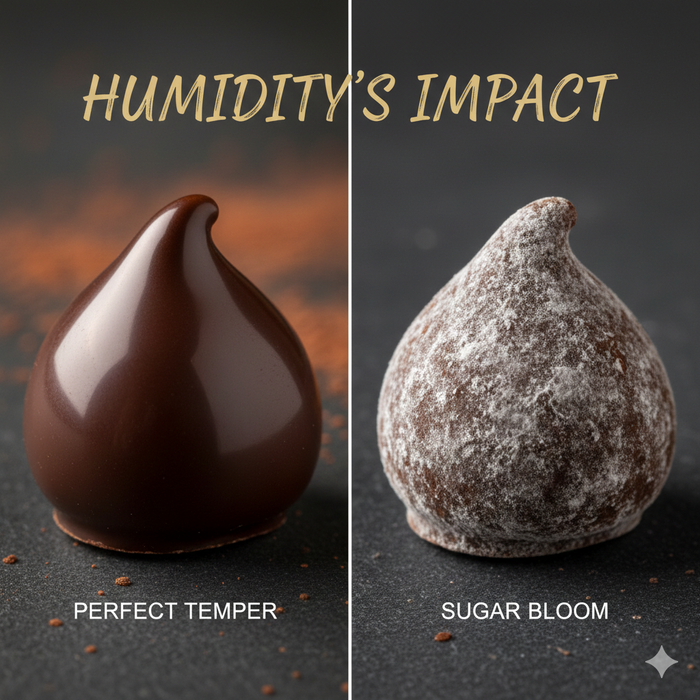
Fat bloom, the whitish layer that surfaces on chocolate, is a crystallization problem: Bilait links it to incorrect crystallization, with the fats rising to the surface. Ghazani and colleagues group the main types by cause:
| Bloom type | What happened |
|---|---|
| Type 2-A | The chocolate set without Form V crystals: untempered chocolate |
| Type 2-B | Form V crystals were present but not enough: under-tempered chocolate |
| Type 3 | Repeated partial melting and recrystallization, from high temperature cycling during tempering or poor storage, which promotes Form VI |
Even well-tempered chocolate can bloom over time, as Form V slowly changes into the more stable Form VI. Barišić and colleagues note that milk fat inhibits fat bloom and delays that change. For storage, Bilait gives 12–18°C (54–64°F) with a humidity of around 45% as optimal values for keeping chocolate.
To tell bloom from mould and fix it, read chocolate bloom vs mould and how to avoid chocolate bloom.
Crystallization beyond couverture: coloured cocoa butter
Coloured cocoa butter needs tempering too. Martellato's instruction for its coloured cocoa butters is short: temper the cocoa butter before each use.
How AI can help your production
Paste the tempering curves of every chocolate you use into an AI assistant and ask it to build one reference sheet per chocolate, with the melt, crystallize and work temperatures in °C and °F. Ask it to set up a temperature log for each batch, with the time, the temperatures at each step, the temper-test result and the operator, so you can trace a bloom problem back to the batch it came from. It can also turn Greweling's test and fixes into a one-page checklist for the bench.
AI organises the information; tasting and the final decision stay with your chef.
Tempering equipment and chocolate at Zucchero Canada
We are an authorized distributor of Martellato and Pavoni Italia, and the exclusive distributor of Bilait in Canada. Each one has a distinct job:
- Martellato Meltinchoc Digital to melt, seed and hold, from 3.6 L to 13.7 L. Martellato, Mol d'Art and Bilait table-top melters come with a free spatula.
- Pavoni MiniTemper for programmable small-batch tempering.
- Bilait Adam tempering machines for production volumes.
- Venezuelan chocolate: Bassan Sur del Lago 71% couverture ($273.00 CAD for a 5 kg bag), and for bean-to-bar makers who temper their own chocolate, Sur del Lago cocoa beans ($80.00 CAD for 1.5 kg).
For tempering, coating and glazing techniques explained step by step, Chocolate, 6th edition, by Ramon Morató ($160.00 CAD) is the reference on our shelf.
Equipping a chocolate shop, bakery or hotel? Contact our team, or call 587-774-8873 (toll free 877-741-8251). Orders over CAD 500 get 5% off automatically at checkout.
Tempering machines | Chocolate melters | Thermometers | Tempered vs untempered chocolate | Chocolate viscosity
This article is for information only. Every business is different: draw your own conclusions based on your own expectations, budget and goals, and talk to qualified experts before you decide or invest.
Sources: Ghazani S.M., Donnelly M.-E., Marangoni A.G., "Chocolate Tempering: A Perspective", Crystal Growth & Design 25 (2025) 2764–2783; Barišić V. et al., "The Chemistry behind Chocolate Production", Molecules 24 (2019) 3163; Greweling P., "Tempering Chocolate", Pastry Arts Magazine (2024); Martellato, Digital Meltinchoc "Hand book of use and maintenance"; Martellato, Food Colours catalogue; Pavoni Italia, MiniTemper product page; Bilait, 2026 catalogue (Adam K6, chocolate refrigerator); Zucchero Canada product pages.
Good to know
Frequently asked questions
What is chocolate crystallization?
It is how the cocoa butter in chocolate turns solid. Cocoa butter can crystallize in six forms, I to VI, each with its own melting range. Tempering steers it into Form V, the form that gives gloss, snap and resistance to fat bloom.
What are the crystal forms of cocoa butter?
Six forms: I (sub-α, 13.0–18.0°C), II (α, 17.1–24.0°C), III (β′2, 22.4–28.0°C), IV (β′1, 21.0–33.0°C), V (β2, 30.0–34.5°C) and VI (β1, 33.5–38.5°C), according to the 2025 review by Ghazani, Donnelly and Marangoni. Forms I and II are unstable, III to V are metastable, and VI is the most stable and is associated with fat bloom.
At what temperature do Form V crystals melt?
At about 30.0–34.5°C (86–94°F), close to body temperature. That is why tempering reheats the chocolate to around 31–32°C (88–90°F): just below the melting point of Form V, so unstable crystals melt and the Form V crystals survive.
Why is my tempered chocolate soft, streaky or dull?
Usually there were not enough Form V seed crystals. Peter Greweling's temper test: dip a palette knife in the chocolate; dark chocolate should set within about seven minutes with no streaks or grain. If it fails, add more seed chocolate or table a bit more, and do not warm the chocolate, which would melt the crystals you already have.
Can well-tempered chocolate still bloom?
Yes. Over time, Form V can change into the more stable Form VI, which is linked to fat bloom, and temperature cycling during tempering or storage promotes it. Milk fat inhibits fat bloom and delays the change. Bilait gives 12–18°C (54–64°F) and around 45% humidity as optimal storage values for chocolate.
Do tempering machines and melters qualify for free shipping or discounts?
Machines are excluded from free shipping. Orders over $500 CAD get 5% off automatically at checkout, and Martellato, Mol d'Art and Bilait table-top melters come with a free spatula. Customers who bought their machine from Zucchero get 15% off genuine spare parts with the code PARTS15.
Shop this article
Products mentioned in this guide
 MartellatoMeltinchoc Digital Melter 3.6 L – MCD101110V$1,150.00 CADView product →
 Pavoni ItaliaPavoni MiniTemper 110V Chocolate Tempering Machine MINITEMPER-110V$3,350.00 CADView product →
 BilaitBilait Adam K6 — 6 kg Tabletop Chocolate Tempering Machine$10,990.00 CADView product →
 MartellatoDigital Thermometer for Chocolate 50T001$29.95 CADView product →
For professionals
Equipping a chocolate shop, bakery or kitchen?
Tell us what you produce and how much. We will recommend the right machine, moulds and ingredients, and send you a quote.
For home bakers
Professional tools for your own kitchen
The same European moulds, tools and ingredients the professionals use.
5% off orders over $500 CAD, applied automatically at checkout.
Keep reading



Leave a comment
All comments are moderated before being published.
This site is protected by hCaptcha and the hCaptcha Privacy Policy and Terms of Service apply.