



Short answer: yes, chocolate can get moldy, but it is rare on plain chocolate: its water activity is below 0.60, while most molds need at least 0.80 to grow. A flat, dull grey-white film or white spots is almost always bloom, a quality defect in the cocoa butter or the sugar, and food scientists describe bloomed chocolate as no threat to health, only less attractive. Mold is a living growth: fuzzy, furry, velvety or coloured, and more likely on pieces with a moist filling. Two quick tests tell them apart: fat bloom melts under a warm spatula and sugar bloom dissolves in a drop of water.
Chocolate bloom vs. mold: the quick check
Look first, then test: fat bloom melts with gentle heat, sugar bloom dissolves in water, and mold looks alive.
| What you see | Most likely | Quick test | What to do |
|---|---|---|---|
| Dull grey film, marbling, white spots or white rings on a once-glossy surface | Fat bloom | A warm spatula melts it | Correct tempering, cooling or storage; re-melt and temper the chocolate |
| Whitish, dry surface after cold storage, condensation or humidity | Sugar bloom | A drop of water dissolves it | Keep moisture away from the chocolate |
| Fuzzy, furry or velvety growth, threads, green or grey spots | Mold | No test needed | Do not eat or sell it; find the moisture source |
The two tests come from a 2020 study in Scientific Reports (Heuler et al.): a drop of water left on the surface for two minutes dissolved sugar bloom, and a metal spatula warmed on a 40°C (104°F) hot plate melted fat bloom. The same study notes that a piece can carry both types of bloom at once.
Can chocolate get moldy?
It can, but plain chocolate is too dry for most molds. The Province of Manitoba's food safety factsheet lists chocolate at a water activity below 0.60, while most molds need at least 0.80 to grow and even molds adapted to dry foods need about 0.60–0.62. That is why mold on a plain bar or shell is unusual.
The picture changes with moist components. The same table puts jams at 0.75–0.80 and raw fruit at 0.98, so bonbons and bars with fruit, jam or other moist fillings are where mold is more plausible. Mold on chocolate is therefore a warning sign about moisture: a wet filling, condensation or damp storage.
What does mold on chocolate look like?
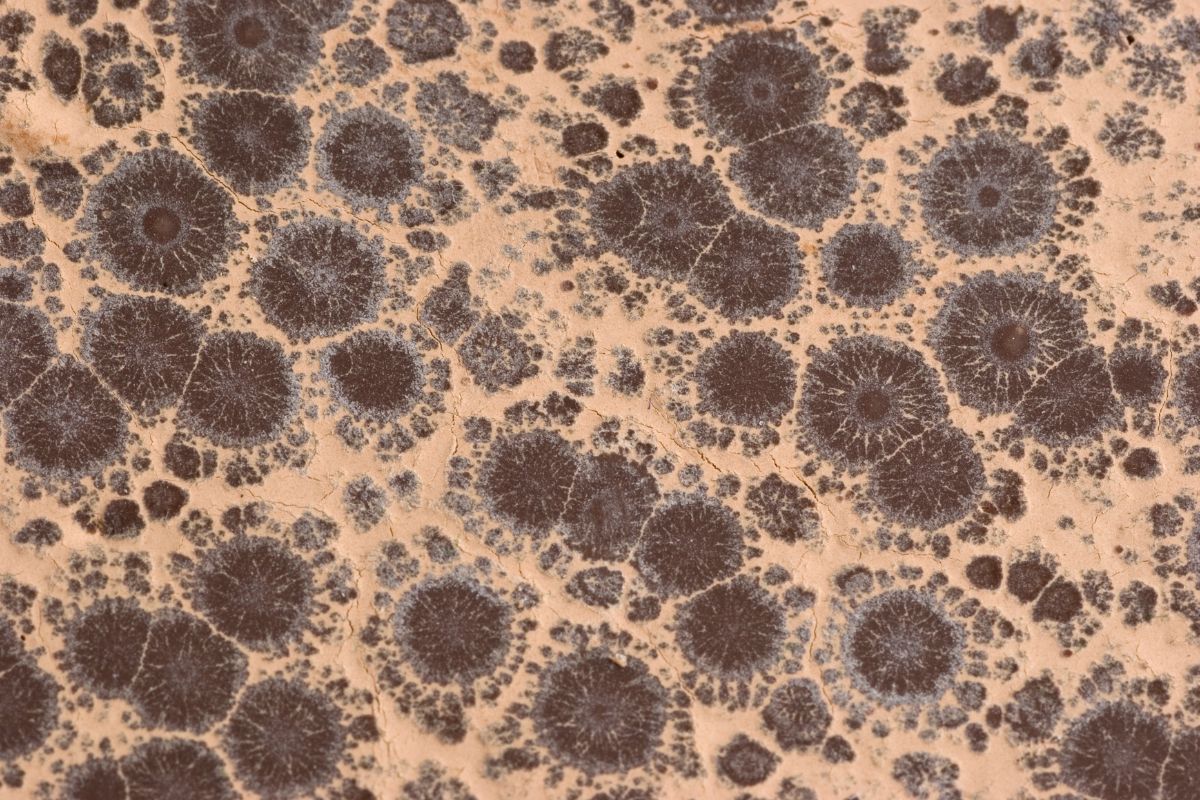
Mold looks like something growing on the surface, not like a flat film. The USDA Food Safety and Inspection Service describes mold on food as anything from grey fur to fuzzy green dots, velvety circles or white dust, with thread-like roots that can reach below the surface of moist foods.
Because mold can also be white, colour alone does not settle the question. Use the two tests: if the white film melts under a warm spatula (fat bloom) or dissolves in a drop of water (sugar bloom), it is bloom. If it does neither, or it looks fuzzy, raised or patchy in colour, treat it as mold.
Is moldy or bloomed chocolate safe to eat?
Bloom is a quality problem, not a safety problem. Researchers at Mendel University in Brno state that grey, bloomed chocolate is no threat to consumer health; it loses its gloss and appeal, which makes it unsellable as a finished piece. Don Mercer, a food scientist at the University of Guelph, says the same of fat bloom and sugar bloom: there is no risk in eating it.
Mold is different. The USDA advises discarding food that is covered with mold and not sniffing the moldy item, because that can cause respiratory trouble, and notes that a few molds, in the right conditions, produce mycotoxins, which are poisonous substances. In a shop or production kitchen, a moldy piece is never sold or reworked: discard it, clean the spot where it was stored, and check the pieces stored next to it.
What causes fat bloom
Fat bloom is cocoa butter crystallising in the wrong form or in the wrong place, and it starts in the workshop as often as in storage. In their review in the European Journal of Lipid Science and Technology, Lonchampt and Hartel (2004) group the causes like this:
- Under-tempering: too few stable seed crystals. Bloom can appear in less than two days, as large white spots or white rings around a dark, glossy centre.
- Over-tempering: too many seed crystals. The surface is not bright out of the mould and turns dull grey quickly.
- Cooling too fast: unstable crystals and hair cracks on the surface, both of which promote bloom later.
- Warm storage: between 18°C and 30°C (64–86°F) bloom develops faster as the temperature rises. Above 32–34°C (90–93°F) the cocoa butter partly melts and recrystallises uncontrolled, giving large white spots.
- Temperature swings: even small fluctuations speed bloom up; the review cites a measurable difference between chocolate kept at 24°C (75°F) and at 24 ± 1°C.
- Fillings and nuts: filled chocolates, often with a high-oil centre, are more prone to bloom than plain chocolate. The more filling and the thinner the chocolate, the greater the risk; nuts cause similar problems.
What causes sugar bloom
Sugar bloom is a moisture problem: water condenses on the chocolate, draws sugar out to the surface, and the sugar recrystallises when the water evaporates (Barišić et al., Molecules, 2019). The usual triggers are humid conditions and moving chocolate quickly between cold and warm conditions (Abe-Inge et al., Heliyon, 2024). In production, cooling at too low a temperature can also deposit moisture on the pieces (Lonchampt and Hartel, 2004).
How professionals prevent bloom
Bloom is prevented in three places: the tempering, the cooling and the storage. Below is the short version; our chocolate bloom prevention guide covers each step for producers in detail.
Temper accurately, every batch
Good tempering gives the chocolate the largest number of the smallest possible crystals in the stable form, Form V; that is what gives gloss, clean release from the mould and resistance to bloom (Lonchampt and Hartel, 2004). Martellato's user manual for the Digital Meltinchoc melters (MCD101 to MCD104) lists these pre-set programs for the seeding method:
| Program | Melting temperature | Holding (tempered) temperature |
|---|---|---|
| Dark | 45°C (113°F) | 31°C (88°F) |
| Milk | 45°C (113°F) | 29°C (84°F) |
| White | 45°C (113°F) | 28°C (82°F) |
The sequence: melt to 45°C, add seed chocolate, then let the machine bring the chocolate down to its holding temperature and keep it there, stirring during use. Different chocolates need different tempering conditions, so when your couverture maker gives its own curve, set it in manual mode. Confirm the temperature with a thermometer.
For a full walkthrough, read our guide to tempering chocolate and, if pieces still come out dull or streaky, the tempering troubleshooting guide.
Cool gradually, not cold
After moulding, cool the pieces gradually; a 2024 study in Heliyon describes moulds being carried into a cooling chamber and cooled gradually at about 10°C (50°F). Cooling too fast creates unstable crystals and hair cracks, and cooling too cold can leave moisture on the surface, which leads to sugar bloom.
Store cool, steady and dry
Keep finished chocolate cool and at a constant temperature. Lonchampt and Hartel report that bloom inhibition is greatest at 18°C (64°F) or below without temperature fluctuations, and cite storage below 18°C holding off bloom for more than a year. In a 2014 Mendel University trial, six chocolate products kept at 6°C and 12°C (43°F and 54°F) showed no deterioration after ten weeks; at 20°C (68°F) fat bloom appeared on some products from the sixth week, and at 30°C (86°F) all products deteriorated clearly.
Follow your couverture's own sheet as well: for Bassan Sur del Lago 71%, the product sheet specifies sealed storage at 16–20°C (61–68°F) below 50% relative humidity, away from temperature fluctuations. Keep the storage area dry and avoid taking chocolate straight from cold storage into a warm, humid room. For humidity in the chocolate room, see our guide to humidity for storing chocolate.
Can you fix bloomed chocolate?
Fat-bloomed chocolate can be re-melted and tempered again. The bloom crystals are cocoa butter in Form VI, which melts at about 34–36°C (93–97°F) (Heuler et al., 2020); melting to 45°C (113°F) takes the chocolate well above that, and the tempering cycle is designed to remove unstable forms and build Form V crystals again (Lonchampt and Hartel, 2004). If the bloom keeps coming back, the cause is still in your process: tempering, cooling or storage.
Sugar bloom behaves differently: in the same 2020 study, laser heat partly removed fat bloom but did not remove sugar bloom. The fix is upstream: keep moisture away from the chocolate. Moldy chocolate is never reworked.
Equipment that keeps bloom out of production
Each tool below does a different job; pick by batch size and by how much of the curve you want the machine to run.
| Need | Product | Price |
|---|---|---|
| Check the temperature of the chocolate | Martellato digital thermometer 50T001 | $29.95 |
| Melt and hold temper by seeding, small batches | Martellato Digital Meltinchoc MCD101, 3.6 L | $1,150.00 |
| Melt and hold temper by seeding, a full shift | Martellato Digital Meltinchoc MCD102, 6 L | $1,259.99 |
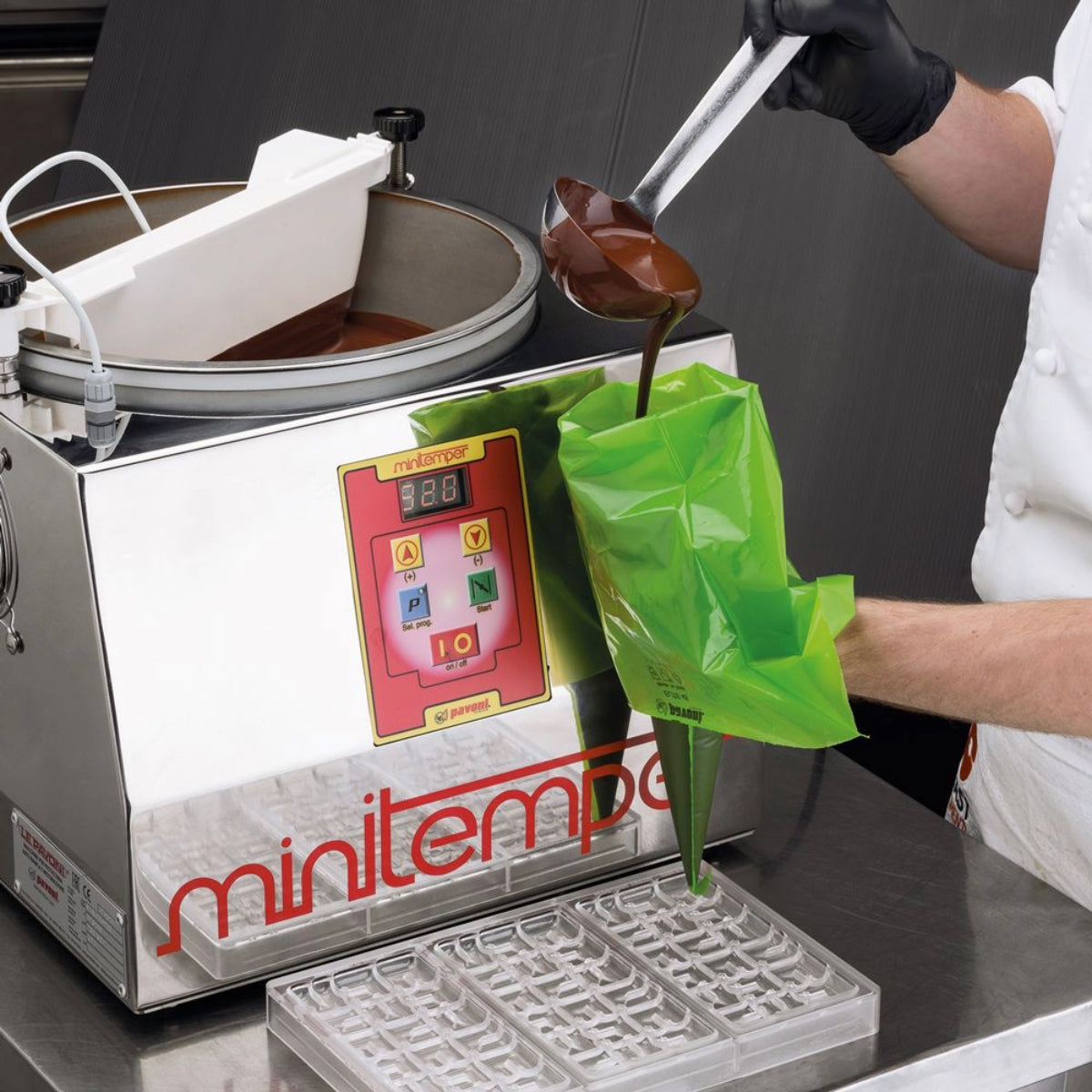
| Machine-run tempering curve, 3.5 kg | Pavoni MiniTemper 110V | $3,350.00 |
- Martellato Digital Meltinchoc: PID temperature control, an integrated probe and three pre-set programs for dark, milk and white, in a removable stainless tank. The MCD101 holds 3.6 L; the MCD102 holds 6 L, enough to work through a production shift without refilling. You add the seed chocolate; the melter holds the temperature.
- Pavoni MiniTemper: three-stage control (melt, crystallise, harden) with five programmable presets, 20–60°C in 0.5°C steps, a 3.5 kg tank and an interchangeable basin for switching between dark, milk and white. Choose it when you want the machine, not the operator, to run the whole curve.
- Martellato infrared digital thermometer 50T002: a second thermometer for the bench. View the infrared thermometer → $76.50
For continuous production at higher volumes, compare the Chocolate World and Pomati tempering machines, and the Bilait range, of which we are the exclusive distributor in Canada.
View chocolate tempering machines → | View Bilait →
How AI can help your production
Paste the tempering table above into an AI assistant and ask it to write a one-page tempering procedure for your team, with a line to sign the melting temperature, the holding temperature and the room temperature at each batch. Ask it to build a storage log for your chocolate room, and when bloom appears, give it the log and the batch records and ask which steps changed. A written routine and a simple log make bloom traceable instead of a mystery.
AI organises the information; tasting and the final decision stay with your chef.
Chocolate and tempering supplies at Zucchero Canada
We are an authorized distributor of Martellato and Pavoni Italia, and we sell the couverture and cacao to go with them:
- Couverture for moulding: Bassan Sur del Lago 71% dark couverture, made in Canada from Venezuelan cacao, for moulded bonbons, tablets and ganaches; 5 kg bag $273.00, also in 20 kg cases.
- Making chocolate from the bean: Sur del Lago cocoa beans from Venezuela, 1.5 kg bag $80.00. Bean-to-bar chocolate needs the same tempering and storage discipline.
- The reference book: Chocolate by Ramon Morató, 416 pages covering tempering, coating and glazing and bonbon fillings that resist drying and crystallisation, $160.00. We stock Books for Chefs titles in Calgary and ship across Canada.
Food products ship within Canada only. Orders over $500 CAD get 5% off automatically at checkout. Buying couverture or equipment in volume for a shop, hotel or production kitchen? Contact our team or call 587-774-8873 (toll free 877-741-8251).
How to prevent chocolate bloom | Does chocolate go bad? | How to temper chocolate | Tempering machines | Chocolate melters | Thermometers
This article is for information only. Every business is different: draw your own conclusions based on your own expectations, budget and goals, and talk to qualified experts before you decide or invest.
Sources: Lonchampt P. and Hartel R.W., "Fat bloom in chocolate and compound coatings", European Journal of Lipid Science and Technology 106 (2004) 241–274; Heuler J. et al., "Point-of-care detection, characterization, and removal of chocolate bloom using a handheld Raman spectrometer", Scientific Reports 10 (2020) 9833; Barišić V. et al., "The Chemistry behind Chocolate Production", Molecules 24 (2019) 3163; Abe-Inge V. et al., "Assessment of chocolate retail in Ghana and willingness to use cooling devices", Heliyon 10 (2024) e36961; Machálková L., Hřivna L., Nedomová Š. and Jůzl M., "The effect of storage temperature and production method of chocolate confectionery on changes in its quality", MendelNet 2014; Mercer D., "When the Bloom is on the Chocolates", University of Guelph, Department of Food Science; Province of Manitoba, "Water Activity vs. Water Content"; USDA Food Safety and Inspection Service, "Molds on Food: Are They Dangerous?"; Martellato, Digital Meltinchoc user and maintenance manual (rev. 2019); Martellato, Pavoni Italia and Bassan Chocolate product data.








Leave a comment
All comments are moderated before being published.
This site is protected by hCaptcha and the hCaptcha Privacy Policy and Terms of Service apply.