

Ideal Humidity for Storing Chocolate: Targets, Condensation and Control
Short answer: store finished chocolate below about 50–55% relative humidity, in a cool room that stays steady at roughly 16–21°C (61–70°F), sealed and away from light and odours. That is the range given by Iowa State University Extension (below 50–55% at 65–70°F) and by makers' own sheets: Bassan asks for 16–20°C below 50% for its couverture, and Bilait designs its chocolate cabinets for 12–18°C at about 45%. The bigger danger is not the room's humidity itself but condensation: chocolate that is colder than the air's dew point gets wet, and that water causes sugar bloom.
What is the ideal humidity for storing chocolate?
Below 50–55% relative humidity (RH) for finished chocolate, with a steady temperature. Here is what each source specifies:
| Source | Temperature | Relative humidity |
|---|---|---|
| Bilait, chocolate storage cabinets | 12–18°C (54–64°F) | About 45% |
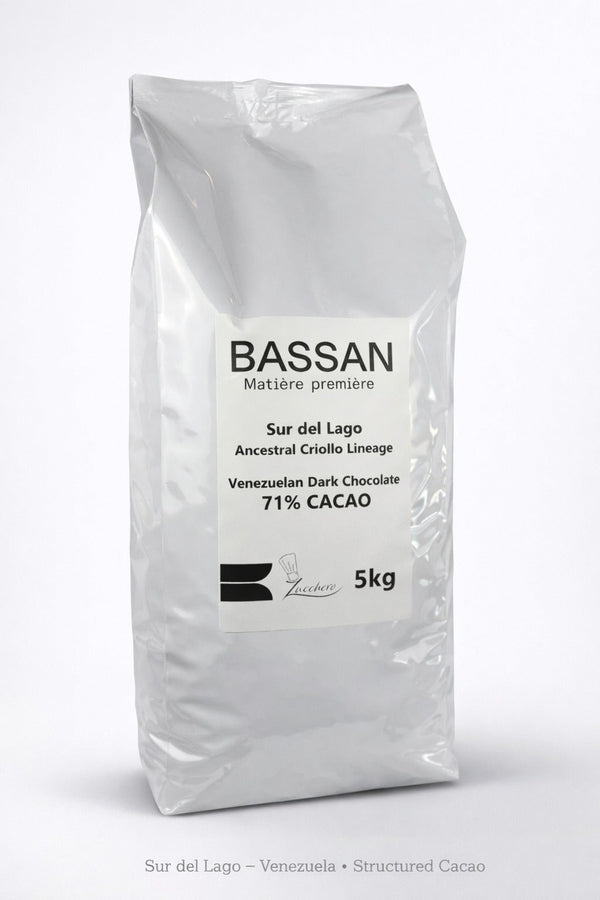
| Bassan Sur del Lago 71% couverture, product sheet | 16–20°C (61–68°F), sealed, no fluctuations | Below 50% |
| Iowa State University Extension | 65–70°F (18–21°C), airtight, dark | Below 50–55% |
| Bilait Verticool 275 cooling tunnel, production room | Air-conditioned room | 45% |
| TIS cargo guide, storage and transport | 10–18°C (50–64°F) | 65–70%; 70% maximum equilibrium humidity |
The first four come from a chocolate maker, an equipment maker and a university food-science extension, and are written for storing and working chocolate. The last comes from the Transport Information Service (TIS) of the German Insurance Association, which advises on cargo: its figures are for chocolate in transport and warehouses, with 70% given as the maximum equilibrium humidity. Whatever the RH, keep the temperature steady: Lonchampt and Hartel's review of fat bloom (2004) finds bloom best inhibited at 18°C (64°F) or below without fluctuations.
Why humidity matters: sugar bloom and odours
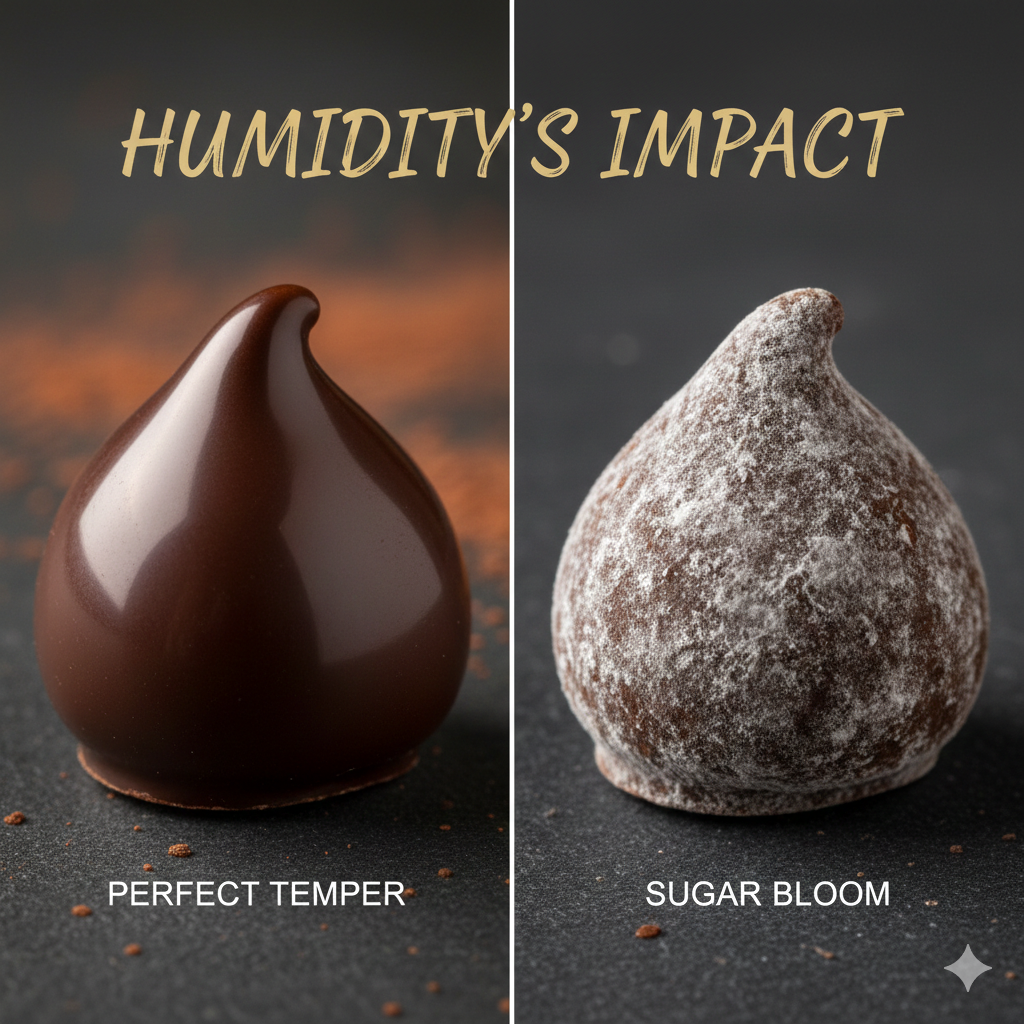
Water dissolves the sugar at the surface of the chocolate, and when it evaporates the sugar recrystallises as a fine, dull white film: sugar bloom (Barišić et al., Molecules, 2019). TIS names excessive humidity and marked temperature swings as the causes, and Iowa State University Extension describes sugar bloom as rough to the touch and most likely on refrigerated chocolate. It does not make chocolate unsafe, but a bloomed piece cannot be sold as a finished product.
Humid, warm storage brings a second problem. TIS warns that high humidity and temperatures can turn chocolate musty, mouldy and rancid, and that all cocoa products absorb foreign odours very easily, more so the higher their cocoa butter content. That is why every source asks for sealed, airtight storage away from strong smells.
For the whole picture of fat and sugar bloom, read our guide on how to prevent chocolate bloom.
Condensation: the dew-point rule
Chocolate gets wet when it is colder than the dew point of the air around it. The US National Weather Service defines the dew point as the temperature to which air must be cooled to reach saturation; a cold bar, box or mould cools the air touching it, and below the dew point that air leaves water on the surface. Using the Weather Service's vapour-pressure formula, these are the dew points of some typical rooms:
| Room | Relative humidity | Dew point (calculated) |
|---|---|---|
| 20°C (68°F) | 50% | About 9°C (49°F) |
| 20°C (68°F) | 60% | About 12°C (54°F) |
| 20°C (68°F) | 70% | About 14°C (58°F) |
| 25°C (77°F) | 50% | About 14°C (57°F) |
| 25°C (77°F) | 60% | About 17°C (62°F) |
Chocolate straight from a refrigerator is colder than every one of these dew points, which is why TIS warns that chocolate carried refrigerated at 4.4–7.2°C (40–45°F) risks condensation when it is unloaded into a warm room. On a humid summer day the margin is small even for a cool storage room: chocolate kept at 16°C (61°F) is already below the dew point of a 25°C room at 60% RH.
How to bring cold chocolate into a warm room
Iowa State University Extension advises against storing chocolate in the refrigerator and gives this procedure when it has to be chilled or frozen:
- Before freezing, put the chocolate in the refrigerator, unwrapped, for 24 hours, then wrap it well and freeze it in an airtight container.
- To use it, thaw it, still wrapped, in the refrigerator for 24 hours, then bring it to room temperature.
- Unwrap it only once it has reached room temperature.
Temperature and humidity work together
Relative humidity depends on temperature: cool the same air and its RH rises. In its cocoa-bean guide, TIS describes how rapid, major cooling can push the relative humidity inside a container up to 100%, with condensation and wetting as the result. In practice, that means:
- Keep the storage room at a steady temperature; swings raise the risk of both fat bloom and sugar bloom.
- Do not store chocolate colder than you need: the colder it is, the further it sits below the dew point of the room it is taken into.
- Keep stock sealed in its original packaging until you use it, as Bassan's sheet asks.
Measure both values. A hygrometer, ideally one that logs readings, shows whether the room holds its humidity overnight and through the seasons, and a thermometer at the bench tells you whether pieces are colder than the room. In a humid space, a dehumidifier brings the RH down; in all cases, keep chocolate away from steam from sinks, dishwashers and bains-marie.
Humidity for cocoa beans, cocoa butter and cocoa powder
Cacao products bring their own risks: moisture and odours. These are the figures from the cargo guide, the International Cocoa Organization (ICCO) and our product sheets:
| Product | What the source says |
|---|---|
| Cocoa beans, general | Dried to about 7.5% moisture, which the ICCO gives as appropriate for secure storage for a couple of months in the tropics. Highly hygroscopic; water content 6–8%; above 8% there is a risk of mould, below 6% the beans become brittle; transport at 70% RH (TIS) |
| Sur del Lago cocoa beans, Venezuela | Sun-dried to about 5.4% moisture and packed in GrainPro bags; store at 16–20°C, cool and dry, away from sunlight and strong odours, sealed until use; 24 months |
| Ucayali cocoa beans, Peru | Cool, dry place away from direct sunlight and strong odours; 24 months |
| Natural cocoa butter | Sealed, cool and dry, away from strong odours, because cocoa butter absorbs them; up to 24 months in its original packaging |
| Cocoa liquor wafers | Cool, dry place; up to 24 months |
| Dutched 20/22 cocoa powder | Cool, dry place at room temperature, around 20°C (68°F), away from direct sunlight and moisture |
The TIS guide also explains what goes wrong: when night cooling takes the temperature below the dew point, condensation ("sweat") drips onto the bags, and the beans underneath grow white mould and taste musty. Its advice is to keep the bags dry and covered against dripping condensation, and never to store cocoa next to moisture-releasing goods.
Humidity in the production room
The same rules apply where you temper, mould and cool. Bassan's sheet asks for a work environment of 16–20°C (61–68°F) before you open the chocolate, and Bilait specifies an air-conditioned room at 45% RH for its Verticool 275 cooling tunnel. Moulds must be completely dry too: Chocolate World asks you to dry the back of each mould after washing, because the moisture can transfer to other moulds and show on the finished chocolate. See our guide to cleaning polycarbonate chocolate moulds.
How AI can help your production
Export a month of readings from a logging hygrometer and thermometer, paste them into an AI assistant and ask it to flag the hours when the room went above 55% RH or when a cold delivery was opened below the dew point; give it the dew-point table above to work from. Ask it to write a one-page receiving procedure for cold-weather deliveries and a weekly storage-room checklist. A written routine keeps every shift handling chocolate the same way.
AI organises the information; tasting and the final decision stay with your chef.
Storing chocolate and cacao from Zucchero Canada
We store our couverture and cacao in Calgary and ship across Canada. Each product page lists its own storage conditions:
- Couverture with a full storage spec: Bassan Sur del Lago 71% → made in Canada from Venezuelan cacao, with a bilingual technical sheet; 5 kg bag $273.00 CAD, also in 20 kg cases.
- Cocoa beans for bean-to-bar: Sur del Lago, Venezuela → 1.5 kg GrainPro bag $80.00 CAD, and Ucayali, Peru → 1.5 kg GrainPro bag $80.00 CAD.
- Cocoa butter: natural, not deodorised, 8 kg box → $550.00 CAD.
- Cocoa liquor: 100% Peruvian cocoa liquor wafers → 1 kg bag from $29.99 CAD.
- Cocoa powder in bulk: Dutched 20/22, 25 kg bag → $710.00 CAD.
- A thermometer for the bench: Martellato digital thermometer 50T001 → $29.95 CAD.
For larger production, Bilait, whose machines we distribute exclusively in Canada, designs its cooling equipment around controlled temperature and humidity. View Bilait →
Food products ship within Canada only, and cacao and chocolate are not part of the free-shipping offer. Orders over $500 CAD get 5% off automatically at checkout. Buying cacao or couverture in volume for a production kitchen? Contact our team or call 587-774-8873 (toll free 877-741-8251).
How to prevent chocolate bloom | Chocolate bloom vs. mold | Does chocolate go bad? | Raw cocoa beans | Dark couverture | Cocoa butter & cacao
This article is for information only. Every business is different: draw your own conclusions based on your own expectations, budget and goals, and talk to qualified experts before you decide or invest.
Sources: Iowa State University Extension and Outreach, AnswerLine, "Chocolate – Shelf Life, Storage, and Bloom" (2023); Transport Information Service (German Insurance Association), "Chocolate" and "Cocoa/Cocoa beans"; US National Weather Service, glossary "Dew point" and "Vapor Pressure" calculation sheet; Lonchampt P. and Hartel R.W., European Journal of Lipid Science and Technology 106 (2004) 241–274; Barišić V. et al., Molecules 24 (2019) 3163; International Cocoa Organization, "Processing Cocoa"; Bilait catalogue 2026 and Verticool 275 datasheet; Chocolate World Moulds catalogue, Edition 15; Bassan Chocolate and Canada Cacao Co. product data.
Good to know
Frequently asked questions
What is the ideal humidity for storing chocolate?
Below about 50–55% relative humidity, at a steady, cool temperature. Iowa State University Extension recommends below 50–55% at 65–70°F (18–21°C); Bassan's sheet for its 71% couverture asks for below 50% at 16–20°C (61–68°F), sealed; and Bilait designs its chocolate storage cabinets for about 45% at 12–18°C (54–64°F).
Does humidity cause chocolate bloom?
Yes, sugar bloom. Moisture dissolves the sugar at the surface and leaves it behind as fine white crystals when it evaporates. The most common source is condensation on chocolate that is colder than the dew point of the room, for example chocolate taken straight from a refrigerator. Fat bloom is a temperature problem rather than a humidity one.
Should I store chocolate in the fridge?
Iowa State University Extension advises against it: chocolate picks up odours and gets a moist surface when it returns to room temperature, which causes bloom. If you must refrigerate it, wrap it tightly. To freeze it, leave it unwrapped in the refrigerator for 24 hours first, then wrap it and freeze it airtight; to use it, thaw it wrapped in the refrigerator for 24 hours, bring it to room temperature and only then unwrap it.
How do you stop condensation on chocolate?
Keep chocolate warmer than the dew point of the air it is in. In a 20°C (68°F) room at 50% relative humidity the dew point is about 9°C (49°F); at 60% it is about 12°C (54°F). Let cold chocolate warm up to room temperature in its sealed packaging before you open it, and keep it away from steam.
What humidity do cocoa beans need?
Cocoa beans are highly hygroscopic. The TIS cargo guide gives a water content of 6–8%, with a risk of mould above 8% and brittle beans below 6%; the ICCO gives about 7.5% moisture as appropriate for secure storage for a couple of months in the tropics. Our Sur del Lago beans are sun-dried to about 5.4% and packed in GrainPro bags; store them sealed at 16–20°C, cool, dry and away from strong odours.
Do cocoa beans and couverture qualify for free shipping?
No. Cacao and chocolate are excluded from our free shipping on orders of $300 CAD or more, and food products ship within Canada only. Orders over $500 CAD get 5% off automatically at checkout. For volume orders, contact our team or call 587-774-8873.
Shop this article
Products mentioned in this guide
 Bassan ChocolateSur del Lago Ancestral Criollo Lineage Dark Chocolate 71%From $69.95 CADView product →
 Canada Cacao Co.Sur del Lago Ancestral Criollo Lineage Cocoa Beans · VenezuelaFrom $80.00 CADView product →
 Canada Cacao Co.Ucayali Peru Raw Cacao Beans - Fine Flavor Fermented & Sun-DriedFrom $80.00 CADView product →
 Canada Cacao Co.Natural Cocoa Butter 100% Peruvian Fine CacaoFrom $69.99 CADView product →
For professionals
Equipping a chocolate shop, bakery or kitchen?
Tell us what you produce and how much. We will recommend the right machine, moulds and ingredients, and send you a quote.
For home bakers
Professional tools for your own kitchen
The same European moulds, tools and ingredients the professionals use.
5% off orders over $500 CAD, applied automatically at checkout.
Keep reading



Leave a comment
All comments are moderated before being published.
This site is protected by hCaptcha and the hCaptcha Privacy Policy and Terms of Service apply.