



Short answer: chocolate rarely goes bad the way milk or bread does. Plain chocolate is too dry for most moulds and bacteria to grow, and in Canada a best-before date tells you about quality, not safety: you can still eat chocolate after that date if it was stored well and looks, smells and tastes normal. What chocolate does do is lose quality over time. Iowa State University Extension gives dark chocolate a best-quality shelf life of at least 2 years, milk chocolate 1 year and white chocolate about 6 months. Throw chocolate away if it shows mould, smells or tastes off, got wet, or is part of a recall.
This article is for general information only and is not medical or nutritional advice. Always consult your doctor, pharmacist or a registered dietitian about your own situation, especially during pregnancy or breastfeeding, or if you have diabetes, allergies or a medical condition.
How long does chocolate last? The numbers at a glance
The type of chocolate decides how long it keeps its best quality, because milk fat and the absence of cocoa solids shorten its life.
| Chocolate | Best-quality shelf life (stored well) | What limits it |
|---|---|---|
| Dark, semi-sweet and unsweetened baking chocolate | At least 2 years | Keeps longest: the higher the cacao percentage, the longer chocolate tends to keep |
| Milk chocolate | About 1 year | Milk fat oxidises and turns rancid faster than cocoa butter |
| White chocolate | About 6 months | No cocoa solids, so none of their natural antioxidants; prone to rancidity with light and air |
| Ruby chocolate | Strongest berry flavour in its first year | Sensitive to light, moisture and heat (fading and greying) |
Source: Iowa State University Extension and Outreach, AnswerLine, "Chocolate – Shelf Life, Storage, and Bloom" (2023). For a professional ingredient, the manufacturer's data sheet is the reference: for example, the product data for our Peruvian cocoa liquor wafers says to store them in a cool, dry place for up to 24 months.
Does chocolate expire? Best before vs expiration date in Canada
No, chocolate does not carry an expiration date in Canada; when it has a date, it is a best-before date, and that date is about quality. The Canadian Food Inspection Agency (CFIA) explains it like this:
- A best-before date tells you how long a properly stored, unopened food will keep its quality. CFIA states that best-before dates "are not indicators of food safety, neither before nor after the date".
- You can buy and eat food after its best-before date, and it is not illegal to sell it.
- Expiration dates are a different thing and apply only to a short list of products, such as infant formula, formulated liquid diets, meal replacements and nutritional supplements. Food past an expiration date should be discarded.
- Only prepackaged foods with a durable life of 90 days or less must show a best-before date. Foods that keep longer, which includes most chocolate, are not required to carry one; when such a date appears, the manufacturer or retailer has added it voluntarily.
Is expired chocolate safe to eat?
Usually yes, if it was stored dry and shows no sign of spoilage; the date passing does not, on its own, make chocolate unsafe. Chocolate is a very dry food. Manitoba Agriculture lists chocolate with a water activity below 0.60, while most moulds need at least 0.80 and even the most drought-tolerant (xerophilic) moulds need 0.60–0.62. Iowa State University Extension puts chocolate between 0.3 and 0.4. That is why plain chocolate does not spoil like fresh food.
Chocolate past its date is still unsafe or not worth eating when:
- You see mould. Moulds need far more moisture than plain chocolate holds, so fuzzy growth is a sign that moisture got in (a wet package, condensation, a moist filling).
- It smells or tastes off. A stale, rancid smell is fat oxidation; the chocolate is not pleasant to eat or to work with.
- It has a moist filling. Bonbons and truffles with cream, fruit or ganache centres are not plain chocolate: follow the date and storage instructions the maker gives for that product.
- It is part of a recall. Do not eat a recalled product, whatever its date. If in doubt, check the Government of Canada Recalls and Safety Alerts website.
So, can you eat chocolate that is one or two years out of date? If it is plain dark chocolate, stored cool, dry and sealed, with no mould and a normal smell and taste, the date alone is not a reason to throw it out. Expect less aroma, and possibly a dull or white surface.
What does expired chocolate look like?
A dull, grey or white-streaked surface on old chocolate is bloom (fat or sugar crystals on the surface), not spoilage. Iowa State University Extension notes that bloom does not make chocolate unsafe and does not affect its shelf life; it changes how the chocolate looks.
| What you see or smell | What it usually is | What to do |
|---|---|---|
| Smooth grey or white streaks after warm storage | Fat bloom | Safe; melt and temper again to restore the look |
| Dry, dusty white film after the fridge or humidity | Sugar bloom | Safe; keep it away from moisture next time |
| Fuzzy or coloured growth | Mould | Discard |
| Stale, rancid or "off" smell | Fat oxidation | Discard for production; quality is lost |
Not sure which one you are looking at? Our guide chocolate bloom vs mould explains how to tell them apart and how to prevent bloom.
Can you still use old or bloomed chocolate?
Yes, if it smells and tastes right: melting removes bloom, and tempering gives the chocolate its gloss and snap back. Iowa State University Extension notes that bloom cannot be reversed in the bar but can be remedied by melting. Melting works best on fat bloom; chocolate with sugar bloom needs care, because it can seize or turn grainy when melted. In a workshop, that means melting the chocolate fully, then tempering it again before moulding or dipping.
- A chocolate melter holds the chocolate at a set temperature so you can re-melt leftovers and trim without scorching them.
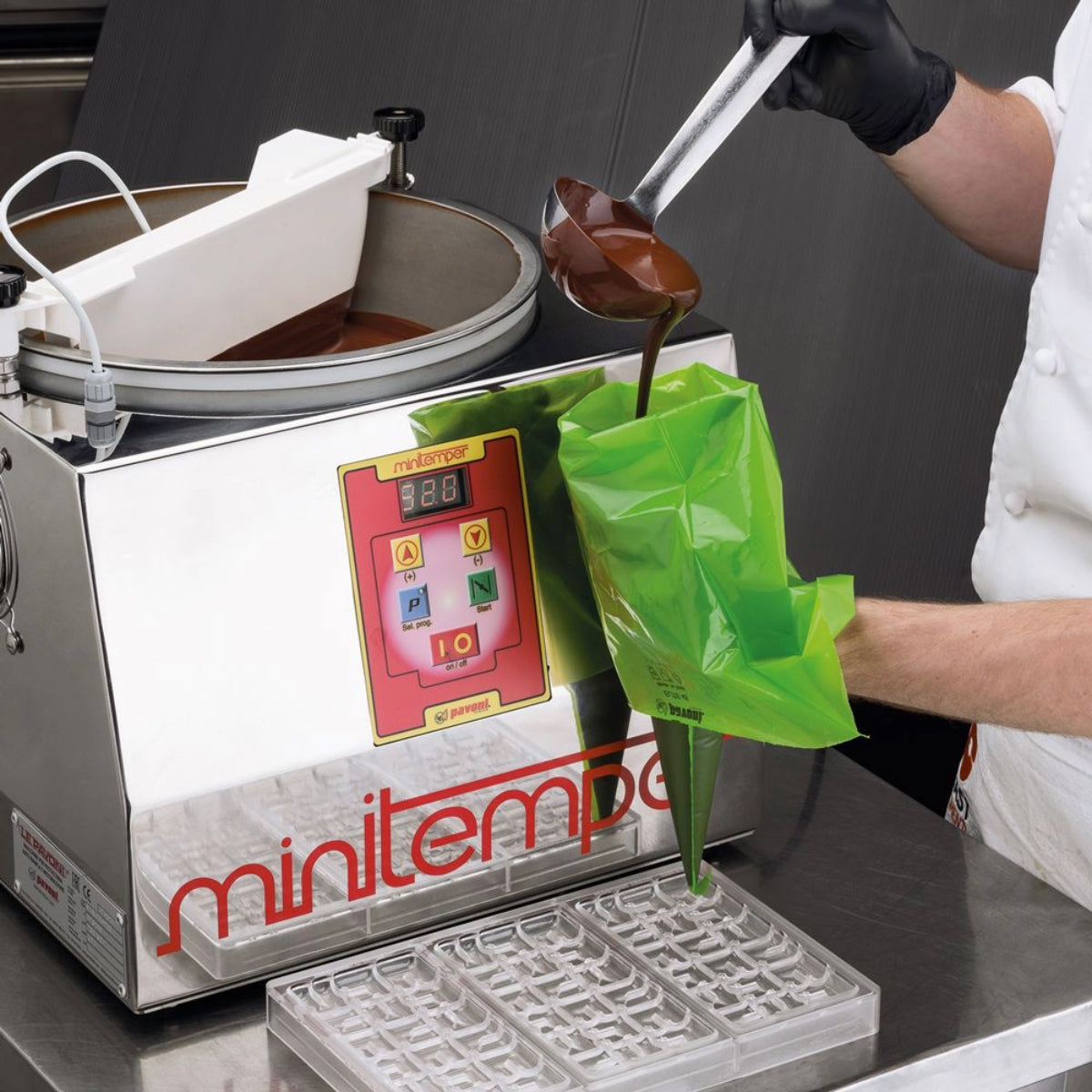
- A tempering machine runs the full melt–cool–work cycle for you, batch after batch.
Chocolate that smells rancid or shows mould does not belong back in production.
How to store chocolate so it lasts
Store chocolate cool, steady, dry, dark and sealed; temperature swings and moisture do more damage than time.
- Temperature: Iowa State University Extension recommends room temperature of 65–70°F (about 18–21°C). For finished chocolates, the food-science review by Lonchampt and Hartel (2004) reports that bloom is held back best at 18°C (64°F) or below, without temperature fluctuations.
- Humidity: below 50–55% relative humidity (Iowa State University Extension). For production rooms, see our guide to humidity for storing chocolate.
- Air and odours: keep chocolate in an airtight container. Cocoa butter picks up the smell of whatever is near it, and oxygen dulls the flavour.
- Light: store in the dark; light, like oxygen, contributes to oxidation, and white chocolate is especially prone to it.
- Fridge: avoid it. Chocolate can absorb odours there and gets a damp surface when it comes back to room temperature, which causes bloom. If heat forces you to refrigerate, wrap it tightly.
- Freezer: chocolate can be frozen for up to a year in an airtight container, but freezing does not really extend its shelf life and the temperature shock can cause bloom. It is a good option for chocolate you will melt or bake with later.
Cacao beans and cocoa products: how they keep
Dried, fermented cacao beans keep well because they are dry: low moisture prevents mould and makes the beans stable for transport and storage (Barišić et al., 2019). The International Cocoa Organization (ICCO) describes drying fermented beans down to about 7.5% moisture, a level suited to storing them.
- Our Sur del Lago cocoa beans are sun-dried to about 5.4% moisture and packed in GrainPro bags; the 1.5 kg bag is $80.00.
- Our Ucayali cacao beans from Peru list a 24-month shelf life in a cool, dry place away from direct sunlight and strong odours; the 1.5 kg bag is $80.00.
Store beans dry, off the floor and away from strong smells, and read each lot's data sheet for its own storage conditions.
For producers: what storage costs you
For a chocolatier or a bakery, storage is a cost line: every bloomed batch is rework, every rancid block is a write-off, and every shift spent re-tempering is labour that did not go into product. A few habits keep that cost down:
- Date every lot on arrival and use the oldest stock first.
- Buy in the format you use before it loses quality; a bigger box only saves money if you finish it in time.
- Log the storage room temperature and humidity so you can trace bloom back to its cause.
- Keep leftovers in the loop: clean, well-stored leftovers and trim can be melted and tempered again instead of thrown away.
| Need | Product | Price |
|---|---|---|
| Re-melt and temper small batches and leftovers | Martellato Meltinchoc Digital 3.6 L (MCD101) | $1,150.00 |
| A machine that runs the whole tempering cycle | Pavoni MiniTemper 110V (3.5 kg) | $3,350.00 |
| Check chocolate temperatures | Martellato digital thermometer 50T001 | $29.95 |
| Single-origin dark couverture | Bassan Sur del Lago 71%, 5 kg bag | $273.00 |
| 100% cocoa liquor for baking and recipes | Natural cocoa liquor wafers, Peru, 1 kg bag | $29.99 |
The Meltinchoc Digital has a PID controller, an integrated probe and three pre-set programs for dark, milk and white chocolate. The MiniTemper holds 3.5 kg and stores five programmable presets of three stages each (melt, crystallise, harden). Martellato table-top melters come with a free spatula.
How AI can help your production
Give an AI assistant your ingredient list with lot numbers, arrival dates and best-before dates, and ask it to build a first-in, first-out stock sheet that flags what to use first each week. Paste your storage-room temperature and humidity log and ask it to point out the days that went outside your limits, so you can match them against bloomed batches. Ask it to turn the storage rules above into a one-page procedure your team signs at each delivery.
AI organises the information; tasting and the final decision stay with your chef.
Chocolate and cacao at Zucchero Canada
We supply chocolatiers, pastry kitchens and bean-to-bar makers across Canada from our Calgary warehouse. Food products ship within Canada only.
- Couverture for moulding, ganache and pastry: Bassan Sur del Lago 71%, made in Canada from Venezuelan cacao, in 1 kg, 5 kg and 20 kg formats; the 5 kg bag is $273.00.
- Inclusions: Venezuelan cacao nibs, 1 kg bag $69.95.
- Making chocolate from the bean: raw cocoa beans from Venezuela and Peru.
- Learning the craft: Chocolate by Ramon Morató (416 pages, tempering, coating and fillings that resist drying and crystallisation), $160.00.
Buying for a production kitchen or a shop? Contact us for volume orders, or call 587-774-8873 (toll free 877-741-8251).
Dark couverture | Chocolate melters | Tempering machines | Chocolate bloom vs mould | Humidity for storing chocolate
This article is for information only. Every business is different: draw your own conclusions based on your own expectations, budget and goals, and talk to qualified experts before you decide or invest.
Sources: Canadian Food Inspection Agency, "Best before, expiration and more: understanding the date labels on your food" (modified 2026-03-25) and "Date markings and storage instructions on food labels" (industry labelling tool); Iowa State University Extension and Outreach, AnswerLine, "Chocolate – Shelf Life, Storage, and Bloom" (M. Geiger, 7 Nov 2023); Province of Manitoba, Agriculture, "Water Activity vs. Water Content"; Lonchampt P. and Hartel R.W., "Fat bloom in chocolate and compound coatings", European Journal of Lipid Science and Technology 106 (2004) 241–274; Barišić V. et al., "The Chemistry behind Chocolate Production", Molecules 24 (2019) 3163; International Cocoa Organization, "Processing Cocoa"; Zucchero Canada product data for Bassan, Canada Cacao Co., Martellato and Pavoni Italia products.







Leave a comment
All comments are moderated before being published.
This site is protected by hCaptcha and the hCaptcha Privacy Policy and Terms of Service apply.