




Short answer: pour leftover melted chocolate into a mould or spread it thin on a silicone mat, let it set, and keep it cool and dry until your next batch; it can be melted and tempered again. If you are still working, a melter keeps it liquid at the temperature you set. Chocolate that melted and set again without tempering may turn grey (bloom), but bloom is not a health risk; re-tempering brings back the gloss.
Quick answer: what to do with it
| Situation | Best move | Product |
|---|---|---|
| You want to reuse it later | Mould it into small bars | Chocolate World bar mould CW1588 $39.95 |
| You want a quick treat now | Spread it thin and make bark | Pavoni SPV43 silicone mat $29.99 |
| You are still dipping or moulding | Keep it liquid in a melter | Digital Meltinchoc 3.6 L $1,150.00 |
| You want it glossy again | Re-temper with a thermometer | Martellato thermometer 50T001 $29.95 |
Can you reuse melted chocolate?
Yes: let it set, then melt and temper it again when you need it. Tempering puts the cocoa butter back into its most desirable crystal form (form V, melting at 29–31.5°C; Barišić et al., 2019), and properly tempered couverture has more sheen and a firmer snap (BCcampus, Understanding Ingredients for the Canadian Baker). The seeding method works well for leftovers:
- Melt the chocolate completely, so that no crystals are left. Pastry chef Ewald Notter melts dark chocolate at 46.1–48.8°C (115–120°F) and milk and white chocolate at 43.3–46.1°C (110–115°F).
- Seed it: add chopped chocolate that has already set. It carries stable crystals, and gentle stirring makes them multiply (Notter, The Art of the Chocolatier).
- Keep stirring until the chocolate reaches the working temperature on its datasheet.
Check the datasheet of your chocolate: our 55% Venezuelan dark chocolate, for example, gives melt 45–50°C (113–122°F), crystallisation 28–29°C (82–84°F) and tempering 31–32°C (88–90°F). Tempering is worth it: well-tempered chocolate has a high gloss and resists fat bloom, while under-tempered chocolate can bloom in less than two days (Lonchampt and Hartel, 2004). For the full method, read our guide to tempering chocolate.
8 ideas for leftover melted chocolate
The best use depends on whether the chocolate is still tempered and how much you have. These ideas go from "use it now" to "save it for later".
1. Mould it into small bars for later
Pour it into a bar mould, let it set and demould: you get clean, weighed pieces that are easy to remelt. The CW1588 makes 9 bars of 12 g (108 g per mould); the CW1366 makes 5 bars of 41 g (205 g per mould).
2. Bark with cacao nibs
Spread the chocolate thin on a non-stick silicone mat, scatter Venezuelan cacao nibs on top, let it set and break it into pieces.
3. Gianduja
Chocolate World publishes a gianduja by chef Jessica Pedemont that uses 220 g of liquid tempered dark chocolate (55–70%) with 280 g of nut paste and 5 g of fine sea salt (plus 5 g ground spice, optional): mix, pipe into moulds, tap, let it fully crystallise and demould. It is a good home for leftover dark chocolate. The full recipe is in our easiest homemade chocolate recipes.
4. Dip fruit, biscuits or pretzels
If the chocolate is still fluid, use it straight away for dipping. Our guide to melting chocolate for dipping covers the technique.
5. Chocolate spoons
Small quantities are enough for chocolate spoons to stir into hot milk. See how to make chocolate spoons with a mould.
6. Truffles
Leftover dark chocolate can go into a ganache for truffles; read what is a chocolate truffle for the basics.
7. Bake it into brownies or cake
Melted chocolate is already the first step of many brownie and cake recipes, so weigh what you have and use it in the next bake. Our guide to the best chocolate for brownies explains which chocolate to use.
8. Hot chocolate
Dark chocolate works in drinks too: the datasheet of our 55% Venezuelan dark chocolate lists hot chocolate among its recommended uses.
View Chocolate World chocolate moulds →
How to store leftover melted chocolate
Let it set in a thin layer or in a mould, then keep it cool, dry and at a steady temperature, wrapped or in a closed container. Bloom can come from poor tempering and from storage in warm or humid conditions (Heuler et al., 2020). As a reference for set chocolate, Understanding Ingredients for the Canadian Baker (BCcampus) gives up to a year at 18–20°C (64–68°F) and 60% relative humidity as the ideal storage, away from odours and humidity, and notes that the refrigerator is not the ideal place. In a storage study (Machálková et al., 2014), chocolate products kept at 6°C (43°F) and 12°C (54°F) showed no deterioration after ten weeks; at 20°C (68°F) some developed fat bloom, and at 30°C (86°F) all deteriorated.
| Storage temperature | What the study found after ten weeks |
|---|---|
| 6°C (43°F) and 12°C (54°F) | No deterioration in appearance or taste |
| 20°C (68°F) | Fat bloom on some products |
| 30°C (86°F) | Clear deterioration of all products |
Can you freeze melted chocolate?
We have not found a supplier or official source that gives a freezer shelf life for chocolate, so we do not give one. What the sources do explain is the risk: when moisture condenses on the surface of chocolate, it dissolves sugar that then recrystallises as white sugar bloom (Barišić et al., 2019). If you chill or freeze chocolate, keep it sealed so moisture cannot settle on it. For storage in general, read does chocolate go bad?
Is chocolate that melted and set again safe to eat?
Bloom is a quality problem, not a safety one: in the words of the storage study, grey chocolate "does not constitute a threat to the public or consumer health", but it is less attractive (Machálková et al., 2014). Chocolate that melted and set again without tempering may lose its gloss and turn grey or streaky, because cocoa butter recrystallises at the surface when chocolate is heated (Heuler et al., 2020). Melting and re-tempering it fixes the look. If you are not sure whether you are looking at bloom or mould, read chocolate bloom vs. mold.
How to keep melted chocolate liquid
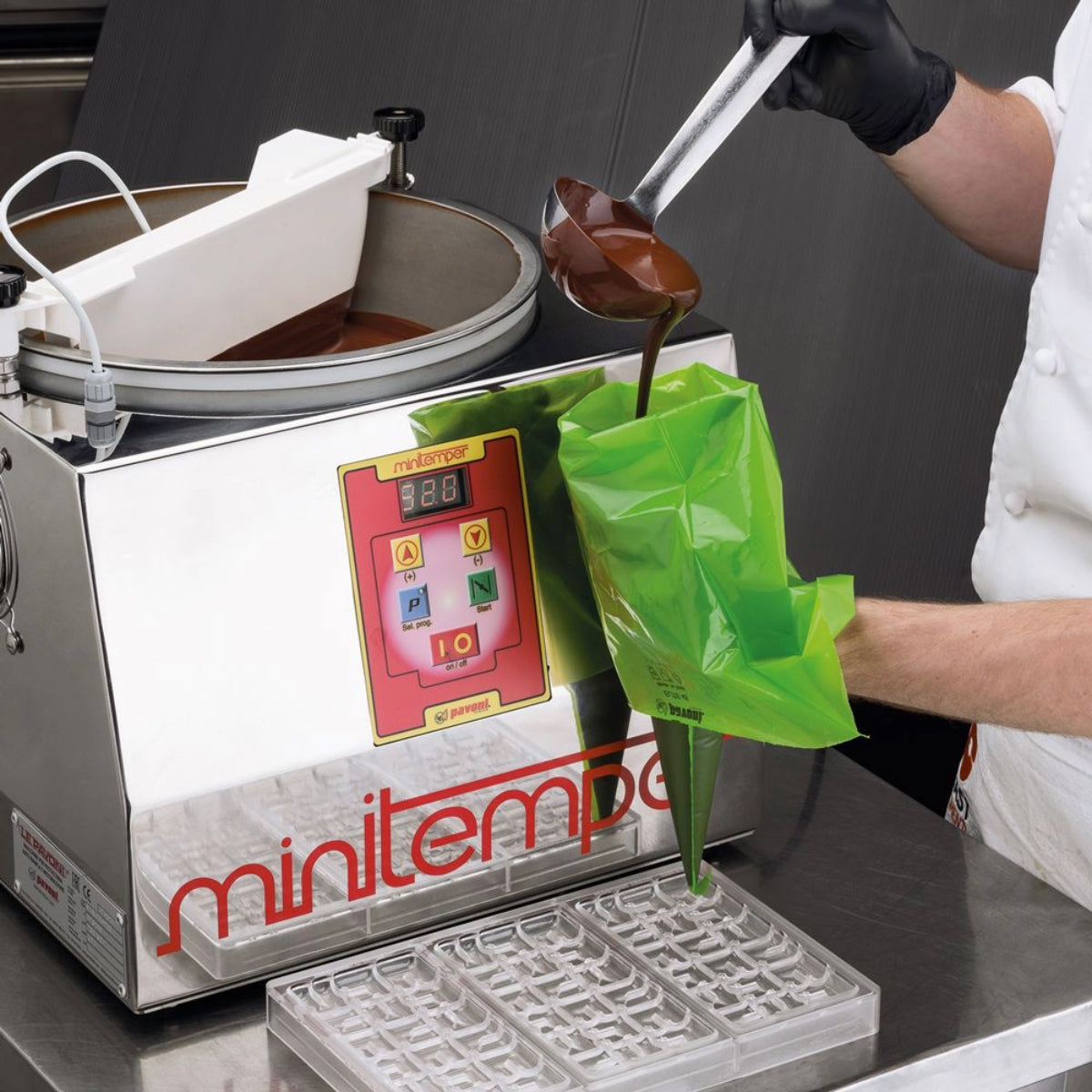
A melter holds the chocolate at the temperature you set, so it stays liquid while you work. The analogue Meltinchoc models we sell work with a manual thermostat; the Digital Meltinchoc adds PID temperature control, an integrated probe and pre-set programs for dark, milk and white. Each Meltinchoc has its own job:
- Mini Meltinchoc 1.8 L → $390.00. Small batches, manual thermostat up to 50°C.
- Deep Meltinchoc 1.7 L → $669.00. A deep round bowl for dipping items on a stick.
- Meltinchoc Multi-Tank 2 × 1.5 L → $865.00. Two independent tanks, so dark and milk stay at their own temperatures.
- Digital Meltinchoc 3.6 L → $1,150.00. PID control, integrated probe and programs for dark, milk and white.
Leftovers in a professional kitchen
In production, leftover chocolate is stock, not waste. Set it in weighed bars, label each tray with the chocolate and the date, keep dark, milk and white apart, and plan to use it first in the next batch of the same chocolate. Bloom on stored chocolate is a quality issue, not a safety one, and re-tempering restores the gloss, so stored leftovers can be melted, tempered and used again. When you top up a batch, use the same chocolate you started with, for example our 55% Venezuelan dark chocolate ($299.00, 10 kg) or our organic 70% dark chocolate chips ($45.95, 1 kg).
How AI can help your production
Keep a simple log of leftover chocolate (type, weight, date, tempered or not) and ask an AI assistant to turn it into a weekly plan: which batch uses which leftovers first, how much fresh chocolate to add, and which products (bark, gianduja, brownies) absorb the rest. It can also write a one-page procedure for setting, labelling and storing leftovers, with the tempering temperatures from your chocolate's datasheet.
AI organises the information; tasting and the final decision stay with your chef.
Melters, moulds and chocolate at Zucchero Canada
We supply chocolatiers, pastry kitchens and home makers across Canada from Calgary. For leftover chocolate, each product has a clear job: Chocolate World polycarbonate moulds to set leftovers in clean bars; Pavoni SPV silicone mats for thin layers and bark; Martellato Meltinchoc melters to keep chocolate liquid while you work; a Martellato thermometer to re-temper by hand. Moulds, mats and thermometers count toward free shipping within Canada on eligible orders; chocolate and machines such as melters are excluded (details in the FAQ). Running a production kitchen? Contact our team about volume orders.
Chocolate melters | Chocolate World moulds | Silicone baking mats | How to temper chocolate | Does chocolate go bad?
This article is for information only. Every business is different: draw your own conclusions based on your own expectations, budget and goals, and talk to qualified experts before you decide or invest.
Sources: E. Notter, The Art of the Chocolatier (Wiley, 2011), "The Seeding Method"; BC Cook Articulation Committee, Understanding Ingredients for the Canadian Baker (BCcampus), chapter 7; Lonchampt P. and Hartel R.W., "Fat bloom in chocolate and compound coatings", Eur. J. Lipid Sci. Technol. 106 (2004) 241–274; Chocolate World Moulds catalogue, Edition 15 (gianduja recipe by Jessica Pedemont; CW1588 and CW1366 cavity data); Zucchero Canada product datasheets (55% Venezuelan dark chocolate, Meltinchoc melters, Pavoni SPV mats, cacao nibs, organic 70% chips); Machálková L. et al., "The effect of storage temperature and production method of chocolate confectionery on changes in its quality", MendelNet 2014; Barišić V. et al., "The Chemistry behind Chocolate Production", Molecules 24 (2019) 3163; Heuler J. et al., "Point-of-care detection, characterization, and removal of chocolate bloom using a handheld Raman spectrometer", Scientific Reports 10 (2020) 9833.







Leave a comment
All comments are moderated before being published.
This site is protected by hCaptcha and the hCaptcha Privacy Policy and Terms of Service apply.