

How to Melt Chocolate Chips for Dipping: Microwave, Double Boiler or Melter
Short answer: to melt chocolate chips for dipping, put them in a completely dry bowl and heat them gently, in a microwave in short rounds with a stir between each, or over a double boiler kept away from steam, and stop before the last pieces melt: the heat keeps rising after you stop. Check the temperature and never go above the maker's maximum (50°C / 122°F for the Bassan 71% couverture we stock). Melted chips that are not tempered can set soft, dull or streaky, so for dipped strawberries or pretzels that must set glossy at room temperature, temper the chocolate, by hand or with a melter that guides the seeding and holds the working temperature for you.
| Your need | What we recommend | Price |
|---|---|---|
| Chips that melt smoothly for dipping fruit | Organic Dark Chocolate Chips 70%, 1 kg | $45.95 |
| Checking the temperature as you melt | Martellato digital thermometer for chocolate 50T001 | $29.95 |
| Dipping cleanly, piece after piece | Martellato dipping fork set, 10 pieces | $69.50 |
| Holding melted chocolate for small batches | Martellato Mini Meltinchoc 1.8 L, silver | $390.00 |
| Melting, seeding and holding at tempering temperature | Martellato Digital Meltinchoc 3.6 L | $1,150.00 |
Which chocolate chips work for dipping?
Chips made with cocoa butter can be melted for dipping, but many chips are designed to hold their shape in the oven, so check the ingredient list before you buy.
- Baking chips: according to Understanding Ingredients for the Canadian Baker (BCcampus), chips and chunks are developed to be more heat stable so they stay whole in cookies, and some have another fat substituted for the cocoa butter.
- Couverture: the same textbook describes couverture as chocolate with extra cocoa butter, used by professionals for dipping, coating, moulding and garnishing.
- Compound coating ("candy melts"): usually made with another fat instead of cocoa butter, so it needs no tempering; it melts at about 35–37°C (95–99°F), coats best at about 40°C (104°F), and heating it to 50°C (122°F) or more can reduce its viscosity.
Our Organic Dark Chocolate Chips 70% are made from organic cocoa mass, cane sugar, cocoa butter and natural cocoa powder, and the product data lists them for coating fruit and dipping. For a full comparison of chocolates for melting, read what chocolate is best for melting and dipping.
Before you start: keep everything dry
Even a little water can turn melting chocolate thick and grainy, so the bowl, spatula and anything you dip must be completely dry.
Moisture makes the sugar particles in chocolate stick together into gritty lumps and raises its viscosity (Afoakwa et al., 2007). KREA Swiss lists condensation, high humidity, a bowl that is not fully dry and steam off a bain-marie among the common causes of failed chocolate work. Dry washed strawberries thoroughly before dipping.
How to melt chocolate chips in the microwave
The microwave is the quickest method for small amounts, but its heat is uneven, so melt in short rounds and stir between each one.
- Put the chips in a dry, microwave-safe bowl.
- Heat briefly, then stir well, even if the chips still look whole; stirring spreads the heat from the hot spots.
- Repeat with short rounds and stir each time.
- Stop while a few pieces are still solid and stir until they melt: the chocolate keeps warming after the heat stops.
- Check with a thermometer and stay below the maker's maximum (50°C / 122°F for Bassan 71%).
KREA Swiss warns that microwave heating is uneven and can add moisture, and that the chocolate keeps climbing past your target after you stop heating. That is why short rounds and a thermometer matter more than a fixed time: every microwave and every bowl is different.
How to melt chocolate chips with a double boiler
A double boiler (bain-marie) gives gentler heat than the microwave, as long as no steam or water reaches the chocolate.
- Choose a dry, heatproof bowl that fits snugly on the pan, so steam cannot rise around it into the chocolate.
- Heat the water gently, add the chips to the dry bowl and stir as they melt.
- Take the bowl off the pan before everything has melted and finish by stirring.
- Wipe the bottom of the bowl when you lift it, so no water drips into the chocolate.
Steam is the main risk: KREA Swiss names steam off a bain-marie as one way moisture gets into chocolate. For a side-by-side comparison of both methods, see double boiler vs microwave melting.
Melted is not tempered: what that means for dipping
Melted chocolate that is not tempered can set soft, dull or streaky; for a glossy coating with a clean snap, the chocolate must be tempered.
KREA Swiss explains it this way: cocoa butter can set in six crystal forms, and only Form V (beta-5) gives gloss, snap and a long shelf life. Tempering means melting the chocolate, seeding and cooling it so beta-5 forms, rewarming it to working temperature and holding it there. If the chocolate is already tempered and you only warm it to working temperature, taking it much above about 34°C (93°F) destroys the stable crystals. Badly tempered chocolate may look fine at first and develop grey bloom weeks later.
| Published working figures | Melt | Work at |
|---|---|---|
| Bassan Sur del Lago 71% dark (product sheet) | 50°C (122°F) maximum | 30–32°C (86–90°F) |
| Martellato Digital Meltinchoc, dark program | 45°C (113°F), then seed | 31°C (88°F) |
| Martellato Digital Meltinchoc, milk program | 45°C (113°F), then seed | 29°C (84°F) |
| Martellato Digital Meltinchoc, white program | 45°C (113°F), then seed | 28°C (82°F) |
Recipes differ, so KREA's advice is to follow the maker's figures for your chocolate. Bassan's sheet also asks you to let the 71% crystallise at 16–18°C (61–64°F) and to use it within 4 hours of tempering. For the full method, read how to temper chocolate.
Too thick, grainy or burnt: quick fixes
Most dipping problems come from heat, moisture or over-crystallisation, and each one has a different fix.
- Too thick to dip: it may be cooling and over-crystallising; KREA notes that stirring too fast or too long makes tempered chocolate thick and stiff. Our guide on how to make melted chocolate thinner explains the options, including adding cocoa butter.
- Thick and grainy after water or steam got in: the chocolate has seized. See how to fix overheated and seized chocolate.
- Overheated: keep a thermometer in the bowl and stay below the maker's maximum; the same guide covers what you can still save.
Dipping strawberries, pretzels and other treats
Dip completely dry items into chocolate held at its working temperature, let the excess drip off, and set them on parchment in a cool room.
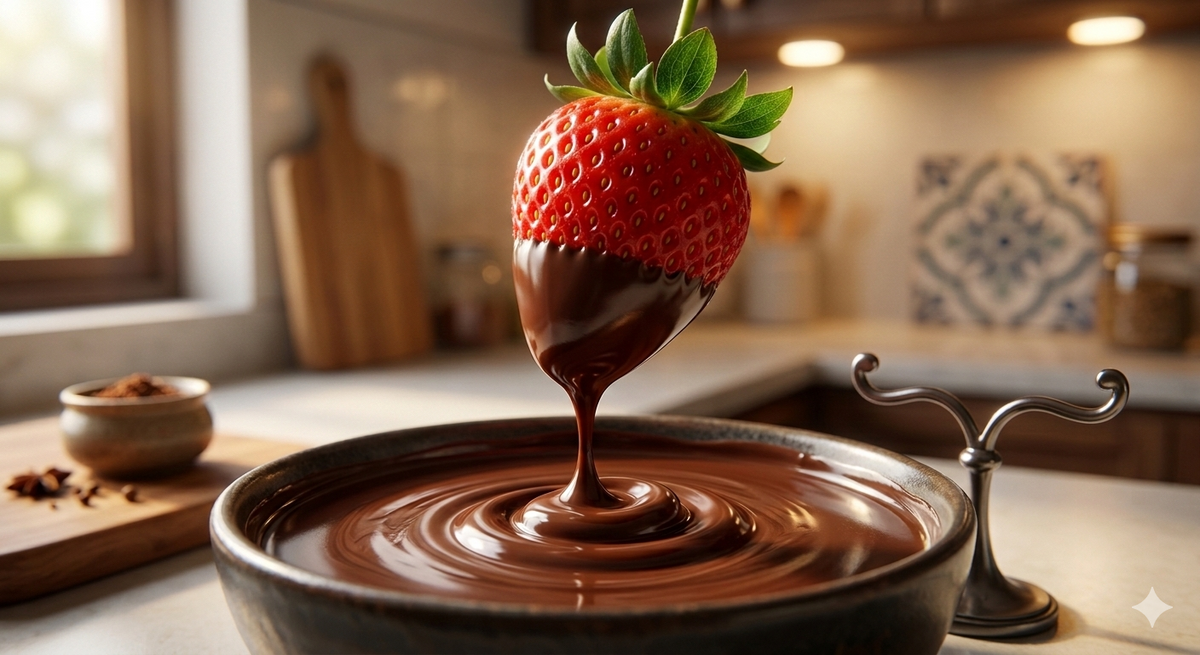
- Fruit: hold strawberries by the leaves, dip, lift and let the excess fall back into the bowl. For which chocolate to choose, read the best chocolate for chocolate-covered strawberries.
- Pretzels, biscuits, truffles and bonbons: a dipping fork lets you coat the whole piece, lift it and tap off the excess before you set it down. Martellato's set has 10 stainless-steel forks, 18.5 cm long. Our guide on how to use chocolate dipping tools shows the technique.
- Setting: let the pieces crystallise in a cool room. Bassan's sheet gives 16–18°C (61–64°F) for its 71%, and storage at 16–20°C below 50% relative humidity.
View chocolate dipping forks →
Colour and decoration for dipped treats
To colour chocolate, use fat-soluble colours, which dissolve in cocoa butter; water-based colours bring in the moisture that makes chocolate grainy.
- Coloured chocolate: Pavoni Italia's Chocolart fat-soluble powders dissolve in cocoa butter for colour in chocolate masses and glazes. View the white fat-soluble powder → $46.99 CAD
- Metallic finish: Pavoni's Brilliant Gold powder can be brushed dry on set chocolate or dissolved in food-grade alcohol for painting. View Brilliant Gold → $56.99 CAD
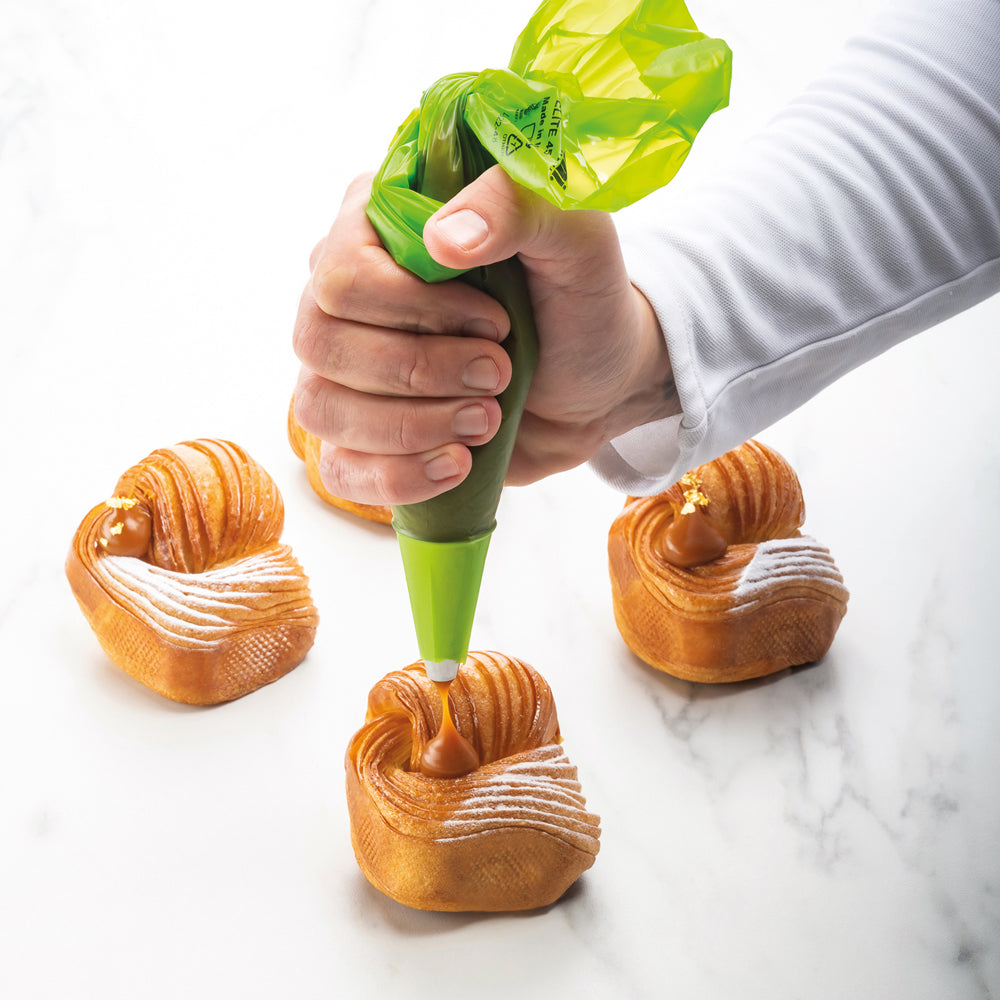
- Drizzles: Martellato GreenPoche disposable piping bags have a multilayer structure and a grip coating. View GreenPoche bags → from $7.95 CAD
- Patterns: Pavoni transfer sheets such as Pearly Gold (340 × 265 mm, box of 30) work with dark, milk or white chocolate.
View chocolate transfer sheets → View fat-soluble colours →
For colouring compound coatings, see can you add food colouring to candy melts?
When to move from a bowl to a melter
Once you dip more than a few hundred grams at a time, or need the chocolate ready for hours, a melter that holds a set temperature saves time and chocolate.
KREA Swiss notes that by hand, past roughly 500 g, passive cooling cannot bring the chocolate down to the ~26°C (79°F) that tempering needs, which is why hand tempering does not scale. Each Martellato melter below has a different job:
| Model | Capacity | Best for | Price |
|---|---|---|---|
| Mini Meltinchoc MC09 | 1.8 L | Small batches of pralines and dipping; dry heat, manual thermostat up to 50°C | $390.00 |
| Deep Meltinchoc MC10 | 1.7 L | Dipping on a stick (ice cream bars, parfaits): a deep round bowl | $669.00 |
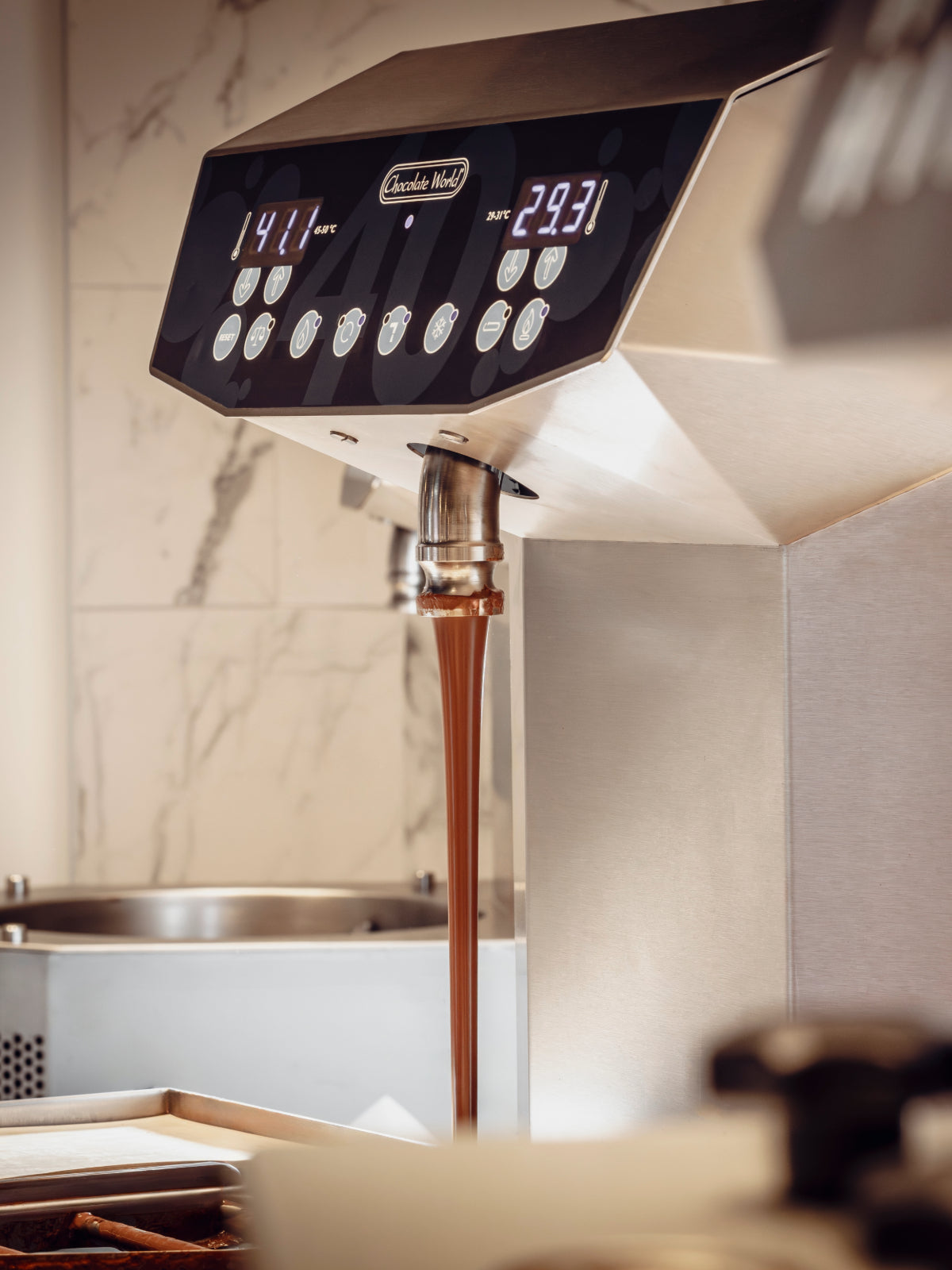
| Digital Meltinchoc MCD101 | 3.6 L | Tempered dipping: melts to 45°C, signals when to seed, then holds 31 / 29 / 28°C for dark, milk or white | $1,150.00 |
All three run on 110V and come with a 145 mm professional scraper: it is the free spatula included with every Martellato table-top melter. For larger tanks and other brands, see the full collection.
How AI can help your production
Paste your chocolate's technical sheet into an AI assistant and ask it to write a one-page dipping procedure for your team: melting limit, seeding, working temperature, setting room temperature and how long the chocolate stays in use. Ask it to build a shift log (time, chocolate temperature, temper test, notes on gloss) and to estimate how much chocolate each dipped product uses, so you know how many kilograms to order for a holiday rush of chocolate-covered strawberries.
AI organises the information; tasting and the final decision stay with your chef.
Dipping chocolate and tools at Zucchero Canada
We are an authorized distributor of Martellato and Pavoni Italia, and we stock chocolate, melters and tools for chocolatiers, pastry chefs and serious home bakers across Canada. Choose by job: organic 70% chips or Bassan Sur del Lago 71% couverture (5 kg bag $273.00 CAD) for the chocolate, a thermometer and dipping forks for hand work, a Mini or Deep Meltinchoc to hold chocolate through a session, and the Digital Meltinchoc when tempered dipping becomes daily work. For a complete reference on tempering and coating, Ramon Morató's Chocolate, 6th edition (416 pages, 200 recipes) is on our shelf: $160.00 CAD.
Buying for a chocolate shop, bakery or catering business? Contact our team for volume orders and equipment advice, write to sales@zuccherocanada.ca or call 587-774-8873 (toll free 877-741-8251).
Chocolate melters | Dipping forks | Transfer sheets | Best chocolate for melting | Make melted chocolate thinner
This article is for information only. Every business is different: draw your own conclusions based on your own expectations, budget and goals, and talk to qualified experts before you decide or invest.
Sources: BC Cook Articulation Committee, Understanding Ingredients for the Canadian Baker (BCcampus, CC BY 4.0), §7.3 "Compound Chocolate", §7.4 "Couverture" and §7.7 "Chips, Chunks, and Other Baking Products"; KREA Swiss Knowledge, "Tempering, what it really is and where it goes wrong" (kreaswiss.com); Afoakwa E. O., Paterson A. and Fowler M., "Factors influencing rheological and textural qualities in chocolate – a review", Trends in Food Science & Technology 18(6):290–298, 2007; Martellato, Digital Meltinchoc use and maintenance handbook (programs and directions for use); product data for Bassan Sur del Lago 71%, Organic Dark Chocolate Chips 70%, Martellato Meltinchoc melters, dipping forks, thermometer and GreenPoche bags, Pavoni Italia colours and transfer sheets, and Chocolate by Ramon Morató (zuccherocanada.ca).
Good to know
Frequently asked questions
How do you melt chocolate chips for dipping?
Put the chips in a completely dry bowl and melt them gently: in the microwave in short rounds, stirring between each, or over a double boiler kept away from steam. Stop while a few pieces are still solid and stir until smooth, because the chocolate keeps warming after you stop. Check with a thermometer and stay below the maker's maximum (50°C / 122°F for Bassan 71% couverture).
Is it better to melt chocolate chips in the microwave or a double boiler?
Both work for small amounts if you keep the chocolate dry and the heat gentle. The microwave is faster but heats unevenly, so it needs short rounds and frequent stirring; the double boiler is gentler, but steam must not reach the chocolate. KREA Swiss names both microwave and water-based melting as common ways moisture gets into chocolate, so a dry bowl and a thermometer matter more than the method.
Why did my melted chocolate chips get thick and grainy?
Usually because water or steam got into the chocolate, or it was overheated. Moisture makes the sugar particles stick together into gritty lumps (Afoakwa et al., 2007). Chocolate that thickens slowly while you work may instead be cooling and over-crystallising. Our guide to fixing overheated and seized chocolate explains what can be saved.
Will melted chocolate chips harden after dipping?
They will set, but if the chocolate was not tempered it can set soft, dull or streaky and bloom later. For a glossy coating with a snap at room temperature, temper the chocolate: melt, seed, cool and hold it at the working temperature on its technical sheet (30–32°C / 86–90°F for Bassan 71%). Compound coatings (candy melts) need no tempering.
Can I add food colouring to melted chocolate chips?
Use fat-soluble colours, which dissolve in cocoa butter, such as Pavoni Italia's Chocolart fat-soluble powders. Water-based colours bring in moisture, which makes chocolate thick and grainy.
Do chocolate melters qualify for free shipping?
Machines, including melters, are excluded from our free shipping on orders of $300 CAD or more, and so are chocolate and cacao. Orders over $500 CAD get 5% off automatically at checkout, and every Martellato, Mol d'Art and Bilait table-top melter comes with a free spatula.
Shop this article
Products mentioned in this guide
 Canada Cacao Co.Organic Dark Chocolate Chips 70% Cacao 1 kg$45.95 CADView product →
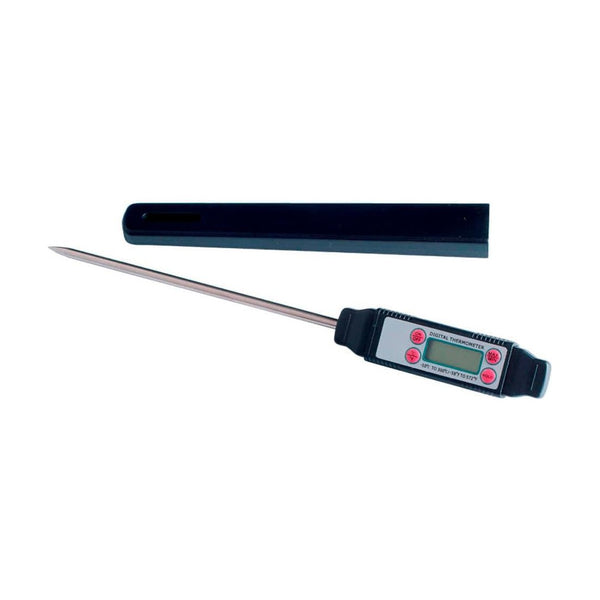 MartellatoDigital Thermometer for Chocolate 50T001$29.95 CADView product →
 MartellatoDipping Fork Set - 10 Pcs – CHOCOFORK$69.50 CADView product →
 Martellato"Mini Meltinchoc" Chocolate Melter 1.8 L – MC09GUSAFrom $390.00 CADView product →
For professionals
Equipping a chocolate shop, bakery or kitchen?
Tell us what you produce and how much. We will recommend the right machine, moulds and ingredients, and send you a quote.
For home bakers
Professional tools for your own kitchen
The same European moulds, tools and ingredients the professionals use.
5% off orders over $500 CAD, applied automatically at checkout.
Keep reading

Leave a comment
All comments are moderated before being published.
This site is protected by hCaptcha and the hCaptcha Privacy Policy and Terms of Service apply.