
How Much Caffeine Is in Chocolate Covered Coffee Beans? Per Bean and per Serving
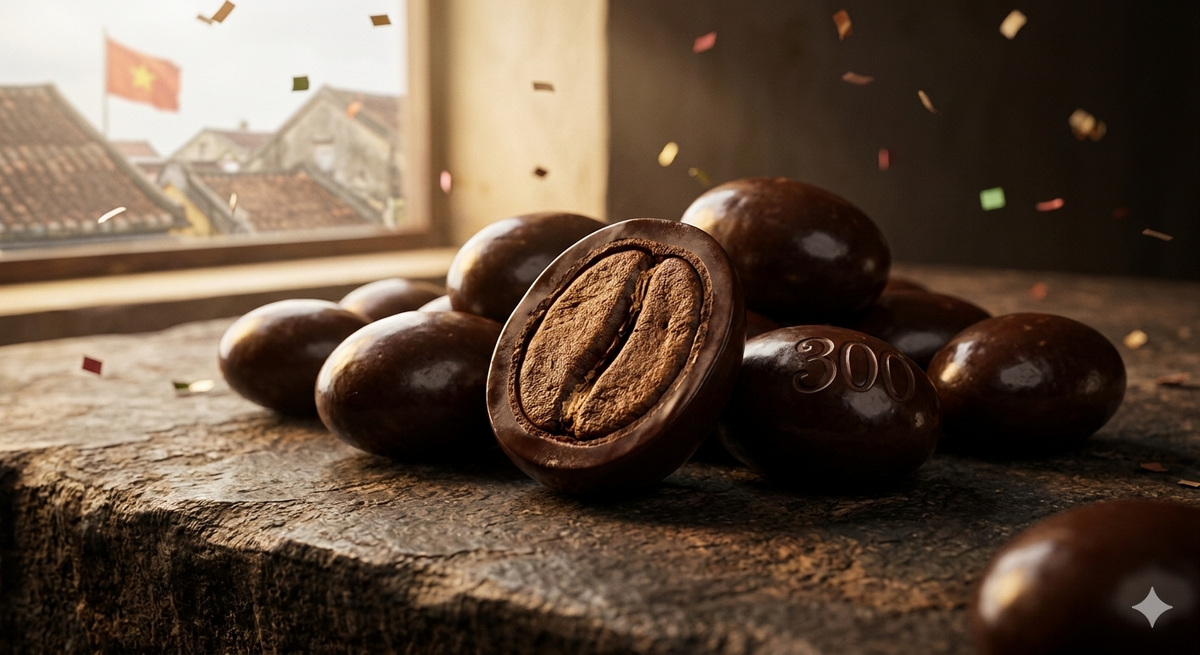
Short answer: about 12 mg of caffeine per bean. USDA FoodData Central lists dark-chocolate-coated coffee beans at 839 mg of caffeine per 100 g, with a 40 g serving of 28 pieces: that works out to about 336 mg per serving and about 12 mg per piece. At that rate, Health Canada's maximum for adults, 400 mg a day, is reached at about 33 pieces.
This article is for general information only and is not medical or nutritional advice. Always consult your doctor, pharmacist or a registered dietitian about your own situation, especially during pregnancy or breastfeeding, or if you have diabetes, allergies or a medical condition.
Caffeine per chocolate covered coffee bean
One dark chocolate covered coffee bean has about 12 mg of caffeine by USDA's figures, and an ounce of the milk chocolate version has about 227 mg.
| Product | Serving | Caffeine | Theobromine |
|---|---|---|---|
| Dark chocolate coated coffee beans | 1 piece (about 1.4 g) | about 12 mg* | about 5 mg* |
| Dark chocolate coated coffee beans | 28 pieces (40 g) | about 336 mg* | about 147 mg* |
| Dark chocolate coated coffee beans | 1 oz (28.35 g) | about 238 mg* | about 104 mg* |
| Milk chocolate coated coffee beans | 1 oz (28.35 g) | about 227 mg* | about 50 mg* |
*Calculated by us from USDA's values per 100 g: 839 mg caffeine and 368 mg theobromine for dark chocolate coated coffee beans (serving of 28 pieces = 40 g), 800 mg caffeine and 178 mg theobromine for milk chocolate coated coffee beans.
Read these as estimates, not lab results. USDA built the dark chocolate entry from a product's ingredient list and label claim, and the milk chocolate entry from approximate recipe proportions. The caffeine in the bag you buy depends on its recipe, so check the label when it gives a figure.
Almost all of that caffeine comes from the coffee. USDA lists dark chocolate (70–85% cacao) at 80 mg of caffeine per 100 g, so even if a whole 1.4 g piece were dark chocolate it would carry only about 1 mg. The rest of the 12 mg is the roasted bean.
How many chocolate covered coffee beans equal a cup of coffee?
About 8 dark chocolate covered coffee beans match an 8 fl oz cup of brewed coffee by USDA's figures, and about 11 match Health Canada's 135 mg average for the same cup.
| Food or drink | Serving | Caffeine | Same caffeine as |
|---|---|---|---|
| Brewed coffee (USDA) | 8 fl oz (237 ml) | about 95 mg | about 8 beans* |
| Brewed coffee (Health Canada) | 8 oz (237 ml) | 135 mg (average) | about 11 beans* |
| Espresso (USDA) | 1 fl oz | about 63 mg | about 5 beans* |
| Black or green tea, brewed (Health Canada) | 8 oz (237 ml) | 30–50 mg | about 2½–4 beans* |
| Dark chocolate, 70–85% cacao (USDA) | 1 oz (28.35 g) | about 23 mg | about 2 beans* |
| Milk chocolate candy (Health Canada) | 1 oz (28 g) | 7 mg (average) | less than 1 bean* |
*Calculated by us at about 12 mg per dark chocolate covered coffee bean. USDA coffee, espresso and dark chocolate values are calculated from USDA's figures per 100 g, as in our article on caffeine in dark chocolate vs coffee.
The difference is speed and volume: a handful of beans is eaten in a minute, while a cup of coffee is a drink you notice. Count the pieces if you are watching your caffeine.
How many chocolate covered coffee beans can you eat? Health Canada's limits
Health Canada recommends a maximum of 400 mg of caffeine a day for adults, 300 mg for people who are planning to become pregnant, pregnant or breastfeeding, and 2.5 mg per kg of body weight for children and adolescents.
| Group | Health Canada maximum per day | About the same as |
|---|---|---|
| Adults (18 years and over) | 400 mg | 33 dark chocolate covered coffee beans* |
| Planning a pregnancy, pregnant or breastfeeding | 300 mg | 25 beans* |
| Children and adolescents (up to 18 years) | 2.5 mg per kg of body weight | a 30 kg (66 lb) child: 75 mg, about 6 beans* |
*Calculated by us at about 12 mg per bean; the 30 kg child is only an example.
These counts assume the beans are the only caffeine you have that day. Coffee, tea and chocolate contain caffeine too, as the table above shows, so their caffeine adds to the beans'. If you have been told to limit caffeine, or if you are pregnant or breastfeeding, ask your doctor or pharmacist how they fit in. Our articles on chocolate during pregnancy and chocolate while breastfeeding cover those questions separately.
Does the roast or the type of coffee change the caffeine?
The coffee species matters more than the roast, according to a laboratory study.
Researchers roasted Arabica and Robusta beans at 220 ± 10°C (428 ± 18°F) for 7, 9 and 11 minutes and analysed the drinks made from them. The caffeine content did not vary with roasting time, while caffeine was one of the measures that separated the two species (Bicho et al., International Journal of Food Sciences and Nutrition, 2011). In practice, a darker roast is not a reliable way to get less caffeine; the beans themselves decide it.
Calories and sugar in chocolate covered coffee beans
A 40 g serving of 28 dark chocolate covered coffee beans has about 216 calories and 17 g of sugars, by USDA's figures.
These are calculated by us from USDA's values per 100 g: 540 kcal, 42.5 g total sugars and 30 g fat. That makes about 8 calories per piece. As with caffeine, the label of the product you buy is the figure to trust.
For producers: how chocolate covered coffee beans are made
Chocolate covered coffee beans are made by panning: the beans tumble in a rotating bowl while tempered chocolate is added little by little, and cool air sets each layer until the coating reaches the thickness you want.
That is how Chocolate World describes the process for its panning machines, which it builds for coating nuts, coffee beans and dried fruit. For a first test batch, coffee beans can also be dipped by hand with a dipping fork, one by one.
| Your production | Product | Price |
|---|---|---|
| Test batches by hand | Martellato dipping fork set, 10 pieces | $69.50 CAD |
| Small to medium batches on a 110 V outlet | Chocolate World panning machine, 7 L, 110 V | $10,775.00 CAD |
| Medium-scale batches on a 110 V outlet | Chocolate World panning machine, 16 L, 110 V | $12,995.00 CAD |
| Tabletop panning with hot and cold air, 240 V | Pomati Bassina Mini, 4.5 kg drum | $14,550.00 CAD |
| Larger batches with hot and cold air, 240 V | Pomati Bassina, 16 kg drum | $21,450.00 CAD |
Which machine fits which kitchen. The two Chocolate World machines run on 110 V single-phase, the standard North American supply, with variable speed and a fan that blows cooling air through a removable silicone tube; choose 7 L or 16 L by batch size. The two Pomati Bassina machines run on 240 V and have an integrated heat pump that supplies both hot and cold air, a touch-screen panel and drum speed adjustable from 10 to 60 rpm; the Mini takes 4.5 kg per cycle and the Bassina 8 or 16 kg batches.
View chocolate panning and coating machines →
The chocolate for the coating
Use a couverture you can temper and hold at a steady working temperature:
- Bassan Sur del Lago 71%, 5 kg bag → $273.00 CAD. Made in Canada from Venezuelan Trinitario cacao with ancestral Criollo lineage; working temperature 30–32°C (86–90°F), crystallisation at 16–18°C (61–64°F), fluidity 4 on Bassan's 5-point scale.
- FCH 55% dark chocolate minibars, 10 kg box → $299.00 CAD. 100% Venezuelan Trinitario cacao; melt at 45–50°C (113–122°F), crystallise at 28–29°C (82–84°F), work at 31–32°C (88–90°F).
The coffee look without the caffeine
If you want the shape of a coffee bean without any coffee, mould it in chocolate. The Chocolate World CW1281 coffee bean mould (from $39.95 CAD) has 104 cavities of about 1 g each. A 1 g piece of 70–85% dark chocolate carries about 0.8 mg of caffeine by USDA's figure (80 mg per 100 g), roughly a fifteenth of a real chocolate covered coffee bean.
If you sell either product and want to state its caffeine, use a lab analysis or a calculation from your suppliers' data, and call it an estimate unless it comes from a lab.
How AI can help your production
Give an AI assistant the caffeine figure your coffee roaster provides, the weight of your beans before and after panning, and the cacao content of your couverture. Ask it to estimate the caffeine per piece and per bag, and to show how the number changes if you build a thicker coating or switch beans. It can also turn your panning steps into a written routine for each batch: load weight, chocolate added per pass, drum speed and setting time.
AI organises the information; tasting and the final decision stay with your chef.
Panning equipment and couverture at Zucchero Canada
Zucchero Canada is an authorized distributor of Chocolate World and Pomati machines and of Martellato tools. Bassan Sur del Lago 71% is made in Canada and ships across Canada from Calgary; the Chocolate World panning machines ship across Canada by freight. The product pages list voltage, power and drum capacity, so you can check your electrical supply before you order.
Orders over $500 CAD get 5% off automatically at checkout. Chocolate and machines are not part of our free shipping offer, and food products ship within Canada only. Buying couverture by the case or equipping a production room? Contact us or call 587-774-8873 (toll free 877-741-8251).
Panning & coating machines | Dark couverture | Dipping forks | Caffeine in dark chocolate vs coffee | Does dark chocolate have caffeine? | Cocoa vs coffee
This article is for information only. Every business is different: draw your own conclusions based on your own expectations, budget and goals, and talk to qualified experts before you decide or invest.
Sources: USDA FoodData Central, "Candies, dark chocolate coated coffee beans" (FDC 169634, SR Legacy 19268), "Candies, milk chocolate coated coffee beans" (FDC 169637, SR Legacy 19279), "Chocolate, dark, 70–85% cacao solids" (FDC 170273), brewed coffee (FDC 171890) and espresso (FDC 171891); Health Canada, "Caffeine in foods" (modified 2025-04-02); Bicho NC, Leitão AE, Ramalho JC, De Alvarenga NB, Lidon FC, "Identification of nutritional descriptors of roasting intensity in beverages of Arabica and Robusta coffee beans", International Journal of Food Sciences and Nutrition 62(8):865–871, 2011; Zucchero Canada product data for the Chocolate World 7 L and 16 L panning machines, Pomati Bassina and Bassina Mini, Martellato dipping forks, Chocolate World CW1281, Bassan Sur del Lago 71% and FCH 55%.
Good to know
Frequently asked questions
How much caffeine is in one chocolate covered coffee bean?
About 12 mg. USDA FoodData Central lists dark-chocolate-coated coffee beans at 839 mg of caffeine per 100 g, with a serving of 28 pieces weighing 40 g, which works out to about 12 mg per piece and about 336 mg per serving. USDA's figure is an estimate from a product label, so the label of the bag you buy is the number to trust.
How many chocolate covered coffee beans equal a cup of coffee?
About 8 dark chocolate covered coffee beans match an 8 fl oz (237 ml) cup of brewed coffee by USDA's figures (about 95 mg), and about 11 match Health Canada's 135 mg average for the same cup. A shot of espresso (about 63 mg, USDA) is about 5 beans.
How many chocolate covered coffee beans are too many?
Health Canada recommends a maximum of 400 mg of caffeine a day for adults, which is about 33 dark chocolate covered coffee beans, and 300 mg for people who are planning a pregnancy, pregnant or breastfeeding, about 25 beans. For children and adolescents the maximum is 2.5 mg per kg of body weight. Those counts assume no other caffeine that day; coffee, tea and chocolate add to it. Ask your doctor or pharmacist about your own situation.
Do milk chocolate covered coffee beans have less caffeine than dark?
Only slightly. USDA lists 800 mg of caffeine per 100 g for milk chocolate coated coffee beans and 839 mg for dark: about 227 mg and 238 mg per ounce. Almost all of the caffeine comes from the coffee bean, not the chocolate.
Does a darker roast mean less caffeine in the bean?
Not according to a laboratory study of Arabica and Robusta beans roasted for 7, 9 and 11 minutes: the caffeine content did not vary with roasting time, while it differed between the two species (Bicho et al., 2011). The coffee species matters more than the roast.
Can I buy the equipment and chocolate to make chocolate covered coffee beans from Zucchero Canada?
Yes. We carry Chocolate World 7 L and 16 L panning machines on 110 V, Pomati Bassina and Bassina Mini panning machines on 240 V, Martellato dipping forks and couverture such as Bassan Sur del Lago 71% and FCH 55%. Orders over $500 CAD get 5% off automatically. Chocolate and machines are not included in our free shipping offer, and food products ship within Canada only. For volume orders, contact us or call 587-774-8873.
Shop this article
Products mentioned in this guide
 MartellatoDipping Fork Set - 10 Pcs – CHOCOFORK$69.50 CADView product →
 Chocolate WorldChocolate Panning Machine 7L - 110V$10,775.00 CADView product →
 Chocolate WorldChocolate panning machine 16 L - 110V$12,995.00 CADView product →
 PomatiPomati Mini Bassina Tabletop Panning Machine$14,550.00 CADView product →
For professionals
Equipping a chocolate shop, bakery or kitchen?
Tell us what you produce and how much. We will recommend the right machine, moulds and ingredients, and send you a quote.
For home bakers
Professional tools for your own kitchen
The same European moulds, tools and ingredients the professionals use.
5% off orders over $500 CAD, applied automatically at checkout.
Keep reading


Leave a comment
All comments are moderated before being published.
This site is protected by hCaptcha and the hCaptcha Privacy Policy and Terms of Service apply.