

Can You Eat Chocolate When Breastfeeding? Caffeine, Theobromine and How Much
Short answer: yes, most breastfeeding mothers can eat chocolate; what matters is its caffeine, which passes into breast milk. Health Canada sets a maximum of 300 mg of caffeine a day for people who are breastfeeding, and a 28 g (1 oz) serving of 70–85% dark chocolate has about 23 mg, while milk chocolate has much less and white chocolate is listed with none. Count chocolate together with coffee, tea and other caffeine sources, and ask your doctor about a newborn or premature baby, who clears caffeine very slowly.
This article is for general information only and is not medical or nutritional advice. Always consult your doctor, pharmacist or a registered dietitian about your own situation, especially during pregnancy or breastfeeding, or if you have diabetes, allergies or a medical condition.
What in chocolate reaches breast milk?
Caffeine and theobromine, the two stimulants in cocoa, both pass into breast milk.
- Caffeine. LactMed, the U.S. National Institutes of Health's database on substances and breastfeeding, says caffeine appears in breast milk rapidly after the mother takes it, usually peaking about 1 hour later. Clearance is very low in premature and newborn babies and reaches adult values by 3 to 5 months of age.
- Theobromine. In a 1977 study in the Journal of Pediatrics, six nursing mothers each ate 113 g of milk chocolate containing 240 mg of theobromine. Theobromine peaked at 3.7 to 8.2 mg per litre in plasma, saliva and milk 2 to 3 hours later, and its half-life averaged 7.1 hours. The authors calculated that a mother eating a 4-ounce bar every 6 hours, with the baby nursing at the peak, could pass on about 10 mg of theobromine a day.
How much caffeine and theobromine is in chocolate?
Dark chocolate has the most of both: 70–85% dark chocolate has four times the caffeine of milk chocolate, and white chocolate is listed with none.
| Chocolate (USDA entry) | Caffeine per 100 g | Caffeine per 28 g (1 oz) | Theobromine per 28 g (1 oz) |
|---|---|---|---|
| Dark, 70–85% cacao | 80 mg | about 23 mg | about 227 mg |
| Dark, 60–69% cacao | 86 mg | about 24 mg | about 179 mg |
| Dark, 45–59% cacao | 43 mg | about 12 mg | about 140 mg |
| Milk chocolate | 20 mg | about 6 mg | about 58 mg |
| White chocolate | 0 mg (estimated) | 0 mg | 0 mg |
Per-100 g values from USDA FoodData Central; the 1 oz columns are our calculation (× 0.2835). USDA's white chocolate values are estimated from its formulation, not analysed.
For comparison, Health Canada lists 135 mg of caffeine in an 8 oz (237 ml) cup of brewed coffee, 7 mg in 1 oz (28 g) of milk chocolate candy and 25 to 58 mg in 1 oz of unsweetened baking chocolate. One cup of brewed coffee has about as much caffeine as six 1 oz servings of 70–85% dark chocolate (our calculation: 135 ÷ 23).
Our article on caffeine in dark chocolate vs coffee goes into more detail.
How much caffeine is OK while breastfeeding?
Health Canada's maximum for people who are breastfeeding is 300 mg of caffeine a day, from all sources together.
- Health Canada: 300 mg a day for people who are breastfeeding, pregnant or planning to become pregnant; 400 mg for other adults.
- LactMed: a maternal limit of 300 to 500 mg a day might be a safe level for most mothers, although European authorities set a likely safe level at 200 mg. LactMed also notes that there are not enough high-quality data to make good evidence-based recommendations, and that maternal doses over 130 mg a day may decrease weight gain in exclusively breastfed infants, which still needs confirmation.
- Newborn and premature babies: LactMed says they metabolise caffeine very slowly, so a lower intake is preferable for their mothers.
In practice: a 1 oz (28 g) serving of 70–85% dark chocolate is about 8% of Health Canada's 300 mg (our calculation), but coffee, tea, cola and energy drinks all count toward the same total. If your baby is a newborn, premature or unwell, ask your doctor, pharmacist or a lactation consultant what is right for you.
Can chocolate make my baby fussy or keep them awake?
The reported cases involve very high caffeine intakes, not a few squares of chocolate.
- LactMed: fussiness, jitteriness and poor sleep have been reported in babies of mothers with very high caffeine intakes, equivalent to about 10 or more cups of coffee a day. Studies in mothers drinking 5 cups of coffee a day found no stimulation in breastfed babies 3 weeks of age and older.
- Santos, Matijasevich and Domingues (Pediatrics, 2012) followed 885 babies in Pelotas, Brazil. Caffeine consumption during pregnancy and by nursing mothers seemed not to affect the babies' night waking at 3 months; the highest ratio, in breastfed babies of mothers taking 300 mg a day or more throughout pregnancy and after birth, was not statistically significant.
Every baby is different, and fussiness has many causes. If you notice a pattern, write down what you ate and when, and talk to your doctor or lactation consultant before cutting foods out.
Dark, milk or white chocolate: which has the least caffeine?
White chocolate, then milk chocolate. In Canada, white chocolate is defined as cocoa butter combined with milk ingredients and a sweetener; it contains no cocoa liquor, and USDA lists it with no caffeine or theobromine. Milk chocolate has about a quarter of the caffeine of 70–85% dark chocolate per USDA (20 vs 80 mg per 100 g). Check the label of any chocolate for its allergens: milk chocolate and white chocolate contain milk, and many chocolates contain soy lecithin. For pregnancy, read our article on chocolate during pregnancy.
For producers: answering parents' questions
A chocolatier should never give medical advice, but you can give new parents clear facts about what is in your chocolate.
- Print the cacao percentage. It tells customers how dark the chocolate is; the USDA table above shows how caffeine and theobromine rise with it.
- Keep ingredient and allergen lists to hand. Parents who watch milk or soy will read them.
- Refer health questions on. "Please ask your doctor or pharmacist" is the right answer to "Is this chocolate OK while I'm breastfeeding?".
The chocolate we stock comes with its cacao content and ingredients declared on the product page:
| Chocolate | Cacao and ingredients (product data) | Price |
|---|---|---|
| Bassan Sur del Lago 71%, 5 kg bag | 71% total cocoa; roasted cocoa beans, cocoa butter, cane sugar, organic sunflower lecithin | $273.00 CAD |
| Organic Dark Chocolate Chips 70%, 1 kg | 70% cacao; organic cocoa mass, cane sugar, cocoa butter, natural cocoa powder (may contain peanuts, tree nuts, soy) | $45.95 CAD |
| FCH 55% dark chocolate minibars, 10 kg box | 55%; cocoa liquor, cocoa fat, sugar, soy lecithin | $299.00 CAD |
| Natural Cocoa Liquor Wafers, 100% Peruvian cocoa, 1 kg | 100% natural cocoa mass; no added fat or sugar | from $29.99 CAD |
View dark chocolate couverture →
How AI can help your production
Ask an AI assistant to turn your supplier data into a one-page information sheet for each chocolate you sell: cacao percentage, ingredients, allergen statements and any nutrition values from labels or technical sheets. Your counter staff then give every customer the same accurate answer, and anything that sounds like a health question gets the same reply: please ask your doctor or pharmacist. Check every line against the original documents before you print it.
AI organises the information; tasting and the final decision stay with your chef.
Chocolate and cacao at Zucchero Canada
We stock couverture, chocolate chips, cocoa mass and cacao beans for chocolatiers, pastry chefs and bakeries across Canada. Bassan's Sur del Lago 71% is made in Canada from Venezuelan cacao and ships across Canada from Calgary, AB. Food products ship within Canada only.
- Bonbons, tablets and ganache: Bassan Sur del Lago 71%.
- Ganache, mousse and pastry in volume: FCH 55% minibars.
- Cookies, brownies and bark: Organic Dark Chocolate Chips 70%.
- Your own recipes and percentages: Natural Cocoa Liquor Wafers, or raw cocoa beans for bean-to-bar.
Buying for a chocolate shop, bakery or café? Contact us for volume pricing, write to sales@zuccherocanada.ca or call 587-774-8873 (toll free 877-741-8251).
Dark couverture | Cacao | Caffeine in dark chocolate vs coffee | Chocolate during pregnancy | Chocolate percentages explained
This article is for information only. Every business is different: draw your own conclusions based on your own expectations, budget and goals, and talk to qualified experts before you decide or invest.
Sources: Health Canada, "Caffeine in foods" (modified 2025-04-02); Drugs and Lactation Database (LactMed), National Institute of Child Health and Human Development, "Caffeine" (updated 15 April 2026); Resman BH, Blumenthal P, Jusko WJ, "Breast milk distribution of theobromine from chocolate", Journal of Pediatrics 91(3):477–480, 1977; Santos IS, Matijasevich A, Domingues MR, "Maternal caffeine consumption and infant nighttime waking: prospective cohort study", Pediatrics 129(5):860–868, 2012; USDA FoodData Central, entries 170271, 170272, 170273, 167587 and 167571; Canadian Food Inspection Agency, Canadian Food Compositional Standards, Volume 4 (4.1.9 White chocolate); BC Cook Articulation Committee, Understanding Ingredients for the Canadian Baker (BCcampus), 7.2; Zucchero Canada product data for Bassan Sur del Lago 71%, Organic Dark Chocolate Chips 70%, FCH 55% and Natural Cocoa Liquor Wafers.
Good to know
Frequently asked questions
Can I eat dark chocolate while breastfeeding?
Most breastfeeding mothers can, as long as they count its caffeine. USDA lists 80 mg of caffeine per 100 g of 70–85% dark chocolate, about 23 mg in a 28 g (1 oz) serving, and Health Canada's maximum for people who are breastfeeding is 300 mg a day from all sources. If your baby is a newborn or premature, ask your doctor first: LactMed notes that these babies clear caffeine very slowly.
How much chocolate can I eat while breastfeeding?
Health Canada's guidance is for caffeine, not for chocolate: 300 mg a day for people who are breastfeeding, counting coffee, tea, cola and chocolate together. For scale, Health Canada lists 135 mg in an 8 oz cup of brewed coffee and 7 mg in 1 oz of milk chocolate candy. LactMed adds that more than 130 mg a day may decrease weight gain in exclusively breastfed babies, which still needs confirmation. Your doctor or pharmacist can tell you what suits you.
Can chocolate make my breastfed baby fussy or keep them awake?
The reports in LactMed involve very high caffeine intakes, equivalent to about 10 or more cups of coffee a day; studies of mothers drinking 5 cups a day found no stimulation in breastfed babies 3 weeks and older. A 2012 study of 885 babies in Brazil (Pediatrics) found that caffeine taken by nursing mothers seemed not to affect night waking at 3 months. If you notice a pattern, talk to your doctor or lactation consultant.
Does theobromine from chocolate pass into breast milk?
Yes. In a 1977 study, six nursing mothers ate 113 g of milk chocolate with 240 mg of theobromine; levels in their milk peaked 2 to 3 hours later, at 3.7 to 8.2 mg per litre, and the half-life averaged 7.1 hours. The authors estimated a baby could take in about 10 mg a day if the mother ate a 4-ounce bar every 6 hours.
Is white chocolate caffeine-free?
USDA lists white chocolate with 0 mg of caffeine and theobromine, an estimated value based on its formulation. White chocolate is made with cocoa butter and contains no cocoa liquor. It does contain milk, so check the label for allergens.
Does Zucchero Canada ship chocolate and cacao across Canada?
Yes, within Canada only: food products are not shipped outside Canada. Chocolate and cacao are excluded from our free shipping on orders of $300 CAD or more, and orders over $500 CAD get 5% off automatically at checkout. For volume orders, contact sales@zuccherocanada.ca or call 587-774-8873.
Shop this article
Products mentioned in this guide
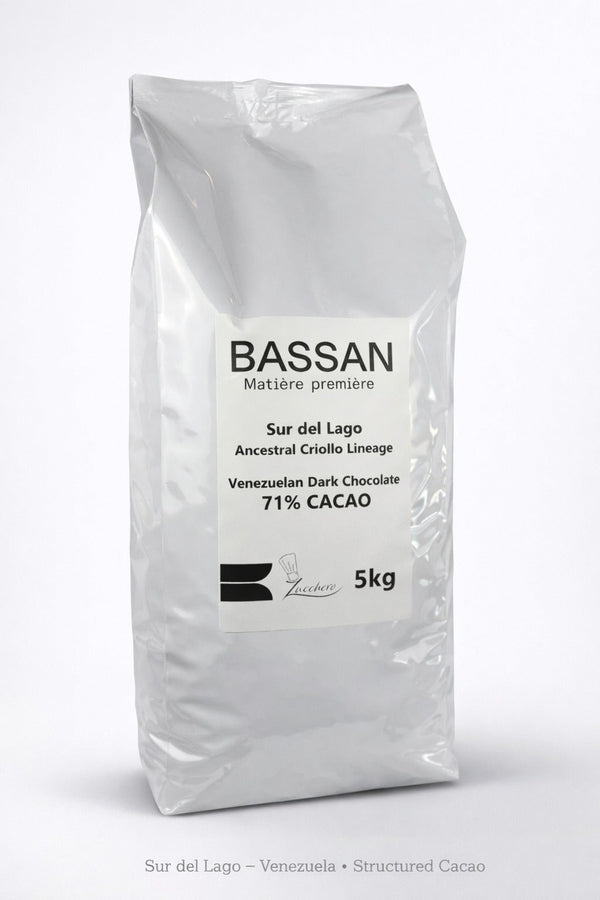 Bassan ChocolateSur del Lago Ancestral Criollo Lineage Dark Chocolate 71%From $69.95 CADView product →
 Canada Cacao Co.Organic Dark Chocolate Chips 70% Cacao 1 kg$45.95 CADView product →
 FCH Origins55% DARK CHOCOLATE MINIBARS 10 kg box - Origin Venezuela$299.00 CADView product →
 Canada Cacao Co.Natural Cocoa Liquor Wafers - 100% Peruvian Fine CocoaFrom $29.99 CADView product →
For professionals
Equipping a chocolate shop, bakery or kitchen?
Tell us what you produce and how much. We will recommend the right machine, moulds and ingredients, and send you a quote.
For home bakers
Professional tools for your own kitchen
The same European moulds, tools and ingredients the professionals use.
5% off orders over $500 CAD, applied automatically at checkout.
Keep reading


Leave a comment
All comments are moderated before being published.
This site is protected by hCaptcha and the hCaptcha Privacy Policy and Terms of Service apply.