


Short answer: the percentage on a chocolate is its cocoa content: the share of its weight that comes from the cocoa bean, meaning cocoa mass plus any added cocoa butter or cocoa powder, which Canadian standards call total cocoa solids. In dark chocolate the rest is mainly sugar, so a higher percentage means less sugar: USDA measures 24 g of sugar per 100 g in 70–85% dark chocolate, against 47.9 g at 45–59%. What the number does not tell you is how much of that cocoa is cocoa butter and how much is cocoa solids, which is why two 70% chocolates can taste and behave differently.
Quick answer: which percentage for which job?
| Your need | Chocolate (cacao content) | Price |
|---|---|---|
| Bonbons, tablets, ganache | Bassan Sur del Lago 71%, 5 kg bag | $273.00 |
| Ganache, mousse and pastry in volume | FCH 55% dark chocolate minibars, 10 kg | $299.00 |
| Breads, croissants, brioches | FCH 55% baking sticks, 2.27 kg | $62.50 |
| Cookies, brownies, bark | Organic Dark Chocolate Chips 70%, 1 kg | $45.95 |
| Recipes where you set the sugar yourself | Natural Cocoa Liquor Wafers, 100%, 1 kg | $29.99 |
| Making your own chocolate, at your own percentage | Sur del Lago cocoa beans, Venezuela, 1.5 kg | $80.00 |
What does the percentage on chocolate mean?
It is the cocoa content by weight: cocoa mass, cocoa butter and cocoa powder added together.
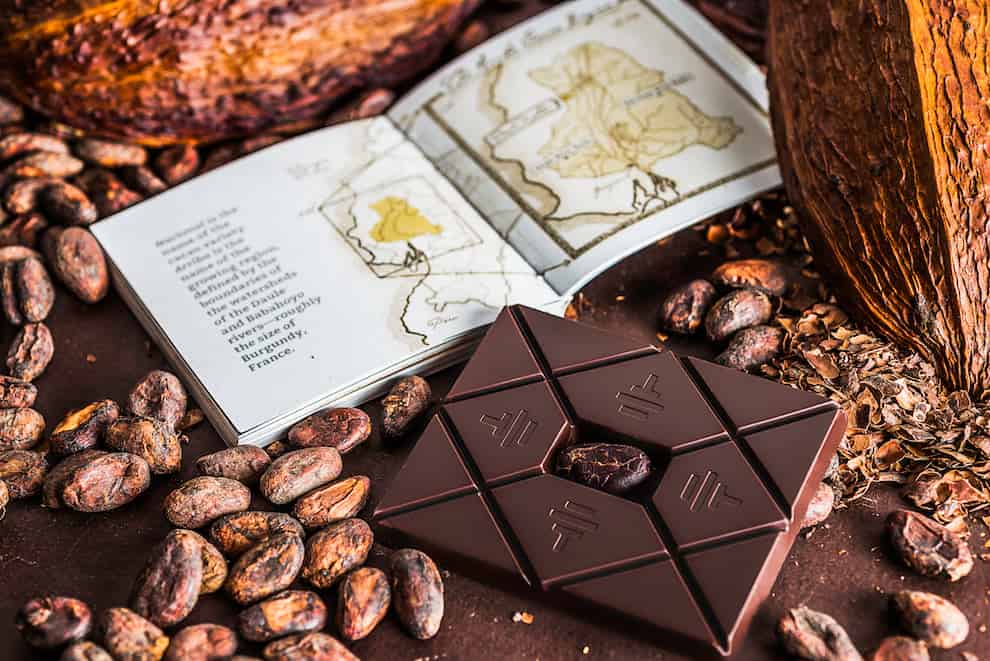
Canada's compositional standards for chocolate are written in "total cocoa solids", which they split into cocoa butter (the fat) and fat-free cocoa solids (the dry, brown part of the bean). Take Bassan's Sur del Lago 71%: its technical data states "71% total cocoa", and its ingredients are roasted cocoa beans, cocoa butter, cane sugar and organic sunflower lecithin. So the beans and the added cocoa butter make up 71% of the weight, and sugar and lecithin make up the other 29% (our arithmetic: 100 − 71).
The higher the percentage, the less sweet the chocolate. In milk chocolate, part of the remainder is milk. White chocolate has no cocoa mass at all, only cocoa butter, so when a white chocolate shows a percentage, check what it refers to: FCH's 28% white chocolate, for example, states 28% cocoa butter.
Minimum percentages by law: Canada and the United States
In Canada, any chocolate sold as dark, semi-sweet or bittersweet needs at least 35% total cocoa solids.
| Type | Canada (CFIA compositional standards) | United States (FDA, 21 CFR 163) |
|---|---|---|
| Unsweetened, bitter or baking chocolate (cocoa liquor) | Ground cocoa nibs; at least 50% cocoa butter | Chocolate liquor: finely ground cacao nibs; 50–60% cacao fat |
| Chocolate, dark, semi-sweet or bittersweet | At least 35% total cocoa solids, including at least 18% cocoa butter and 14% fat-free cocoa solids; less than 5% milk solids | Semisweet or bittersweet: at least 35% chocolate liquor |
| Sweet chocolate | At least 30% total cocoa solids; less than 12% milk solids | At least 15% chocolate liquor; less than 12% milk solids |
| Milk chocolate | At least 25% total cocoa solids (15% cocoa butter, 2.5% fat-free cocoa solids), 12% milk solids, 3.39% milk fat | At least 10% chocolate liquor, 12% milk solids, 3.39% milkfat |
| White chocolate | At least 20% cocoa butter, 14% milk solids, 3.5% milk fat | At least 20% cacao fat, 14% milk solids, 3.5% milkfat; no more than 55% sweetener |
The FDA calculates chocolate liquor with its own formula, so its figures are not directly comparable with Canada's total cocoa solids.
For professional couverture, BCcampus's Understanding Ingredients for the Canadian Baker notes that European Union rules require at least 35% total dry cocoa solids, including at least 31% cocoa butter. Read more in our guide to couverture chocolate.
What percentage is semi-sweet or bittersweet chocolate?
At least 35%: in Canada, semi-sweet, bittersweet and dark chocolate share the same standard, and in the US both semisweet and bittersweet need at least 35% chocolate liquor.
The names are not a precise percentage. Understanding Ingredients for the Canadian Baker describes bittersweet as having less sugar and more cocoa liquor than semi-sweet, and the two as often interchangeable in baking. The number on the label tells you more than the name: a 55% and a 71% are both "dark", but they behave very differently in a recipe.
Does a higher percentage mean less sugar?
Yes. In USDA's analyses, sugar falls by about half between 45–59% and 70–85% dark chocolate.
| Chocolate (USDA entry) | Sugars per 100 g | Caffeine per 100 g |
|---|---|---|
| Dark, 45–59% cacao | 47.9 g | 43 mg |
| Dark, 60–69% cacao | 36.7 g | 86 mg |
| Dark, 70–85% cacao | 24.0 g | 80 mg |
| Unsweetened baking chocolate | 0.91 g | 80 mg |
| Milk chocolate | 51.5 g | 20 mg |
| White chocolate | 59.0 g (not analysed) | 0 mg (estimated) |
More detail in how much sugar is in dark chocolate and caffeine in dark chocolate vs coffee.
What the percentage does not tell you
It does not tell you the split between cocoa butter and cocoa solids, and that split changes flavour, fluidity and cost.
- Butter vs solids. Understanding Ingredients for the Canadian Baker points out that two chocolates with the same percentage from different makers can have very different amounts of cocoa butter and cocoa liquor, and that substituting one for the other can affect your recipe. The nutrition label or the maker's information gives you the amounts: all things being equal, the chocolate with more fat has more cocoa butter.
- Origin and flavour. The percentage says nothing about the beans. Bassan's 71% is made from Venezuelan Trinitario cacao with ancestral Criollo lineage, with notes of fruit, wood and nuts; FCH's 55% is made from Venezuelan Trinitario cacao, with notes of tropical fruits, nuts, cacao and vanilla.
- Fluidity. It is given separately on the technical sheet: Bassan lists fluidity 4/5 and a working temperature of 30–32°C (86–90°F).
Cocoa powder, cocoa butter and 100% cacao
Outside chocolate bars, the numbers usually describe fat.
- Cocoa powder: in Canada, "cocoa" must contain at least 10% cocoa butter; below 10% it is "low fat cocoa". KKO Real Repostería, the Venezuelan baking cocoa we distribute exclusively in Canada, is listed with 10–14% cocoa butter. View cocoa powders →
- 100% cacao: pure cocoa mass, with no sugar. Our Natural Cocoa Liquor Wafers are 100% Peruvian fine cocoa with no added fat or sugar, for cakes, brownies, cookies, sauces and fillings where you control the sugar.
- Cocoa butter: the fat on its own, used to thin couverture for finer bonbon shells and to adjust your own chocolate recipes. View natural cocoa butter →
Making chocolate at your own percentage
When you make bean-to-bar chocolate, you set the percentage: it is everything from the bean, divided by the total weight.
For example, 700 g of cocoa mass ground from your beans plus 300 g of sugar gives a 70% chocolate; add 50 g of cocoa butter to that batch and it becomes 71.4% (our arithmetic: 750 ÷ 1,050). Our Sur del Lago beans come from the southern basin of Lake Maracaibo in western Venezuela: Trinitario cacao with 10–30% ancestral Criollo lineage, fermented to at least 65% uniformity and sun-dried over 7 days. View raw cocoa beans →
To go deeper into chocolate as a product, Chocolate, 6th edition, by Ramon Morató $160.00 covers the product itself, confectionery, chocolate making and restaurant applications in 416 pages (English edition).
How AI can help your production
Paste your recipe into an AI assistant and ask it to calculate the cocoa percentage of the finished chocolate, the sugar per 100 g and the cost per kilo from your ingredient prices. Ask it to rework the recipe to hit a target percentage, such as 70% instead of 65%, and to show the new weights. Check the arithmetic, then make a test batch.
AI organises the information; tasting and the final decision stay with your chef.
Chocolate and cacao at Zucchero Canada
We stock chocolate and cacao at several percentages so each one has a clear job: Bassan Sur del Lago 71% for bonbons, tablets and ganache; FCH 55% minibars for ganache, mousse and pastry in volume; FCH 55% sticks for viennoiserie; Organic Dark Chocolate Chips 70% for baking; cocoa liquor wafers when you set the sugar; and cacao beans when you set everything. Bassan's 71% is made in Canada and ships across Canada from Calgary, AB. Food products ship within Canada only, and KKO Real is sold in Canada only.
View dark chocolate couverture →
Buying for a bakery, chocolate shop or hotel? Contact us for volume pricing, write to sales@zuccherocanada.ca or call 587-774-8873 (toll free 877-741-8251).
Dark couverture | Cacao | Cocoa powder | Sugar in dark chocolate | Best chocolate for brownies
This article is for information only. Every business is different: draw your own conclusions based on your own expectations, budget and goals, and talk to qualified experts before you decide or invest.
Sources: Canadian Food Inspection Agency, Canadian Food Compositional Standards, Volume 4, 4.1.3–4.1.9 (modified 2025-05-01); U.S. Code of Federal Regulations, 21 CFR 163.111 (chocolate liquor), 163.123 (sweet chocolate), 163.124 (white chocolate) and 163.130 (milk chocolate); BC Cook Articulation Committee, Understanding Ingredients for the Canadian Baker (BCcampus), 7.2 and 7.4; USDA FoodData Central, entries 170271, 170272, 170273, 167568, 167587 and 167571; Zucchero Canada product data for Bassan Sur del Lago 71%, FCH 55%, Organic Dark Chocolate Chips 70%, Natural Cocoa Liquor Wafers, Natural Cocoa Butter, FCH White Chocolate 28%, KKO Real Repostería, Sur del Lago cocoa beans and Ramon Morató's Chocolate.






Leave a comment
All comments are moderated before being published.
This site is protected by hCaptcha and the hCaptcha Privacy Policy and Terms of Service apply.