How Much Sugar Is in Dark Chocolate? Sugar by Cacao Percentage
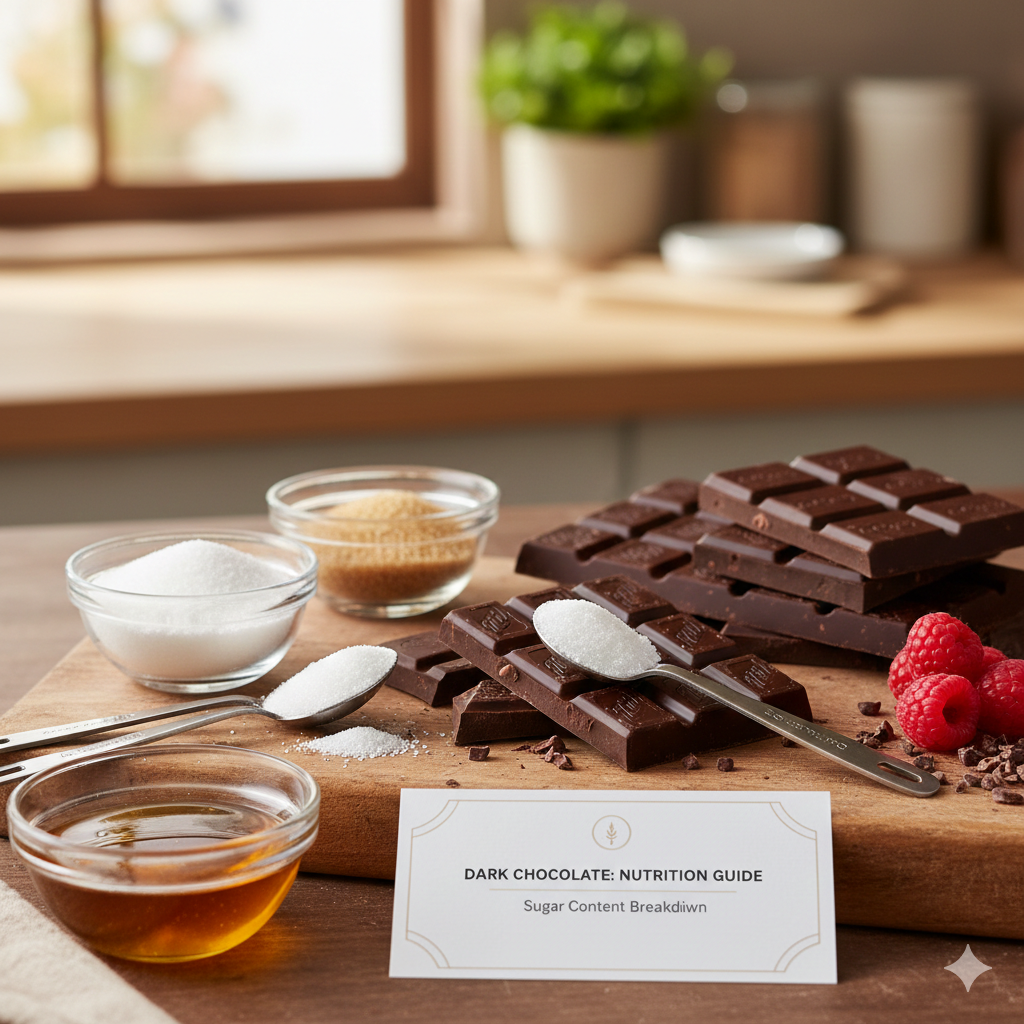
Short answer: according to USDA FoodData Central, dark chocolate with 45–59% cacao contains about 47.9 g of sugars per 100 g, 60–69% about 36.7 g, and 70–85% about 24.0 g (roughly 6.8 g in a 1 oz / 28 g piece). In other words, roughly 24% to 48% of the bar's weight is sugar. The higher the cacao percentage, the less room there is for sugar; for comparison, USDA lists milk chocolate at 51.5 g and unsweetened baking chocolate at 0.91 g per 100 g. For a specific bar, the Nutrition Facts table on its label is the number that counts.
This article is for general information only and is not medical or nutritional advice. Always consult your doctor, pharmacist or a registered dietitian about your own situation, especially during pregnancy or breastfeeding, or if you have diabetes, allergies or a medical condition.
Dark chocolate sugar content by cacao percentage
Sugar drops as the cacao percentage rises: USDA's dark chocolate entries go from 47.9 g of sugars per 100 g at 45–59% cacao to 24.0 g at 70–85%.
| Chocolate (USDA entry) | Total sugars per 100 g | Per 1 oz (28.35 g)* | USDA samples (range per 100 g) |
|---|---|---|---|
| Dark, 45–59% cacao solids | 47.9 g | 13.6 g | 5 samples (43.9–51.7 g) |
| Dark, 60–69% cacao solids | 36.7 g | 10.4 g | 6 samples (35.4–37.9 g) |
| Dark, 70–85% cacao solids | 24.0 g | 6.8 g | 2 samples (14.5–30.3 g) |
| Baking chocolate, unsweetened | 0.91 g | 0.3 g | 3 samples (0.56–1.09 g) |
*Per-ounce values are calculated by us from USDA's per-100 g figures.
Two things to keep in mind when you read the table. First, USDA groups everything from 70% to 85% in one entry, and its two samples ranged from 14.5 g to 30.3 g of sugars per 100 g, so two bars with similar percentages can differ a lot. Second, these are averages of analysed samples, not the values of any particular brand. The label on the bar, or the technical sheet of the couverture you buy, is always the reference for that product.
To understand what the percentage on the wrapper measures, read our guide to chocolate percentages.
Dark vs milk vs white chocolate
Per 100 g, USDA lists milk chocolate at 51.5 g of sugars and white chocolate at 59.0 g, against 24.0 g for 70–85% dark chocolate.
| Chocolate (USDA entry) | Total sugars per 100 g | Per 1 oz (28.35 g)* |
|---|---|---|
| White chocolate | 59.0 g | 16.7 g |
| Milk chocolate | 51.5 g | 14.6 g |
| Dark, 45–59% cacao solids | 47.9 g | 13.6 g |
| Dark, 70–85% cacao solids | 24.0 g | 6.8 g |
*Calculated by us from USDA's per-100 g figures. USDA's milk chocolate value comes from 9 samples (50.1–55.1 g); its white chocolate record lists no analysed samples for total sugars.
Note how close a 45–59% dark chocolate sits to milk chocolate: the word "dark" alone says little about sugar. The cacao percentage says much more.
Where the sugar in dark chocolate comes from
Almost all of the sugar in dark chocolate is sugar the maker adds; the cacao bean itself carries very little.
- The bean: the nutrition values on our Ucayali Peru cacao beans list about 1 g of sugars per 100 g (approximate values), and USDA lists unsweetened baking chocolate at 0.91 g per 100 g.
- The type of sugar: in USDA's analyses of dark chocolate, the sugar is sucrose (table sugar). Glucose and fructose were measured at 0 g in all three dark entries; sucrose accounts for 24.0 of the 24.0 g in the 70–85% entry, 36.4 of 36.7 g at 60–69%, and 46.2 of 47.9 g at 45–59% (that entry also shows 1.65 g of lactose).
- The recipe: look at an ingredient list. Bassan's Sur del Lago 71% couverture is declared as 71% total cocoa, made from roasted cocoa beans, cocoa butter, cane sugar and organic sunflower lecithin. FCH's 55% Venezuela dark chocolate minibars list cocoa liquor, cocoa fat, sugar and soy lecithin.
For a producer, this is the key point: the sugar in your chocolate is a decision in your recipe, made through the couverture you choose or, in bean-to-bar, through the sugar you add to your beans.
How much is a lot? Sugar guidelines in context
Health Canada uses a Daily Value of 100 g of total sugars on the Nutrition Facts table, and the WHO recommends keeping free sugars below 10% of total energy intake.
- Health Canada: the % Daily Value for sugars is calculated on 100 g a day for people aged 4 and over. Health Canada's rule of thumb: 5% DV or less is a little, 15% DV or more is a lot.
- World Health Organization (2015): adults and children should reduce free sugars to less than 10% of total energy intake; a further reduction to below 5%, or roughly 25 g (6 teaspoons) a day, would bring additional benefits. Free sugars are the sugars added by the manufacturer, cook or consumer, plus those in honey, syrups and fruit juices.
- American Heart Association: no more than about 100 calories (about 6 teaspoons) of added sugar a day for most American women and 150 calories (about 9 teaspoons) for men.
To put the USDA figures against Health Canada's 100 g Daily Value:
| 1 oz (28.35 g) of… | Total sugars* | Share of the 100 g Daily Value* |
|---|---|---|
| Dark chocolate, 70–85% | 6.8 g | about 7% |
| Dark chocolate, 60–69% | 10.4 g | about 10% |
| Dark chocolate, 45–59% | 13.6 g | about 14% |
| Milk chocolate | 14.6 g | about 15% |
*Calculated by us from USDA's per-100 g values. The %DV printed on a real label is based on the serving size declared on that product.
For anything about your own diet, including diabetes, ask your doctor or a registered dietitian. Our article on dark chocolate and diabetes covers that question separately.
Reading the sugar on a Canadian label
On a Canadian label, look at "Sugars" in the Nutrition Facts table and at the sugar-based ingredients grouped in the ingredient list.
- Nutrition Facts table: it shows total sugars per serving and their % Daily Value. Compare two chocolates on the same serving size.
- Ingredient list: sugar-based ingredients added to a prepackaged food appear in brackets after the word "Sugars", in descending order by weight, so you can see at a glance that sugars were added and how much they weigh in the recipe.
- Front-of-package symbol: since January 1, 2026, prepackaged foods that meet or exceed set levels of sugars, sodium or saturated fat must carry Health Canada's nutrition symbol. For sugars, the trigger is 15% DV or more for products with a reference amount above 30 g, and 10% DV or more for products with a reference amount of 30 g or less.
If you sell packaged chocolate, check Health Canada's front-of-package labelling guide for your product's reference amount and for the exemptions, such as very small packages under 15 cm² of display surface, and the conditional exemptions for products sold only at farmers' markets or where they are made.
For producers: how you control the sugar in your chocolate
You control sugar by choosing the cacao percentage of your couverture, by working from unsweetened cacao, or by setting your own recipe from the bean.
| What you need | Product | Price |
|---|---|---|
| A 70%+ couverture for bonbons, tablets and ganache | Bassan Sur del Lago 71% | from $69.95 CAD |
| 70% chips for baking | Organic Dark Chocolate Chips 70%, 1 kg | $45.95 CAD |
| Cacao with no added sugar for cakes, brownies and sauces | Natural Cocoa Liquor Wafers, 100% Peruvian cocoa | from $29.99 CAD |
| Beans for your own bean-to-bar recipe | Sur del Lago cocoa beans, Venezuela | from $80.00 CAD |
| A 55% for breads, croissants and brioches | Venezuelan Blend 55% sticks, 2.27 kg | $62.50 CAD |
Choose the cacao percentage of your couverture
Moving a recipe from a 55% to a 70%-plus couverture is the simplest way to reduce sugar, because a higher share of the bar is cacao. Bassan's Sur del Lago 71% is made in Canada from Venezuelan Trinitario cacao with ancestral Criollo lineage, with a working temperature of 30–32°C (86–90°F) and a bilingual technical sheet included. Keep the 55% where sweetness is part of the product, such as the FCH 55% sticks made for breads, croissants and brioches.
View dark chocolate couverture →
Work from unsweetened cacao
Our Natural Cocoa Liquor Wafers are 100% natural cocoa mass from Peruvian fine cocoa, with no added fat or sugar, in easy-melt wafers for cakes, brownies, cookies, sauces and fillings. You decide how much sugar goes in. KKO Real Repostería, the Venezuelan baking cocoa we distribute exclusively in Canada, is a dark alkalized cocoa powder with no sugar added and 10–14% cocoa butter, sold with a bilingual Canadian Nutrition Facts label.
- View the Natural Cocoa Liquor Wafers → from $29.99 CAD
- View KKO Real cocoa →
Set your own recipe from the bean
In bean-to-bar, the sugar in the bar is the sugar you put in the refiner. Our Sur del Lago beans come from the southern basin of Lake Maracaibo in western Venezuela, Trinitario cacao with 10–30% ancestral Criollo lineage, fermented to at least 65% uniformity and sun-dried over 7 days, in 1.5 kg, 5 kg, 20 kg and 60 kg formats. For refining, the Bilait R15 takes batches up to about 15 kg, heats up to 70°C (158°F) and holds that temperature in a closed chamber; a conching fan and a glass lid can be requested.
- View the Sur del Lago cocoa beans → from $80.00 CAD
- View bean-to-bar machines →
Starting out? Read how to start a bean-to-bar chocolate business in Canada.
Rethink sugar in your pastry
Frédéric Bau's Reasoned Gourmandise takes a careful look at how much butter and sugar a pastry really needs: 60 recipes, including classics such as Paris-Brest and lemon pie, in a 336-page English edition with a foreword by Pierre Hermé.
- View Reasoned Gourmandise → $115.00 CAD
How AI can help your production
Give an AI assistant your recipe in grams (couverture, cocoa liquor, sugar, cream, inclusions) and the sugar per 100 g from each supplier's technical sheet or label. Ask it to calculate sugars per 100 g and per piece, and to show what changes if you swap a 55% couverture for a 71%. It can also lay out the numbers you will need when you prepare a Nutrition Facts table, ready for your labelling specialist to check against Health Canada's rules.
AI organises the information; tasting and the final decision stay with your chef.
Dark chocolate and cacao at Zucchero Canada
We stock couverture, unsweetened cacao and cacao beans for chocolatiers, pastry chefs and bean-to-bar makers across Canada. Bassan's Sur del Lago 71% is made in Canada and ships across Canada from our Calgary warehouse. We are the exclusive distributor of KKO Real Venezuelan cocoa in Canada. Food products, including chocolate and cacao, ship within Canada only.
- Bonbons, tablets, ganache: Bassan Sur del Lago 71%, in 1 kg, 5 kg and 20 kg formats.
- Baking: Organic Dark Chocolate Chips 70% or, for full control of sugar, the Natural Cocoa Liquor Wafers.
- Viennoiserie: the FCH Venezuelan Blend 55% sticks, about 450 sticks of 5 g per box.
- Bean-to-bar: raw cocoa beans from Venezuela, Peru and Ecuador.
Buying for a bakery, hotel or production kitchen? Contact us for volume pricing, write to sales@zuccherocanada.ca or call 587-774-8873 (toll free 877-741-8251).
Dark couverture | Cacao | Raw cocoa beans | Chocolate percentages explained | Calories in dark chocolate
This article is for information only. Every business is different: draw your own conclusions based on your own expectations, budget and goals, and talk to qualified experts before you decide or invest.
Sources: USDA FoodData Central, entries "Chocolate, dark, 45–59% cacao solids" (FDC 170271), "60–69%" (170272), "70–85%" (170273), "Candies, milk chocolate" (167587), "Candies, white chocolate" (167571) and "Baking chocolate, unsweetened, squares" (167568); Health Canada, "Sugars: Using the food labels", "Nutrition Labelling – Table of Daily Values", "% Daily Value" and "Front-of-package nutrition symbol labelling guide for industry"; World Health Organization, "WHO calls on countries to reduce sugars intake among adults and children" (4 March 2015); American Heart Association, "Added Sugars" (reviewed 2024); Zucchero Canada product data for Bassan Sur del Lago 71%, FCH 55%, Ucayali Peru cacao beans, Natural Cocoa Liquor Wafers, KKO Real Repostería, Sur del Lago cocoa beans, Bilait R15 and Reasoned Gourmandise.
Good to know
Frequently asked questions
How much sugar is in 70% dark chocolate?
USDA FoodData Central lists dark chocolate with 70–85% cacao solids at 24.0 g of total sugars per 100 g, or about 6.8 g in a 1 oz (28.35 g) piece. That entry is based on two samples that ranged from 14.5 g to 30.3 g per 100 g, so check the Nutrition Facts table of the bar or couverture you actually use.
Is unsweetened chocolate the same as dark chocolate?
Not when it comes to sugar. USDA lists unsweetened baking chocolate at 0.91 g of sugars per 100 g, while its dark chocolate entries (45–85% cacao solids) range from 24.0 g to 47.9 g. Dark chocolate contains added sugar; products made only from cocoa mass, such as our Natural Cocoa Liquor Wafers, have no added sugar.
Does dark chocolate have less sugar than milk chocolate?
At higher percentages, yes. USDA lists milk chocolate at 51.5 g of sugars per 100 g and 70–85% dark chocolate at 24.0 g. A 45–59% dark chocolate, at 47.9 g, is much closer to milk chocolate, so the cacao percentage matters more than the word "dark".
Does dark chocolate have added sugar?
Yes, and almost all of its sugar is added. In USDA's analyses of dark chocolate the sugar is sucrose, with glucose and fructose measured at 0 g, while unsweetened baking chocolate has 0.91 g of sugars per 100 g and our Ucayali raw cacao beans list about 1 g per 100 g (approximate value). The ingredient list shows it: sugar or cane sugar appears next to the cocoa ingredients.
How do I read the sugar on a Canadian chocolate label?
Look at "Sugars" in the Nutrition Facts table: it gives grams per serving and a % Daily Value based on 100 g of sugars a day. Health Canada's rule of thumb is that 5% DV or less is a little and 15% DV or more is a lot. In the ingredient list, sugar-based ingredients are grouped in brackets after the word "Sugars".
Does chocolate qualify for free shipping at Zucchero Canada?
No. Cacao and chocolate are excluded from our free shipping on orders of $300 CAD or more, and food products ship within Canada only. Orders over $500 CAD get 5% off automatically at checkout.
Shop this article
Products mentioned in this guide
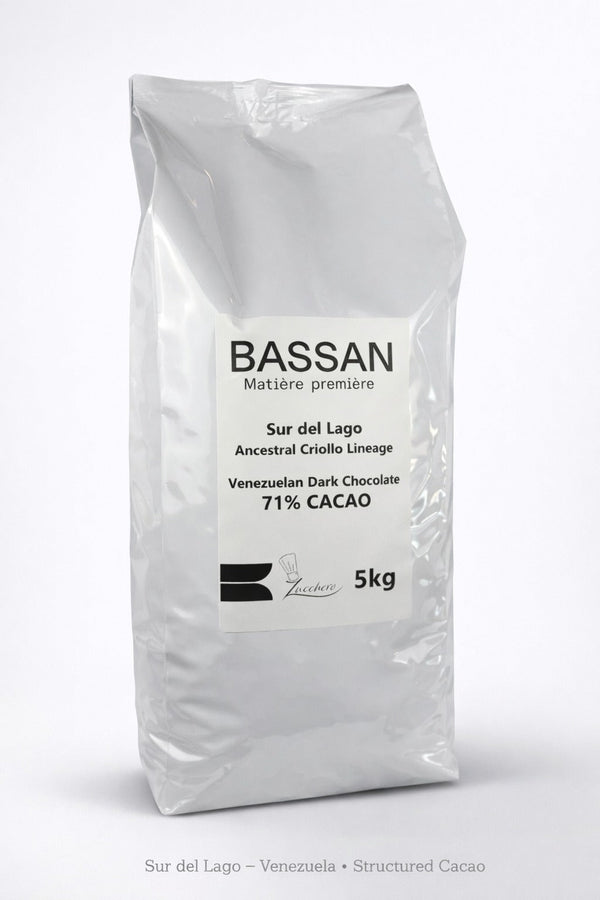 Bassan ChocolateSur del Lago Ancestral Criollo Lineage Dark Chocolate 71%From $69.95 CADView product →
 Canada Cacao Co.Organic Dark Chocolate Chips 70% Cacao 1 kg$45.95 CADView product →
 Canada Cacao Co.Natural Cocoa Liquor Wafers - 100% Peruvian Fine CocoaFrom $29.99 CADView product →
 Canada Cacao Co.Sur del Lago Ancestral Criollo Lineage Cocoa Beans · VenezuelaFrom $80.00 CADView product →
For professionals
Equipping a chocolate shop, bakery or kitchen?
Tell us what you produce and how much. We will recommend the right machine, moulds and ingredients, and send you a quote.
For home bakers
Professional tools for your own kitchen
The same European moulds, tools and ingredients the professionals use.
5% off orders over $500 CAD, applied automatically at checkout.
Keep reading


Leave a comment
All comments are moderated before being published.
This site is protected by hCaptcha and the hCaptcha Privacy Policy and Terms of Service apply.