

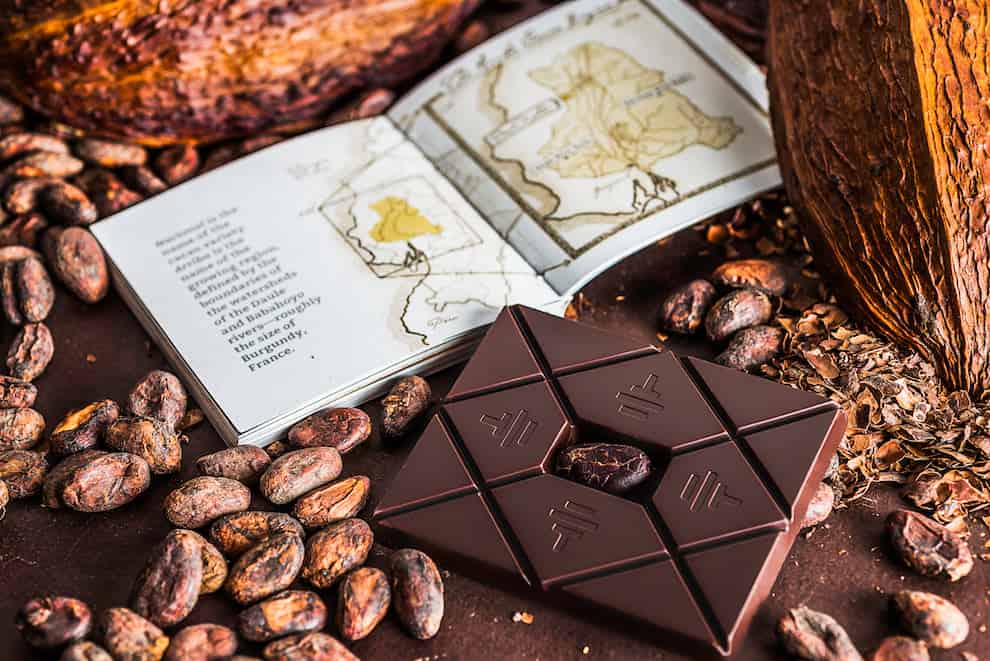
Short answer: rare chocolate starts with rare cacao. Among the rarest are Criollo-type and heirloom varieties, such as Porcelana from south of Lake Maracaibo in Venezuela and Nacional from Ecuador and Peru, grown in origins recognised for fine-flavour cocoa. According to the International Cocoa Organization (ICCO), fine-flavour cocoa comes from Criollo or Trinitario trees (plus Ecuador's Nacional) and makes up only about 12% of world cocoa bean exports. For a chocolate maker, the way to work with these varieties is to buy traceable beans or single-origin couverture and process them carefully.
Quick answer: rare-origin cacao for chocolate makers
| Your need | Product | Price |
|---|---|---|
| Venezuelan beans with ancestral Criollo lineage, for bean to bar | Sur del Lago cocoa beans, Venezuela, 1.5 kg | $80.00 |
| Single-origin couverture from the same Venezuelan region | Bassan Sur del Lago 71% dark chocolate, 5 kg | $273.00 |
| Fine-flavour Peruvian beans from the Amazon | Ucayali cocoa beans, Peru, 1.5 kg | $80.00 |
| Venezuelan cacao in a ready-to-use form | Venezuelan cacao nibs, 1 kg | $69.95 |
| Refine your own small test batches, 110 V | Chocolate World M1025 conching device, 1.3–4.5 kg | $1,750.00 |
What makes a chocolate rare?
There is no official definition of "rare chocolate". The closest official reference is the ICCO definition of fine-flavour cocoa, which explains why these beans taste different. It describes cocoa with "a complex sensory profile" that results from the interaction between:
- a particular genetic composition;
- favourable growing conditions in a given environment or terroir;
- specific plantation management techniques;
- specific harvesting and post-harvest practices;
- stable chemical and physical composition, and integrity of the bean.
The definition makes clear that genetics alone is not enough: terroir, farming and post-harvest practices count too. That is why traceability (where the beans come from, and how they were fermented and dried) matters as much as the variety name.
Criollo, Trinitario, Forastero and Nacional
Cacao has traditionally been sorted into three groups: Criollo, Forastero and Trinitario, a Criollo × Forastero hybrid. The ICCO states that fine-flavour beans come from Criollo or Trinitario trees and bulk (ordinary) beans from Forastero trees, with one exception: Ecuador's Nacional trees, considered a Forastero type, also produce fine-flavour cocoa.
Modern genetics gives a more detailed picture. A 2008 study of Amazonian cacao (Motamayor and colleagues, PLoS ONE) identified 10 genetic clusters instead of the two groups traditionally recognised: Marañón, Curaray, Criollo, Iquitos, Nanay, Contamana, Amelonado, Purús, Nacional and Guiana. The authors note that this classification reflects the genetic diversity available to breeders more accurately than "Criollo, Forastero or Trinitario". In practice, the old names are still used on labels, so ask your supplier what the genetics actually are.
Rare cacao varieties worth knowing
| Variety | Origin | What makes it special |
|---|---|---|
| Porcelana | South of Lake Maracaibo, Venezuela | A Criollo cacao with white cotyledons (the inside of the bean). Venezuelan researchers describe it as "considered the best of the world by its flavor and aroma"; a 6-hectare collection there is kept as a reserve of high-purity material. |
| Nacional ("Arriba") | Ecuador | The Forastero-type tree that the ICCO recognises as producing fine-flavour cocoa. One of the 10 genetic clusters in the 2008 study. |
| Pure Nacional | Peru | In 2011 the U.S. Department of Agriculture reported that collaborators had found Pure Nacional in Peru, describing it as "an old, very rare and highly coveted variety of cacao". |
| Criollo-lineage Venezuelan cacao | Venezuela: Sur del Lago, Ocumare | Cacao selections that still carry ancestral Criollo genetics: Sur del Lago is Trinitario with 10–30% Criollo lineage; Ocumare, on the Aragua coast, carries a significant proportion of Criollo genetics. Venezuela is one of the countries the ICCO lists as an exporter of fine-flavour cocoa. |
A note on names: Porcelana is a specific Criollo variety. Our Sur del Lago beans come from the same southern basin of Lake Maracaibo but are a different selection: Trinitario cacao with 10–30% ancestral Criollo lineage, selected for consistent fermentation and batch-to-batch repeatability.
Fine-flavour origins: where rare cacao grows
The ICCO keeps a list of countries recognised as exporters of fine-flavour cocoa, with the share of each country's exports that qualifies. In 2016 it recognised 23 countries; its 2024 review lists 20.
| Country | Fine-flavour share of exports (ICCO, 2016) | ICCO review, 2024 |
|---|---|---|
| Venezuela | 100% | Fine-flavour exports present; share not determined |
| Ecuador | 75% | 75% |
| Peru | 75% | 75% |
| Madagascar | 100% | 100% |
| Trinidad and Tobago | 100% | 100% |
For a buyer, these origins are a starting point, not a guarantee: a share of 75% also means a quarter of that country's exports are bulk cocoa. Ask for the exact region, the genetics, the fermentation and the drying, and taste a sample before you commit to a lot. To compare origins side by side, see our guide to single-origin cocoa beans for bean-to-bar production in Canada.
Our Venezuelan, Ecuadorian and Peruvian cacao
Each origin we sell has its own profile, so pick by the chocolate you want to make:
- Sur del Lago, Venezuela: Trinitario with 10–30% ancestral Criollo lineage, from the southern basin of Lake Maracaibo (Zulia and Trujillo). Fruity, woody and nutty notes with low acidity and low astringency; fermented to at least 65% uniformity and sun-dried over 7 days. Each lot comes with a Certificate of Origin and Authenticity. View Sur del Lago beans → $80.00
- Bassan Sur del Lago 71%: a dark couverture made in Canada by Bassan Chocolate from Venezuelan Trinitario beans with ancestral Criollo lineage, with notes of fruit, wood and nuts and low acidity and astringency. For makers who want this origin without roasting and refining. View Bassan 71% → $273.00 (5 kg)
- Hacienda Victoria, Ecuador: 100% Arriba Nacional, "Cacao Fino de Aroma", from a single estate on the Ecuadorian coast, sun-dried for 7 days. View Ecuadorian cocoa beans →
- Ucayali, Peru: fine-flavour beans from the Amazon, grown at 100–1,000 m by a group of 140 farmers; hints of ripe fruit, spice and light wood, with very low bitterness and astringency. View Ucayali beans → $80.00
These are raw, unroasted beans: an agricultural product that needs roasting and processing before it is eaten. Food products ship within Canada only.
From rare beans to your own chocolate
Working with rare cacao means keeping its character through every step: roasting, cracking and winnowing, refining and conching, then tempering. The two refiners below cover different stages of a bean-to-bar business:
- Testing a new origin: the Chocolate World M1025 conching device stone-grinds batches of 1.3 to 4.5 kg on 110 V. $1,750.00
- Regular production: the Bilait R15 refiner takes batches up to about 15 kg, refines directly from the nibs and heats to 70°C, so refining and conching happen in the same closed chamber. Bilait notes that the closed design protects the mass from outside contamination and keeps the volatile aromas of the cocoa. $12,370.00
Both refiners are special-order items that ship directly from the manufacturer; contact us for the current lead time. Start with our guides to roasting cacao beans and starting a bean-to-bar business in Canada.
How AI can help your production
When you trial several origins, ask an AI assistant to build a tasting sheet for each lot (origin, genetics, roast time and temperature, refining time, tasting notes) and to compare your notes across batches, so you can see which variables changed the flavour. Give it your bean price, your measured yield after winnowing and your bar weight, and ask it to calculate the cacao cost per bar for each origin. It can also draft the origin story for your label from the supplier's certificate and your own notes, for you to check.
AI organises the information; tasting and the final decision stay with your chef.
Rare cacao at Zucchero Canada
Zucchero Canada is the brand of Canada Cacao Company, which brokers Venezuelan cacao, including the Sur del Lago and Ocumare selections. We stock fine-flavour beans from Venezuela, Ecuador and Peru for chocolatiers, bean-to-bar makers and pastry labs across Canada. We are the exclusive distributor of Bilait machines in Canada and an authorized distributor of Chocolate World. Priority allocation is available for standing B2B orders that need consistent volume and quality year-round: contact us or call 587-774-8873 (toll free 877-741-8251) to plan your lots.
Raw cocoa beans | Venezuelan cocoa beans | Bassan Chocolate | What is single-origin chocolate? | History of cacao
This article is for information only. Every business is different: draw your own conclusions based on your own expectations, budget and goals, and talk to qualified experts before you decide or invest.
Sources: ICCO, "Fine or flavour cocoa" (icco.org, 2024), "ICCO Panel recognizes 23 countries as fine and flavour cocoa exporters" (29 June 2016) and "Revision of Annex C of the International Cocoa Agreement 2010" (15 May 2024); J. C. Motamayor et al., "Geographic and genetic population differentiation of the Amazonian chocolate tree (Theobroma cacao L)", PLoS ONE 3(10), 2008; I. Chacón de Ramírez, C. Ramis and C. Gómez, "Morphological description of fruits and seeds of the Criollo Porcelana cocoa in south of Maracaibo Lake", Revista de la Facultad de Agronomía (LUZ) 28 (Supl. 1), 2011; USDA, "Possible New Flavor Sensations from the Jungles of Peru" (11 October 2011); Bilait catalogue 2026; Canada Cacao Co., Hacienda Victoria, Bassan Chocolate, Chocolate World and Bilait product data on zuccherocanada.ca.





Leave a comment
All comments are moderated before being published.
This site is protected by hCaptcha and the hCaptcha Privacy Policy and Terms of Service apply.