




Can Diabetics Eat Dark Chocolate? Carbs by Cacao % and What Research Shows
Short answer: dark chocolate contains carbohydrate, so any piece you eat counts in your meal plan. Diabetes Canada says people with diabetes can enjoy sugar in small amounts, with up to 10% of daily calories from added sugar. The cacao percentage makes a big difference: USDA data put 70–85% dark chocolate at about 9.9 g of available carbohydrate (carbohydrate minus fibre) per 1 oz (28 g), against about 15.4 g for 45–59% dark chocolate and 15.9 g for milk chocolate. Research on cocoa and insulin sensitivity is limited to small, short trials, and chocolate is not a treatment for diabetes. Ask your doctor or dietitian whether and how much dark chocolate fits your plan.
This article is for general information only and is not medical or nutritional advice. Always consult your doctor, pharmacist or a registered dietitian about your own situation, especially during pregnancy or breastfeeding, or if you have diabetes, allergies or a medical condition.
Carbohydrate in dark chocolate by cacao percentage
The higher the cacao percentage, the less sugar and the more fibre: per 100 g, USDA lists 24.0 g of sugars and 10.9 g of fibre for 70–85% dark chocolate, against 47.9 g of sugars and 7.0 g of fibre at 45–59%.
| Chocolate (USDA entry) | Carbohydrate per 100 g | Fibre per 100 g | Sugars per 100 g | Available carbohydrate per 100 g* | Available carbohydrate per 1 oz (28.35 g)* |
|---|---|---|---|---|---|
| Dark, 70–85% cacao solids | 45.9 g | 10.9 g | 24.0 g | 35.0 g | 9.9 g |
| Dark, 60–69% cacao solids | 52.4 g | 8.0 g | 36.7 g | 44.4 g | 12.6 g |
| Dark, 45–59% cacao solids | 61.2 g | 7.0 g | 47.9 g | 54.2 g | 15.4 g |
| Milk chocolate | 59.4 g | 3.4 g | 51.5 g | 56.0 g | 15.9 g |
| Baking chocolate, unsweetened | 28.4 g | 16.6 g | 0.91 g | 11.8 g | 3.3 g |
*Calculated by us from USDA's per-100 g values: available carbohydrate = carbohydrate minus fibre, the method Diabetes Canada uses for carbohydrate counting. USDA's 70–85% entry is based on only two samples, whose sugars ranged from 14.5 g to 30.3 g per 100 g, so the label of the bar you eat is always the reference.
Fibre matters here: Diabetes Canada states that fibre does not raise blood sugar and should be subtracted from total carbohydrate. To see what the cacao percentage actually measures, read our guide to chocolate percentages.
Is dark chocolate good for diabetics?
It is better treated as a measured treat than as a health food: the studies on cocoa and blood sugar are small or observational, and none shows that chocolate treats diabetes.
| Study | Who and how much | What it found |
|---|---|---|
| Mellor et al., Diabetic Medicine, 2010 | 12 people with type 2 diabetes; 45 g of chocolate a day for 8 weeks, high- or low-polyphenol, crossover | HDL cholesterol rose with the high-polyphenol chocolate; weight, glycaemic control and insulin resistance did not change over 16 weeks |
| Grassi et al., American Journal of Clinical Nutrition, 2005 | 15 healthy adults; 100 g dark chocolate a day for 15 days vs 90 g white chocolate | Insulin sensitivity was better after dark chocolate than after white chocolate |
| Grassi et al., Hypertension, 2005 | 20 untreated patients with high blood pressure; 100 g dark chocolate a day for 15 days vs white chocolate | Lower blood pressure and insulin resistance after dark chocolate; the authors note that total calories must be balanced |
| Liu et al., BMJ, 2024 | Three US cohorts of adults without diabetes at the start (about 112,000 in the dark vs milk chocolate analysis), followed for years (observational) | Five or more servings a week of dark chocolate were associated with a 21% lower risk of developing type 2 diabetes; milk chocolate was not, and was associated with weight gain. The authors call for randomised trials |
Two cautions. The trials used chocolate amounts (45–100 g a day) that carry a lot of carbohydrate and energy, and they lasted weeks, not years. The large 2024 study looked at people who did not have diabetes and shows an association, not proof that chocolate lowers risk. For someone already living with diabetes, the practical question is how many grams of carbohydrate a piece adds to the day.
How to fit dark chocolate into a diabetes meal plan
Count it like any other carbohydrate: weigh the piece, read the label, and subtract the fibre.
- Weigh the portion. A 20 g piece of chocolate with the USDA 70–85% values carries about 7.0 g of available carbohydrate; the same 20 g of 45–59% dark chocolate carries about 10.8 g (our calculation from the table above).
- Read the Nutrition Facts table. Look at carbohydrate, fibre and sugars for the serving size shown, and scale them to the piece you actually eat.
- Read the ingredient list. Health Canada groups sugar-based ingredients in brackets after the word "Sugars", so added sugars are easy to spot. Fillings and inclusions appear in the same list.
- Keep added sugar in its place. Diabetes Canada's figure is up to 10% of daily calories from added sugar, ideally agreed with your health care team.
- Ask your team about your own response. Your doctor or dietitian can tell you how to check how a given chocolate affects you, and how it interacts with your medication.
Thinking about a sugar-free bar instead? Read sugar-free chocolate for diabetics for what those labels mean in Canada and how sugar alcohols behave. For sugar alone, see how much sugar is in dark chocolate.
Choosing the best dark chocolate for diabetics
Choose on the label: a high cacao percentage, a short ingredient list, and a known weight per piece.
- Cacao percentage: in USDA's data, available carbohydrate per 100 g drops from 54.2 g at 45–59% to 35.0 g at 70–85%.
- Plain over filled: a plain bar is easier to count than a filled bonbon.
- Same-weight comparison: compare two chocolates on the same number of grams, since serving sizes differ between labels.
- Pieces of known weight: a square or tablet of stated weight is easier to count than a piece broken from a slab.
For producers: dark chocolate your customers can count
If you make chocolate for customers who count carbohydrate, the most useful things you can give them are a clear cacao percentage, a short ingredient list and a fixed piece weight on the label.
| What you need | Product | Price |
|---|---|---|
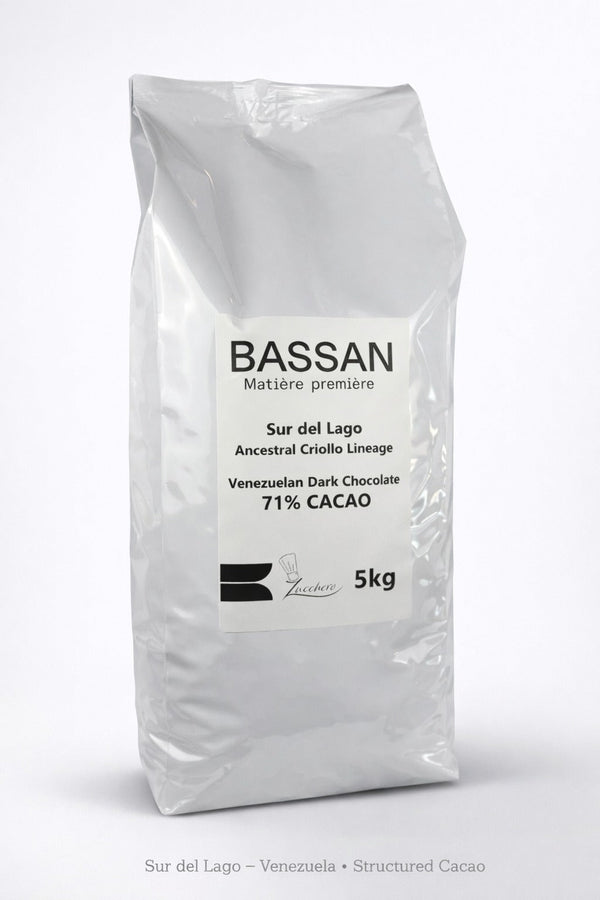
| A 71% couverture for tablets, bonbons and ganache | Bassan Sur del Lago 71%, 5 kg | $273.00 CAD |
| 70% chips for baking | Organic Dark Chocolate Chips 70%, 1 kg | $45.95 CAD |
| Cocoa mass with no added sugar, so you set the sugar yourself | Natural Cocoa Liquor Wafers, 1 kg | $29.99 CAD |
| A mould that casts tablets of a fixed weight | Chocolate World Tablet 100 g mould (CW2162) | $44.95 CAD |
A higher-percentage couverture
Bassan's Sur del Lago 71% is made in Canada from Venezuelan Trinitario cacao with ancestral Criollo lineage. Its ingredients are roasted cocoa beans, cocoa butter, cane sugar and organic sunflower lecithin, and it comes with a bilingual technical sheet: use that sheet, not general averages, when you prepare your nutrition figures. Our Organic Dark Chocolate Chips 70% list organic cocoa mass, organic cane sugar, organic cocoa butter and organic natural cocoa powder.
View dark chocolate couverture →
Unsweetened cacao for your own recipes
Our Natural Cocoa Liquor Wafers are natural cocoa mass from Peruvian fine cocoa with no added fat or sugar. For bean-to-bar makers, our Sur del Lago cocoa beans from western Venezuela let you set the sugar in your recipe from the start.
Fixed weights for clear labels
Chocolate World's Tablet 100 g mould is a polycarbonate mould that casts three tablets of 100 g, a format that makes nutrition per tablet simple to state on your label. Browse the full range of chocolate bar and tablet moulds for other formats.
- View the Tablet 100 g mould → $44.95 CAD
Rethink sugar in your pastry
Frédéric Bau's Reasoned Gourmandise takes a careful look at how much butter and sugar a pastry really needs: 60 recipes in a 336-page English edition with a foreword by Pierre Hermé.
- View Reasoned Gourmandise → $115.00 CAD
How AI can help your production
Give an AI assistant your recipe in grams and the carbohydrate, fibre and sugars per 100 g from each ingredient's label or technical sheet. Ask it to calculate available carbohydrate per 100 g and per piece for each of your products, and to show what changes when you move a recipe from a 55% couverture to a 71%. It can turn the result into a simple card for your counter or website ("carbohydrate per piece") for your labelling specialist to check.
AI organises the information; tasting and the final decision stay with your chef.
Dark chocolate and cacao at Zucchero Canada
We stock couverture, unsweetened cacao, cacao beans and chocolate moulds for chocolatiers, pastry chefs and bean-to-bar makers across Canada. Bassan's Sur del Lago 71% is made in Canada and ships across Canada from our Calgary warehouse. Food products ship within Canada only.
- Tablets, bonbons, ganache: Bassan Sur del Lago 71%, in 1 kg, 5 kg and 20 kg formats.
- Baking: Organic Dark Chocolate Chips 70%, 1 kg.
- Your own sugar level: Natural Cocoa Liquor Wafers, in 1 kg, 5 kg and 18 kg formats.
- Moulds: Chocolate World and Pavoni bar and tablet moulds.
Buying for a chocolate shop, bakery or hotel? Contact us for volume pricing, write to sales@zuccherocanada.ca or call 587-774-8873 (toll free 877-741-8251).
Dark couverture | Cacao | Bar & tablet moulds | Sugar-free chocolate for diabetics | Calories in dark chocolate
This article is for information only. Every business is different: draw your own conclusions based on your own expectations, budget and goals, and talk to qualified experts before you decide or invest.
Sources: USDA FoodData Central, entries "Chocolate, dark, 45–59% cacao solids" (FDC 170271), "60–69%" (170272), "70–85%" (170273), "Candies, milk chocolate" (167587) and "Baking chocolate, unsweetened, squares" (167568); Diabetes Canada, "Sugars and sweeteners" and "Basic carbohydrate counting"; Health Canada, "Sugars: Using the food labels"; Mellor D.D. et al., Diabetic Medicine 27 (2010): 1318–1321; Grassi D. et al., American Journal of Clinical Nutrition 81 (2005): 611–614; Grassi D. et al., Hypertension 46 (2005): 398–405; Liu B. et al., "Chocolate intake and risk of type 2 diabetes: prospective cohort studies", BMJ 387 (2024): e078386; Zucchero Canada product data for Bassan Sur del Lago 71%, Organic Dark Chocolate Chips 70%, Natural Cocoa Liquor Wafers, Sur del Lago cocoa beans, Chocolate World CW2162 and Reasoned Gourmandise.
Good to know
Frequently asked questions
Can diabetics eat dark chocolate?
Diabetes Canada says people with diabetes can enjoy sugar in small amounts, with up to 10% of daily calories from added sugar. Dark chocolate contains carbohydrate, so any piece counts in your carbohydrate plan. Ask your doctor or dietitian whether and how much fits your own plan.
How many carbs are in dark chocolate?
USDA lists 45.9 g of carbohydrate and 10.9 g of fibre per 100 g for 70–85% dark chocolate, or about 35.0 g of available carbohydrate (about 9.9 g per 1 oz). At 45–59% cacao, the figures are 61.2 g of carbohydrate and 7.0 g of fibre, or about 54.2 g available per 100 g. Always check the label of the bar you eat.
What is the best dark chocolate for diabetics?
Look for a high cacao percentage, a plain bar with a short ingredient list, and a stated weight per piece, then count its available carbohydrate (carbohydrate minus fibre) from the Nutrition Facts table. In USDA's data, available carbohydrate per 100 g falls from 54.2 g at 45–59% cacao to 35.0 g at 70–85%.
Does dark chocolate raise blood sugar?
It contains carbohydrate, including sugar, so it can. Higher-percentage dark chocolate has less sugar and more fibre per gram, and Diabetes Canada notes that fibre does not raise blood sugar. Small studies have linked cocoa to better insulin sensitivity, but a 2010 trial in people with type 2 diabetes eating 45 g a day for 8 weeks found no change in glycaemic control.
Is dark chocolate better than sugar-free chocolate for diabetics?
They are different choices. Plain dark chocolate is sweetened with sugar (in USDA's analyses, sucrose); sugar-free chocolate replaces the sugar with sugar alcohols or sweeteners, which Diabetes Canada says can still raise blood sugar, though less than sugar, and can cause digestive side effects above 10 g a day. Your dietitian can help you compare two labels.
Does dark chocolate qualify for free shipping at Zucchero Canada?
No. Cacao and chocolate are excluded from our free shipping on orders of $300 CAD or more, and food products ship within Canada only. Chocolate moulds do count toward free shipping, and orders over $500 CAD get 5% off automatically at checkout.
Shop this article
Products mentioned in this guide
 Bassan ChocolateSur del Lago Ancestral Criollo Lineage Dark Chocolate 71%From $69.95 CADView product →
 Canada Cacao Co.Organic Dark Chocolate Chips 70% Cacao 1 kg$45.95 CADView product →
 Canada Cacao Co.Natural Cocoa Liquor Wafers - 100% Peruvian Fine CocoaFrom $29.99 CADView product →
 Chocolate WorldTablet 100 g Chocolate Mold CW2162From $44.95 CADView product →
For professionals
Equipping a chocolate shop, bakery or kitchen?
Tell us what you produce and how much. We will recommend the right machine, moulds and ingredients, and send you a quote.
For home bakers
Professional tools for your own kitchen
The same European moulds, tools and ingredients the professionals use.
5% off orders over $500 CAD, applied automatically at checkout.
Keep reading



Leave a comment
All comments are moderated before being published.
This site is protected by hCaptcha and the hCaptcha Privacy Policy and Terms of Service apply.