



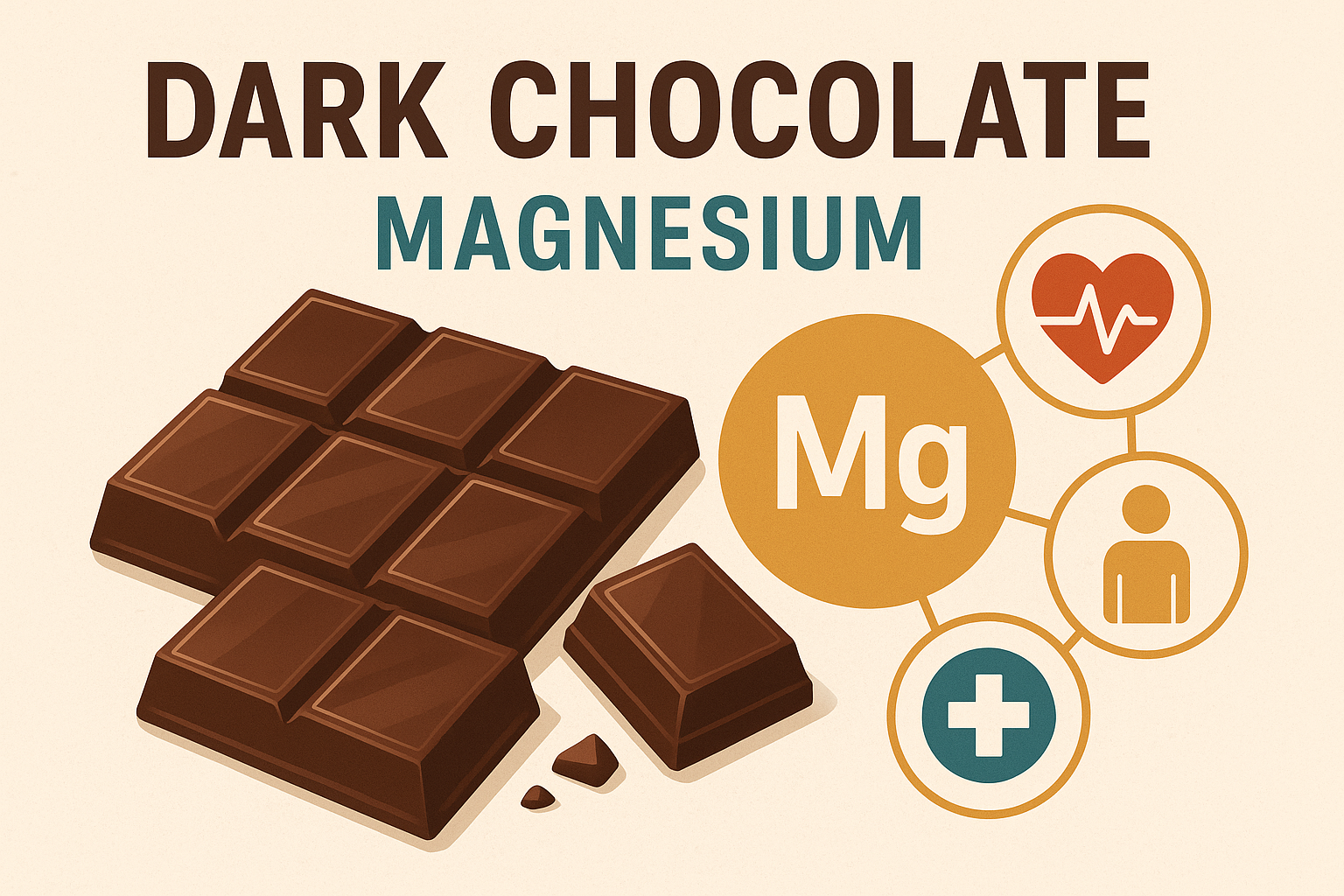
Short answer: dark chocolate can have a place in a balanced diet, but it is not a health food. A 1 oz (28 g) piece of 70–85% dark chocolate gives about 3 g of fibre, 65 mg of magnesium and 3.4 mg of iron by USDA's figures, and its cocoa flavanols are the best-studied compounds: the European Food Safety Authority (EFSA) accepts that 200 mg of cocoa flavanols a day, which it says 10 g of high-flavanol dark chocolate could provide, help maintain normal blood flow. The same piece also carries about 170 calories, 7 g of saturated fat and 7 g of sugar, and the largest trial of cocoa flavanols, which used a supplement rather than chocolate, did not significantly reduce total cardiovascular events. The darker the chocolate, the more cacao and the less sugar it contains.
This article is for general information only and is not medical or nutritional advice. Always consult your doctor, pharmacist or a registered dietitian about your own situation, especially during pregnancy or breastfeeding, or if you have diabetes, allergies or a medical condition.
Dark chocolate benefits: what the research actually shows
The evidence for dark chocolate's benefits is real but limited: one effect on blood flow is officially accepted in Europe, and the other findings come from a supplement trial or from observational studies that cannot prove cause and effect.
| Source | What it looked at | What it found |
|---|---|---|
| EFSA, scientific opinion (2012) | Human studies of cocoa flavanols and blood vessel function | Cocoa flavanols "help maintain endothelium-dependent vasodilation, which contributes to normal blood flow", at 200 mg of cocoa flavanols a day, an amount EFSA says could come from 10 g of high-flavanol dark chocolate or 2.5 g of high-flavanol cocoa powder |
| COSMOS trial (Sesso et al., 2022) | 21,442 older US adults taking a cocoa extract supplement (500 mg of flavanols a day) or a placebo for a median of 3.6 years | No significant reduction in total cardiovascular events; deaths from cardiovascular disease were 27% lower, a secondary result the authors say needs more research |
| US FDA, qualified health claim (2023) | Cocoa flavanols and cardiovascular disease | Allows a claim only for high-flavanol cocoa powder (at least 4% naturally conserved cocoa flavanols), states that the evidence is very limited, and says the claim does not apply to chocolate |
| Harvard cohorts (Liu et al., 2024) | 111,654 US nurses and health professionals followed for type 2 diabetes, by type of chocolate eaten | Five or more servings a week of dark chocolate were associated with a 21% lower risk of type 2 diabetes; no significant association for milk chocolate, and milk (not dark) chocolate was associated with weight gain. Observational: the authors call for randomized trials |
| US national survey (Jackson et al., 2019) | 13,626 US adults: chocolate intake from two 24-hour dietary recalls, and depressive symptoms | People who reported eating dark chocolate had lower odds of clinically relevant depressive symptoms; a cross-sectional study that cannot tell which came first |
In short: cocoa flavanols are a serious research subject, the effect EFSA accepts is specific, and ordinary chocolate is not the same as the high-flavanol products or extracts used in those studies. No chocolate treats or prevents disease.
For cocoa powder and raw cacao rather than chocolate, read is cacao good for you?
What is in dark chocolate: nutrition per ounce
Compared with milk chocolate, a 1 oz piece of 70–85% dark chocolate carries more than three times the fibre and magnesium and about five times the iron, and less than half the sugar.
| Per 1 oz (28.35 g)* | Dark, 70–85% cacao | Milk chocolate | % Daily Value (dark)* |
|---|---|---|---|
| Energy | 170 kcal | 152 kcal | — |
| Fibre | 3.1 g | 1.0 g | 11% |
| Sugars | 6.8 g | 14.6 g | 7% |
| Saturated + trans fat | 7.0 g | 5.2 g** | 35% |
| Iron | 3.4 mg | 0.7 mg | 19% |
| Magnesium | 65 mg | 18 mg | 15% |
| Copper | 0.50 mg | 0.14 mg | 56% |
| Manganese | 0.55 mg | 0.13 mg | 24% |
*Calculated by us from USDA FoodData Central ("Chocolate, dark, 70–85% cacao solids" and "Candies, milk chocolate") and Health Canada's Daily Values for people aged 4 and over (fibre 28 g, sugars 100 g, saturated + trans fat 20 g, iron 18 mg, magnesium 420 mg, copper 0.9 mg, manganese 2.3 mg). USDA's dark chocolate minerals come from two samples. **Saturated fat only; USDA gives no trans value for milk chocolate.
On Health Canada's scale, 15% of the Daily Value or more is "a lot": an ounce of 70–85% dark chocolate is a lot of copper, manganese, iron and magnesium, and also a lot of saturated fat. For the details, see how many calories are in dark chocolate, how much sugar is in dark chocolate and does dark chocolate have magnesium?
Does the cacao percentage matter?
Yes: in USDA's data, moving from 45–59% to 70–85% cacao raises fibre, magnesium and iron and halves the sugar, but the percentage does not tell you how many flavanols the chocolate kept.
| Per 100 g (USDA) | Dark 45–59% | Dark 60–69% | Dark 70–85% |
|---|---|---|---|
| Energy | 546 kcal | 579 kcal | 598 kcal |
| Sugars | 47.9 g | 36.7 g | 24.0 g |
| Fibre | 7.0 g | 8.0 g | 10.9 g |
| Magnesium | 146 mg | 176 mg | 228 mg |
| Iron | 8.02 mg | 6.32 mg | 11.9 mg |
| Theobromine | 493 mg | 632 mg | 802 mg |
| Caffeine | 43 mg | 86 mg | 80 mg |
Flavanols are a different matter. Labels do not list them, and both EFSA and the FDA refer to "high-flavanol" products, not to chocolate in general. Processing makes a large difference: in a survey of commercial cocoa powders, natural powders averaged 34.6 mg of flavanols per gram and heavily alkalised (Dutch-process) powders 3.9 mg per gram (Miller et al., 2008). So two chocolates with the same percentage can differ widely in flavanols.
To understand what the percentage on the wrapper measures, read our guide to chocolate percentages.
Caffeine and theobromine in dark chocolate
A 1 oz piece of 70–85% dark chocolate has about 23 mg of caffeine and 227 mg of theobromine, by USDA's figures; Health Canada's maximum daily caffeine intake for healthy adults is 400 mg.
Health Canada sets lower maximums of 300 mg a day for people who are pregnant, planning a pregnancy or breastfeeding, and 2.5 mg per kg of body weight for children and adolescents. If caffeine matters to you, see does dark chocolate have caffeine? and caffeine in dark chocolate vs coffee.
How much dark chocolate a day?
We found no Canadian recommendation for a daily amount of dark chocolate; the only official figure is EFSA's 200 mg of cocoa flavanols, which it links to 10 g of high-flavanol dark chocolate.
For scale, 10 g of 70–85% dark chocolate has about 60 calories and 2.4 g of sugar by USDA's averages (our calculation). In the 2024 Harvard study, the group with the lowest risk ate five or more servings of dark chocolate a week, but that was an association, not a tested dose. If you have a medical condition, ask your doctor or dietitian how chocolate fits your diet; for diabetes specifically, see can diabetics eat dark chocolate?
For producers: dark chocolate your customers can trust
Customers who ask whether dark chocolate is good for them are also asking what is in it and where it comes from; the cacao percentage, a short ingredient list and a traceable origin are what you can show them.
| What you need | Product | Price |
|---|---|---|
| A 71% single-origin couverture for bonbons, tablets and ganache | Bassan Sur del Lago 71%, 5 kg bag | $273.00 |
| 70% chips for baking | Organic Dark Chocolate Chips 70%, 1 kg | $45.95 |
| Cacao with no added sugar for cakes, brownies and sauces | Natural Cocoa Liquor Wafers, 1 kg | $29.99 |
| Cacao pieces for inclusions, toppings and drinks | Venezuelan cacao nibs, 1 kg | $69.95 |
| Beans for your own bean-to-bar recipe | Sur del Lago cocoa beans, 1.5 kg | $80.00 |
A couverture with a story you can tell
Bassan's Sur del Lago 71% is made in Canada from Venezuelan Trinitario cacao with ancestral Criollo lineage, with notes of fruit, wood and nuts and low acidity and astringency. Its ingredient list is short: roasted cocoa beans, cocoa butter, cane sugar and organic sunflower lecithin. It is vegan and comes with a bilingual technical sheet, so you have the data your own labels need. A 71% single-origin couverture with a traceable origin is a different product from a generic 70% bar, in flavour and in the story you can tell your customers.
View dark chocolate couverture →
Less sugar, more cacao
For recipes where you want to control the sugar, our Natural Cocoa Liquor Wafers are 100% cocoa mass from Peruvian fine cocoa with no added fat or sugar. Our Venezuelan cacao nibs are made from Carenero Superior, Río Caribe Superior and Sur del Lago beans, with a 54–56% fat content, for desserts, baked goods, chocolate making and drinks. KKO Real, the Venezuelan cocoa powder and cocoa butter brand we distribute exclusively in Canada, completes the range.
From the bean
Our Sur del Lago beans come from the southern basin of Lake Maracaibo in western Venezuela, Trinitario cacao with 10–30% ancestral Criollo lineage, with a Certificate of Origin and Authenticity for each lot. In bean-to-bar, you decide the percentage and the sugar yourself.
View single-origin cacao beans →
For the pastry side
Ramon Morató's Files treats pastry as research across 15 projects, including nutrition and trends such as healthier pastry; Frédéric Bau's Reasoned Gourmandise looks at how much butter and sugar a pastry really needs.
- View Files by Ramon Morató → $150.00
- View Reasoned Gourmandise → $115.00
How AI can help your production
When customers ask health questions, an AI assistant can help your team answer accurately. Give it your recipes in grams and the technical sheets of your couverture and cacao, and ask it to calculate sugar, fat and cacao content per piece, or to draft a short, factual product card (origin, percentage, ingredients) for your shop counter and website. Ask it to flag any sentence that sounds like a health claim, so you can check it against Health Canada's rules before you publish.
AI organises the information; tasting and the final decision stay with your chef.
Dark chocolate and Venezuelan cacao at Zucchero Canada
We supply chocolatiers, pastry chefs and bean-to-bar makers across Canada. Bassan's Sur del Lago 71% is made in Canada and ships across Canada from our Calgary warehouse; food products, including chocolate and cacao, ship within Canada only. All Venezuelan cacao we carry is sourced through Canada Cacao Co. with full traceability and Certificate of Origin on every lot. Priority allocation is available for standing B2B orders.
- Bonbons, tablets, ganache: Bassan Sur del Lago 71%, in 5 kg bags or 20 kg cases.
- Baking: Organic Dark Chocolate Chips 70%, or the Natural Cocoa Liquor Wafers for full control of sugar.
- Inclusions and drinks: Venezuelan cacao nibs.
- Bean-to-bar: Sur del Lago beans and our other single-origin beans.
Contact our team to discuss volume pricing, write to sales@zuccherocanada.ca or call 587-774-8873 (toll free 877-741-8251).
Bassan Sur del Lago Dark 71% | Venezuelan cocoa nibs | Single-origin cacao beans | Cacao | Is cacao good for you? | Calories in dark chocolate
This article is for information only. Every business is different: draw your own conclusions based on your own expectations, budget and goals, and talk to qualified experts before you decide or invest.
Sources: EFSA NDA Panel, "Scientific Opinion on the substantiation of a health claim related to cocoa flavanols and maintenance of normal endothelium-dependent vasodilation", EFSA Journal 10(7):2809, 2012; Sesso H. D. et al., "Effect of cocoa flavanol supplementation for the prevention of cardiovascular disease events: the COcoa Supplement and Multivitamin Outcomes Study (COSMOS) randomized clinical trial", American Journal of Clinical Nutrition 115(6):1490–1500, 2022; US FDA, "FDA announces qualified health claim for cocoa flavanols in high flavanol cocoa powder and reduced risk of cardiovascular disease", 3 February 2023; Liu B. et al., "Chocolate intake and risk of type 2 diabetes: prospective cohort studies", BMJ 387:e078386, 2024; Jackson S. E. et al., "Is there a relationship between chocolate consumption and symptoms of depression? A cross-sectional survey of 13,626 US adults", Depression and Anxiety 36(10):987–995, 2019; Miller K. B. et al., "Impact of alkalization on the antioxidant and flavanol content of commercial cocoa powders", Journal of Agricultural and Food Chemistry 56(18):8527–8533, 2008; USDA FoodData Central, FDC 170271, 170272, 170273 and 167587; Health Canada, "Nutrition Labelling – Table of Daily Values", "Nutrition facts tables" and "Caffeine in foods"; Zucchero Canada product data for Bassan Sur del Lago 71%, Organic Dark Chocolate Chips 70%, Natural Cocoa Liquor Wafers, Venezuelan cacao nibs, Sur del Lago cocoa beans, KKO Real, Files and Reasoned Gourmandise.







Leave a comment
All comments are moderated before being published.
This site is protected by hCaptcha and the hCaptcha Privacy Policy and Terms of Service apply.