





Short answer: almost every tempering problem comes down to the seed crystals in the cocoa butter. Too few, and the chocolate sets slowly or stays soft, shows streaks, sticks in the mould and blooms within days; too many, and it turns thick, sets dull and does not contract enough to release cleanly. Test before you use it: dip a palette knife, and tempered dark chocolate should set within about seven minutes with no streaks. If finished pieces failed, melt them down completely and temper again.
Quick answer: what fixes most tempering problems
| Need | Product | Price |
|---|---|---|
| Check the chocolate's real temperature | Martellato digital thermometer 50T001 | $29.95 |
| Melt, seed by hand, then hold the working temperature | Martellato Digital Meltinchoc 3.6 L | $1,150.00 |
| Automatic tempering in small batches, 110V | Pavoni MiniTemper | $3,350.00 |
| Couverture with a published tempering curve | Bassan Sur del Lago 71%, 5 kg | $273.00 |
How to tell if chocolate is tempered
Do a temper test before you mould or dip: dip a palette knife into the chocolate and watch how it sets. Peter Greweling, professor of baking and pastry arts at the Culinary Institute of America, gives the benchmark: dark chocolate should set within about seven minutes, free of streaks or a grainy texture; milk and white chocolate take a little longer.
- Sets on time, glossy, no streaks: tempered. Go ahead.
- Does not set in time, or sets streaky or grainy: under-seeded. Greweling's advice: do not warm the chocolate; add more seed (more pistoles, or table a little more) and test again.
- Sets fine but the chocolate in the bowl is clearly thicker than when it was melted: over-seeded (see problem 4).
Greweling checks in this order: the temper test first, then viscosity, then temperature.
Tempering temperatures: follow your chocolate's curve
Use the curve on your chocolate's label or technical sheet: different chocolates need different tempering conditions, and milk chocolate must be cooled lower than dark to reach the same crystallisation. These are the published figures for the couvertures and equipment we stock:
| Source | Melt | Crystallise / cool to | Work at |
|---|---|---|---|
| FCH 55% dark (Venezuela) | 45–50°C (113–122°F) | 28–29°C (82–84°F) | 31–32°C (88–90°F) |
| Bassan Sur del Lago 71% dark | 50°C (122°F) maximum | — | 30–32°C (86–90°F) |
| Martellato Digital Meltinchoc, dark program | 45°C (113°F), then seed | — | 31°C (88°F) |
| Martellato Digital Meltinchoc, milk program | 45°C (113°F), then seed | — | 29°C (84°F) |
| Martellato Digital Meltinchoc, white program | 45°C (113°F), then seed | — | 28°C (82°F) |
Compound coatings made with cocoa butter substitutes crystallise directly in a stable form and do not need tempering. If a "chocolate" you bought behaves differently, read its ingredient list.
Why tempered chocolate sets, shines and releases from the mould
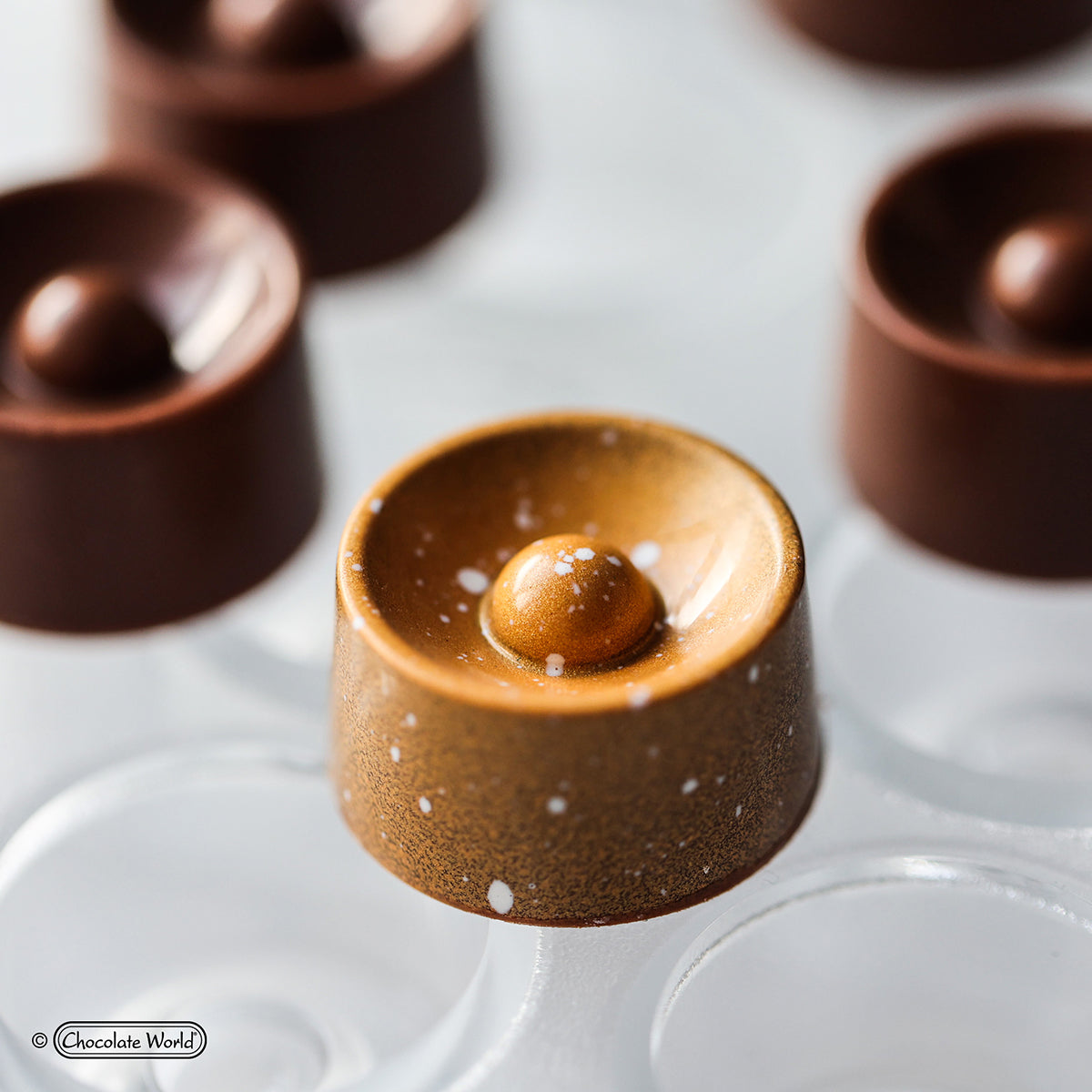
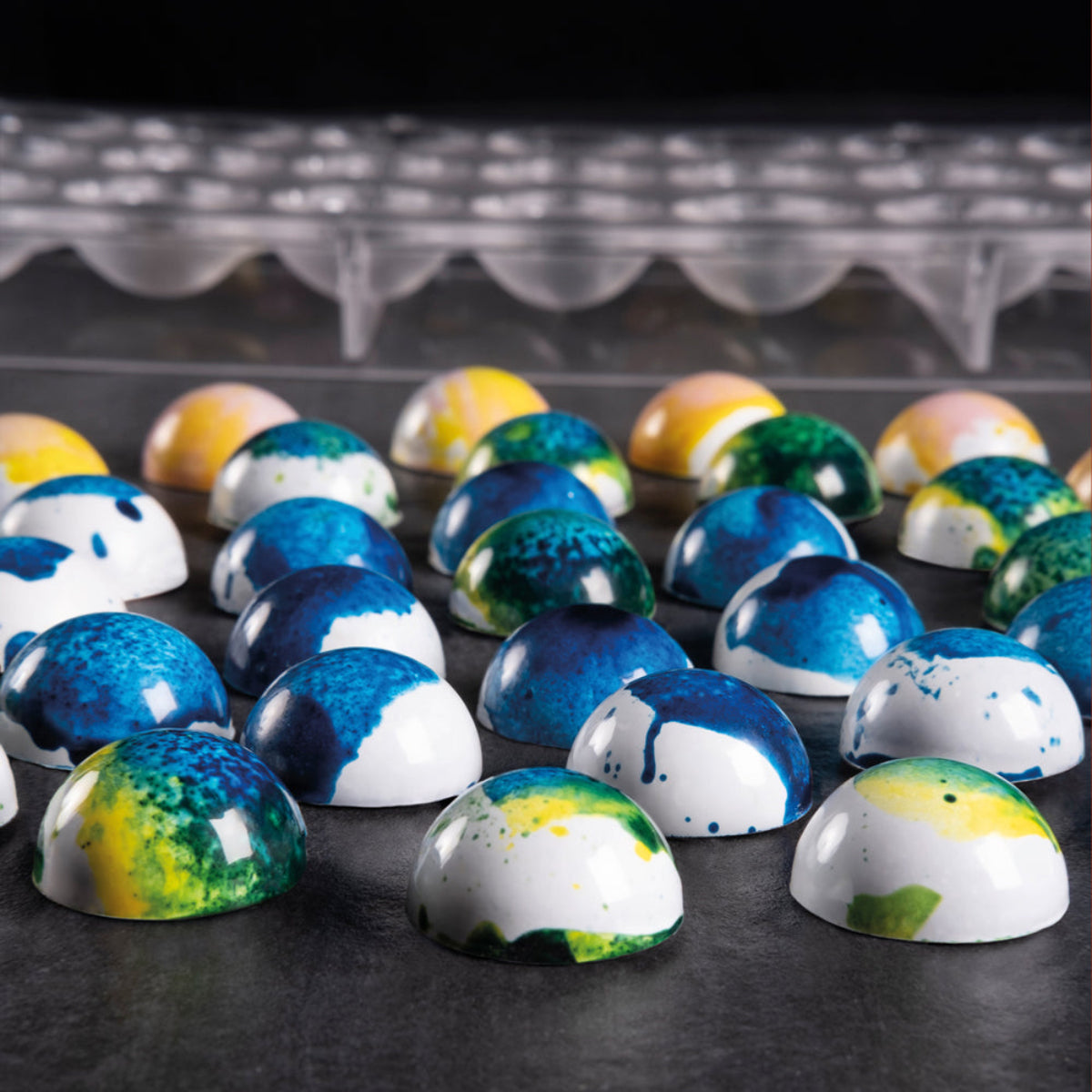
Good tempering leaves the chocolate with the largest number of the smallest possible crystals, in the right form (form V). Chocolate in that state crystallises quickly, contracts as much as it can (which is what pulls it away from a polycarbonate mould), sets with a high gloss and resists fat bloom. The seed crystals let the surrounding liquid cocoa butter crystallise quickly in the same stable form. Smaller, more regular seed crystals give a glossier chocolate with better bloom resistance. Each problem below is a departure from that state.
Problem 1: Chocolate is not setting or stays soft
The usual cause is too few seed crystals (under-tempering), so the chocolate has to form new crystals on its own and takes far longer to set.
Cause: when the concentration of seed is too low, crystallisation time increases drastically, and the crystals that form spontaneously during cooling are unstable. Heat does the same thing after the fact: above about 32–34°C (90–93°F) cocoa butter partly melts and recrystallises in unstable forms, like untempered chocolate.
Fix:
- Run the palette-knife test before you fill another mould. If it fails, add seed rather than heat.
- For pieces that already set soft or streaky: melt them down completely and temper again. Tempering starts by melting out all the crystals (the Martellato programs melt to 45°C/113°F before seeding).
- Check the bowl with a thermometer, not by feel.
Problem 2: Streaks, swirls or a grainy surface
Streaks or a grainy texture on the test or on finished pieces mean the chocolate is under-seeded.
Fix: add more seed (pistoles) or table a little more, stir, and test again before you continue. Do not raise the temperature to fix it.
Problem 3: White or grey bloom within a few days
Bloom that appears quickly, often in less than two days, as large white spots or white rings around a dark glossy centre, is the signature of under-tempered chocolate.
Fix: the bloomed pieces cannot be sold as they are; melt them down and temper again. Then look at storage: bloom forms faster as storage temperature rises, and chocolate that goes above about 32–34°C (90–93°F) partly melts and blooms on cooling. Bassan specifies storage at 16–20°C (61–68°F), below 50% relative humidity, away from temperature fluctuations.
To tell bloom from mould, and to prevent it in storage, read chocolate bloom vs mould and how to prevent chocolate bloom.
Problem 4: Chocolate gets too thick to work (over-tempered)
Chocolate that thickens in the bowl although its temperature looks right has too many crystals: it is over-tempered (over-seeded).
Check: lift some on your paddle and let it run back from 15–20 cm (six to eight inches) above the bowl. If the tempered chocolate is clearly thicker than it was melted, it is over-seeded.
Cause: the seed concentration rises with excessive tempering time. Ewald Notter also warns that too much stirring makes the chocolate too thick.
Fix: melt some crystals out very carefully, warming slightly while leaving enough to keep the chocolate seeded, then test again. Work in batches you can use in time: Bassan, for example, says to use its 71% within four hours of tempering.
If the chocolate is tempered but still too thick for thin bonbon shells or dipping, adding cocoa butter increases fluidity. See how to make melted chocolate thinner.
Problem 5: Chocolate sticks to the mould and will not release
Chocolate that will not release did not contract enough, which points back to the crystals.
Cause: well-tempered chocolate contracts as it crystallises, and that contraction is what makes demoulding easy. Over-tempered chocolate does not crystallise enough in the mould to produce that contraction; under-tempered chocolate crystallises far more slowly.
Fix:
- Test the temper before filling the next mould, and correct the seed as above.
- Demould with tools softer than polycarbonate, and use several light taps rather than one hard strike, as Chocolate World advises for its moulds.
Problem 6: Dull finish, no shine
A dull surface comes from the chocolate or from the mould.
- Over-tempering: the moulded surface is not bright, and the unmoulded surface turns grey and dull quickly.
- The mould surface: chocolate copies the cavity. Chocolate World notes that hard water can leave traces in polycarbonate that are visible on the end product, and that a first moulding after washing restores part of the shine, with full gloss returning over the following productions. See how to clean polycarbonate chocolate moulds.
Problem 7: Cracks, pores or marks after cooling
Cooling too fast can produce unstable crystal forms and fine hair cracks and pores on the surface, both of which promote bloom later. In filled chocolates, cooling that is too hot or too cold can melt the chocolate, crack it, or deposit moisture that leads to sugar bloom.
Fix: cool in a controlled space rather than the coldest place available. For its 71%, Bassan specifies crystallising at 16–18°C (61–64°F) and a work room at 16–20°C (61–68°F).
Problem 8: Lumps in the bowl
Notter's diagnosis: if the chocolate becomes too cold, lumps may form. He breaks them up with an immersion blender, whose friction also warms the chocolate, then stirs gently. Do not stir too briskly: it traps air bubbles that carry moisture into the chocolate. Milk and white chocolates are especially vulnerable, because their milk powder and extra sugar absorb more moisture.
Preventing the problems: hold the temperature
Most of the problems above start when the chocolate drifts after it has been tempered. The right tool depends on your volume:
- Measure: a probe thermometer such as the Martellato 50T003 with immersion probe ($53.95) or the Martellato infrared thermometer 50T002 ($76.50).
- Seed by hand, then hold: the Martellato Digital Meltinchoc melts to 45°C, signals when to seed, lowers to the program's working temperature and keeps it constant while you work. Three programs (dark, milk, white), integrated probe, 110V. The 6 L MCD102 ($1,259.99) suits a full production shift.
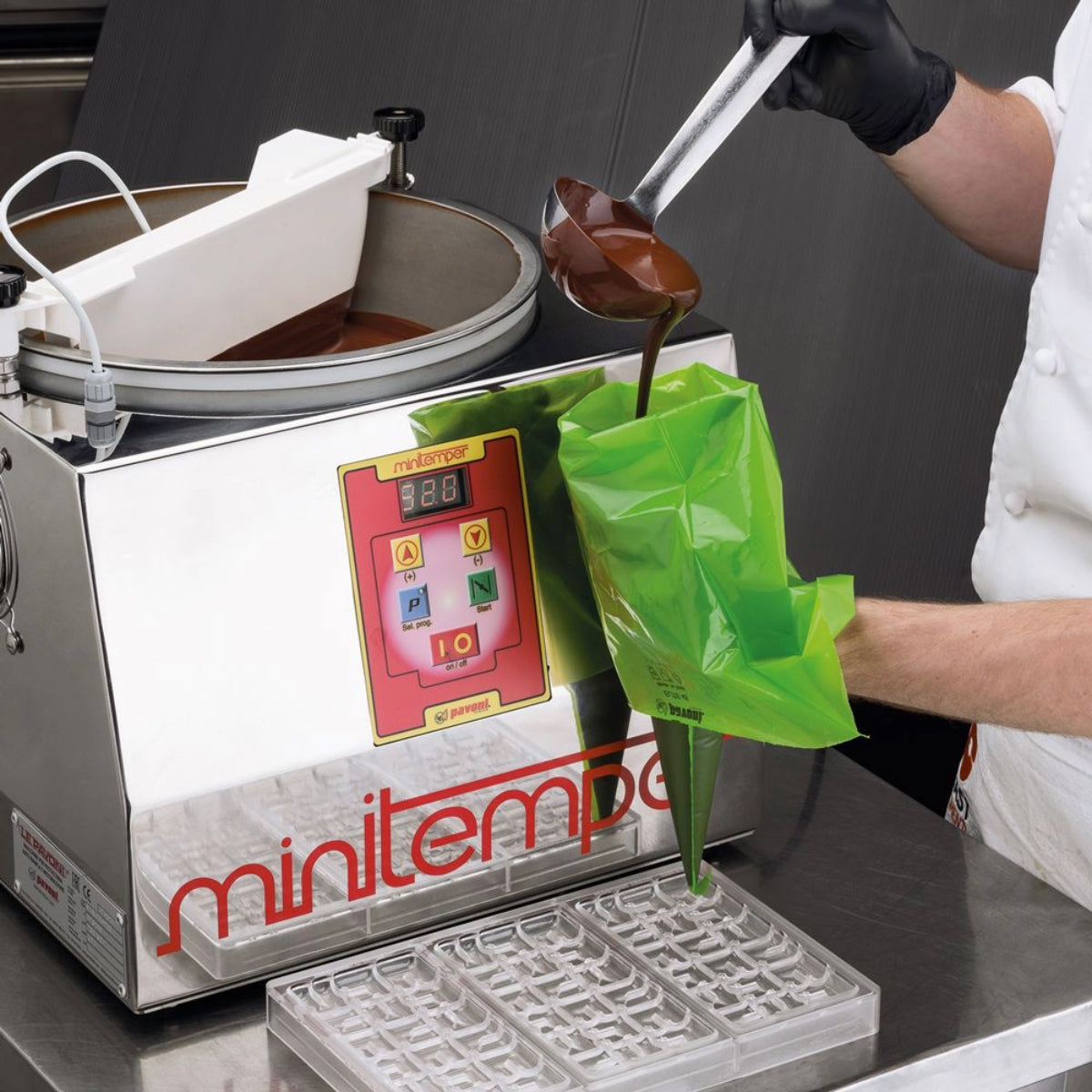
- Automatic, small batches: the Pavoni MiniTemper (3.5 kg, 110V) runs three-stage programs (melt, crystallise, harden) with five programmable presets and an interchangeable basin for switching chocolates.
- Production volumes: tabletop auger machines with 5–6 kg tanks. The Pomati T5 (5 kg tank, $11,650.00) tempers directly in its auger; the Bilait Adam K6 (6 kg, $10,990.00) tempers 20 kg of chocolate in 4.5 hours, up to 45 kg a day, with a heated vibrating table and a stop & go pedal for dosing.
View tabletop tempering machines → View Bilait →
For help choosing, read why you need a chocolate tempering machine.
How AI can help your production
Ask an AI assistant to turn the troubleshooting steps above into a one-page tempering SOP for your team, with a log for each batch: chocolate and lot, melt temperature, working temperature, temper-test time and result, room temperature and any correction made. After a few weeks, paste the log back and ask it to find patterns, for example which shift or which chocolate fails the test most often. Ask it to scale a recipe to the capacity of your machine so batches are used before they thicken.
AI organises the information; tasting and the final decision stay with your chef.
Tempering equipment and couverture at Zucchero Canada
We are an authorized distributor of Martellato, Pavoni Italia and Pomati, and the exclusive distributor of Bilait in Canada, based in Calgary. Each brand has its own job in tempering: Martellato for thermometers and melters that hold a hand-seeded temper, Pavoni for automatic small-batch tempering at 110V, and Pomati and Bilait for auger machines at production volume.
For the chocolate itself, Bassan Sur del Lago 71% is made in Canada from Venezuelan cacao and comes in 5 kg bags and 20 kg cases ($880.00), and FCH 55% dark ($299.00, 10 kg box) prints its full tempering curve. To adjust fluidity, natural cocoa butter comes in an 8 kg box ($550.00).
Browse all tempering machines →
Machines and chocolate are excluded from free shipping; orders over CAD 500 get 5% off automatically at checkout, and customers who bought their machine from us get 15% off genuine spare parts with code PARTS15. Not sure which machine fits your volume and electrical setup? Contact our team — we work with chocolatiers and pastry chefs across Canada and can recommend the right machine for your production. You can also call 587-774-8873 (toll free 877-741-8251).
Tempering machines | Chocolate melters | Thermometers | How to temper chocolate | Tempered vs untempered | Best chocolate for melting
This article is for information only. Every business is different: draw your own conclusions based on your own expectations, budget and goals, and talk to qualified experts before you decide or invest.
Sources: P. Lonchampt and R. W. Hartel, "Fat bloom in chocolate and compound coatings", European Journal of Lipid Science and Technology 106 (2004) 241–274; P. Greweling, "Tempering Chocolate", Pastry Arts Magazine, Summer 2024; E. Notter, The Art of the Chocolatier (Wiley, 2011), "Troubleshooting for Tempering Chocolate"; Martellato, Digital Meltinchoc user manual (programs table); Chocolate World Moulds catalogue, Edition 15, "Cleaning polycarbonate moulds"; product data for FCH 55% dark, Bassan Sur del Lago 71%, natural cocoa butter, Pavoni MiniTemper and Martellato Meltinchoc (zuccherocanada.ca); Bilait 2026 catalogue (Adam K6); Pomati, T5 tempering machine page (pomati.it).







Leave a comment
All comments are moderated before being published.
This site is protected by hCaptcha and the hCaptcha Privacy Policy and Terms of Service apply.