


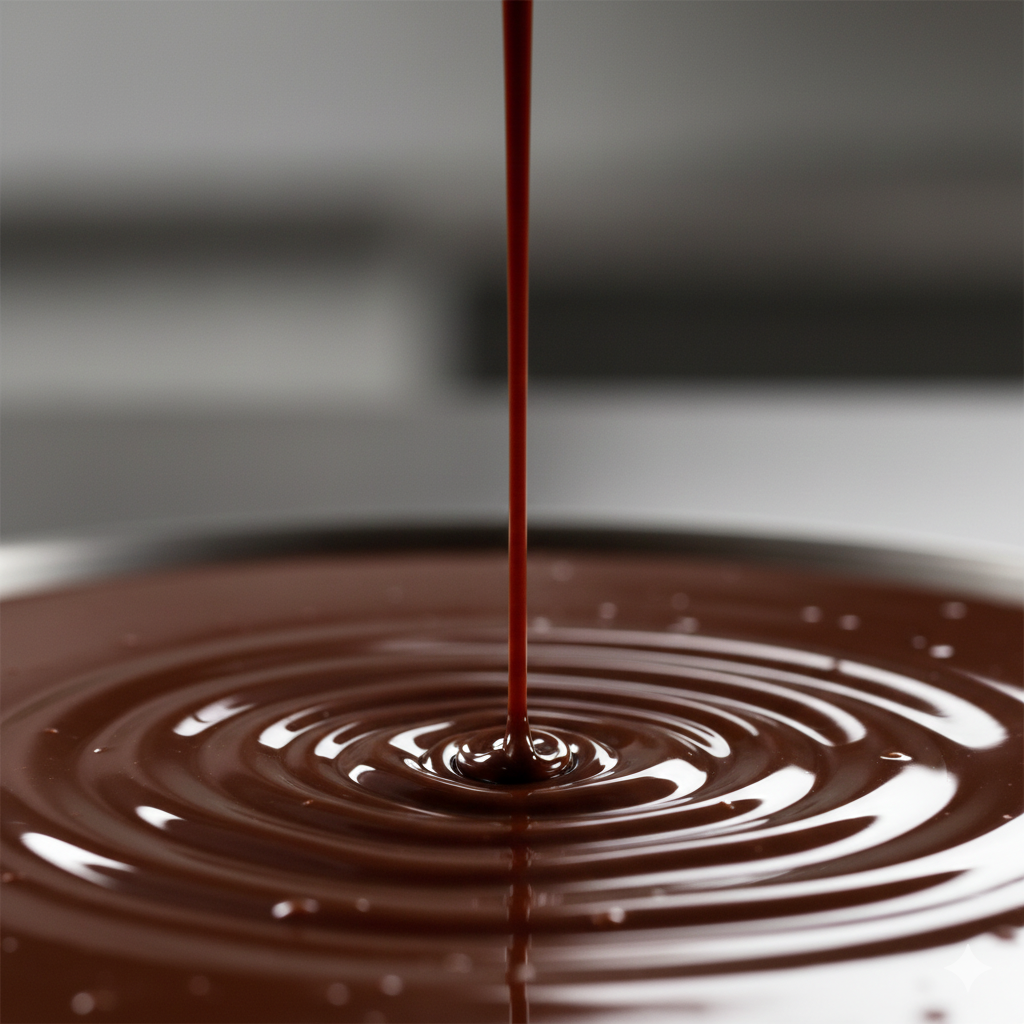
Chocolate Viscosity: What It Is, Why It Matters and How to Control It
Short answer: chocolate viscosity is how easily melted chocolate flows. Melted chocolate is a suspension of sugar, cocoa and milk particles in cocoa butter, so it does not flow like water: it has a yield value (the force needed to start it moving) and a plastic viscosity (its resistance once it moves). Viscosity matters because it decides how cleanly moulds fill and drain, how thick a shell or coating ends up and how fast a line can run. You control it with fat content, particle size, moisture, emulsifiers and, above all, the temper of the chocolate.
What viscosity means in chocolate
Chocolate is a non-Newtonian fluid: its viscosity changes with the force applied to it. A 2024 study of an industrial dark chocolate explains why. Molten chocolate is a suspension of sugar, cocoa and/or milk solids in a continuous fat phase, and its flow is described by two numbers:
- Yield value (yield stress): the energy needed to start the chocolate flowing. A high yield value makes chocolate stand up and hold its shape; a low one lets it level out under its own weight.
- Plastic viscosity: the energy needed to keep it flowing once it moves. A high plastic viscosity is thick and slow; a low one is fluid.
Chocolate is also shear-thinning: KREA Swiss notes that the harder you work it, the thinner it behaves.
Why viscosity matters in production
Each application needs a different flow. The Canadian baking textbook Understanding Ingredients for the Canadian Baker (BCcampus) gives the working rule:
| Application | Viscosity needed |
|---|---|
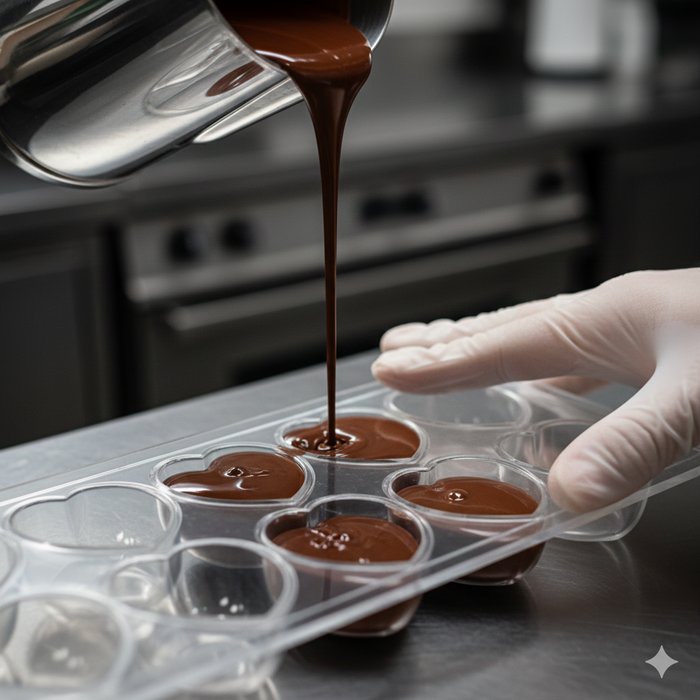
| Moulded pieces (Easter eggs, hollow figures) | Lower: the chocolate should be somewhat runny so it flows into the moulds |
| Coating cookies and most cakes | Lower: a thin, attractive, protective coating |
| Enrobers (machines that coat centres) | Thinner, to ensure an adequate coat |
| Ganache, flavouring creams and fillings | Somewhat thicker |
The same source notes that viscosity varies between manufacturers, and one type of chocolate can be sold in more than one viscosity. Some datasheets state it: our Bassan Sur del Lago 71% lists a target viscosity of about 5,000 mPa·s and a fluidity of 4 out of 5, with a working temperature of 30–32°C (86–90°F).
Viscosity also costs time on equipment. The same 2024 study points out that, with the same pump, a chocolate with twice the viscosity takes twice as long to pump the same distance.
What changes chocolate viscosity: a quick chart
Recipe, processing and handling all move the two flow numbers. This chart summarises what the 2024 study (and the tempering sources cited below) report:
| Factor | Effect on flow |
|---|---|
| More fat (cocoa butter) | Lower viscosity: the particles sit farther apart. The effect is stronger on plastic viscosity than on yield value |
| Finer particles (same fat content) | Higher viscosity and higher yield value: more particle surface to coat, less free fat |
| More moisture | Significantly higher viscosity: water forms syrup layers on the sugar particles and increases friction |
| Lecithin | Lowers plastic viscosity; in the study the effect levelled off at about 0.5–0.6%, while the yield value kept rising as lecithin went from 0.3% to 1.1% |
| PGPR | Lowers the yield value sharply |
| Too many cocoa butter crystals (over-seeded or over-crystallised chocolate) | Thickens the chocolate, until it sets in the bowl |
One point is often written the wrong way round: finer grinding does not thin chocolate. At the same fat content, smaller particles raise viscosity. Particle size is still worth controlling, because particles must be under about 25 µm so they are not perceived in the mouth.
Does adding cocoa butter reduce viscosity?
Yes. Adding cocoa butter increases the free fat between the particles, which lowers viscosity and improves fluidity; the 2024 study found fat acts more on plastic viscosity than on yield value. That is the classic way chocolatiers get thinner bonbon shells and easier dipping, and it is how we describe our natural cocoa butter (100% cocoa butter from Peruvian fine cacao, not deodorised). Emulsifiers do part of the same job at a lower cost: BCcampus notes that lecithin thins melted chocolate and is less expensive than cocoa butter for that purpose.
How much to add depends on your chocolate, so work from its datasheet and test small batches. For the hands-on techniques (cocoa butter, temperature, what not to add), see our guide on how to make melted chocolate thinner.
What are lecithin and PGPR in chocolate?
They are the two emulsifiers most used by the chocolate industry. Commercial soy lecithin is a mixture that contains 65–75% phospholipids; its molecules surround the sugar particles and keep them apart, which lowers plastic viscosity. PGPR (polyglycerol polyricinoleate) is made from polymerised glycerol and polymerised ricinoleic acid and acts mainly on the yield value. The industrial chocolate in the 2024 study contained 0.3% lecithin and 0.2% PGPR. Lecithin can also come from sunflower: our Bassan 71% uses organic sunflower lecithin.
Viscosity and temper: the most common cause of thick chocolate
In daily production, chocolate that thickens in the bowl is usually a temper problem, not a recipe problem. Peter Greweling, professor at the Culinary Institute of America, writes that properly tempered chocolate should not be significantly thicker than the same chocolate melted and untempered; if it is decidedly thicker, it is over-seeded, and you need to melt some crystals out very carefully while leaving enough to keep it tempered. KREA Swiss adds that stirring too fast or too long over-crystallises the chocolate, which turns thick and stiff, and that warming it much above about 34°C (93°F) destroys the stable crystals.
Greweling's order of checks is worth pinning above the bench:
- Temper test first. Dip a palette knife: dark chocolate should set within about seven minutes, with no streaks or grainy texture. If it fails, the chocolate is under-seeded; do not warm it.
- Then viscosity. Hold the paddle 15–20 cm (6–8 in) above the chocolate and watch how it lands: does it pile up or flatten, and how fast?
- Then temperature. Only when the first two are right.
More on the crystal side in chocolate crystallization.
How chocolate viscosity is measured
Laboratories measure molten chocolate with a rotational rheometer. The International Confectionery Association's standard, ICA method 46, tests molten chocolate at 40°C (104°F) and fits the flow curve to the Casson model, which gives the plastic viscosity and the yield value. The 2024 study used a slightly modified version of the ICA method, conditioning the sample at 40°C and shearing it at rates from 2 to 50 s⁻¹. KREA Swiss warns that many published viscosity figures are apparent values measured at very low shear (or with a flow cup under gravity), so they overstate the resistance the chocolate meets in a spray nozzle. Compare figures only when they were measured the same way.
What to check with your supplier when viscosity changes
If a couverture or cocoa liquor suddenly runs thicker on your enrober or in your moulds, ask the supplier for the parameters that drive flow, batch by batch:
- Fat content (%).
- Particle-size distribution (for example D90, or the share of particles under 20 µm).
- Moisture content (%).
- Emulsifier type and level (lecithin, PGPR).
- Plastic viscosity and yield value, measured with ICA method 46 (Casson model at 40°C).
Batches of the same industrial chocolate can differ: in the 2024 study, three batches of one 48% dark chocolate showed different particle sizes and different viscosities.
Equipment that keeps viscosity steady
Once the recipe is fixed, the goal is to hold the same temperature and the same temper from the first mould to the last.
- Martellato Digital Meltinchoc 3.6 L → $1,150.00 CAD. A probe in the chocolate and programs for dark, milk and white; after seeding, Martellato's manual says it keeps the tempering temperature constant.
- Martellato Digital Meltinchoc 6 L → $1,259.99 CAD. The same control with more chocolate on hand.
- Pavoni MiniTemper 110V → $3,350.00 CAD. A bench tempering machine that, according to Pavoni, keeps chocolate tempered for hours with customisable programs.
- Martellato 50T001 digital thermometer → $29.95 CAD, to check the chocolate itself, not just the machine setting.
How AI can help your production
Keep a simple log for each batch: chocolate and lot number, working temperature, temper-test time, your paddle observation and any cocoa butter you added. Paste a few weeks of it into an AI assistant and ask it to find patterns, for example which lots or which room temperatures go with thick chocolate. Ask it to turn your supplier's datasheet into a one-page viscosity checklist for your team, and to draft the email asking a supplier for the parameters above.
AI organises the information; tasting and the final decision stay with your chef.
Couverture and cocoa butter at Zucchero Canada
For producers who need predictable flow, start from a chocolate whose datasheet gives you the numbers. Bassan Sur del Lago 71% is made in Canada from Venezuelan Trinitario cacao with ancestral Criollo lineage and states its viscosity, fluidity and working temperature (5 kg bag $273.00 CAD). To adjust fluidity, our natural cocoa butter comes in an 8 kg box ($550.00 CAD). We are also the exclusive Canadian distributor of KKO Real Venezuelan cocoa products.
For the technique behind tempering, coating and glazing, Ramon Morató's Chocolate, 6th edition ($160.00 CAD) covers them in 416 pages.
Running an enrobing line or ordering couverture by volume? Contact our team or call 587-774-8873 (toll free 877-741-8251): we work with chocolatiers and pastry chefs across Canada.
Natural cocoa butter | Dark couverture | Tempering machines | How to make melted chocolate thinner | Chocolate crystallization
This article is for information only. Every business is different: draw your own conclusions based on your own expectations, budget and goals, and talk to qualified experts before you decide or invest.
Sources: Pombal M., Marcet I., Rendueles M., Díaz M., "Emulsifiers: Their Influence on the Rheological and Texture Properties in an Industrial Chocolate", Molecules 29 (2024) 5185; TA Instruments, "Evaluating the Flow Behavior of Molten Chocolate" (application note RH113, ICA method 46); BC Cook Articulation Committee, Understanding Ingredients for the Canadian Baker (BCcampus, CC BY 4.0), 7.7 "Viscosity"; Greweling P., "Tempering Chocolate", Pastry Arts Magazine (2024); KREA Swiss Knowledge, "Tempering, what it really is and where it goes wrong" and "Spraying chocolate, and why the viscosity figures mislead"; Martellato, Digital Meltinchoc user manual; Pavoni Italia, Machines catalogue (MiniTemper); Zucchero Canada product specifications (Bassan, natural cocoa butter).
Good to know
Frequently asked questions
Why is viscosity important when making chocolate?
Viscosity decides how chocolate behaves in each step: how it fills and drains a mould, how thick a shell or coating ends up, and how fast it can be pumped. Moulded pieces and thin coatings need a more fluid chocolate; ganache and fillings work with a thicker one. With the same pump, a chocolate twice as viscous takes twice as long to move the same distance.
Is chocolate a non-Newtonian fluid?
Yes. Melted chocolate is a suspension of sugar, cocoa and milk particles in cocoa butter, so its viscosity changes with the force applied. It has a yield value (the force needed to start it flowing) and a plastic viscosity (its resistance once flowing), and it is shear-thinning: the more you work it, the thinner it behaves.
Does adding cocoa butter reduce chocolate viscosity?
Yes. Extra cocoa butter adds free fat between the particles, which lowers viscosity and increases fluidity; the effect is stronger on plastic viscosity than on yield value. Chocolatiers use it for thinner bonbon shells and easier dipping. The right amount depends on your chocolate, so start from its datasheet and test small batches.
Why is my melted chocolate too thick?
In tempered chocolate, the usual cause is too many cocoa butter crystals: over-seeding, or stirring too fast or too long. Properly tempered chocolate should not be much thicker than the same chocolate melted and untempered. Moisture is the other common cause, because water forms syrup on the sugar particles and raises viscosity. Check the temper first, then the viscosity, then the temperature.
What is yield value in chocolate?
Yield value (or yield stress) is the energy needed to make melted chocolate start flowing. A high yield value makes chocolate stand up and hold its shape; a low one lets it level out under its own weight. It is measured with a rheometer and the Casson model, following ICA method 46 at 40°C (104°F). The emulsifier PGPR lowers it sharply.
Does couverture or cocoa butter qualify for free shipping?
Chocolate and cacao products are excluded from our free shipping offer on orders of $300 CAD or more, and food products ship within Canada only. Orders over $500 CAD get 5% off automatically at checkout. For volume orders of couverture or cocoa butter, contact our team.
Shop this article
Products mentioned in this guide
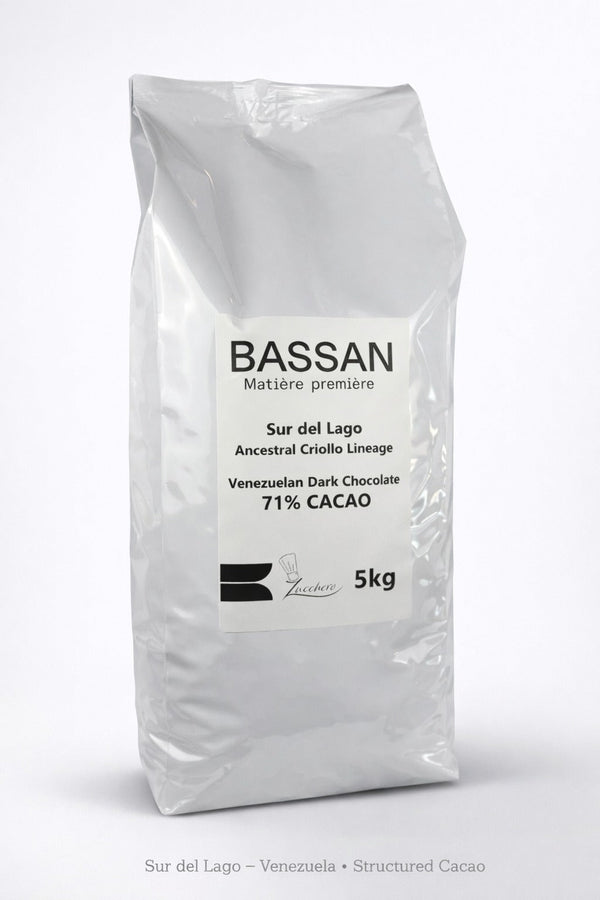 Bassan ChocolateSur del Lago Ancestral Criollo Lineage Dark Chocolate 71%From $69.95 CADView product →
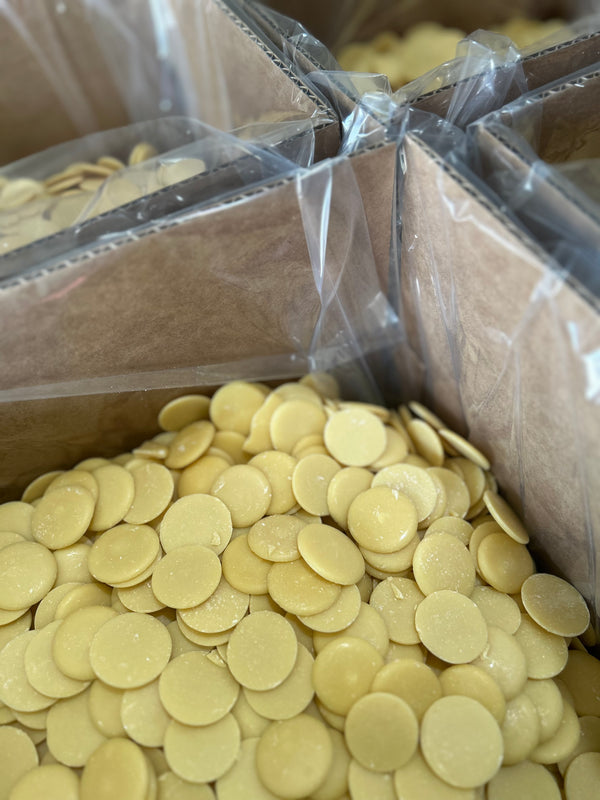 Canada Cacao Co.Natural Cocoa Butter 100% Peruvian Fine CacaoFrom $69.99 CADView product →
 MartellatoMeltinchoc Digital Melter 3.6 L – MCD101110V$1,150.00 CADView product →
 MartellatoMeltinchoc Digital Melter 6 L – MCD102110V$1,259.99 CADView product →
For professionals
Equipping a chocolate shop, bakery or kitchen?
Tell us what you produce and how much. We will recommend the right machine, moulds and ingredients, and send you a quote.
For home bakers
Professional tools for your own kitchen
The same European moulds, tools and ingredients the professionals use.
5% off orders over $500 CAD, applied automatically at checkout.
Keep reading


Leave a comment
All comments are moderated before being published.
This site is protected by hCaptcha and the hCaptcha Privacy Policy and Terms of Service apply.