







Short answer: for a chocolate melter, Martellato's manual says to switch it off, unplug it and let it cool before cleaning, wash the steel pan with hot water and dishwashing liquid, wipe the outer housing with a damp sponge, and never splash the electrical parts. For other equipment, follow its maker's own routine: Bilait builds the Adam K6 and K12 tempering machines for a complete cleaning in 10 and 15 minutes, Pavoni gives the MiniTemper interchangeable bowls, and Chocolate World publishes exact washing and drying temperatures for its moulds. Below, each type of equipment is covered with the numbers your team needs.
Quick answer: what to use for each job
| Your need | Equipment | Price |
|---|---|---|
| Melt and hold chocolate in a pan that lifts out for washing | Martellato Meltinchoc Digital 3.6 L | $1,150.00 |
| A spare 6 kg pan so one can be washed while the other works | Martellato 6 kg stainless steel bowl (MCV02) | $120.00 |
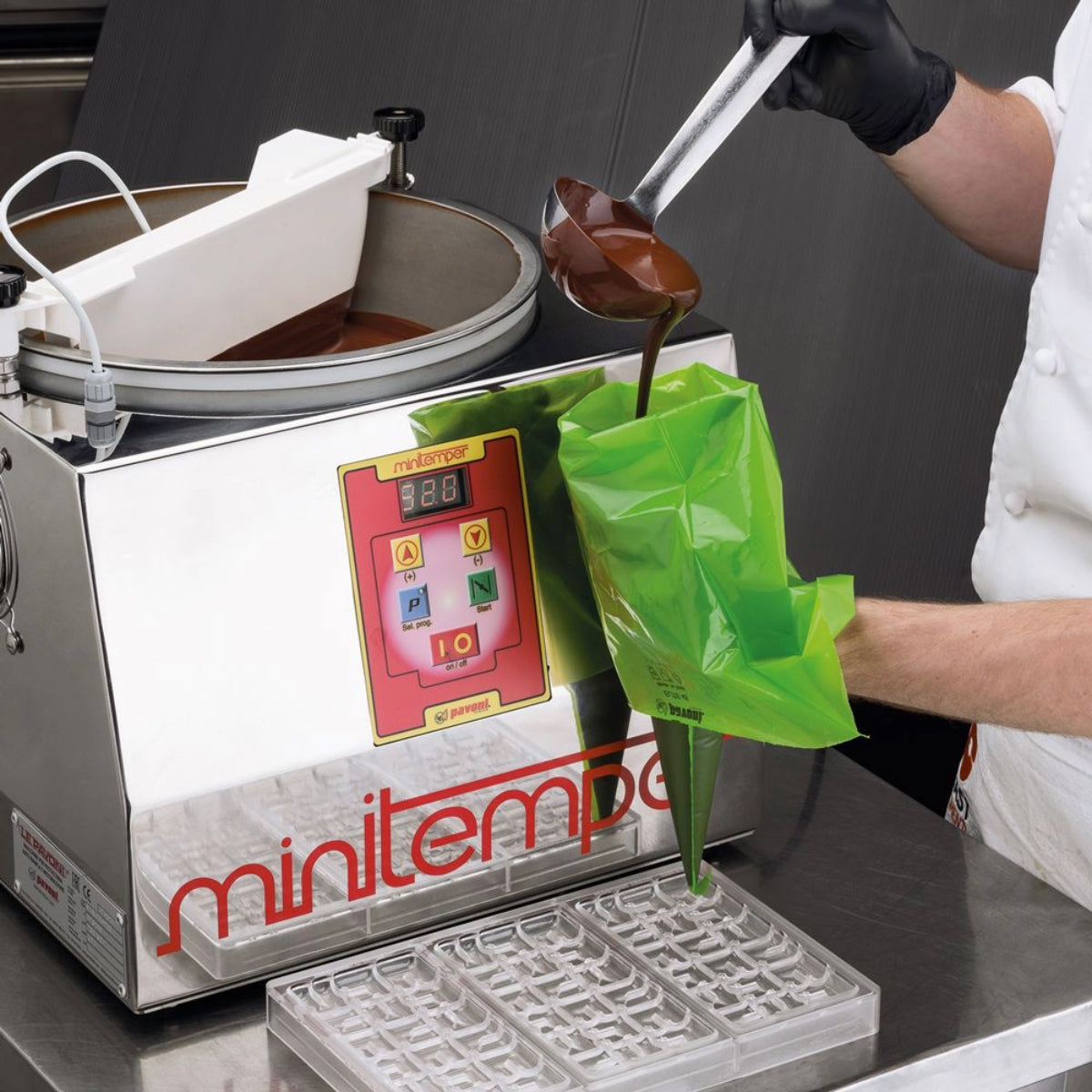
| Small-batch tempering with quick changeovers | Pavoni MiniTemper 110V | $3,350.00 |
| Production tempering with a 10-minute cleaning cycle | Bilait Adam K6 (6 kg) | $10,990.00 |
| A second MiniTemper bowl for another chocolate | MiniTemper extra stainless steel bowl | $299.00 |
| Scrape warm chocolate out of a pan before washing | Martellato soft one-piece spatula | $12.95 |
Before you clean anything: off, unplugged, cool
Every cleaning session starts with the power off. Martellato's manual for the Digital Meltinchoc melters gives the order: switch the appliance off at its switch, unplug it, and make sure no part is still hot; if it is, let the unit cool. The same manual warns that the parts inside the housing and the steel pan can become dangerously hot during operation, so lift the pan out only after the appliance has cooled, or with oven gloves.
Two more rules from that manual protect the machine between washes: never switch the melter on without the pan containing chocolate, and switch it off after each melting cycle.
Chocolate melters: the pan and the housing
A melter has two parts to clean, and they are cleaned differently. For the Digital Meltinchoc range, Martellato specifies:
| Part | How to clean it (Martellato) |
|---|---|
| Stainless steel pan (AISI 304) | Hot water and dishwashing liquid |
| Plastic outer housing | Warm water applied with a damp sponge; do not splash accessible electrical parts |
| Power cord | Check daily that it is in good condition and that the insulation is not damaged |
Scrape the chocolate out of the warm pan first with a soft spatula; Martellato's soft one-piece spatula is made of thermoplastic rated up to 100°C (212°F). Chocolate World gives the same advice for moulds: remove the chocolate before washing, so the dishwasher is not overloaded.
Not every Meltinchoc uses the same pan: the Mini Meltinchoc and the Deep Meltinchoc have anodised aluminium tanks, while the Digital range uses AISI 304 stainless steel. Follow the manual for the model you own.
- View the Meltinchoc Digital 3.6 L → $1,150.00
- View the Meltinchoc Analogue 6 L → $925.00
- View the Meltinchoc Multi-Tank (2 × 1.5 L tanks that lift out separately) → $865.00
A second pan changes the routine: the 6 kg MCV02 bowl, in 18/10 AISI 304 stainless steel, fits the 6 kg Meltinchoc models and also Mol d'Art 6 kg melters, so one pan can go to the sink while the other keeps working.
Tempering machines: plan the cleaning into the changeover
On a tempering machine, cleaning time is production time, so the design of the machine matters as much as the routine. Here is what each maker builds in:
| Machine | What the maker designed for cleaning |
|---|---|
| Pavoni MiniTemper | Body and bowl in AISI 304 stainless steel; interchangeable bowls "for reduced downtime"; transparent PET lid |
| Bilait Adam K6 | Reversible pump that allows a complete cleaning in 10 minutes; heated vibrating table that prevents chocolate buildup; stainless steel auger |
| Bilait Adam K12 | Stainless steel auger that is easily removable, for a complete cleaning in 15 minutes |
With the MiniTemper, a second bowl lets you switch between batches or keep a backup bowl in production while the first one is washed. Pavoni rates the MiniTemper at 5 L / 3 kg and 300 W.
- View the Pavoni MiniTemper 110V → $3,350.00
- View the MiniTemper extra bowl → $299.00
For production volumes, Bilait rates the Adam K6 at a 6 kg capacity that tempers 20 kg of chocolate in 4.5 hours, up to 45 kg a day. A machine you can clean in a set number of minutes lets you plan a colour or chocolate change into the shift instead of losing the afternoon to it.
- View the Bilait Adam K6 → $10,990.00
View Bilait tempering machines →
Moulds: polycarbonate and silicone are cleaned differently
Polycarbonate moulds need controlled temperatures; silicone moulds need gentle products. The two sets of instructions come from the makers of the moulds we stock:
| Point | Polycarbonate (Chocolate World) | Silicone (Pavoni) |
|---|---|---|
| Washing | Around 60°C (140°F), detergent compatible with polycarbonate | Dishwasher, without abrasive products or harsh detergents |
| Rinsing | Demineralised water, about 60°C (140°F) | Not specified |
| Drying | Hot air, 70–80°C (158–176°F); magnetic moulds 65°C (149°F) | Not specified |
| Temperature in use | 5°C to 80°C (41–176°F) | -40°C to +250°C (-40°F to 482°F) |
| Avoid | Sharp items in the cavities, hard strikes, storage under pressure, direct sunlight | Knives on the mould, direct heat (flame, grill, ceramic hob, electric plate), the microwave's CRISP function |
Chocolate World also advises cleaning new moulds before their first use, removing chocolate before washing so the dishwasher is not overloaded, and running a first moulding after washing to bring back the shine. The full procedure, step by step, is in our guide to cleaning polycarbonate chocolate moulds.
View Chocolate World polycarbonate moulds →
View Pavoni Pavoflex silicone moulds →
Write the routine down
A written routine is what makes every shift clean the same way. The Canadian Food Inspection Agency's guidance on cleaning and sanitation programs says a written program should describe who cleans, where, what, when and how, with step-by-step details, and that cleaning and sanitizing should be recorded on a standard form showing who was responsible, the activities, the chemicals used, the date and time, and the verification.
The CFIA also separates the two jobs: cleaning removes dirt or debris by physical or chemical means, while sanitizing reduces micro-organisms to levels considered safe. Here is a starting routine built only from the manufacturers' instructions above; add your own sanitizing step and products as your food safety plan requires.
| When | Task | From |
|---|---|---|
| Every day | Check melter power cords and their insulation | Martellato manual |
| After each melting cycle | Switch the melter off | Martellato manual |
| At each chocolate change | Swap in a clean bowl or pan, wash the used one | Pavoni MiniTemper; Martellato MCV02 bowl |
| End of production | Empty and clean the tempering machine as its manual describes | Bilait Adam K6 / K12 |
| After every wash of polycarbonate moulds | Dry at 70–80°C (158–176°F), then run a first moulding | Chocolate World |
For more on keeping moulds in good condition between productions, see how to store chocolate moulds properly.
Repairs and spare parts
Martellato's manual says repairs and the replacement of any parts should be done by a professional electrician or by contacting Martellato's service centre. For wear parts, genuine parts keep the machine running as its maker designed it: customers who bought their machine from Zucchero get 15% off genuine spare parts with the code PARTS15.
View machine wear parts in the 15% program →
How AI can help your production
Paste the tables above into an AI assistant and ask it to turn them into a one-page cleaning procedure for each machine on your floor, with the who, where, what, when and how that the CFIA guidance describes. Ask it to build a cleaning log with columns for the person responsible, the products used, the date and time and a verification signature, and a reminder schedule for daily cord checks and end-of-shift cleaning. A written, signed routine is easier to train and easier to show an inspector.
AI organises the information; tasting and the final decision stay with your chef.
Chocolate equipment at Zucchero Canada
We are an authorized distributor of Martellato, Pavoni Italia and Chocolate World, and the exclusive distributor of Bilait in Canada. Each brand has a clear job in a chocolate kitchen:
- Martellato Meltinchoc to melt and hold chocolate, from the 1.8 L Mini Meltinchoc to the 13.7 L Digital. Martellato, Mol d'Art and Bilait table-top melters come with a free spatula.
- Pavoni MiniTemper for small-batch tempering with interchangeable bowls.
- Bilait Adam tempering machines for production volumes.
- Chocolate World polycarbonate moulds and Pavoni silicone moulds for shaping.
Buying for a chocolate shop, bakery or hotel? Contact our team for volume orders, or call 587-774-8873 (toll free 877-741-8251).
Chocolate melters | Tempering machines | Machine parts | Cleaning polycarbonate moulds | Melter vs temperer
This article is for information only. Every business is different: draw your own conclusions based on your own expectations, budget and goals, and talk to qualified experts before you decide or invest.
Sources: Martellato, Digital Meltinchoc "Hand book of use and maintenance" (MCD101–MCD104), sections 2.0, 4.0, 6.0 and 8.0; Pavoni Italia, MiniTemper product page (pavonitalia.com) and Machines catalogue 2022; Bilait, 2026 catalogue (Adam K6, Adam K12); Chocolate World Moulds catalogue, Edition 15, "Cleaning polycarbonate moulds"; Pavoni Italia, Food Equipment catalogue 2026, "Silicone in pastry: tips"; Canadian Food Inspection Agency, "Cleaning and sanitation program" (2020); Zucchero Canada product pages.







Leave a comment
All comments are moderated before being published.
This site is protected by hCaptcha and the hCaptcha Privacy Policy and Terms of Service apply.