




If you've opened a chocolate bar and found a chalky white film on the surface, you're probably wondering whether it's safe to eat — or whether something has gone wrong. The short answer: a white or grayish coating is almost always bloom, which is harmless. Actual mold on chocolate is rare and looks completely different.
This guide explains how to tell them apart, what causes bloom, and — for chocolatiers and pastry chefs — how to prevent it from happening in production.
The quick answer: bloom vs mold
Chocolate bloom is a surface defect caused by either fat or sugar crystals migrating to the surface of the chocolate. It looks like a dusty, chalky, or streaky white-to-gray film. The chocolate underneath is completely safe to eat.
Mold on chocolate is extremely rare because chocolate's low water activity (typically below 0.5) doesn't support microbial growth. When mold does appear, it usually grows on a filling or inclusion. Mold is fuzzy, three-dimensional, and often green, gray, black, or blue.
How to tell the difference at a glance
- Bloom is flat, dusty, and uniform across the surface. Wipe a finger across it and it smudges like powder.
- Mold is raised, fuzzy, and patchy with visible filaments. Usually appears in discrete spots, not across the whole surface.
- Bloom has no smell. Mold smells musty or sour.
- Bloom appears on the chocolate itself. Mold almost always appears on a filling or moist surface.
The two types of chocolate bloom
Fat bloom
The most common type. Happens when cocoa butter crystallizes in an unstable form, then re-crystallizes on the surface over time. Looks like a soft, greasy white film.
Main causes: improper tempering (unstable Form V crystals), temperature fluctuations during storage above 18°C, and fat migration from rich fillings (hazelnut praline, ganache) through the shell over weeks.
Sugar bloom
Happens when moisture contacts the chocolate surface — condensation or humid storage. Moisture dissolves surface sugar; when it evaporates, the sugar recrystallizes into rough, gritty crystals. Sugar bloom feels sandy or sticky; fat bloom feels dry and powdery.
How professionals prevent bloom in production
Precise tempering
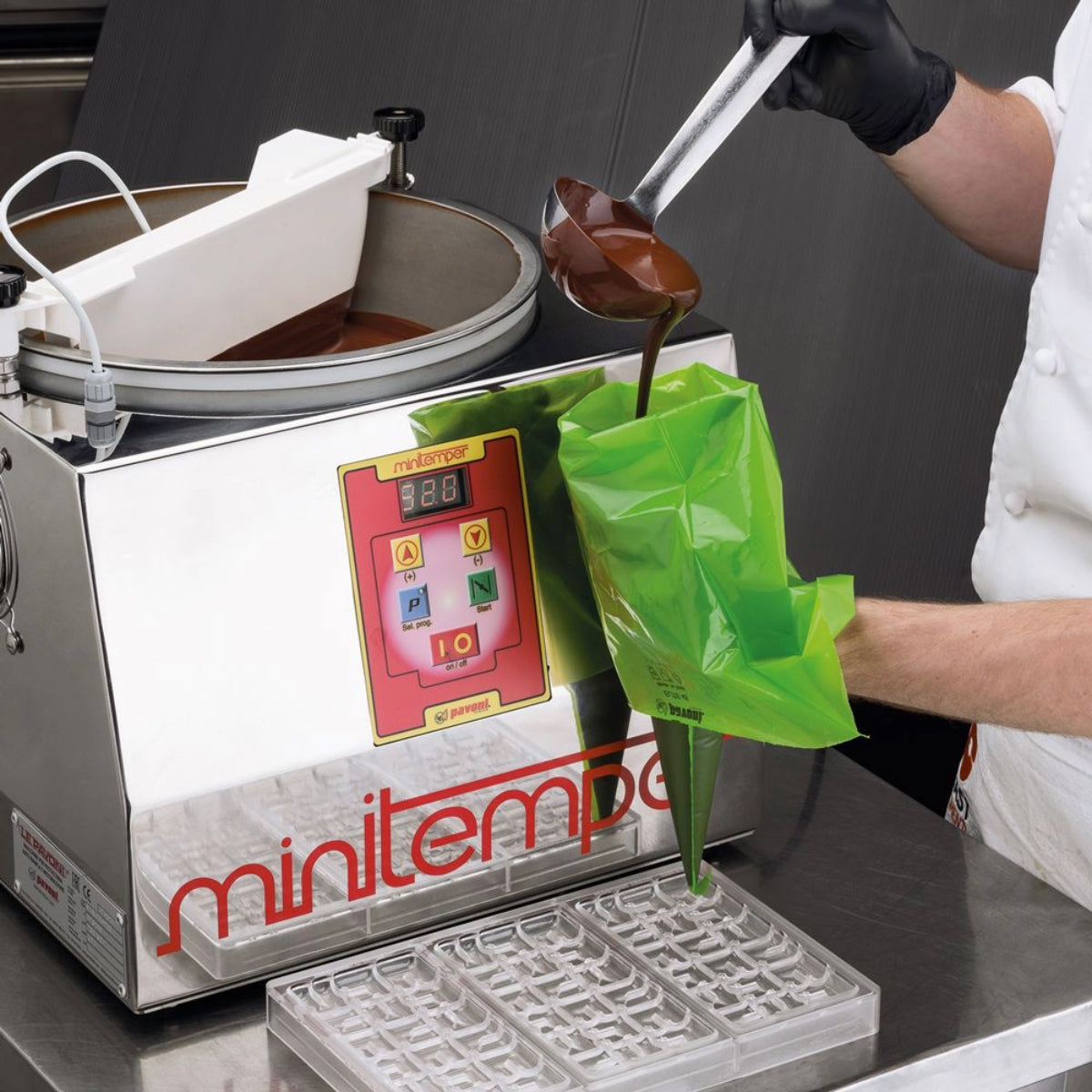
Tempering is the controlled formation of stable Form V cocoa butter crystals. For production volume, a continuous tempering machine maintains the temperature curves required:
- Dark chocolate: heat to 45-50°C, cool to 28-29°C, work at 31-32°C
- Milk chocolate: heat to 40-45°C, cool to 27-28°C, work at 29-30°C
- White chocolate: heat to 40°C, cool to 26-27°C, work at 28-29°C
Quality couverture and cocoa butter
Single-origin cocoa butter from Venezuela or Peru has a more consistent fatty acid profile than mass-market alternatives, meaning more predictable crystallization. Couverture-grade chocolate (32%+ cocoa butter) tempers more forgivingly.
Climate-controlled storage
Store tempered chocolate at 16-18°C, below 50% RH. A dedicated chocolate fridge is far more reliable than a standard kitchen cooler, which cycles between 4-8°C and creates condensation every time the door opens.
Avoid temperature shock
Never move chocolate directly from cold storage to a warm production room. Allow gradual acclimation in sealed packaging.
Controlled cooling after molding
Cool at 12-15°C with gentle airflow. A cooling cabinet or tunnel gives consistent results; avoid refrigerators that cycle too cold too fast.
When you've already got bloom: can you fix it?
- Re-melt and re-temper. Bloomed chocolate goes back into your melter, gets re-tempered, and is fine for the next batch.
- Repurpose for ganache or baking. Bloomed couverture works perfectly in ganaches, mousses, and baked goods.
If you're seeing bloom regularly in production, it's a process signal — tempering, storage, or cooling. Contact our team to troubleshoot.
Frequently asked questions
- Is it safe to eat chocolate that has turned white or gray?
- Yes — a white or gray film is almost always fat bloom or sugar bloom, both of which are harmless. The chocolate is safe to eat and can be re-melted and re-tempered. Actual mold on chocolate is extremely rare and looks fuzzy, not flat.
- What is the difference between fat bloom and sugar bloom?
- Fat bloom is dry and powdery — caused by unstable cocoa butter crystals migrating to the surface. Sugar bloom is sandy or sticky — caused by moisture dissolving surface sugar, which recrystallizes when moisture evaporates. Both are cosmetic defects, not spoilage.
- Can bloomed chocolate be re-tempered and used for production?
- Yes — re-melting bloomed chocolate in a melter and re-tempering it restores full working chocolate. Most professional chocolatiers run a reclaim stream of bloomed and trim chocolate back into production alongside fresh couverture.
- How do I prevent bloom in a professional production environment?
- Precise tempering with a continuous tempering machine, stable storage at 16-18°C below 50% RH, pre-warmed molds (26-28°C), and controlled cooling at 12-15°C prevent the overwhelming majority of bloom issues in professional production.









Leave a comment
All comments are moderated before being published.
This site is protected by hCaptcha and the hCaptcha Privacy Policy and Terms of Service apply.