

How to Choose the Best Chocolate Mold: Materials, Designer Molds and Accessories
Short answer: the best chocolate mold is the one whose material fits your chocolate work and whose cavities fit your product. For glossy bonbons and bars in tempered chocolate, choose a rigid polycarbonate or Tritan mould; for pastry, inserts and frozen desserts, choose silicone; for hollow and seasonal figures, transparent, reusable thermoformed moulds are another option. Then read the specification: cavity size, number of cavities, weight per piece and mould size tell you exactly what one mould produces.
| Your need | What we recommend | Price |
|---|---|---|
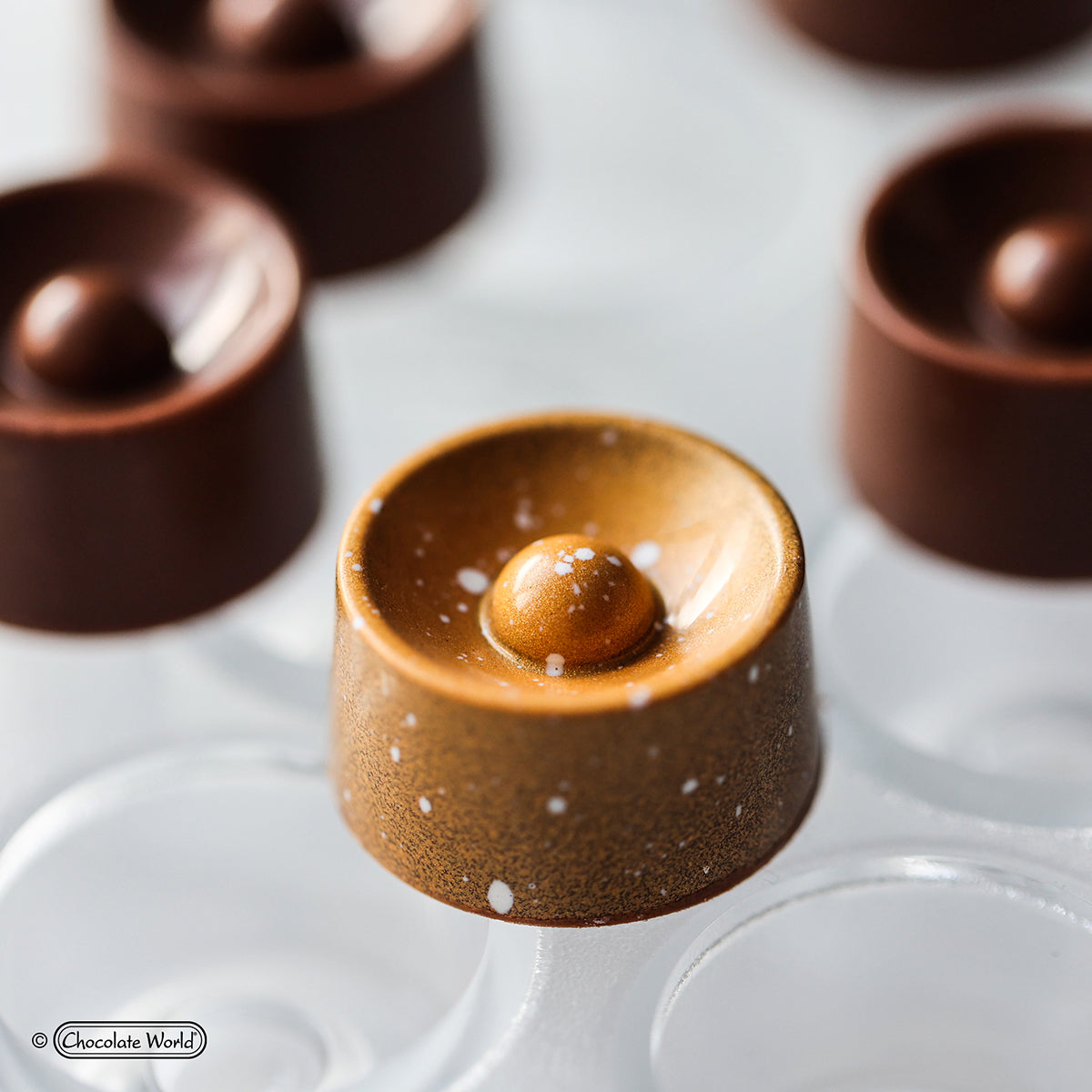
| Filled bonbons, 10.5 g | Chocolate World × Andrey Dubovik CW1921, 21 cavities | $39.95 CAD |
| A designer praline shape | Chocolate World × Frank Haasnoot Praline Curve CW1903 | $39.95 CAD |
| Designer chocolate bars | Pavoni Italia Lovely by Antonio Bachour PC5000FR (Tritan) | $46.99 CAD |
| Classic retail tablets | Chocolate World Tablet CW2162, 3 tablets | $44.95 CAD |
| Pastry and frozen desserts | Pavoni Italia Pavoflex Heart by Gianluca Fusto | $40.50 CAD |
| Scraping moulds clean | Professional chocolate scraper 145 mm | $36.95 CAD |
Polycarbonate, Tritan, silicone or thermoformed: which material?
Rigid moulds (polycarbonate and Tritan) are for tempered chocolate that must shine and snap; flexible silicone is for pastry; transparent, reusable thermoformed plastic suits hollow and seasonal figures.
| Material | Best for | Manufacturer data |
|---|---|---|
| Polycarbonate (Chocolate World) | Bonbons, pralines, tablets, lollipops | Use between 5°C and 80°C (41–176°F); wash at about 60°C (140°F) with a detergent compatible with polycarbonate; dry at 70–80°C (158–176°F) maximum |
| Tritan (Pavoni Italia) | Bars and pralines in daily production | BPA free; Pavoni: ideal for professional and intensive use, with high resistance to impacts, scratches and washing cycles |
| BPA-free resin (Martellato) | Pralines and seasonal shapes | BPA-free food-grade resin, dishwasher safe |
| Silicone (Pavoni Italia Pavoflex) | Entremets, inserts, baked and blast-chilled desserts | 100% platinum food-grade silicone; oven and blast chiller from −40°C to +250°C (−40°F to 482°F); dishwasher safe |
| Thermoformed plastic (Pavoni Italia) | Hollow and seasonal figures | Transparent and reusable; the Snow Tree KT191, for example, is rated from −40°C to +60°C (−40°F to 140°F) |
Why rigid moulds need tempered chocolate: good tempering makes chocolate crystallise quickly with maximal contraction, which facilitates mould release, and gives a high gloss (Lonchampt and Hartel, 2004). Compound coating does not set firmly enough to come out of a mould (BCcampus). Silicone releases by flexing, so it forgives more, but the shine and snap of the chocolate still come from tempering.
Choose the shape by the product you sell
Start from what you will sell, then pick the mould family that makes it.
- Filled bonbons and pralines: bonbon and praline moulds, where the cavity depth leaves room for a shell and a filling.
- Bars and tablets: bar and tablet moulds, for retail bars and gift tablets.
- Figures and hollow shapes: 3D figure moulds and thermoformed moulds for seasonal pieces.
- Logos and printed designs: Chocolate World magnetic moulds. A polycarbonate frame with magnets holds a transfer sheet against a removable metal plate; as the tempered chocolate cools, the print adheres to it (Chocolate World).
- Pastry: Pavoflex silicone moulds for entremets and individual desserts.
How to read a chocolate mold specification
Cavity size, cavities per mould and weight per piece tell you your yield; the mould size tells you whether it fits your machine, your racks and your fridge.
| Mould | Cavity (mm) | Pieces × weight | Chocolate per mould | Mould size (mm) |
|---|---|---|---|---|
| Chocolate World CW1921 (Dubovik) | 36.5 × 27.5 × 16.5 | 21 × 10.5 g | About 220 g of finished pieces | 275 × 135 × 24 |
| Chocolate World CW1903 (Haasnoot) | 45.5 × 28 × 14 | 21 × 7.5 g | About 158 g | 275 × 135 × 24 |
| Chocolate World CW2162 tablet | 155 × 77 × 9 | 3 × 10⁸ g | About 324 g | 275 × 175 × 24 |
| Pavoni Italia PC5000 Lovely (Bachour) | 150 × 76 × 10 | 3 × about 100 g | About 300 g | 275 × 175 |
Weights are the manufacturers' catalogue figures for a full piece; a filled bonbon combines shell and filling. Two frame sizes recur across Chocolate World's catalogue, 275 × 135 mm and 275 × 175 mm; if you use a tempering machine with a vibrating table, check the frame size against it before you buy a series of moulds.
Designer chocolate molds: chef signature collections
Designer moulds are shapes developed with well-known chefs; they give your range a recognisable look without a custom mould.
- Chocolate World Chef's signature: moulds developed in cooperation with chefs, such as Andrey Dubovik's CW1921 and Frank Haasnoot's Praline Curve CW1903. Chocolate World's catalogue publishes a chef recipe with several of these moulds; for the CW1921, Dubovik fills the shells at 29–30°C (84–86°F).
- Pavoni Italia bar collections: Tritan bar moulds by Antonio Bachour, Vincent Vallée and Fabrizio Fiorani, such as the Lovely PC5000FR.
- Pavoni Italia Pavoflex: silicone moulds designed by pastry chefs, such as Gianluca Fusto's Heart.
Chocolate mold accessories that matter
A mould works only as well as the tools around it: temperature control, a clean scrape, colour and decoration.
| Accessory | Its job | Our pick |
|---|---|---|
| Thermometer | Check the chocolate is at working temperature before filling | Martellato 50T001, $29.95 CAD |
| Scraper | Clear excess chocolate from the mould surface for flat, neat bases | 145 mm stainless-steel blade, $36.95 CAD |
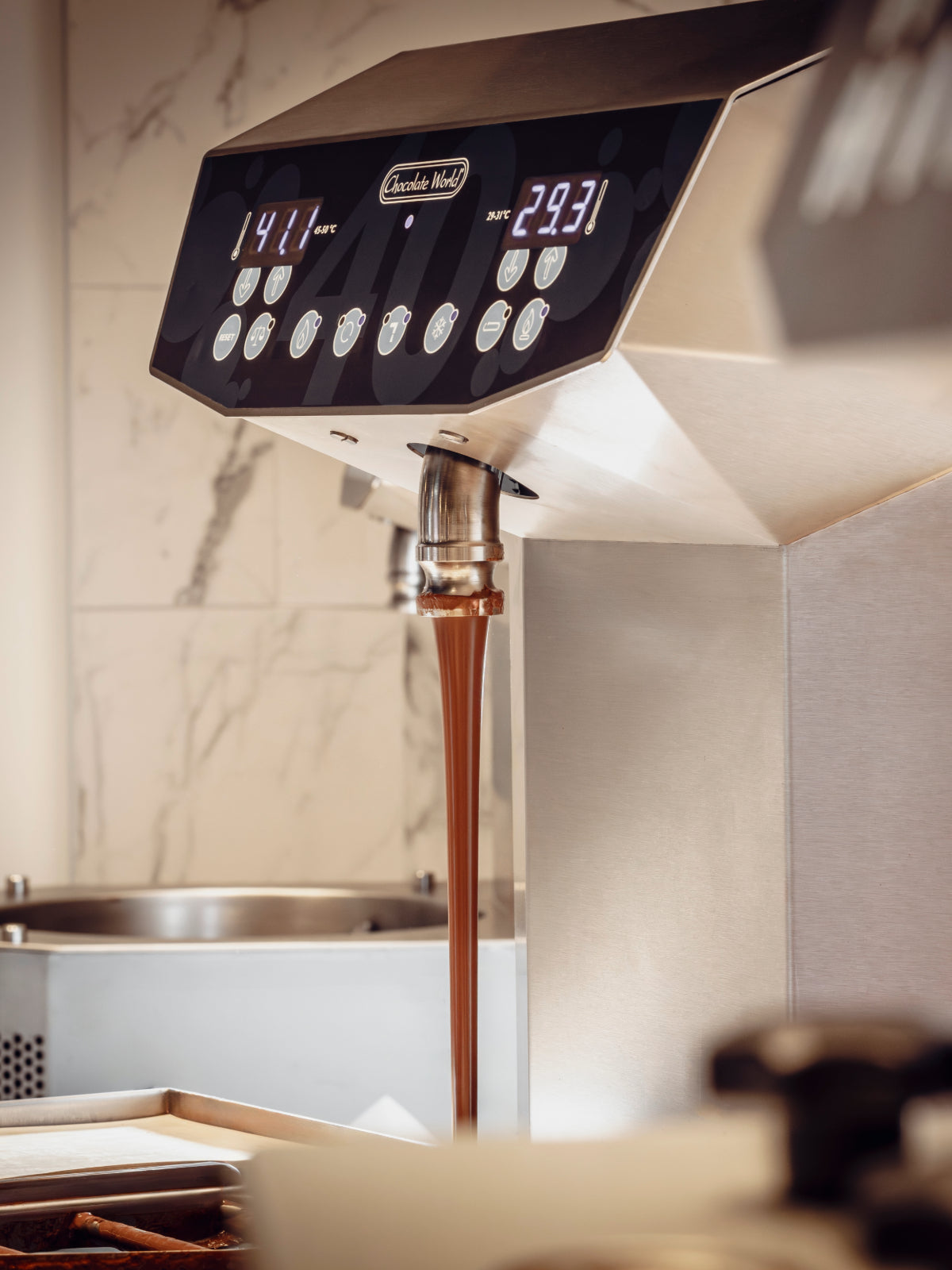
| Melter | Hold tempered chocolate at working temperature while you fill | Meltinchoc Digital 3.6 L, $1,150.00 CAD |
| Coloured cocoa butter | Colour the cavities before the chocolate goes in | Pavoni Chocolart, 200 g, $79.99 CAD |
| Heated spray gun | Spray coloured cocoa butter or velvet finishes | KREA Swiss chocSPRAYER, 120 V, $1,250.00 CAD |
| Mould stencil | Decorate pieces made in a specific mould | Stencil for CW1921, $39.95 CAD |
| Transfer sheets | Print designs onto chocolate in magnetic moulds | Chocolate transfer sheets |
The KREA Swiss chocSPRAYER keeps pre-tempered chocolate workable for up to an hour in its insulated 700 ml container and sprays 120–240 g per minute; it does not temper, so bring the chocolate to working temperature first. For the colouring technique, read our chocolate spray gun guide.
When moulding volume grows, the bottleneck is keeping chocolate tempered and filling moulds fast. The Bilait Adam K6 ($10,990.00 CAD), for which we are the exclusive distributor in Canada, has a 6 kg capacity, tempers 20 kg of chocolate in 4.5 hours, up to 45 kg a day, and has a heated vibrating table and a stop & go pedal for dosing.
Caring for your moulds
A polycarbonate mould gives back exactly what is on its surface, so gentle cleaning and careful storage protect its shine.
- Clean new moulds before first use: they can carry dust and oil from manufacturing and transport (Chocolate World).
- Do not pour fillings, such as sugar- or alcohol-based ones, straight into the mould; minimise twisting; demould with a material softer than polycarbonate and several soft taps rather than one hard strike.
- Store moulds clean, completely dry, not under pressure and away from direct sunlight. Coloured moulds are not as strong as clear ones.
The full routine is in how to clean polycarbonate chocolate molds and how to store chocolate molds. For the moulding technique itself, see how to mold chocolate.
How AI can help your production
Give an AI assistant the specification of each mould you own (pieces per mould, weight per piece, mould size) and your weekly orders, and ask it how many moulds you need per run and how much couverture to temper. Ask it to compare two moulds by chocolate per piece and pieces per hour of filling, and to keep a mould register with purchase date, washes and condition, so damaged moulds come out of production on time.
AI organises the information; tasting and the final decision stay with your chef.
Chocolate moulds at Zucchero Canada
We are an authorized distributor of Chocolate World, Pavoni Italia and Martellato, and each brand has its job:
- Chocolate World → Belgian polycarbonate moulds: bonbons, pralines, tablets, lollipops, Chef's signature designs and magnetic moulds for transfers.
- Pavoni Italia → Tritan bar and praline moulds by named chefs, thermoformed moulds, and the Pavoflex silicone range for pastry.
- Martellato → BPA-free resin moulds for pralines and seasonal pieces, alongside the Meltinchoc melters and tools.
Buying for a production kitchen? The Chocolate World moulds in this guide are also sold by the box of 30 moulds, for example the CW1921 at $1,090.00 CAD. Moulds and tools count toward free shipping on orders of CAD 300 or more within Canada (remote areas and the territories pay the actual carrier rate; machines are excluded), and orders over CAD 500 get 5% off automatically at checkout. To learn the techniques that make a mould shine, Chocolate by Ramon Morató ($160.00 CAD) covers tempering, coating and glazing in 416 pages and 200 recipes.
Not sure which mould fits your product? Contact our team or call 587-774-8873 (toll free 877-741-8251).
Chocolate moulds | Bonbon & praline moulds | Tritan moulds | Chef-inspired moulds | Shiny bonbons guide
This article is for information only. Every business is different: draw your own conclusions based on your own expectations, budget and goals, and talk to qualified experts before you decide or invest.
Sources: Chocolate World Moulds catalogue Edition 15 (specifications, Chef's signature recipes, "Cleaning polycarbonate moulds", "Usage of the moulds", "Storage of the moulds") and "Magnetic moulds" (chocolateworld.be, 2026); Pavoni Italia Food Equipment 2026 catalogue (praline and choco bar moulds); Bilait catalogue 2026 (Adam K6); P. Lonchampt and R. W. Hartel, Eur. J. Lipid Sci. Technol. 106 (2004); BCcampus, Understanding Ingredients for the Canadian Baker, §7.03; product data for Pavoni Italia, Martellato, KREA Swiss and Chocolate World products (zuccherocanada.ca).
Good to know
Frequently asked questions
What is the best type of chocolate mold?
For bonbons and bars in tempered chocolate, a rigid polycarbonate or Tritan mold: tempered chocolate contracts as it sets and releases with a high gloss. Silicone suits pastry and frozen desserts, and transparent, reusable thermoformed plastic suits hollow and seasonal figures.
Are polycarbonate chocolate molds better than silicone?
For shiny, snapping chocolates, yes: rigid moulds give the gloss and sharp detail of professional bonbons. Silicone moulds release by flexing, which suits entremets, inserts and baked or blast-chilled desserts; Pavoni's Pavoflex range is rated from −40°C to +250°C (−40°F to 482°F).
Which chocolate molds are BPA-free?
Pavoni Italia's Tritan moulds and Martellato's BPA-free resin moulds (the 21MA line) are BPA-free. Do not assume a polycarbonate mould is BPA-free; check the product page of the mould you choose.
How do I know how much chocolate a mold makes?
Multiply the number of cavities by the weight per piece in the specification. The Chocolate World CW1921 makes 21 pieces of 10.5 g, about 220 g per mould; the CW2162 tablet mould makes 3 tablets of 108 g according to Chocolate World's catalogue.
What accessories do I need for chocolate molds?
At minimum a thermometer and a stiff scraper; then a melter or tempering machine to hold tempered chocolate while you fill, coloured cocoa butter and a spray gun for colour, and stencils or transfer sheets for decoration.
Where can I buy professional chocolate molds in Canada?
Zucchero Canada is an authorized distributor of Chocolate World, Pavoni Italia and Martellato moulds. Moulds count toward free shipping on orders of CAD 300 or more within Canada (remote areas and the territories pay the actual carrier rate), orders over CAD 500 get 5% off automatically, and the Chocolate World moulds in this guide are also sold by the box of 30.
Shop this article
Products mentioned in this guide
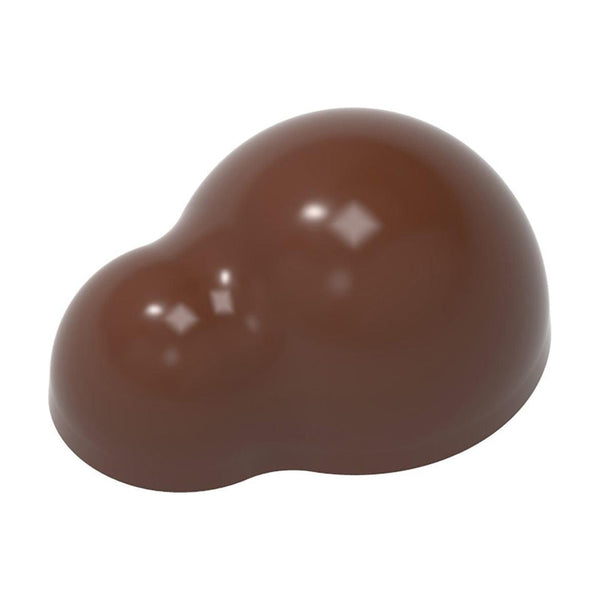 Chocolate WorldAndrey Dubovik Chocolate Mold CW1921From $39.95 CADView product →
 Chocolate WorldPraline Curve - Frank Haasnoot Chocolate Mold CW1903From $39.95 CADView product →
 Pavoni ItaliaLovely Chocolate Bar Mold – Antonio Bachour PC5000FR$46.99 CADView product →
 Chocolate WorldTablet 100 g Chocolate Mold CW2162From $44.95 CADView product →
For professionals
Equipping a chocolate shop, bakery or kitchen?
Tell us what you produce and how much. We will recommend the right machine, moulds and ingredients, and send you a quote.
For home bakers
Professional tools for your own kitchen
The same European moulds, tools and ingredients the professionals use.
5% off orders over $500 CAD, applied automatically at checkout.
Keep reading


Leave a comment
All comments are moderated before being published.
This site is protected by hCaptcha and the hCaptcha Privacy Policy and Terms of Service apply.