
Chocolate Enrobing: How to Coat Chocolates by Hand and by Machine
Short answer: chocolate enrobing means covering a centre (ganache, nuts, biscuits, caramel, fruit) with a thin, even layer of tempered chocolate. For small batches you dip by hand with dipping forks; for regular production an enrober carries the centres on a belt through a curtain of tempered chocolate, then a blower, a vibrator and a detailer remove the excess. Three things decide the result: properly tempered chocolate, centres at 21–24°C (70–75°F) when they meet the chocolate, and gradual cooling. Below: how each step works, how to choose an enrobing belt, and which setup fits your volume.
Quick answer: which enrobing setup for which production?
| Your production | Setup | Price |
|---|---|---|
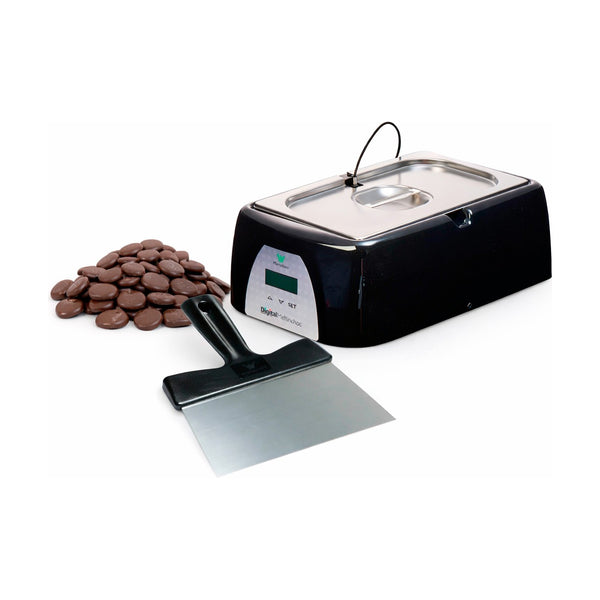
| Small batches, hand-finished bonbons | Martellato dipping fork set, 10 forks and chocolate held in temper in a Meltinchoc Digital 3.6 L | $69.50 CAD + $1,150.00 CAD |
| First enrober on a Chocolate World CW12 tempering machine | Chocolate World M1200A enrobing line, 180 mm | $13,999.00 CAD |
| Enrobing on a CW24 to CW80 tempering machine | Chocolate World M1300A enrobing line, 200 mm | $14,650.00 CAD |
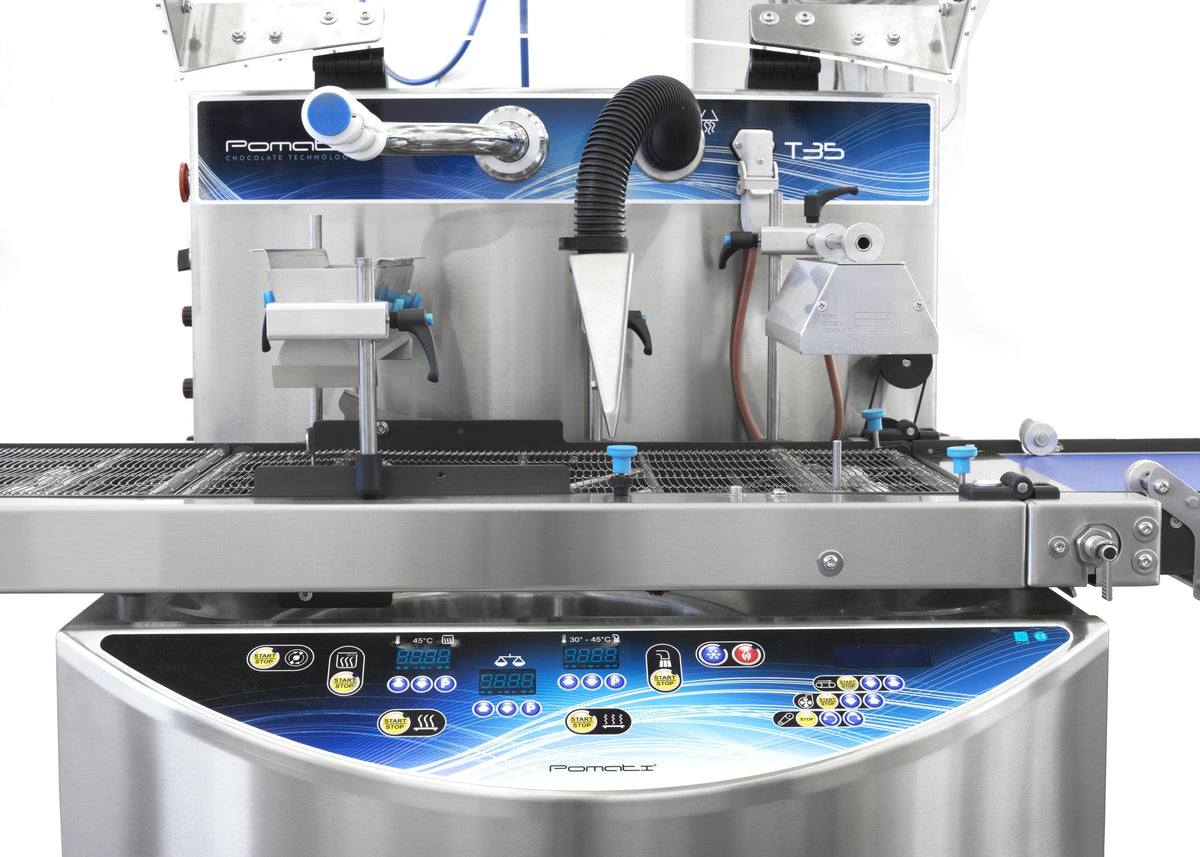
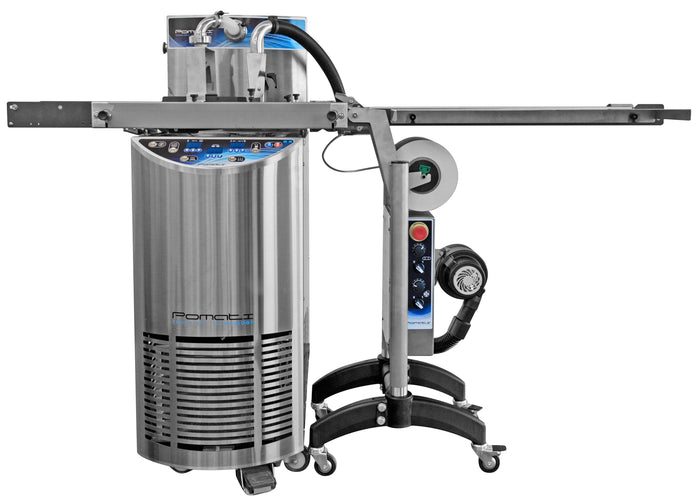
| Enrobing on a Pomati T8, T20 or T35 tempering machine | Pomati tilting enrobing belt, 180 mm | $15,500.00 CAD |
| A continuous enrobe-and-cool line | Chocolate World M1850 enrobing station, 300 mm, mounted on a cooling tunnel | $19,760.00 CAD |
Most of these machines are special-order items that ship directly from the manufacturer. Contact us for the current lead time.
What is chocolate enrobing?
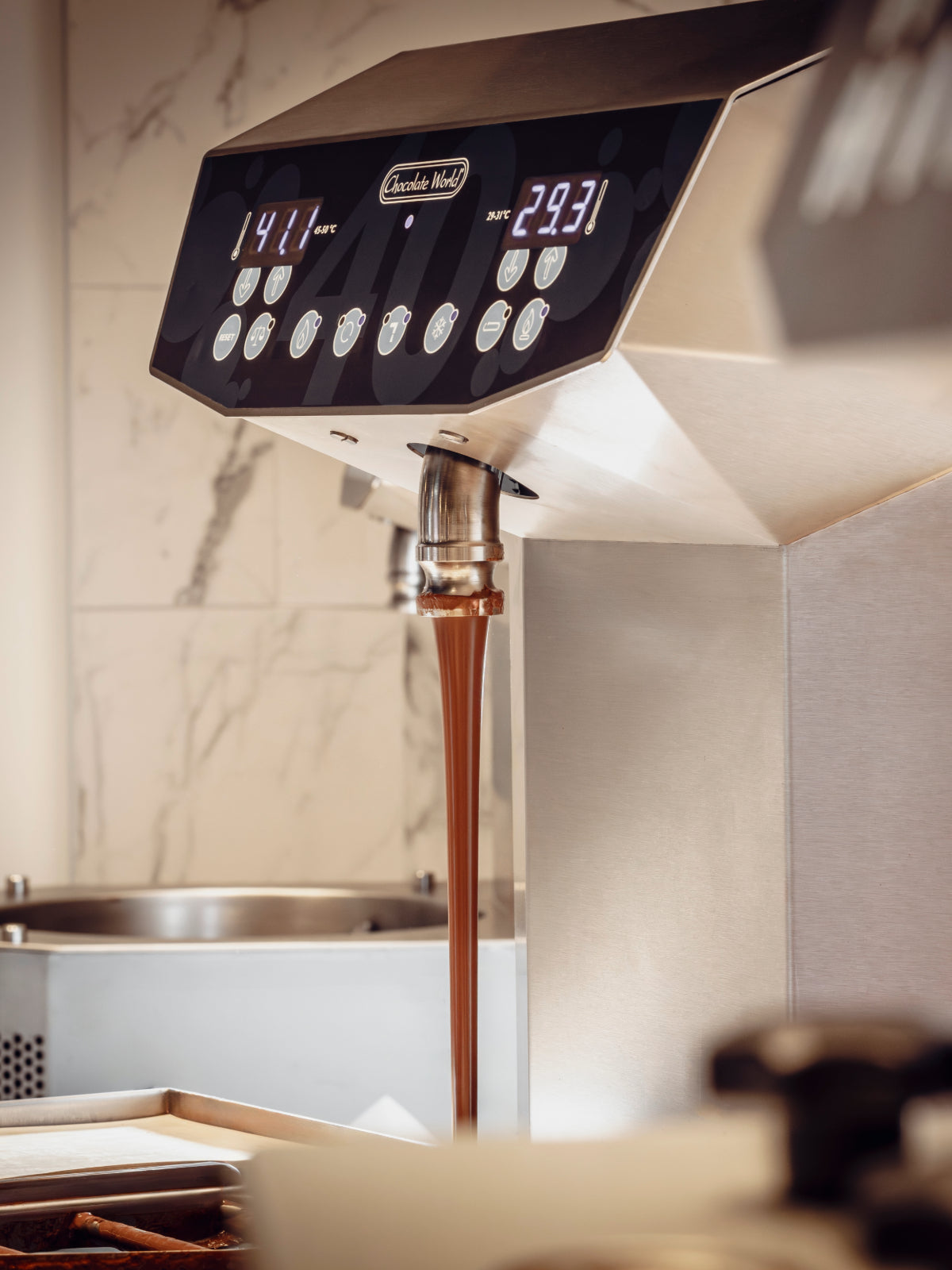
Enrobing is covering a confection or snack with chocolate or a chocolate coating. In a machine, tempered chocolate is held at a constant temperature and fed to a flow pan that forms a continuous curtain; a second flow (the "bottoming") floods the belt so the underside is coated as well. The centres pass through both and come out covered on every side. An air blower then removes excess chocolate, a vibrator settles the coating and improves its appearance, and a fast-spinning detailer at the end of the belt cuts off the "tail" that forms as each piece leaves the belt. The excess chocolate falls back and is reused.
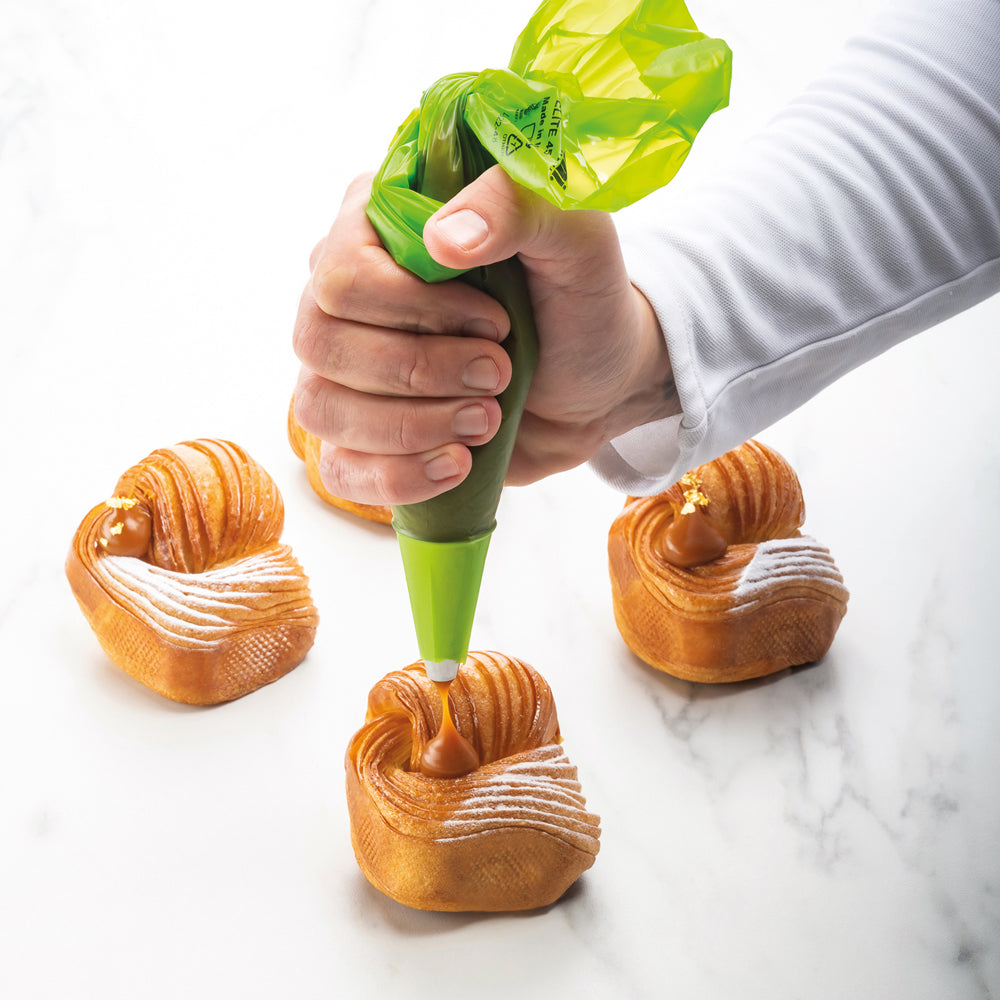
By hand the principle is the same: you dip the centre, let the excess drain, scrape the base and set the piece down. Well-tempered chocolate gives the coating its gloss and snap.
Step 1: Start with tempered chocolate
Real chocolate always needs tempering before enrobing. Without the right temper, chocolate turns soft, dull or streaky and can bloom; incorrect tempering is also one of the causes of fat bloom on finished enrobed pieces. For a high-quality coating you also want a fluid, low-viscosity chocolate, so the layer stays thin and even, but not so thin that it runs down the sides and forms "feet" at the base.
| Chocolate | Melting | Working (holding) temperature | Source |
|---|---|---|---|
| Dark | 45°C (113°F) | 31°C (88°F) | Martellato Meltinchoc Digital, "Dark" program |
| Milk | 45°C (113°F) | 29°C (84°F) | Martellato Meltinchoc Digital, "Milk" program |
| White | 45°C (113°F) | 28°C (82°F) | Martellato Meltinchoc Digital, "White" program |
| FCH 55% dark (Venezuela) | 45–50°C (113–122°F) | 31–32°C (88–90°F) | FCH technical data |
Your couverture's own technical sheet always comes first. The FCH 55% dark chocolate from Venezuela lists "coating for fillings" among its recommended uses (10 kg box, $299.00 CAD). For the full method, see our guide to tempering chocolate.
Step 2: Get the centres to the right temperature
Centres should go into the chocolate at 21–24°C (70–75°F). Both extremes cause problems:
- Centres too cold: as the centre warms up after enrobing, it expands and can crack the shell; cold centres can also lead to bloom.
- Centres too warm: the residual heat raises the temperature of the coating and can cause bloom.
Keep the centres and the room dry, too: water is the enemy of temper, and condensation, humidity or a damp surface can trigger sugar bloom. A fat-rich filling can also migrate into the shell over time and cause fat bloom, so test the shelf life of new fillings before scaling up.
Step 3a: Enrobing by hand with dipping forks
Hand dipping is the right choice for small batches, tests and high-end pieces that need a hand-finished look. You need tempered chocolate held at its working temperature, a set of dipping forks, and parchment or a paper-lined tray.
- Drop the centre into the tempered chocolate and cover it completely.
- Lift it out on the fork and tap the fork gently on the edge of the bowl so the excess drains back.
- Scrape the underside on the rim to avoid a "foot" of chocolate at the base.
- Slide the piece onto the paper and decorate at once if needed (a fork mark, a nut, a transfer sheet).
- Let it set before handling.
The Martellato CHOCOFORK set gives you one of each of the ten stainless-steel shapes in Martellato's catalogue: 2-, 3- and 4-prong forks, a spiral, round forks of 14, 16, 18 and 20 mm, a triangle and a drop. A dry-heat melter with a holding program keeps the chocolate in temper while you work; see how to use chocolate dipping tools.
Step 3b: Enrobing by machine
An enrober takes over the dipping, draining and tail-cutting, so every piece gets the same coating. On the enrobing lines we sell, the tempering machine supplies the chocolate and the line handles the rest:
- Double chocolate curtain (Chocolate World M1200A, M1300A and M1850) or a double-coat hopper (Pomati) for full or partial coating.
- Adjustable vibration and blower to set the coating thickness. Chocolate World notes that the coating thickness is adjusted with the vibrating system and a blowing unit that is adjustable in height and intensity.
- Detailer or tail cutter to remove the tail at the exit.
- Paper-lined exit belt so the pieces can be lifted off cleanly.
The output depends on the tempering machine feeding the line. As a guide, the product data for the Chocolate World CW12 gives up to 45 kg of tempered chocolate per hour (12 kg tank) and for the CW24 Delight up to 90 kg per hour (24 kg tank). That chocolate flow, not the belt alone, sets the pace of your line.
How to choose an enrobing belt
Choose the belt that matches the tempering machine you have or plan to buy, then check width, options, power and space. These are the points that matter in daily work:
| Model | Belt width | Fits | Power | Dimensions (L × W × H) |
|---|---|---|---|---|
| Chocolate World M1200A | 180 mm | CW12 (also CW24 Delight to CW80) | 220 V single-phase, powered by the tempering machine, 0.5 kW | 174 × 60 × 123 cm in use |
| Chocolate World M1300A | 200 mm | CW24 Delight, CW24, CW40, CW60, CW80 | 220 V single-phase, powered by the tempering machine, 0.5 kW | 174 × 53 × 126 cm in use |
| Pomati tilting belt | 180 mm (also 250 and 320 mm) | Pomati T8, T20, T35 | 230 V / 50 Hz single-phase, 0.5 kW (special voltages on request) | 182 × 45 × 103 cm open; folds to 50 × 45 × 189 cm |
| Chocolate World M1850 | 300 mm | CW24, CW24 Delight, CW40, CW60, CW80; infeed of 300 mm cooling tunnels | 230 V single-phase, 50/60 Hz, about 6 A | 115 × 60 × 146 cm |
- Width: the belt must take your largest piece with room to spare. Our product data describes the 200 mm M1300A as a wider belt for higher throughput than the 180 mm M1200A.
- Options: the Chocolate World 180 and 200 mm lines accept a bottom-only enrobing option (M1300AB) $1,150.00 CAD, a partial "half-dipped" option (M1300AP) $1,150.00 CAD and a truffle grill (M1300B) $8,299.00 CAD for the rough truffle finish.
- Power: check the voltage, phase and frequency against your electrical panel before you order. The Chocolate World lines run from their tempering machine; the M1850 has its own 230 V supply.
- Space: plan for the line in use, not stored. The Pomati belt is a tilting, folding attachment: closed, it takes 50 × 45 cm of floor space.
- Paper: the exit belt runs on paper. Chocolate World makes rolls from 160 to 300 mm wide; the 200 mm roll (VP0103, about 8.8 kg) $250.00 CAD matches the 200 mm lines.
- Cleaning: the care instructions for the Chocolate World lines are to clean the belt and the parts in contact with chocolate after each use, so factor that time into your shift.
View chocolate enrobing machines →
Step 4: Cool the coating gradually
A good industrial cooling tunnel has three zones; to avoid bloom, temperature changes should be gradual and relative humidity properly controlled. Published guide times are about 6 minutes for dark chocolate and 8 minutes for milk chocolate, and the coating and filling come out at about 18°C (64°F), ready for packaging.
Without a tunnel, avoid sudden temperature changes: let the pieces set gradually and keep them away from humidity. If you produce continuously, the M1850 enrobing station mounts at the infeed of the Chocolate World M1850T4 Premium or M1850TD6 Delight cooling tunnels, so pieces go straight from the curtain into cooling.
Common enrobing faults and their causes
| Fault | Likely cause | What to check |
|---|---|---|
| Cracked shells | Centres too cold; they expand as they warm | Bring centres to 21–24°C (70–75°F) |
| Grey or white bloom | Chocolate out of temper, centres too warm or too cold, or abrupt cooling | Tempering curve, centre temperature, gradual cooling |
| Bloom appearing after some weeks | Fat migrating from the filling into the shell | Filling recipe and shelf-life tests |
| Thick, heavy coating | Chocolate too viscous, or too little blower and vibration | Chocolate fluidity, blower height and intensity |
| "Feet" or skirts at the base | Coating runs down and pools; tail not removed | Draining time, detailer, scraping the base by hand |
For tempering problems in detail, see troubleshooting when tempering chocolate.
How AI can help your production
Give an AI assistant your recipe and target piece weight and ask it to scale the batch of centres and calculate how much chocolate the coating adds per piece once you have weighed a few test pieces before and after enrobing. Ask it to turn the steps above into a one-page enrobing procedure with a log for chocolate temperature, centre temperature and room conditions at each run, so you can trace any bloom back to its cause. Before buying a line, you can also ask it to compare your current hand-dipping time per tray with the throughput of the tempering machine you are considering, using your own labour cost.
AI organises the information; tasting and the final decision stay with your chef.
Enrobing equipment at Zucchero Canada
We are an authorized distributor of Chocolate World, Pomati and Martellato, and each covers a different stage of growth:
- Martellato for hand work: dipping forks and Meltinchoc melters that hold chocolate in temper on the bench. Martellato table-top melters come with a free spatula.
- Chocolate World for a complete Belgian line: the M1200A and M1300A enrobing lines match the CW tempering machines, and the M1850 links enrobing to a cooling tunnel. The CW12 tempering machine ($20,299.00 CAD) is the entry point for the 180 mm line.
- Pomati for a compact Italian lab: the tilting belt turns a Pomati T8 tempering machine (9 kg tank, 220 V / 60 Hz, $19,890.00 CAD) into an enrober and folds away when not in use. See all Pomati machines.
For the technique in depth, Chocolate by Ramon Morató, 6th edition (416 pages, 200 recipes) covers tempering, coating and glazing techniques: $160.00 CAD.
Customers who bought their machine from Zucchero get 15% off genuine spare parts with code PARTS15, and orders over $500 CAD get 5% off automatically at checkout. Planning a full line or buying for several locations? Contact us or call 587-774-8873 (toll free 877-741-8251) and we will help you match the tempering machine, enrober and cooling to your volume.
Enrobing machines | Tempering machines | Cooling tunnels | Tempering and enrobing bundles | Dipping tools guide
This article is for information only. Every business is different: draw your own conclusions based on your own expectations, budget and goals, and talk to qualified experts before you decide or invest.
Sources: R. Sundara, Á. Máñez and J. Vieira (Nestlé Product Technology Centre), "Enrobing in the confectionery industry", New Food Magazine, 5 March 2014; KREA Swiss, "Tempering, what it really is and where it goes wrong" (kreaswiss.com, 2026); Chocolate World product pages M1300A and M1850 (chocolateworld.be) and Equipment catalogue, Edition 9; Martellato General Catalogue 2026 and Meltinchoc Digital instruction manual; Pomati, Chocolate World, Martellato and FCH product data on zuccherocanada.ca.
Good to know
Frequently asked questions
What temperature should centres be for chocolate enrobing?
Centres should go into the chocolate at 21–24°C (70–75°F). Cold centres expand as they warm and can crack the shell or cause bloom; centres that are too warm raise the temperature of the coating and can also cause bloom.
Do I need to temper chocolate for enrobing?
Yes. Real chocolate always needs tempering before enrobing. Without the right temper the coating turns soft, dull or streaky and can bloom. As a reference, the Martellato Meltinchoc Digital melts at 45°C (113°F) and holds dark chocolate at 31°C (88°F), milk at 29°C (84°F) and white at 28°C (82°F); your couverture's own technical sheet comes first.
What is the difference between enrobing and dipping chocolate?
Both coat a centre with chocolate. Dipping is done by hand, one piece at a time, with a dipping fork. Enrobing usually means a machine: the centres travel on a belt through a curtain of tempered chocolate, and a blower, a vibrator and a detailer remove the excess so every piece gets the same coating.
How do I choose a chocolate enrobing belt?
Start from your tempering machine: the Chocolate World M1200A (180 mm) fits the CW12, the M1300A (200 mm) fits the CW24 Delight to CW80, and the Pomati tilting belt (180 mm) fits the Pomati T8, T20 and T35. Then check belt width against your largest piece, the options you need (bottom-only, partial, truffle grill), the voltage and phase, and the space the line takes in use.
How long should enrobed chocolates cool?
Cool gradually: to avoid bloom, temperature changes should be gradual and humidity controlled. In industrial cooling tunnels with three temperature zones, published guide times are about 6 minutes for dark chocolate and 8 minutes for milk chocolate, with pieces leaving at about 18°C (64°F) ready for packaging.
Can I buy a chocolate enrober in Canada from Zucchero?
Yes. We sell Chocolate World enrobing lines and the Pomati tilting enrobing belt as special-order machines that ship directly from the manufacturer; contact us for the current lead time before you order. Orders over $500 CAD get 5% off automatically, and customers who bought their machine from us get 15% off genuine spare parts with code PARTS15. Call 587-774-8873 or 877-741-8251.
Shop this article
Products mentioned in this guide
 MartellatoDipping Fork Set - 10 Pcs – CHOCOFORK$69.50 CADView product →
 MartellatoMeltinchoc Digital Melter 3.6 L – MCD101110V$1,150.00 CADView product →
 Chocolate WorldChocolate World M1200A Enrobing Line – 180mm for CW12$13,999.00 CADView product →
 Chocolate WorldChocolate World M1300A Enrobing Line – 200mm for CW24/40/60/80$14,650.00 CADView product →
For professionals
Equipping a chocolate shop, bakery or kitchen?
Tell us what you produce and how much. We will recommend the right machine, moulds and ingredients, and send you a quote.
For home bakers
Professional tools for your own kitchen
The same European moulds, tools and ingredients the professionals use.
5% off orders over $500 CAD, applied automatically at checkout.
Keep reading

Leave a comment
All comments are moderated before being published.
This site is protected by hCaptcha and the hCaptcha Privacy Policy and Terms of Service apply.