

Nut Butter Production: Process, Texture and Equipment Guide
Short answer: nut butter is made by grinding shelled nuts (roasted peanuts, cashews and hazelnuts; raw or roasted almonds) into a paste, then refining that paste to the texture you sell: smooth, medium or chunky. In production, the real decisions are which machine handles each stage (a continuous grinder for volume, a stone or roller refiner for a very fine paste, a ball mill for gianduja and spreads) and how you control salt, stabilisers, temperature and food safety. Below: the reference specifications, the process step by step, and which machine fits which production.
Quick answer: which machine for which nut butter production
| Your production | Machine | What it does (supplier data) | Price |
|---|---|---|---|
| Recipe development and small batches of very smooth butter | Chocolate World M1025 (110 V) | 1.3–4.5 kg per batch; granite stones; refines particles below 20 µm | $1,750.00 CAD |
| Continuous grinding of peanuts, cashews and seeds | Chocolate World Easy Paste M1970 | 80–100 kg/h of peanuts; grinds below 40°C (104°F); no added oil | $9,990.00 CAD |
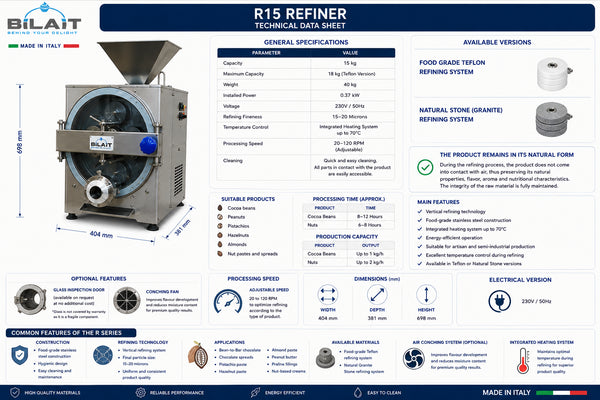
| Refining and conching in one closed, heated chamber | Bilait R15 refiner (Teflon) | Up to about 15 kg; heats up to 70°C (158°F) and holds it | $12,370.00 CAD |
| Gianduja and spreadable creams | FBM TAO KID ball mill | 15 kg tank; 20–25 µm; separate heating and cooling circuits | $27,600.00 CAD |
| Larger batches of nut pastes and spreads | FBM TAOBROMA ball mill | 35 kg batch; 20–25 µm; integrated pump | $48,650.00 CAD |
View ball mills and refiners →
What a nut butter is: the reference specifications
The most detailed public specifications are American, and they are a useful benchmark for any producer. The U.S. standard of identity for peanut butter (21 CFR 164.150) and the USDA purchase specification for nut butters (Commercial Item Description A-A-20328B) set these limits:
| Point | Reference value | Source |
|---|---|---|
| Peanut butter base | Ground shelled, roasted peanuts, blanched or with skins (unblanched) | 21 CFR 164.150 |
| Seasonings and stabilisers in peanut butter | No more than 10% of the finished weight, in total | 21 CFR 164.150 |
| Fat in peanut butter | No more than 55% | 21 CFR 164.150 |
| Not allowed in peanut butter | Artificial flavourings, artificial sweeteners, chemical preservatives, colour additives | 21 CFR 164.150 |
| Almond butter and hazelnut butter | Minimum 90% almonds or hazelnuts | USDA A-A-20328B |
| Nuts used | Roasted peanuts, cashews and hazelnuts; almonds raw or roasted | USDA A-A-20328B |
Two labelling details from the U.S. rule are worth knowing: peanut oil may be added or removed to adjust the oil content, and a butter made from unblanched peanuts must say "prepared from unblanched peanuts (skins left on)" next to its name. If you sell in Canada, confirm the composition and labelling rules for your product with the Canadian Food Inspection Agency before you print labels.
Texture: smooth, medium or chunky
Texture is the first thing your customer judges, and the USDA specification defines three:
- Smooth: "a very fine, very even texture with no perceptible grainy nut particles."
- Medium: "a definite grainy texture with perceptible nut particles approximating not more than 1/16 inch in any dimension."
- Chunky or crunchy: "a substantial amount of nut particles larger than 1/16 inch" (about 1.6 mm) in any dimension.
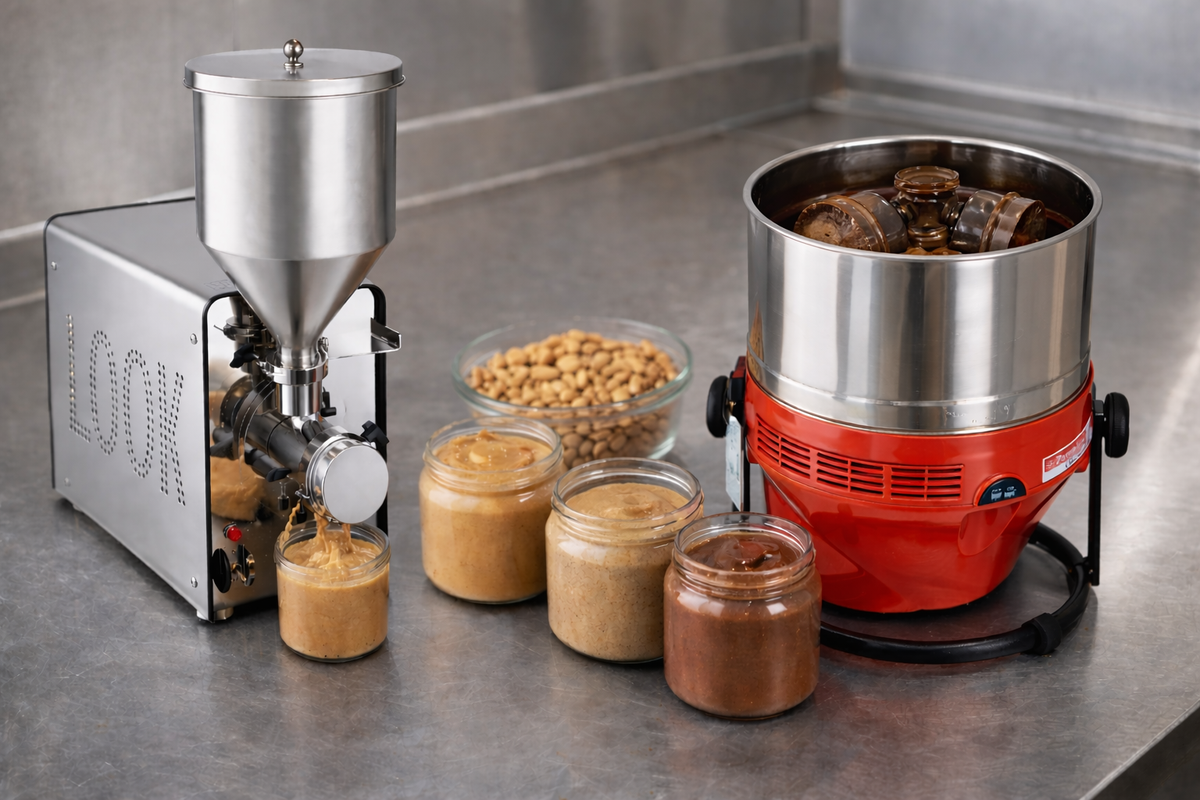
How fine you can go depends on the machine. Chocolate World states that its M1025 refines particles below 20 µm; FBM gives 20–25 µm for the TAO KID and TAOBROMA ball mills. The Easy Paste M1970 grinder has an adjustable particle size (large, medium, small), which suits medium and chunky textures or a first grind before refining.
The process step by step
1. Choose and check the nuts
Decide your nut and your roast (or raw, for almond butter), and buy from suppliers who can document quality. The USDA specification rejects raw nuts with any aflatoxin result other than negative, and caps the finished butter at 15 parts per billion. Ask your supplier for analysis certificates before you build a product on a lot.
2. Grind
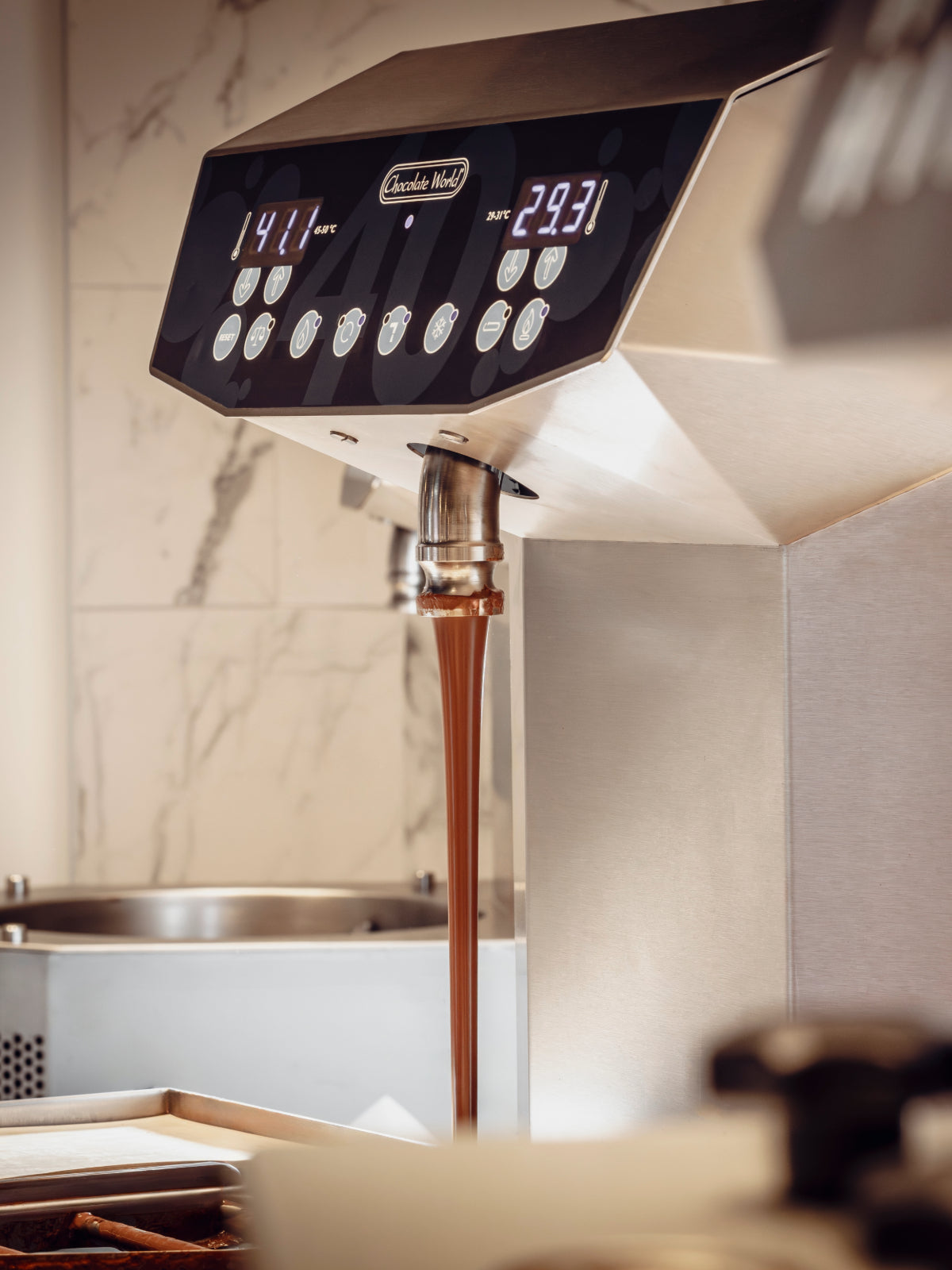
Grinding turns whole nuts into a paste. For volume, a continuous grinder does this in one pass: Chocolate World's Easy Paste M1970 grinds cocoa, peanuts, cashews and sesame into a 100% natural paste with no added oil, at under 40°C (104°F), with a 3.5 kg loading tray and 80–100 kg/h of peanuts. Its 316 stainless-steel parts come apart for washing in about three minutes.
3. Refine for a smooth butter
Refining reduces the particle size until the paste feels smooth. Two approaches fit nut butters:
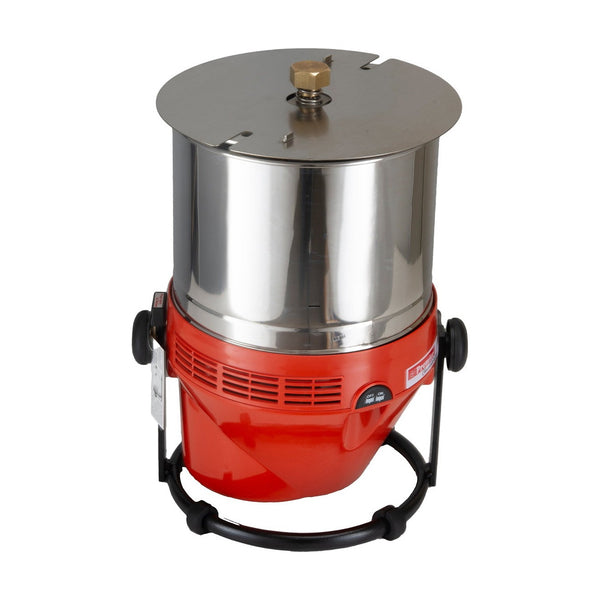
- Stone refining in small batches: the Chocolate World M1025 works with natural granite stones, 1.3–4.5 kg per batch, refining below 20 µm. Its motor is rated for up to 72 hours of continuous running, and it tilts for pouring.
- Roller refining in a closed chamber: Bilait states that its refiners process up to 2 kg per hour of nuts (almonds, hazelnuts, pistachios and peanuts). The R15 takes from very small quantities up to about 15 kg, heats up to 70°C (158°F) and holds that temperature, so a batch can be refined and conched in the same closed chamber; the closed design protects the mass from outside contamination and keeps its aromas.
4. Season and decide on stabilisers
Salt is optional for most nut butters. As a benchmark, U.S. Grade A peanut butter in the USDA specification carries 1.0–1.8% salt, and peanut spread no more than 1.6%. Then decide whether your butter is stabilised: the specification expects stabilised nut butters to show no noticeable oil separation, while non-stabilised butters may need slight mixing to disperse separated oil. Under the U.S. peanut butter standard, the only oil stabilisers allowed are hydrogenated vegetable oils, and seasonings plus stabilisers stay within 10% of the weight. A clean-label butter without stabilisers is a legitimate product; tell the customer to stir it.
5. Control and record temperature
Work with the temperatures your machine maker gives: below 40°C (104°F) for the Easy Paste grinder, up to 70°C (158°F) in the Bilait R15. Measure the paste itself rather than trusting a dial. Martellato's 50T003 digital thermometer has an immersion probe and a timer and reads from −32°F to +482°F (about −36°C to +250°C).
- View the Martellato 50T003 probe thermometer → $53.95 CAD
- View the Martellato 50T001 digital thermometer → $29.95 CAD
6. Plan food safety and allergens
The USDA specification lists the microbiological limits buyers expect from a finished nut butter:
| Test | Limit (USDA A-A-20328B) |
|---|---|
| Aflatoxin | Not more than 15 ppb |
| Standard plate count | Not more than 10,000 per g |
| Yeast and mould | Not more than 100 per g |
| Salmonella | Negative |
| E. coli | Negative |
Peanuts, tree nuts and sesame seeds are all on Health Canada's list of priority food allergens, together with milk and soy, which many chocolates contain. If the same refiner runs chocolate one day and nut butter the next, write the cleaning between products into your procedure and plan your labels around it. Easy cleaning is a buying criterion: the R15 rollers are removable and dishwasher safe, and the Easy Paste dismantles in minutes.
Which machine fits your nut butter business
These machines do different jobs, so the choice follows your volume and your product, not the brand.
- Starting out, testing recipes or making small premium batches: the Chocolate World M1025 runs on 110 V and takes 1.3–4.5 kg, so you can test nuts, roasts and salt levels without committing large quantities.
- Selling peanut or seed butter in volume: the Easy Paste M1970 grinds continuously, at 80–100 kg/h of peanuts, instead of working batch by batch.
- Making both chocolate and nut pastes: the Bilait R15 refines oil seeds and cocoa in one closed, heated chamber up to about 15 kg. A conching fan and a glass lid can be requested.
- Producing gianduja and chocolate-hazelnut spreads: the FBM ball mills (TAO KID, 15 kg, or TAOBROMA, 35 kg) refine to 20–25 µm with touchscreen control and recipe storage.
To compare machines on cost, work out your own numbers: kilograms you need per week, divided by what each machine produces per batch or per hour, gives the hours of machine time; multiply the hours someone must attend the machine by your hourly labour cost, and compare that figure, plus the machine price, across the options.
View all bean-to-bar and refining machines →
How AI can help your production
Keep a simple batch log (nut lot, roast, batch weight, grinding and refining time, paste temperature, salt, texture result) and paste it into an AI assistant: ask it to spot which settings gave your best batches and to turn them into a written procedure for your team. It can also scale your formula: for a 4.5 kg batch, the 1.0–1.8% salt range of U.S. Grade A peanut butter is 45–81 g. Ask it to build a cost sheet per jar from your own nut prices, yields and labour hours.
AI organises the information; tasting and the final decision stay with your chef.
Nut butter equipment at Zucchero Canada
We are the exclusive Bilait distributor in Canada, and an authorized distributor of Chocolate World and FBM Boscolo machines. Bilait units come with pre-purchase consultation and Calgary-based technical support. Customers who bought their machine from us get 15% off genuine spare parts with code PARTS15, and orders over $500 CAD get 5% off automatically at checkout. Machines are not included in our free-shipping offer.
Planning a production line or buying several machines? Contact our team, write to sales@zuccherocanada.ca or call 587-774-8873 (toll free 877-741-8251).
Ball mills & refiners | Bilait | FBM Boscolo | Thermometers & scales | What is conching | Low-impact vs traditional conching | Dipping peanut butter balls
This article is for information only. Every business is different: draw your own conclusions based on your own expectations, budget and goals, and talk to qualified experts before you decide or invest.
Sources: U.S. Code of Federal Regulations, 21 CFR 164.150 "Peanut butter" (eCFR); USDA Commercial Item Description A-A-20328B "Nut Butters and Nut Spreads" (2011); Health Canada, "Food allergies" (priority food allergens); Chocolate World Equipment catalogue, Edition 9 (M1025, M1970); Bilait catalogue 2026 (refiners R7, R15, R60); Zucchero Canada product pages (M1025, M1970, Bilait R15, FBM TAO KID and TAOBROMA, Martellato 50T003).
Good to know
Frequently asked questions
What equipment do I need to make nut butter commercially?
It depends on volume and texture. For small batches of very smooth butter, a stone refiner such as the Chocolate World M1025 (1.3–4.5 kg per batch, below 20 µm) is enough. For continuous volume, a grinder such as the Chocolate World Easy Paste M1970 handles 80–100 kg/h of peanuts. For refining and conching in a heated, closed chamber, the Bilait R15 takes up to about 15 kg; for gianduja and spreads, FBM ball mills refine to 20–25 µm.
Can I use a chocolate refiner to make nut butter?
Yes, if the maker says so. Chocolate World describes the M1025 as a conching device for fine chocolate and nut or seed butters, Bilait states its refiners process almonds, hazelnuts, pistachios and peanuts, and FBM's TAO KID refines gianduja nut pastes. Peanuts, tree nuts, milk and soy are priority allergens in Canada, so plan the cleaning between chocolate and nut butter runs and label accordingly.
What is the difference between smooth, medium and chunky nut butter?
The USDA nut butter specification defines smooth as a very fine, even texture with no perceptible grainy particles; medium as a definite grainy texture with perceptible particles of up to about 1/16 inch; and chunky as containing a substantial amount of nut particles larger than 1/16 inch (about 1.6 mm).
Why does natural nut butter separate, and how do I prevent it?
Without stabilisers, the oil can separate from the paste. The USDA specification expects stabilised nut butters to show no noticeable oil separation, while non-stabilised butters may need slight mixing. Under the U.S. peanut butter standard, the only oil stabilisers allowed are hydrogenated vegetable oils, and seasonings plus stabilisers must stay within 10% of the finished weight. If you sell a stabiliser-free butter, tell customers to stir it.
How much salt goes into peanut butter?
Salt is optional. As a benchmark, the USDA specification sets 1.0–1.8% salt for U.S. Grade A peanut butter and no more than 1.6% for peanut spread. For a 4.5 kg batch, 1.0–1.8% is 45–81 g.
Do nut butter machines qualify for free shipping or discounts?
Machines are not included in our free-shipping offer. Orders over $500 CAD get 5% off automatically at checkout, and customers who bought their machine from Zucchero Canada get 15% off genuine spare parts with code PARTS15. For a quote on several machines, contact sales@zuccherocanada.ca or call 587-774-8873.
Shop this article
Products mentioned in this guide
 Chocolate WorldChocolate World M1025 Conching Device – 4.5kg Tabletop Refiner 110V$1,750.00 CADView product →
 Chocolate WorldNut Grinder "Easy Paste" M1970$9,990.00 CADView product →
 BilaitBilait R15 Refiner (Teflon) — 15 kg Bean to Bar$12,370.00 CADView product →
 FBM Boscolo MachinesTAO KID Ball Mill – Compact Chocolate & Nut Paste Refining – FBM$27,600.00 CADView product →
For professionals
Equipping a chocolate shop, bakery or kitchen?
Tell us what you produce and how much. We will recommend the right machine, moulds and ingredients, and send you a quote.
For home bakers
Professional tools for your own kitchen
The same European moulds, tools and ingredients the professionals use.
5% off orders over $500 CAD, applied automatically at checkout.
Keep reading


Leave a comment
All comments are moderated before being published.
This site is protected by hCaptcha and the hCaptcha Privacy Policy and Terms of Service apply.