



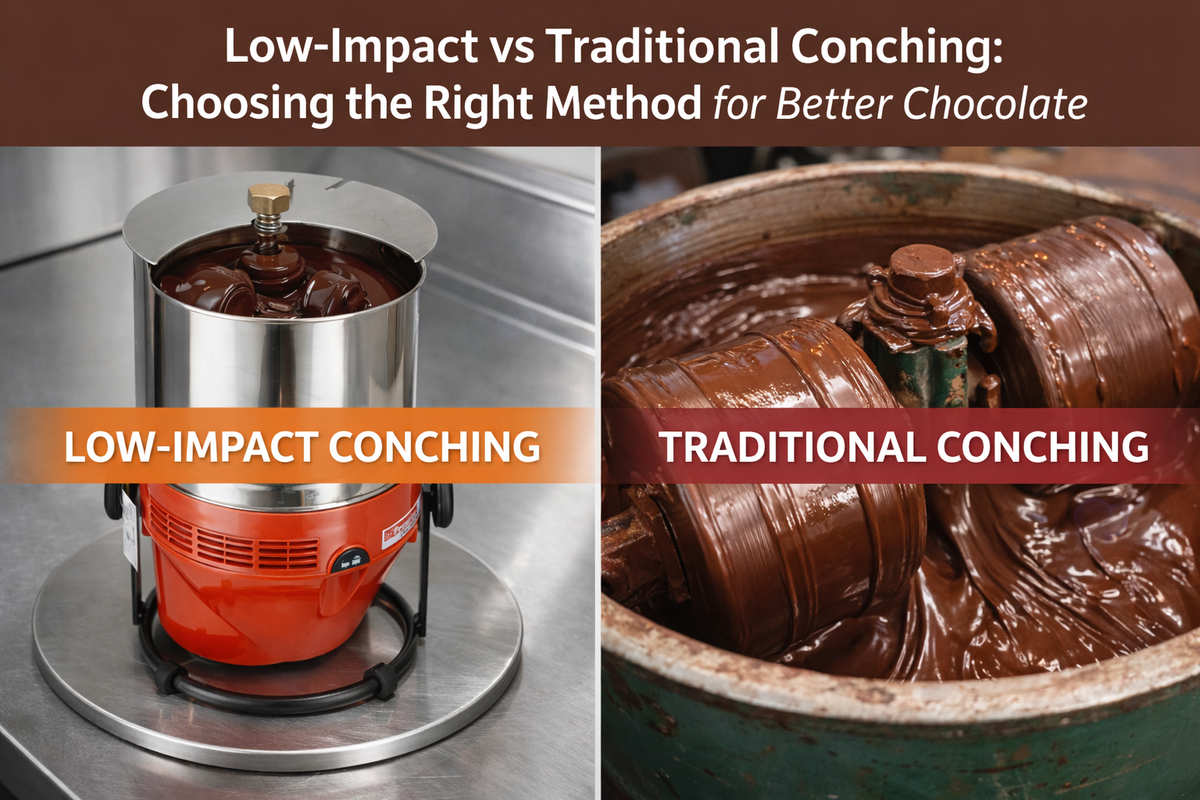
Short answer: low-impact conching works the chocolate with less heat and gentler mechanical energy over a longer time, to keep more of the cacao's own aroma; traditional high-energy conching uses more heat and shear to make the mass flow and lose its acidity faster, at the cost of aroma. In a published 200 kg trial, plastic conching at 80°C (176°F) cut the aroma compound linalool by 78.0%, against 15.8% at 60°C (140°F). Choose low-impact for fine-flavour beans whose aroma is your selling point, and more energy when flow and time matter more.
What "low-impact conching" means
Low-impact conching is an approach, not a machine or a fixed recipe: you conch at moderate, stable temperatures and gentle mechanical energy, and you give the mass more time instead of more heat. Fraunhofer IVV names the parameters you are choosing between: temperature, energy input and duration. Chocolate World describes its M1025 tabletop conche as a "low-impact conching machine".
Whatever the method, conching has the same jobs. It coats every sugar and cocoa particle with fat so the chocolate flows, removes excess moisture, evaporates volatile acids, sets the viscosity and develops the colour (Barišić et al., 2019). Undesired compounds such as excess acetic acid evaporate, but desired aroma compounds are lost as well (Guckenbiehl et al., 2024). That double loss is why the method matters. For the full process, read our guide to what conching is.
Traditional high-energy conching
High-energy conching speeds up flow by using more heat and shear. During conching, the shear forces can generate temperatures of up to 90°C (194°F) (Fraunhofer IVV). Research on dark chocolate shows that higher conching temperature makes the viscosity fall faster, but it also lowers the concentration of value-adding aroma compounds the most (Guckenbiehl et al., 2024).
What it gives you: a mass that reaches its flow faster. What it costs: part of the aroma the beans brought with them. For a neutral, uniform chocolate that is an acceptable trade; for an expensive single-origin bean it gives away part of what you paid for.
Low-impact conching
Low-impact conching keeps the temperature moderate and lets time do the work. The cost is time: at lower temperatures the viscosity falls more slowly. A study on milk chocolate found that conching time (1 hour versus 3 hours) changed the viscosity significantly at 50°C and 55°C (122°F and 131°F), but not at 60°C (140°F), where the viscosity dropped faster (Urbańska et al., 2021, as summarised by Guckenbiehl et al., 2024).
The payoff is aroma. Fermentation forms the precursors that later reactions need, and the most intensive chemical changes happen during fermentation, roasting and conching (Barišić et al., 2019). If you bought well-fermented fine-flavour beans for their aroma, a gentle conche keeps more of it in the bar.
What the research shows: aroma vs flow
The clearest data come from a 200 kg industrial conche trial on a 60% dark chocolate. The table compares the plastic phase run three ways, all with residue from the previous batch in the conche, and shows how much each compound fell in the fat phase between hour 1 and hour 6:
| Compound (fat phase) | 60°C (140°F), forwards | 60°C (140°F), shear reversed | 80°C (176°F), forwards |
|---|---|---|---|
| Acetic acid (undesired) | −31.9% | −40.1% | −42.3% |
| Linalool | −15.8% | −9.0% | −78.0% |
| 2,3,5,6-Tetramethylpyrazine | −19.6% | −27.5% (hours 2–6) | −70.7% |
| 2-Phenylethanol | −19.8% | −14.9% | −47.1% |
| Benzaldehyde | −25.0% | −32.6% | −52.5% |
| Viscosity after 3 and 6 hours | Higher | Lowest | Lowest |
Two readings matter for a maker. First, raising the temperature from 60°C to 80°C removed only a little more acetic acid, but it removed far more of the desired aroma compounds. Second, at 60°C, reversing the direction of the shear elements reached the same low viscosity as 80°C and nearly the same acetic acid loss, while keeping more of most aroma compounds. The authors conclude that flow and flavour have to be balanced against each other (Guckenbiehl et al., 2024).
This is one research set-up (dry phase 30 minutes at 50°C, plastic phase at 1,200 rpm with the lid open), not a recipe for your machine. Use it to decide which lever to pull first: time and mechanical action before heat.
Side-by-side comparison
| Criteria | Low-impact conching | Traditional high-energy conching |
|---|---|---|
| Temperature | Moderate and stable | Higher |
| Mechanical energy | Gentle, controlled | Strong |
| Time to reach flow | Longer | Shorter |
| Desired aroma compounds | More retained | Strongest losses in the research |
| Acetic acid removal | Somewhat slower in the research | Faster |
| Best for | Bean-to-bar, single-origin, fine-flavour cacao | Masses that must flow thinly quickly; standardised flavour |
Which method for which operation
Choose the method by what you sell: aroma or speed.
| Your operation | Approach |
|---|---|
| Bean-to-bar with single-origin, fine-flavour beans | Low-impact: moderate heat, more time, taste as you go |
| Premium bars sold on their origin story | Low-impact |
| Chocolate for thin enrobing or fast turnover | More energy or more time to reach the flow you need; check what you lose in aroma |
| A new origin you have not worked before | Start gentle, sample and taste, then adjust one parameter at a time |
Practical tips for low-impact conching
- Start with well-fermented, well-roasted beans. Conching works on what fermentation and roasting built; it keeps aroma, it does not create it.
- Use a machine with active temperature control. In the research, the hotter run lost the most aroma, so set the temperature and hold it.
- Extend time before you raise heat. If the mass is still too thick or too sharp, give it more time first.
- Taste at every sample. There is no universal conching time: Fraunhofer IVV warns that conching too long or too short both hurt the flavour.
- Write everything down. Bean lot, roast, batch weight, temperature, time and tasting notes, so a good batch can be repeated.
Equipment for low-impact conching
Each machine we carry fits a different scale, so the choice follows your batch size:
| Your production | Machine | Why it fits low-impact work |
|---|---|---|
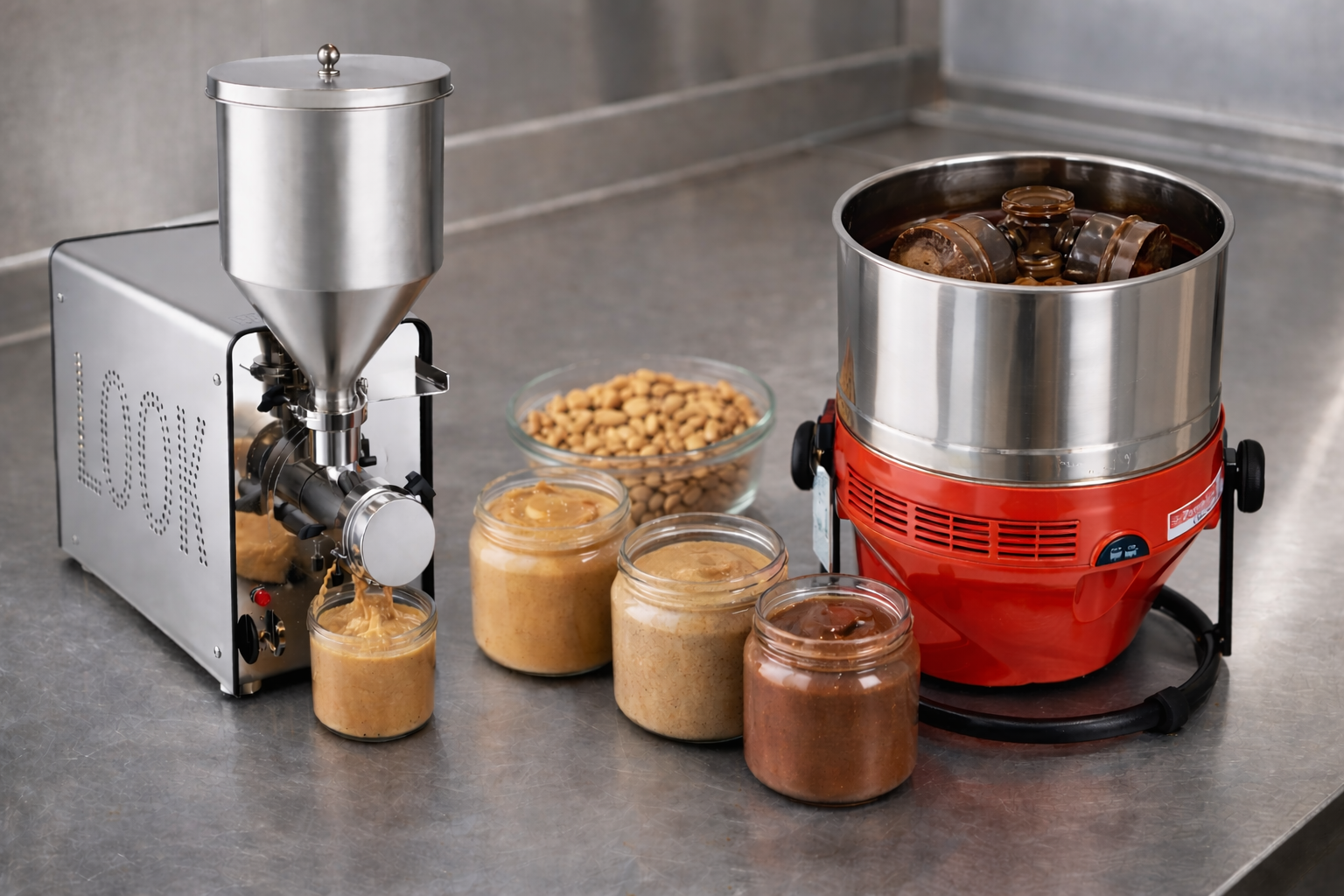
| Small batches, 1.3–4.5 kg | Chocolate World M1025 (110 V) | Described by Chocolate World as a low-impact conching machine; natural granite stones, motor rated for up to 72 hours of continuous running, refines to under 20 µm |
| Refining and conching in one chamber, up to about 15 kg | Bilait R15 refiner (Teflon) | Closed chamber that, per Bilait, protects the batch from outside contamination and keeps the aromas of the cocoa; heats to 70°C (158°F) and holds the temperature; conching fan and glass lid on request |
| Growing line that feeds a tempering machine | FBM KLEEGO 50 or KLEEGO 100 | Melting tank plus conche (50 kg tank with 35 kg conche, or 100 kg with 65 kg); CPU control of speed, airflow and temperature, so you set how gentle or fast each batch runs; pumps straight into a tempering machine |
- Chocolate World M1025 → $1,750.00
- Bilait R15 refiner → $12,370.00
- FBM KLEEGO 50 → $23,899.00
- FBM KLEEGO 100 → $36,500.00
The KLEEGO 100 product data states that it cuts conching time to under 3 hours; when time is the priority, that is the machine for it. The FBM machines are made to order in Italy.
Start with beans worth protecting
Low-impact conching pays off when the beans carry aroma worth keeping:
- Sur del Lago Ancestral Criollo Lineage cocoa beans, Venezuela → $80.00. Trinitario with 10–30% ancestral Criollo lineage, fermented to ≥65% uniformity and sun-dried over 7 days; fruity, woody and nutty, with low acidity and low astringency. Each lot comes with a Certificate of Origin & Authenticity.
- Ucayali Peru fine-flavour cacao beans → $80.00. Fermented and sun-dried; very low bitterness and astringency.
- Natural cocoa butter, 100% Peruvian fine cacao, 8 kg → $550.00. Non-deodorised, so it keeps the cacao aroma, for the cocoa butter you add in the liquid phase.
Not making chocolate from the bean yet? Bassan Sur del Lago 71% dark couverture, 5 kg → $273.00 is made from the same Venezuelan origin.
For the theory behind each step, Chocolate by Ramon Morató → $160.00 includes a full section on chocolate as a product.
View single-origin cacao beans →
How AI can help your production
Run the same bean lot two ways, for example one batch gentler and longer and one hotter and shorter, and log temperature, time, viscosity notes and tasting notes for each sample. Paste the logs into an AI assistant and ask it to line them up side by side, flag where flavour and flow started to diverge, and turn the batch you preferred into a written procedure. It can also estimate the machine hours each method costs per kilo so you can price your bars.
AI organises the information; tasting and the final decision stay with your chef.
Bean-to-bar equipment and cacao at Zucchero Canada
We are the exclusive Canadian distributor of Bilait and an authorized distributor of FBM Boscolo and Chocolate World. Bilait machines come with pre-purchase consultation and Calgary-based technical support. Our cacao beans come through Canada Cacao Co., and every Sur del Lago lot carries its Certificate of Origin.
Priority allocation is available for standing B2B orders. Contact our team to choose a conching set-up for your beans and batch size.
Chocolate conches | Bilait | Cacao beans | What is conching? | Chocolate viscosity | How to roast cacao beans
This article is for information only. Every business is different: draw your own conclusions based on your own expectations, budget and goals, and talk to qualified experts before you decide or invest.
Sources: Guckenbiehl Y. et al., "Conching of dark chocolate – Processing impacts on aroma-active volatiles and viscosity of plastic masses", Current Research in Food Science 9 (2024) 100909; Barišić V. et al., "The Chemistry behind Chocolate Production", Molecules 24 (2019) 3163; Fraunhofer IVV, "Model-based conching"; Chocolate World equipment catalogue (M1025); Bilait catalogue 2026 (R15 refiner); FBM Boscolo product data (KLEEGO 50 and 100); Canada Cacao Co. and Bassan product data.







Leave a comment
All comments are moderated before being published.
This site is protected by hCaptcha and the hCaptcha Privacy Policy and Terms of Service apply.