



Short answer: French flour behaves differently because it is specified differently. Its type number (T45, T55, T65…) is set by ash content, the mineral residue left when the flour is burned, and each Foricher flour is milled for one job: Bagatelle T45 (14.0% protein, W350) for croissants and brioche, Bagatelle T65 (over 11.0% protein, W200) for baguettes and artisan bread, and Terroir T55 for tart shells, choux and sponges. Below: what the T-number means, how French soft wheat compares with Canadian wheat, what CRC® and Label Rouge mean for the flour you receive in Canada, and which flour to use for which product.
French flour is not just an ingredient — it is a philosophy. From its precise milling classification to the quality of the wheat behind it, French flour represents a centuries-old commitment to craftsmanship that produces results no domestic substitute fully replicates. This is why professional bakers who make the switch rarely go back.
| Your production | Foricher flour | Price |
|---|---|---|
| Croissants, brioche, viennoiserie | Bagatelle T45, 25 kg | $175.00 |
| Baguettes, pain de campagne, sourdough | Bagatelle T65, 25 kg | $170.00 |
| Tart shells, choux pastry, sponge cakes | Terroir T55, 25 kg | $175.00 |
| Puff pastry, palmiers, mille-feuille | Terroir Feuilletage, 25 kg | $175.00 |
The classification difference: ash content vs protein
A French flour type is an ash figure, not a protein figure. Ash is the mineral residue left after a flour sample is burned in a laboratory furnace (the international method is ISO 2171, "determination of ash yield by incineration").
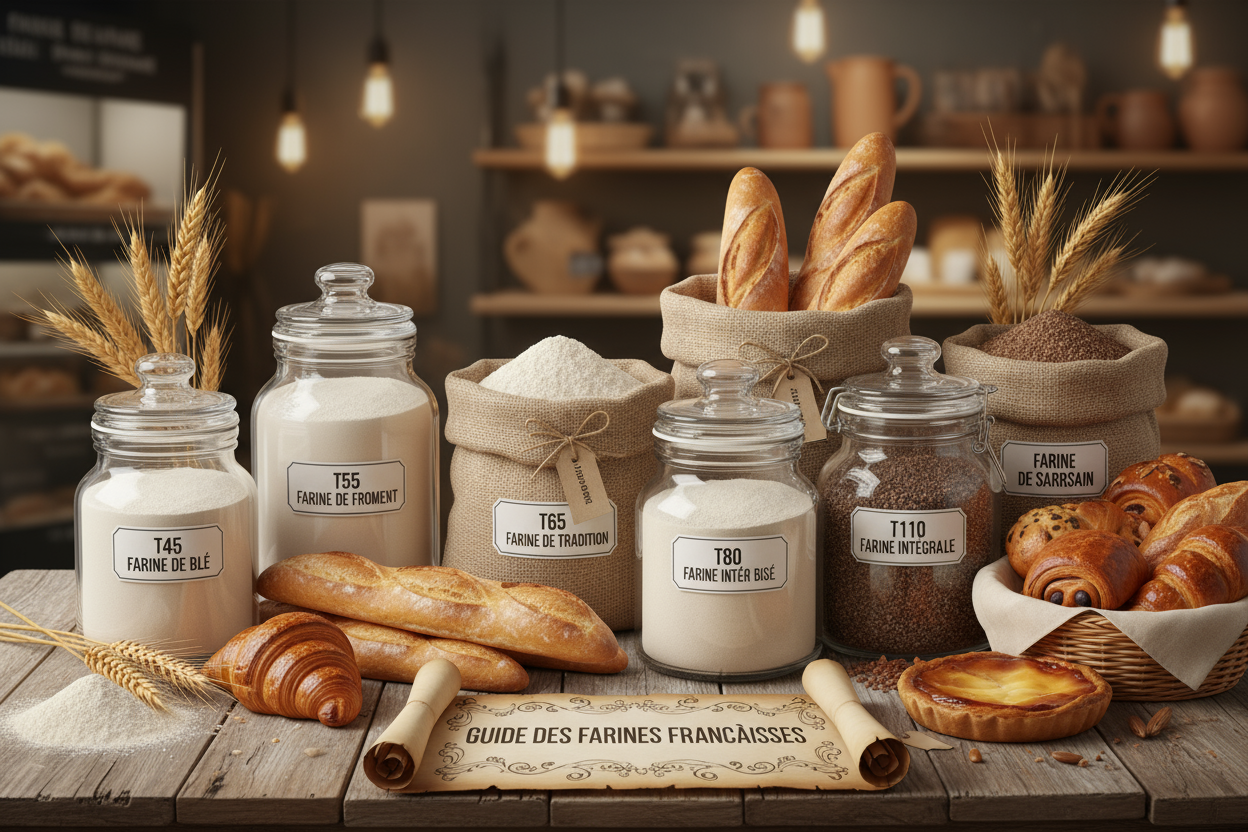
The T-number (T45, T55, T65, T80, T110, T150) tells you how much of that mineral residue the flour carries, which reflects how much of the grain's outer layers stayed in the flour. Lower T = more refined, white flour. Higher T = darker flour, up to wholemeal. France's Label Rouge specification for stone-ground flour (LA 05/14) sets out the scale:
| Flour type | Ash content | Flour and typical uses (LA 05/14) |
|---|---|---|
| T45 | about 0.50% | White flour, mainly pastry |
| T55 | 0.50–0.60% | White flour, bread, rusks, viennoiserie |
| T65 | 0.62–0.75% | White flour, pain de tradition française, biscuits |
| T80 | 0.75–0.90% | Farine bise (light brown), brown breads |
| T110 | 1.00–1.20% | Semi-wholemeal, brown and wholemeal breads |
| T150 | above 1.40% | Wholemeal flour, wholemeal breads |
This distinction matters because the T-number does not tell you how strong a flour is. Foricher's datasheets specify 14.0% (±0.3) protein for Bagatelle T45 and more than 11.0% for Bagatelle T65: the lower T-number is the stronger flour. To choose a French flour, read the type for its refinement, then the protein and the alveograph values (W, P/L) for its strength.
French soft wheat: a different starting material
French flour starts from French blé tendre (soft wheat), which on average carries less protein than the Canada Western Red Spring wheat grown on the prairies.
| Wheat | Average protein | Source |
|---|---|---|
| French soft wheat, 2025 harvest | 11.3% (dry matter); 11.4% in 2024 | FranceAgriMer harvest survey |
| Canada Western Red Spring, 2024 harvest, all grades | 14.0% (13.5% moisture basis); 10-year average 13.8% | Canadian Grain Commission |
The two figures are measured on different bases; on the same dry-matter basis the Canadian figure would be about 16.2% (our calculation), so the gap is wider than it looks. FranceAgriMer also reports an average baking strength of W178 for the 2025 French crop.
That is why the mill's specification matters more than the country of origin alone. Foricher does not sell one generic "French" flour: it mills each type for one job. Bagatelle T45, at 14.0% protein and W350, is the flour our product data describes as made for laminated doughs, "with the strength to carry butter through every fold". Bagatelle T65, at over 11.0% protein and W200, is the bread flour. Match the flour to the product, and the dough behaves the way the recipe expects.
CRC® certification: traceability from field to mill
Our Foricher flours are milled from 100% CRC®-certified French wheat. CRC® stands for Culture Raisonnée Contrôlée, a French cereal supply chain whose grain is certified under a product conformity certification (Certification de Conformité Produit); traceability is one of the four pillars of its strategy, with health, biodiversity and climate resilience, and sustainability. Bagatelle T65 and Terroir T130 are also listed as GMO-free and ionization-free.
For professional bakeries building a product story around quality and transparency, CRC® gives you a certified, traceable supply chain behind every bag you bake with.
Label Rouge: a note on the Canadian market
Label Rouge is a French national quality sign for products whose production conditions give them a higher level of quality than similar products usually sold. Each Label Rouge specification is validated by INAO (Institut national de l'origine et de la qualité) and approved by an interministerial order published in France's Journal officiel. In France, Foricher's Bagatelle T65 carries the Label Rouge seal.
However, Canadian Food and Drug Regulations (section B.13.001) do not allow white flour to be sold unless every 100 g contains 0.64 mg of thiamine (B1), 0.40 mg of riboflavin (B2), 5.30 mg of niacin (B3), 0.15 mg of folic acid (B9) and 4.4 mg of iron. The Canadian-market versions are therefore vitamin-enriched and sold without the Label Rouge designation. They are still milled in France by Foricher Les Moulins from 100% CRC®-certified wheat — what you receive is vitaminée (enriched) Foricher flour, compliant with Canadian law.
The practical difference in the bakery
For professional bakers and pastry chefs, the difference shows up in specific ways:
- Croissants and viennoiserie: Foricher Bagatelle T45 (14.0% ±0.3 protein, W350 ±30, P/L 0.8 ±0.2) is the flour for croissants, brioche and laminated doughs: our product data describes it as made for laminated doughs that need structure without toughness.
- Baguettes and artisan bread: Foricher Bagatelle T65 (over 11.0% protein, W200, P/L 0.7 ±0.2) was milled for the crackling crust and open, creamy crumb of a French baguette, and for pain de campagne, rustic loaves and sourdough.
- Fine pastry: Foricher Terroir T55 is Foricher's Pâtissière flour (T55): the mill lists it for choux pastry, tart shells (pâtes à foncer), cakes, génoises and madeleines.
- Puff pastry: Terroir Feuilletage, Foricher's puff pastry flour, for palmiers, mille-feuille and vol-au-vents.
Working with French flour in Canada: practical adjustments
- Test before you switch: set your hydration, mixing and fermentation times from a trial batch with your own mixer and proofing conditions. Bagatelle T45, Bagatelle T65 and Terroir T55 all come in 1 kg bags for exactly that.
- Read the strength, not just the type: a T65 at W200 and a T45 at W350 will not behave the same in your mixer, even though the T45 is the more refined flour. Keep the datasheet values next to each recipe.
- Storage: Foricher's datasheets give Bagatelle T45 and T65 a 9-month shelf life stored below 25°C (77°F). Rotate your bags first in, first out.
How AI can help your production
Write each formula in baker's percentages and ask an AI assistant to scale it to the day's batch, convert your weekly flour use into 25 kg bags so you know when to reorder, and calculate the flour cost per croissant or per baguette from your purchase price. Ask it to keep a test-bake log for each Foricher flour (dough temperature, room temperature, times, notes on crust and crumb) so the hydration you settle on is written down and repeatable on every shift.
AI organises the information; tasting and the final decision stay with your chef.
Foricher flour at Zucchero Canada
We carry the full Foricher Bagatelle and Terroir lines — stocked in Calgary and shipping across Canada. Available in 1 kg (recipe development), 10 × 1 kg, and 25 kg (production) formats, depending on the flour. Priority allocation for bakeries and food service operations on standing orders.
- Bagatelle T45 for croissants and brioche → 25 kg $175.00 · 10 × 1 kg $95.00 · 1 kg $12.50
- Bagatelle T65 for baguettes and artisan bread → 25 kg $170.00 · 1 kg $12.50
- Terroir T55 for pâtisserie → 25 kg $175.00 · 10 × 1 kg $95.00 · 1 kg $12.50
- Terroir T130 rye for rye breads and sourdough starters → 25 kg $180.00
Contact our team to discuss which line fits your production program, write to sales@zuccherocanada.ca or call 587-774-8873 (toll free 877-741-8251).
Terroir T55 (pâtisserie) | Bagatelle T65 (baguettes, artisan bread) | Bagatelle T45 (croissants, brioche) | Full Foricher collection | T45 vs T55 vs T65 | Label Rouge explained
This article is for information only. Every business is different: draw your own conclusions based on your own expectations, budget and goals, and talk to qualified experts before you decide or invest.
Sources: Foricher technical datasheets FT208A (Bagatelle T45) and FT207A (Bagatelle T65); foricher.com, Pâtissière flour page; Foricher Les Moulins product data on zuccherocanada.ca; INAO, Label Rouge fact sheet, and Label Rouge specification LA 05/14 "Farine de meule" (text published for national consultation); FranceAgriMer, "Qualité des blés tendres français, récolte 2025"; Canadian Grain Commission, "Quality of Canada Western Red Spring wheat in 2024"; Canada, Food and Drug Regulations, C.R.C., c. 870, s. B.13.001; ADEME, "Écoconception baguette de pain, filière CRC"; ISO 2171:2023.






Leave a comment
All comments are moderated before being published.
This site is protected by hCaptcha and the hCaptcha Privacy Policy and Terms of Service apply.