



Short answer: French flour types (T45, T55, T65, T80, T110, T150) are named after their ash content, the mineral residue left when the flour is burned in a laboratory furnace: about 0.50% for T45, 0.50–0.60% for T55, 0.62–0.75% for T65, up to above 1.40% for wholemeal T150. The number tells you how refined the flour is, not how strong it is. For croissants and viennoiserie use T45, for choux, tart shells and cakes a T55 pastry flour, for baguettes and sourdough T65, and for rye bread a T130 rye flour.
French flour is classified by a system that tells you something protein content alone cannot: how refined the flour is and how much of the grain's mineral matter it retains. Understanding the T-number system is the foundation of authentic French baking — and the key to choosing the right flour for croissants, baguettes, brioche, rye bread, or whole grain production.
The T-number system explained
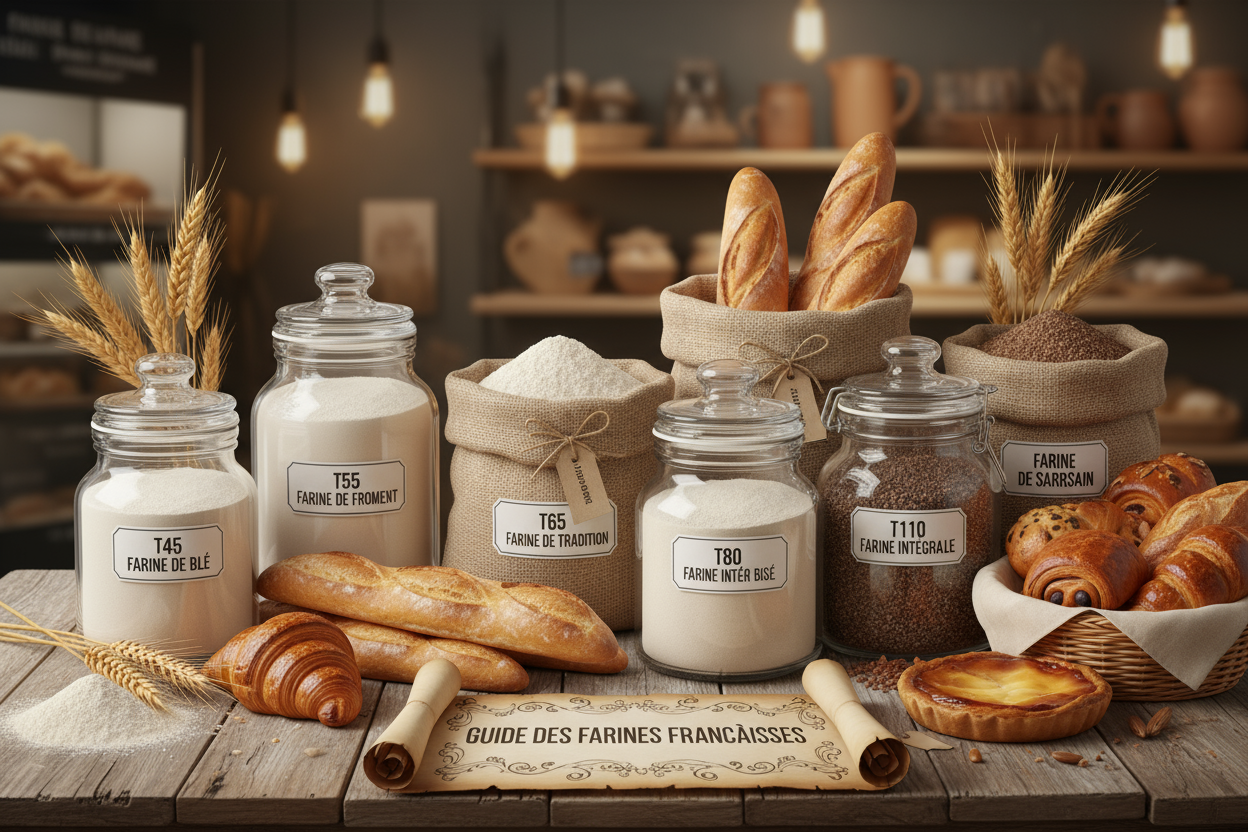
The T stands for type and refers to the flour's ash content — the mineral residue left after a flour sample is incinerated in a laboratory furnace (the international method is ISO 2171, "determination of ash yield by incineration"). Higher T = more mineral residue, moving from white flour (T45 to T65) to light brown farine bise (T80), semi-wholemeal (T110) and wholemeal (T150). Lower T = more refined, lighter colour. Ash and protein are separate measurements, so a lower T-number does not mean a weaker flour.
| Type | Ash content | Character | Primary applications |
| T45 | 0.50% (Bagatelle T45 datasheet: 0.39–0.50%) | White flour, the most refined | Mainly pâtisserie; Bagatelle T45: croissants, brioche, puff pastry, viennoiserie |
| T55 | 0.50–0.60% | White flour | Bread, rusks (biscottes) and viennoiserie; Foricher's T55 pastry flour: choux, tart shells, cakes |
| T65 | 0.62–0.75% | White flour | French tradition bread, biscuits; Bagatelle T65: baguettes, pain de campagne, sourdough |
| T80 | 0.75–0.90% | Light brown (farine bise) | Light brown (pain bis) and special breads |
| T110 | 1.00–1.20% | Semi-wholemeal | Brown, wholemeal and special breads |
| T130 (Rye) | 1.20–1.50% (Terroir T130 datasheet) | Dark rye flour | Rye bread, rustic loaves, sourdough starters, blends with wheat flour |
| T150 | Above 1.40% | Wholemeal | Wholemeal and special breads |
Wheat flour ash ranges and general uses: France's Label Rouge specification for stone-ground flour (INAO, LA 05/14); Foricher uses: mill datasheets, foricher.com and our product data.
The wheat behind Foricher flours
Foricher's wheat flours are milled in France by Foricher Les Moulins from 100% CRC®-certified French wheat; Bagatelle T45 and T65 use wheat grown in the Loiret and Yonne regions near the company's historic mills. The T130 is a rye flour from CRC®-certified French crops. CRC® stands for Culture Raisonnée Contrôlée: a French cereal supply chain whose grain is certified under a product conformity certification, with traceability as one of its pillars. In France, Bagatelle flours are milled without additives or enzymes; the Terroir T55 and Feuilletage are listed as free from preservatives, ionization and GMOs, and the Terroir T130 as GMO-free and ionization-free.
Note on Label Rouge: Several Foricher flours hold Label Rouge certification in France — a French official quality sign whose specifications are handled by INAO. However, Canadian Food and Drug Regulations (section B.13.001) do not allow white flour to be sold unless it is enriched with thiamine (B1), riboflavin (B2), niacin (B3), folic acid (B9) and iron. This mandatory vitaminization means the Canadian-market versions are sold without the Label Rouge designation. What you receive is vitaminée Foricher flour, compliant with Canadian law, still milled from 100% CRC®-certified French wheat.
The Foricher lines we carry
Bagatelle — traditional, additive-free and Label Rouge at origin
From the Bagatelle line we carry Foricher's flour for viennoiserie (T45) and for baguettes and artisan bread (T65). In France, both are milled without additives or enzymes and carry the Label Rouge seal. We carry two types:
- Bagatelle T45 — for croissants, brioche, puff pastry and viennoiserie. Protein 14.0% (±0.3) and ash 0.39–0.50% (mill datasheet), W350 (±30), P/L 0.8 (±0.2): the strength to carry butter through every fold of a laminated dough. 1 kg / 10 × 1 kg / 25 kg, $12.50 CAD for 1 kg.
- Bagatelle T65 — for baguettes de tradition, pain de campagne, sourdough. W200, P/L 0.7 (±0.2), protein over 11.0% and ash 0.62–0.75% (mill datasheet). 1 kg / 25 kg, $12.50 CAD for 1 kg.
Terroir — high-performance, CRC® certified: pastry, puff pastry and rye
The Terroir flours we carry are made for specific jobs: fine pastry, puff pastry and rye bread, all from CRC®-certified French crops. Available in three types:
- Terroir T55 Pâtisserie — Foricher's Pâtissière, which Foricher describes as a T55 pastry flour that gives doughs good extensibility, for choux pastry, tart shells (pâtes à foncer), cakes, génoises, madeleines and pound cakes. Our product data: protein 12.5%, W330 (±30), P/L 0.6 (±0.2). 1 kg / 10 × 1 kg / 25 kg, $12.50 CAD for 1 kg.
- Terroir Feuilletage — for puff pastry and laminated doughs (palmiers, mille-feuille, vol-au-vents). Foricher makes it from a blend of strong wheats and says it gives more consistent results than mixing T45 and T65, with less oxidation than a T65, so puff pastry also keeps better. 25 kg, $175.00 CAD.
- Terroir T130 Rye — dark rye flour (ash 1.20–1.50%) for rye bread, rustic loaves, sourdough starters, and blends with wheat flour. CRC®-certified French crops, GMO-free and ionization-free. 25 kg, $180.00 CAD.
Choosing the right flour by application
| Application | Recommended flour | Why |
| Croissants, pain au chocolat | Bagatelle T45 | Made for laminated doughs: 14.0% protein and W350 to carry butter through every fold |
| Puff pastry, mille-feuille | Terroir Feuilletage | A blend of strong wheats, more consistent than mixing T45 and T65; puff pastry keeps better |
| Brioche, enriched doughs | Bagatelle T45 | Listed for brioche; extra-fine, silky flour for a delicate, airy crumb |
| Choux, tart shells, cakes, génoises | Terroir T55 Pâtisserie | Foricher's pastry flour; good extensibility for these doughs and batters |
| Baguette de tradition | Bagatelle T65 | Milled for a crackling crust and an open, creamy crumb |
| Sourdough, levain loaves | Bagatelle T65 | Listed for sourdough and pain de campagne; strong enough for long fermentation |
| Rustic country bread | T80 (ask us) | Light brown farine bise, the T-type for pain bis |
| Rye bread, sourdough starter | Terroir T130 Rye | Dark rye listed for rye bread, rustic loaves and starters |
| Whole grain production | T150 (ask us) | Wholemeal flour (farine complète) |
Working with French flour in Canada: key adjustments
- Compare strength, not the T-number: when you switch from a Canadian flour, look at protein and W. In Foricher's range the T45 (14.0% protein, W350) is stronger than the T65 (over 11.0%, W200).
- Run a test bake first: the 1 kg bags of Bagatelle T45, Bagatelle T65 and Terroir T55 are there for recipe development before you commit to 25 kg production bags.
- Storage: Foricher's datasheets for Bagatelle T45, Bagatelle T65 and Terroir T130 give a shelf life of 9 months, stored below 25°C (77°F). Keep bags dry.
- Labelling: the Canadian versions are vitamin-enriched (B1, B2, B3, B9 and iron), as Canadian law requires for white flour; account for it in your ingredient lists.
How AI can help your production
Write your formulas in baker's percentages and ask an AI assistant to scale them to each day's batch, split the weekly flour total between T45, T55 and T65 bags so you know when to reorder each, and calculate the flour cost per croissant or per baguette from your purchase price. Ask it to keep a log of your test bakes with each new flour (dough temperature, fermentation times, results), so the settings that work are written down for every shift.
AI organises the information; tasting and the final decision stay with your chef.
Availability at Zucchero Canada
We carry the Foricher Bagatelle and Terroir flours above — stocked in Calgary and shipping across Canada. Bagatelle T45 and Terroir T55 come in 1 kg (recipe development and test batches), 10 × 1 kg, and 25 kg (production format); Bagatelle T65 in 1 kg and 25 kg; Terroir Feuilletage and Terroir T130 in 25 kg. Priority allocation for bakeries and food service operations on standing orders.
- Bagatelle T45 → 25 kg $175.00 · 10 × 1 kg $95.00
- Bagatelle T65 → 25 kg $170.00
- Terroir T55 Pâtisserie → 25 kg $175.00 · 10 × 1 kg $95.00
Questions about which flour fits your program? Contact our team — we work with professional bakeries, hotel pastry programs, and culinary schools across Canada.
Bagatelle T45 | Terroir T55 | Terroir Feuilletage | Bagatelle T65 | Terroir T130 Rye | Full collection
Flour for croissants | Flour for baguettes | Whole grain & rye flour | T45 vs T55 vs T65 | What is T55 flour? | What is T65 flour? | Label Rouge explained
This article is for information only. Every business is different: draw your own conclusions based on your own expectations, budget and goals, and talk to qualified experts before you decide or invest.
Sources: Foricher technical datasheets FT208A (Bagatelle T45, 14/05/2024), FT207A (Bagatelle T65, 02/05/2024) and FT050F (Terroir T130, 14/05/2024); foricher.com, "Pâtissière" and "Feuilletage"; Foricher Les Moulins product data on zuccherocanada.ca; INAO, Label Rouge specification LA 05/14 "Farine de meule" (text published for national consultation); ISO 2171 (cereals, pulses and by-products — determination of ash yield by incineration); ADEME, "Écoconception baguette de pain, filière CRC"; Canada, Food and Drug Regulations, C.R.C., c. 870, s. B.13.001.






Leave a comment
All comments are moderated before being published.
This site is protected by hCaptcha and the hCaptcha Privacy Policy and Terms of Service apply.