




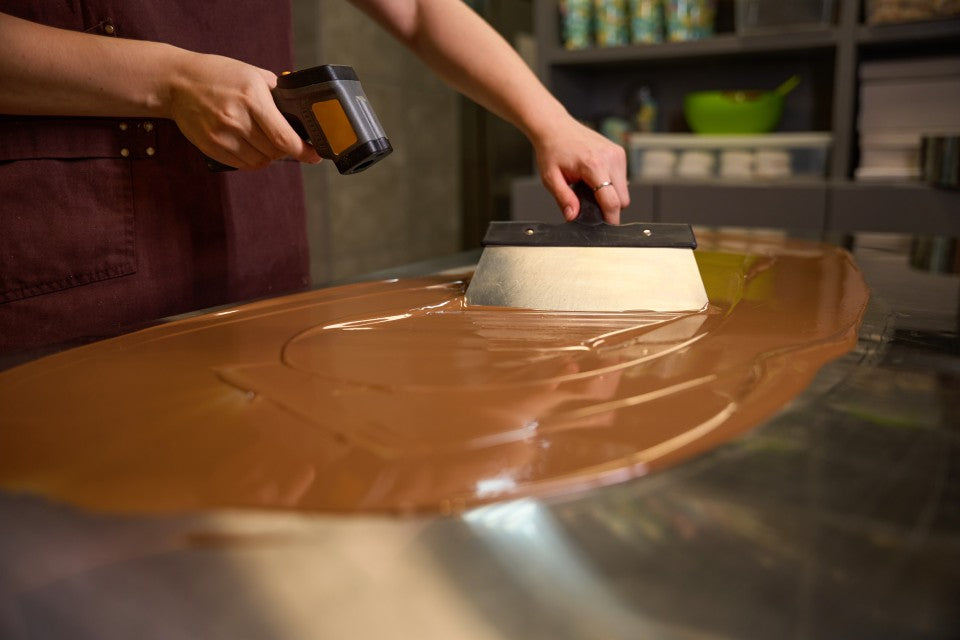
Short answer: to temper chocolate, melt it completely, cool it while you create stable cocoa butter crystals (by stirring in tempered "seed" chocolate or by tabling on marble), then bring it to its working temperature and hold it there: close to 31–32°C (88–90°F) for dark chocolate and 28–30°C (82–86°F) for milk and white, or the figures on your chocolate's own sheet. Check the result in this order: a temper test on a palette knife, the thickness of the chocolate, then the thermometer. Below: the temperatures by chocolate type, the seeding and tabling methods step by step, when a machine pays off, and how to tell if your chocolate is tempered.
Quick answer: what you need to temper chocolate
| Need | Product | Price |
|---|---|---|
| Read the chocolate's temperature | Martellato Digital Thermometer 50T001 | $29.95 |
| Spread, scrape and table chocolate | Martellato Professional Chocolate Scraper 145 mm | $36.95 |
| Melt and hold the working temperature while you seed by hand, 110 V | Martellato Digital Meltinchoc 6 L | $1,259.99 |
| Temper automatically with saved programs, 110 V | Pavoni MiniTemper 110V | $3,350.00 |
| Dark couverture with a published tempering curve | Bassan Sur del Lago 71%, 5 kg | $273.00 |
What tempering does
Tempering controls how the cocoa butter crystallises as the chocolate sets. Cocoa butter can set in six crystal forms, numbered I to VI; only form V (Beta-5) gives a glossy surface, a clean snap, a smooth texture and a longer shelf life with less risk of bloom. Untempered or badly tempered chocolate sets soft, dull or streaky.
You do not need to crystallise much of it. Peter Greweling, professor of baking and pastry arts at the Culinary Institute of America, describes tempering as pre-crystallising a small quantity, about 1%, of the melted cocoa butter: those crystals act as seeds that make the rest of the cocoa butter crystallise quickly and evenly. A 2025 review by researchers at the University of Guelph and the Canadian Light Source gives the melting range of form V crystals as 30.0–34.5°C (86–94°F), which is why the working temperature sits just below that range.
Tempering temperatures for dark, milk and white chocolate
Use your chocolate maker's figures first: they change from one brand and recipe to the next. These are the published reference points we rely on:
| Stage | Dark | Milk | White | Source |
|---|---|---|---|---|
| Melt (seeding method) | 46–49°C (115–120°F) | 43–46°C (110–115°F) | 43–46°C (110–115°F) | Ewald Notter, The Art of the Chocolatier |
| Melt (machine program) | 45°C (113°F) | 45°C (113°F) | 45°C (113°F) | Martellato Digital Meltinchoc programs |
| Hold after seeding | 31°C (88°F) | 29°C (84°F) | 28°C (82°F) | Martellato Digital Meltinchoc programs |
| Optimum working temperature | About 32°C (90°F) | About 30°C (87°F) | About 30°C (87°F) | Peter Greweling, Culinary Institute of America |
For dark chocolate, full three-stage curves are published:
| Dark chocolate | Melt | Cool / crystallise | Work |
|---|---|---|---|
| Scientific review (Stobbs, Ghazani, Donnelly and Marangoni, 2025) | Above 50°C (122°F), often 60°C (140°F) | About 27–29°C (81–84°F), with stirring | About 31–32°C (88–90°F) |
| FCH 55% dark, Venezuelan Trinitario | 45–50°C (113–122°F) | 28–29°C (82–84°F) | 31–32°C (88–90°F) |
| Bassan Sur del Lago 71% | 50°C (122°F) maximum | — | 30–32°C (86–90°F) |
For white chocolate, see our dedicated guide on how to temper white chocolate.
Step by step: the seeding method
Seeding is the simplest method for home chocolatiers and small batches: the stable crystals come from chocolate that is already tempered, so you need no marble slab. Notter calls it a clean and efficient way to retemper chocolate.
- Melt completely. Melt the chocolate slowly, with gentle heat, to the melting temperature above, so every existing crystal disappears. Keep water and steam away: moisture from condensation, a damp bowl or a bain-marie disturbs crystallisation and can cause sugar bloom.
- Seed and cool. Stir in tempered chocolate, such as pistoles or chopped pieces from a tempered bar, and keep stirring gently as the temperature falls. The stirring multiplies the stable crystals. Stir too fast or too long and the chocolate over-crystallises and thickens; too slowly and unstable crystals build up in pockets.
- Run the temper test. Dip a palette knife and let it set. Dark chocolate should set within about seven minutes, without streaks or a grainy texture; milk and white take a little longer. If it fails, add more seed. Do not warm the chocolate: you would melt the few crystals you have.
- Check the thickness. Properly tempered chocolate should not be clearly thicker than the melted, untempered chocolate. If it is, it is overseeded: melt out some crystals very carefully, keeping enough to seed.
- Set the working temperature. Only now use the thermometer: bring the chocolate to its working temperature and hold it there while you mould, dip or coat.
This order comes from Peter Greweling: temper test first (underseeding), then viscosity (overseeding), then temperature. He notes that the thermometer tells you nothing about the presence of crystals; it tells you whether you are working at the temperature that gives the best shine, snap and shelf life.
The tabling method on marble
Tabling cools melted chocolate on a stone or marble slab to create the crystals. Notter describes it as the fastest and most efficient way to temper smaller amounts of chocolate: the slab draws the heat out of the chocolate without becoming too hot itself.
- Pour the melted chocolate onto the slab and keep it moving, spreading and gathering it with spatulas and a scraper.
- Repeat until it has cooled enough to go back into the bowl.
- Work quickly and cleanly; keep your spatulas free of excess chocolate to avoid lumps.
- Timing depends on the amount of chocolate and on the temperature of the air and the slab. If the chocolate gets too cold, reheat it and start again.
Then run the same three checks as for seeding: temper test, thickness, temperature. Tabling takes hand-eye coordination, and the skill builds with practice.
Tempering with a melter or a tempering machine
Hand tempering works for small batches; it gets harder to keep consistent as the batch grows. KREA Swiss notes that passive cooling by hand is fine for a few hundred grams, but past roughly 500 g the air cannot pull the chocolate down to the ~26°C (79°F) the process needs. Temperature swings during a long session also destabilise the temper. Equipment solves both problems in different ways:
- Digital melter, you seed: the Martellato Digital Meltinchoc melts to 45°C (113°F), shows a symbol when it is time to add seed chocolate, then lowers to 31°C (88°F) for dark, 29°C (84°F) for milk or 28°C (82°F) for white and holds that temperature; it reminds you to stir every 10 minutes.
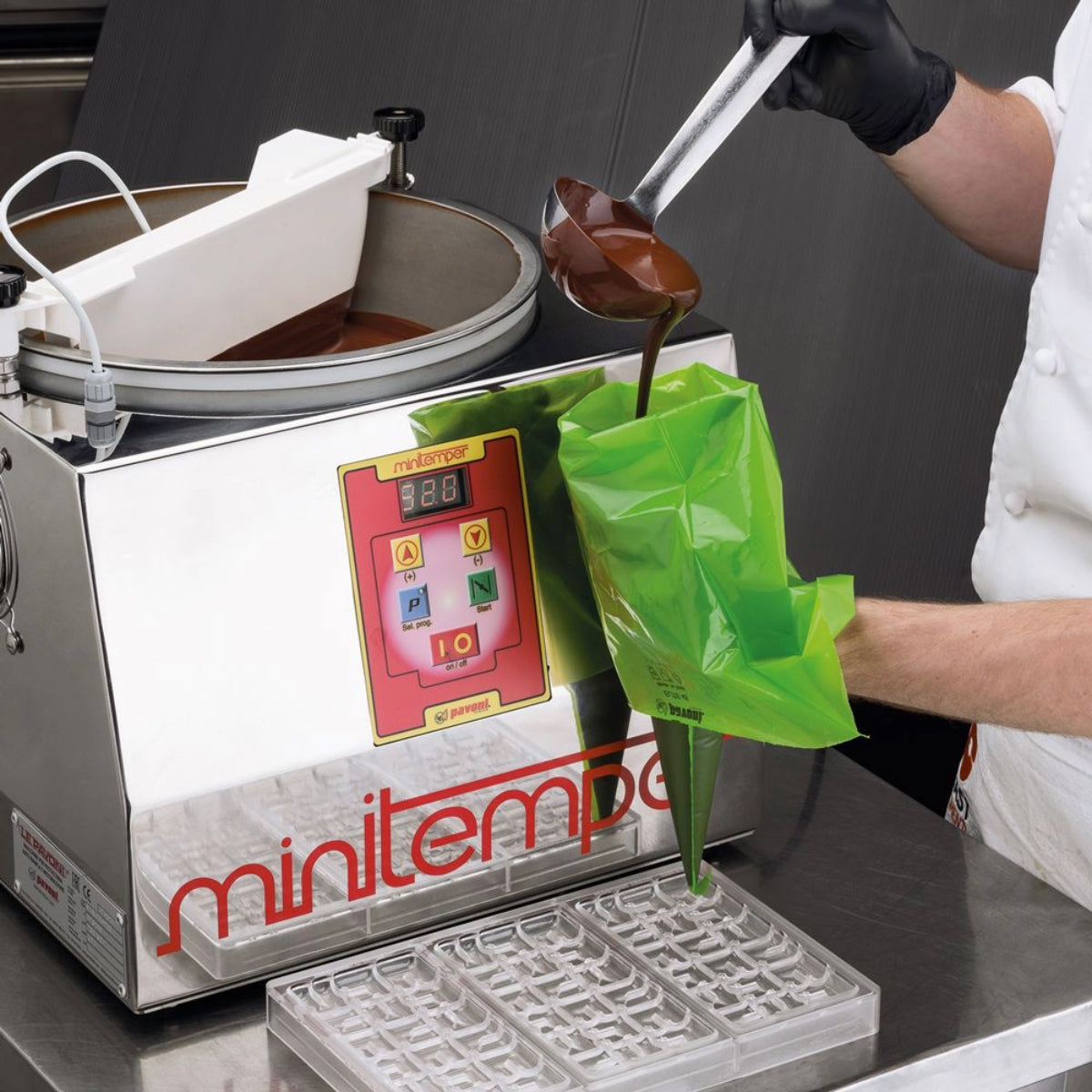
- Automatic batch tempering: the Pavoni MiniTemper has five programmable presets, each with melt, crystallise and harden stages, set from 20 to 60°C in 0.5°C steps, a 5 L bowl and a 110 V plug.
- Continuous tempering for production: machines such as the Pomati T5 (5 kg heated tank, up to 15 kg per hour according to our product data) temper continuously with an auger.
View chocolate tempering machines →
Not sure whether you need a melter or a temperer? Read chocolate melter vs chocolate temperer.
How to tell if chocolate is tempered
Tempered chocolate sets quickly, glossy and without streaks, and contracts enough to release from the mould. Use these checks:
| Check | What you see when it is right | What it tells you |
|---|---|---|
| Temper test on a palette knife | Dark sets within about 7 minutes, no streaks, no grain; milk and white a little longer | Enough seed crystals (not underseeded) |
| Viscosity | Not clearly thicker than the melted, untempered chocolate | Not overseeded |
| Thermometer | At the working temperature for your chocolate | Working conditions for shine, snap and shelf life |
| Moulded pieces | Release cleanly from the mould | Tempered chocolate shrinks slightly as it sets |
If something goes wrong, our tempering troubleshooting guide covers chocolate that will not set, shine or release. For the science, see chocolate crystallization.
Tips for tempering at home and in small batches
- Use couverture. Its extra cocoa butter, combined with proper tempering, gives more sheen and a firmer snap. Compound chocolate, where other fats replace the cocoa butter, does not need tempering, but it does not set as firmly and is hard to release from moulds.
- Do not overheat chocolate that is already tempered. Above about 34°C (93°F) the stable crystals are destroyed, and the chocolate keeps climbing after you stop heating. Warm it slowly.
- Work dry. Condensation, high humidity, a damp bowl or steam are common causes of sugar bloom. Melting chocolate cannot tolerate small drops of water: steam escaping from a double boiler, or condensation dripping from a lid placed over the bowl, is enough to make it seize into a grainy mass that is hard to bring back. Do not cover chocolate while it melts.
- Keep the temperature steady. Drifting in and out of the working window lets unstable crystals form over time.
- Lost the temper? Melt the chocolate completely and start the process again.
- Store chocolate well. Bassan gives 16–20°C (61–68°F) and below 50% relative humidity for its 71%, and asks that tempered chocolate be used within 4 hours.
How AI can help your production
Give an AI assistant the tempering curve from your chocolate's technical sheet and ask it to write a one-page tempering procedure for each chocolate you use, with a log for the temper test, the working temperature at each fill and the room temperature. Ask it to work out how much chocolate to temper for a production run from your mould cavity counts and weights, and to schedule batches so tempered chocolate is used within the time your maker recommends. A written routine is what keeps every shift tempering the same way.
AI organises the information; tasting and the final decision stay with your chef.
Tempering equipment and chocolate at Zucchero Canada
We are an authorized distributor of Martellato, Pavoni Italia and Pomati in Canada, and each has its own job in tempering:
- Hand tempering and checking: Martellato Digital Thermometer 50T001 → $29.95, the Martellato Infrared Digital Thermometer 50T002 → $76.50 and the Professional Chocolate Scraper 145 mm → $36.95.
- Melting and holding while you seed: Martellato Digital Meltinchoc 6 L → $1,259.99, 110 V, with three pre-set programs for dark, milk and white. Martellato table-top melters come with a free spatula.
- Automatic batch tempering: Pavoni MiniTemper 110V → $3,350.00.
- Continuous production: tabletop tempering machines →, including the Pomati T5.
- Chocolate: Bassan Sur del Lago 71% →, made in Canada from Venezuelan Trinitario cacao with ancestral Criollo lineage, working temperature 30–32°C, 5 kg bag $273.00. Making your own chocolate from the bean? Our Sur del Lago cocoa beans from Venezuela → come in a 1.5 kg bag at $80.00.
- Reference book: Chocolate, 6th edition, by Ramon Morató → $160.00, with tempering, coating and glazing techniques.
Machines and chocolate are excluded from free shipping; orders over 500 CAD get 5% off automatically at checkout, and chocolate ships within Canada only. Setting up a chocolate kitchen or production line? Contact us or call 587-774-8873 (toll free 877-741-8251).
Tempering machines | Chocolate melters | Thermometers | Tempering troubleshooting | Tempering white chocolate | Tempered vs untempered
This article is for information only. Every business is different: draw your own conclusions based on your own expectations, budget and goals, and talk to qualified experts before you decide or invest.
Sources: Peter Greweling, "Tempering Chocolate", Pastry Arts Magazine (2024); Ewald Notter, The Art of the Chocolatier (2011), "The Seeding Method" and "The Tabling Method"; J. A. Stobbs, S. M. Ghazani, M.-E. Donnelly and A. G. Marangoni, "Chocolate Tempering: A Perspective", Crystal Growth & Design 25 (2025); KREA Swiss, "Tempering, what it really is and where it goes wrong"; Martellato, Digital Meltinchoc user manual; Pavoni Italia, Machines catalogue; BC Cook Articulation Committee, Understanding Ingredients for the Canadian Baker, ch. 7 (BCcampus, CC BY 4.0); Exploratorium, Science of Cooking, "Why does my melted chocolate seize up?"; product data from Bassan Chocolate, FCH Origins, Canada Cacao Co., Pavoni Italia, Pomati, Martellato and Vilbo on zuccherocanada.ca.







Leave a comment
All comments are moderated before being published.
This site is protected by hCaptcha and the hCaptcha Privacy Policy and Terms of Service apply.