


How to Use Silicone Molds for Pastry and Chocolate, Step by Step
Short answer: to use a silicone mould, choose the right format, pipe the mixture into the cavities, then bake or freeze it inside the mould's temperature range (−40°C to +250°C for Pavoni Italia's platinum silicone) and release the piece by flexing the mould from the corners. Wash it in the dishwasher without abrasive products or harsh detergents, and keep knives and direct heat away from it. Below: each step with Pavoni's own instructions, which line to choose for which job, and where silicone fits when you work with chocolate.
Quick answer: which Pavoni silicone mould for which job
| What you want to make | Pavoni line | Example | Price |
|---|---|---|---|
| Frozen single-portion desserts (mousse, inserts) | Pavoflex 3D | Sphere PX4313S, 12 cavities | $69.00 CAD |
| Decorative portions shaped like fruit and nuts | Gourmand | Cherry GG016S by Felix Lo Basso, 35 cavities | $40.50 CAD |
| Small multi-portion pieces (tartlets, mini savarins) | Formaflex 300 × 175 mm | Mini Tartlet FR011, 15 cavities of about 12 ml | $23.50 CAD |
| Baked pastry that must grip and rise evenly | Formasil (micro-perforated) | Round Formasil FF01 | $95.00 CAD |
| Leavened doughs, cakes and viennoiserie baked in shape | Fiberform | Hemisphere FB01, 600 × 400 mm | $145.00 CAD |
| A non-stick bench and baking surface | SPV mats | SPV43 non-stick mat | $29.99 CAD |
View all Pavoni silicone moulds →
What Pavoni silicone can and cannot take
Pavoni Italia rates its silicone from −40°C to +250°C (−40°F to 482°F), and says the moulds can go from the blast chiller to the oven, and back, without waiting. It makes its moulds from 100% platinum silicone to EU regulations, and describes the material as non-toxic, odourless and tasteless.
| Do | Don't |
|---|---|
| Bake, chill, blast-freeze within −40°C to +250°C | Put the mould on direct heat: flame, grill, ceramic glass or an electric plate |
| Wash it in the dishwasher | Use abrasive products or harsh detergents |
| Release pieces by flexing the mould | Cut or scrape with a knife against the silicone |
| Go from blast chiller to oven, and back, without waiting | Use a microwave's CRISP function |
Pavoni's promise is that a mould treated this way is ready for thousands of uses. One note: some of our product pages do not yet match the catalogue figure (most Gourmand pages show +230°C and the Fiberform pages show +280°C), so until they are aligned, keep to the lower of the two figures for the mould you use.
Step 1: Set the mould up
Pick the format that fits your oven, freezer and blast chiller: Pavoni makes Pavoflex in 400 × 300 mm and 600 × 400 mm, Formaflex multi-portion trays in 300 × 175 mm and Fiberform in 600 × 400 mm. For Formasil micro-perforated mats, Pavoni's instruction is to lay the mat on a micro-perforated baking tray before filling.
Step 2: Fill with a piping bag
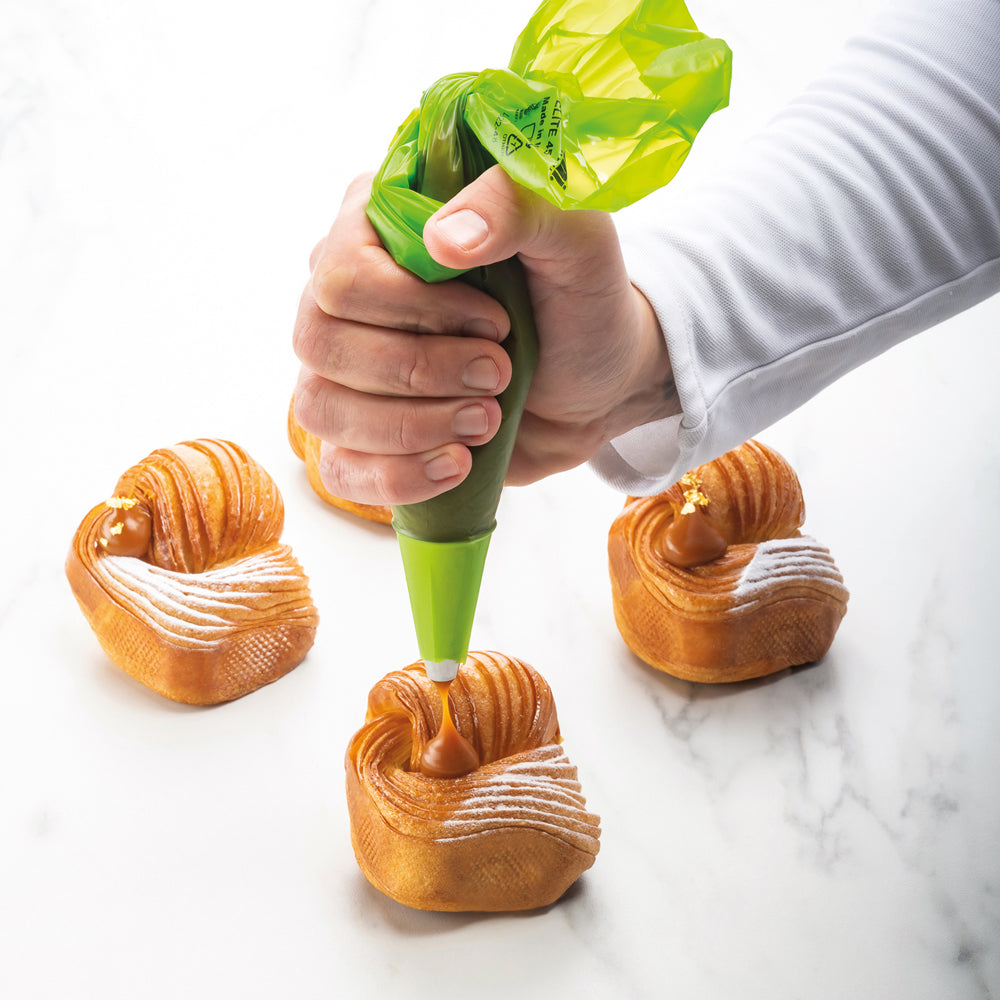
Pipe the mixture into each cavity. Pavoni's Formasil instruction is exactly that: fill the indents with a piping bag. For layered cakes, Pavoni also makes dedicated insert moulds; our entremet techniques guide shows how the layers come together.
Planning portions? Our mould pages give the cavity volume where it is published, for example about 12 ml per cavity on the Formaflex Mini Tartlet.
Step 3: Bake or freeze
- Baking: Formaflex is designed for maximum non-stick release and for even rising and baking. Fiberform adds a fibreglass mesh inside the silicone so the walls keep their shape under heat; Pavoni lists it for leavened dough, cakes, viennoiserie and shortbread. Formasil's micro-perforated surface lets the dough grip, for even rising.
- Freezing: Pavoflex moulds are rated for the blast chiller and Gourmand moulds for the freezer, so mousses and creams can set in the cavity. Fiberform's reinforced structure also stays stable at low temperatures, which Pavoni says allows precise demoulding.
Step 4: Demould from the corners
Pavoni's instruction for Formaflex cake moulds: lift the piece out carefully starting from the corners, then finish demoulding after you have set it on a flat surface. For frozen portions, Pavoni sums up the workflow of its Delicious Snack mould as "fill, freeze, flex": the frozen piece comes out when you flex the silicone.
Step 5: Finish the surface
A frozen mousse straight out of the mould is the right base for a velvet finish. Pavoni's Dolce Velluto sprays are coloured cocoa butter made to be applied on cold surfaces for a velvet effect.
- View the Dolce Velluto black velvet spray, 400 ml → $56.99 CAD
- View the Sphere40time Pavoflex mould by Antonio Bachour, 15 cavities → $40.50 CAD
Step 6: Wash the mould safely
Wash the moulds in the dishwasher without abrasive products or harsh detergents. Keep knives and sharp tools out of the cavities: Pavoni lists "do not use knives in contact with the mould" among its rules. The same washing rules answer the common question of how to clean silicone chocolate moulds.
Using silicone moulds with chocolate
Pavoni positions its silicone chocolate lines for volume and fillings: Chocoflex moulds are for sweet or savoury creations made in large quantities, and Delicious Snack moulds are for snacks with a filling under the coating. For pralines, its chocolate range uses BPA-free Tritan moulds instead. Whatever the mould, work with tempered chocolate: tempering is the step that produces stable cocoa butter crystals in the finished piece.
- For glossy bonbons and bars, Pavoni makes BPA-free Tritan moulds. View Pavoni chocolate moulds →
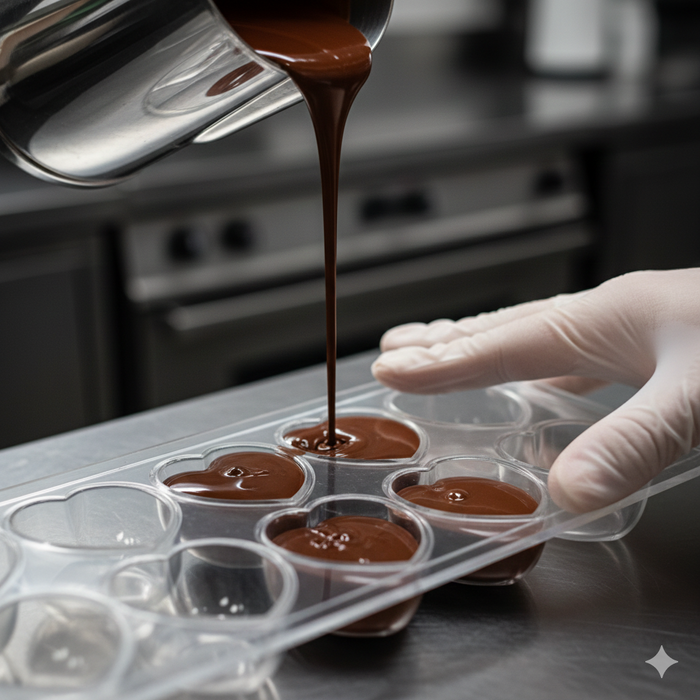
- For the moulding technique itself, read our step-by-step guide to moulding chocolate and the silicone example in how to make chocolate hearts with a silicone mould.
How to choose the right silicone mould
Choose by the finished product first, then by format. Pavoni groups its silicone by job:
- Pavoflex: single-serving and medium-portion 3D moulds, many designed with chefs such as Antonio Bachour, Cédric Grolet and Gianluca Fusto. Pavoflex collection.
- Gourmand: individual portions shaped like fruit, nuts and leaves. Gourmand collection.
- Formaflex: cake moulds and 300 × 175 mm multi-portion trays. Formaflex collection.
- Formasil: micro-perforated mats for baked pastry. Formasil collection.
- Fiberform: fibreglass-reinforced silicone for baking in shape. Fiberform collection.
- Pavocake: 3D cake moulds, such as the Pavocake KE001S at $35.99 CAD.
How AI can help your production
Give an AI assistant the cavity volume and cavity count printed on the mould page, your recipe and your daily output, and ask it to scale the recipe to fill a whole number of moulds, with a piping weight per cavity. Ask it to turn this page into a one-page washing and storage card for your team, and into a freezing and demoulding schedule for each product. Written routines keep every shift using the moulds the same way, which protects them for longer.
AI organises the information; tasting and the final decision stay with your chef.
Pavoni Italia silicone moulds at Zucchero Canada
We are an authorized distributor of Pavoni Italia and carry its silicone ranges for pastry and chocolate work. Our mould pages list details such as format, cavity count, cavity volume and temperature range. Orders of $300 CAD or more on selected products ship free within Canada (remote areas and the territories pay the actual carrier rate), and orders over $500 CAD get 5% off automatically at checkout. European engineering. Canadian support. Buying for a pastry kitchen, hotel or school? Contact our team for volume orders.
For ideas on what to make in them, Antonio Bachour, who designed several Pavoflex moulds, collects 52 small-format creations in his book Bachour Gastro ($105.00 CAD).
Silicone pastry moulds | Pavoflex | Silicone baking mats | Entremet techniques | How to mould chocolate
This article is for information only. Every business is different: draw your own conclusions based on your own expectations, budget and goals, and talk to qualified experts before you decide or invest.
Sources: Pavoni Italia, Food Equipment catalogue 2026 ("Silicone in pastry – Tips", Formaflex and Formasil "How to use", Fiberform, Chocoflex, Dolce Velluto pages); Pavoni Italia product data on zuccherocanada.ca (formats, cavities, volumes, temperature ranges); Barišić et al., "The Chemistry behind Chocolate Production", Molecules 24 (2019) 3163.
Good to know
Frequently asked questions
How do you use silicone molds for chocolate?
Use tempered chocolate, fill the cavities, let the chocolate set and release each piece by flexing the mould. Pavoni designs its silicone chocolate lines (Chocoflex, Delicious Snack) for volume work and filled, coated snacks; for glossy pralines it uses BPA-free Tritan moulds. Our guide to moulding chocolate covers the full technique.
How do you clean silicone chocolate molds?
Pavoni's rule is simple: wash them in the dishwasher without abrasive products or harsh detergents, and never use knives in contact with the mould. Keep the moulds away from direct heat sources such as flame, grill, ceramic glass or an electric plate.
Can silicone molds go in the oven and the freezer?
Yes, within the mould's range. Pavoni rates its platinum silicone from −40°C to +250°C (−40°F to 482°F) and says the moulds can go from the blast chiller to the oven, and back, without waiting. Some of our product pages still show a different figure (+230°C on most Gourmand moulds, +280°C on Fiberform); until they are aligned, keep to the lower figure.
How do I get a cake or frozen dessert out of a silicone mold cleanly?
For Formaflex cake moulds, Pavoni's instruction is to start from the corners and finish demoulding once the cake rests on a flat surface. For frozen portions, flex the silicone away from the piece once it is fully frozen.
Which silicone mold should I buy first?
Choose by product: Pavoflex for frozen single-portion desserts, Gourmand for fruit- and nut-shaped portions, Formaflex for small multi-portion pieces and cakes, Formasil and Fiberform for baked pastry. Our mould pages list details such as format, cavity count and cavity volume.
Do silicone molds qualify for free shipping?
Orders of $300 CAD or more on selected products ship free within Canada; remote areas and the territories pay the actual carrier rate, and cacao, chocolate, flour, machines and pallets are excluded. Orders over $500 CAD also get 5% off automatically at checkout.
Shop this article
Products mentioned in this guide
 Pavoni ItaliaSphere 3D PAVOFLEX Silicone Mold PX4313S$69.00 CADView product →
 Pavoni ItaliaCherry Gourmand Silicone Mold – Felix Lo Basso GG016S$40.50 CADView product →
 Pavoni ItaliaMini Tartlet Formaflex Silicone Mold FR011$23.50 CADView product →
 Pavoni ItaliaRound Formasil Micro-Perforated Silicone Mat FF01$95.00 CADView product →
For professionals
Equipping a chocolate shop, bakery or kitchen?
Tell us what you produce and how much. We will recommend the right machine, moulds and ingredients, and send you a quote.
For home bakers
Professional tools for your own kitchen
The same European moulds, tools and ingredients the professionals use.
5% off orders over $500 CAD, applied automatically at checkout.
Keep reading


Leave a comment
All comments are moderated before being published.
This site is protected by hCaptcha and the hCaptcha Privacy Policy and Terms of Service apply.