



Roasting is the step that unlocks flavor. Raw fermented cacao beans contain the precursors — acids, amino acids, reducing sugars — but roasting is where the Maillard reaction converts those precursors into the chocolate aromatics that define your final product. Whether you're roasting a small batch at home to understand the process, or building a professional bean-to-bar production line, the fundamentals are the same. What changes is the precision, consistency, and scale.
The basics: what roasting does to a cacao bean
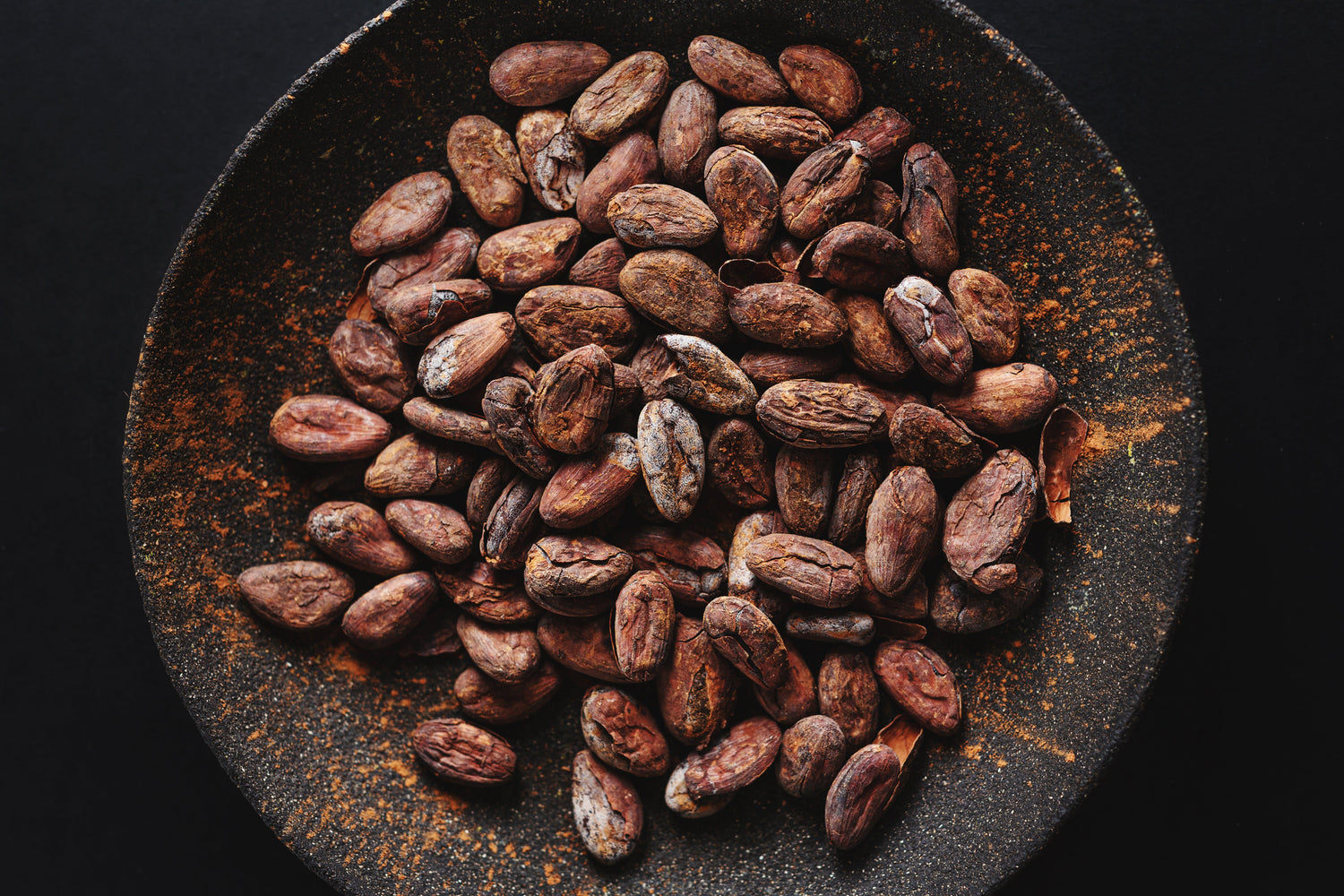
Raw fermented cacao beans are purple-brown, slightly acidic, and don't taste much like chocolate yet. During roasting, three things happen simultaneously:
- Moisture reduction: Beans enter the roaster at 6–8% moisture. You want to bring them down to roughly 2–3%. Too fast and the outside chars before the inside develops. Too slow and you bake rather than roast — flat flavor, no aromatic development.
- Maillard reaction: Above approximately 130°C (265°F), amino acids and reducing sugars begin reacting to form hundreds of new flavor compounds — the pyrazines, furanones, and aldehydes that create chocolate aroma. This is the core of roasting.
- Acid volatilization: Acetic acid (the main fermentation byproduct) volatilizes during roasting. Under-roasting leaves residual acidity and vinegary notes. Correct roasting drives off enough acid to reveal the underlying flavor profile without destroying it.
Temperature and time: the basic parameters
Roasting temperatures for cacao typically fall between 120°C and 150°C (250–300°F), with roasting times of 15–35 minutes depending on origin, bean size, and desired profile. The relationship is not linear — a few degrees difference at peak temperature can meaningfully change the result.
| Roast level | Temperature range | Time | Flavor result |
| Light | 120–130°C (250–265°F) | 20–35 min | Fruity, floral, high acidity, origin-forward |
| Medium | 130–140°C (265–285°F) | 18–25 min | Balanced, chocolate notes emerging, reduced acidity |
| Medium-dark | 140–150°C (285–300°F) | 15–20 min | Rich chocolate, caramel, nutty, low acidity |
| Dark | 150°C+ (300°F+) | 12–18 min | Intense, roasted, bitter risk if pushed too far |
These are starting points, not rules. Venezuelan Criollo beans (like our Sur del Lago and OCUMARE) are typically more delicate — they reward lighter roasting profiles that preserve their floral and fruity character. Forastero-dominant origins with bolder flavor can handle higher temperatures and longer times.
Origin matters more than the roasting profile
You can't roast your way to a great chocolate if you start with mediocre beans. Roasting amplifies what's already there — good fermentation, good variety, good terroir. That's why professional bean-to-bar producers are obsessive about sourcing before they're obsessive about roasting.
At Zucchero Canada, we source through Canada Cacao Co. with full traceability and Certificate of Origin on every lot:
- Sur del Lago Ancestral Criollo Lineage — Zulia & Trujillo, Venezuela. Trinitario with 10–30% ancestral Criollo lineage. Controlled fermentation ≥65% uniformity, sun-dried 7 days to ~5.4% moisture. Fruity, woody, low astringency — profile that rewards a light to medium roast.
- OCUMARE Criollo Blood — Aragua coast, Venezuela. High ancestral Criollo content, low bitterness, floral and fruity aromatics. Delicate profile — roast light to medium to preserve character.
- Carenero Superior — Miranda state, Venezuela. The classic Venezuelan commercial origin — reliable, consistent, forgiving to roast. Good starting point for producers new to Venezuelan cacao.
- Gibraltar Criollo — Sur del Lago micro-origin. Criollo blood in the cup, complex aromatic profile.
- Río Caribe Superior — Sucre state, Venezuela. Gateway Venezuelan origin, accessible flavor profile.
All available in 1.5 kg, 5 kg, 20 kg, and 60 kg formats. Priority allocation for standing B2B orders.
Home roasting: the practical approach
If you're learning the process or developing roasting profiles before investing in dedicated equipment, a standard oven works. Spread beans in a single layer on a baking sheet, preheat to 135°C (275°F), and stir every 5 minutes. Total time: 20–25 minutes for a medium roast on most Venezuelan origins. Cool immediately on a flat surface with airflow — residual heat continues the roast if you don't cool fast.
The limitations of oven roasting are real: uneven heat distribution, no airflow agitation, difficult to replicate batch to batch. For anyone producing chocolate commercially, oven roasting is a development tool, not a production method.
Professional bean-to-bar roasting: FBM and Bilait equipment
When you move beyond experimentation into consistent production, you need equipment that delivers repeatable roasting profiles, even heat distribution, and the throughput your volume requires. This is where FBM Boscolo and Bilait — both Italian manufacturers — come in.
FBM Boscolo — Complete Bean-to-Bar Lines
FBM Boscolo builds dedicated bean-to-bar equipment used by craft chocolate producers across Europe and internationally. Their machines are designed to work as a system — from cracking and winnowing through grinding, refining, conching, and tempering.
The FBM bean-to-bar lineup we carry at Zucchero Canada:
- FBM Ninja Kid — Cracker & Winnower, 25–30 kg/h ($20,650 CAD) — Cracks roasted beans and separates nibs from shells. The entry point of any bean-to-bar line. Consistent nib separation means you're not losing product to incomplete winnowing or carrying shell into your grinder.
- FBM Rumbo Kid — Chocolate Grinder, 28 kg capacity ($27,299 CAD) — Ball mill grinder for refining nibs into chocolate mass. Reduces particle size progressively to the 20–25 micron threshold below which the human tongue stops detecting graininess. For single-origin bars, ganaches, and couverture development.
- FBM Rumbo 120 — Chocolate Grinder, 120 kg capacity ($35,000 CAD) — For producers who have validated their recipes and need to scale. Same principle as the Rumbo Kid at production volume.
- FBM TAOBROMA — Ball Mill, 35 kg ($48,650 CAD) — Advanced ball mill with touchscreen PLC, programmable recipes, and separate heating/cooling circuits for full temperature control throughout refining. Handles chocolate mass, gianduja, and nut pastes. Fineness down to 20–25 microns.
- FBM KLEEGO 50 — 50 kg Melting Tank & 35 kg Conche ($23,899 CAD) — Melts and conches in one unit. Conching develops flavor and texture after refining — it's where residual acids are driven off, flavor compounds develop, and viscosity is adjusted. The KLEEGO 50 handles both functions for mid-scale production.
Bilait — Italian Precision for Tempering and Finishing
After roasting, cracking, winnowing, grinding, and conching, your chocolate mass needs to be tempered before molding. Bilait builds Italian-engineered tempering machines designed for professional bean-to-bar and chocolatier production.
- Bilait Adam K6 — 6 kg Continuous Tempering Machine ($9,899 CAD) — Touchscreen control, dual-zone heating, integrated refrigeration, heated vibrating table. Converts to a compact enrober with optional accessory. 230V single-phase — most commercial kitchens already have 230V available. Contact us to confirm your electrical setup before ordering.
Additional Bilait machines are being added to our Canadian catalog this week — contact us for the full current lineup.
The complete bean-to-bar process flow
For producers building or scaling a bean-to-bar operation, here's how the equipment maps to the process:
| Step | Process | Equipment |
| 1 | Source & evaluate beans | — |
| 2 | Roast | Dedicated roaster (contact us for options) |
| 3 | Crack & winnow | FBM Ninja Kid |
| 4 | Grind & refine | FBM Rumbo Kid / Rumbo 120 / TAOBROMA |
| 5 | Conche | FBM KLEEGO 50 |
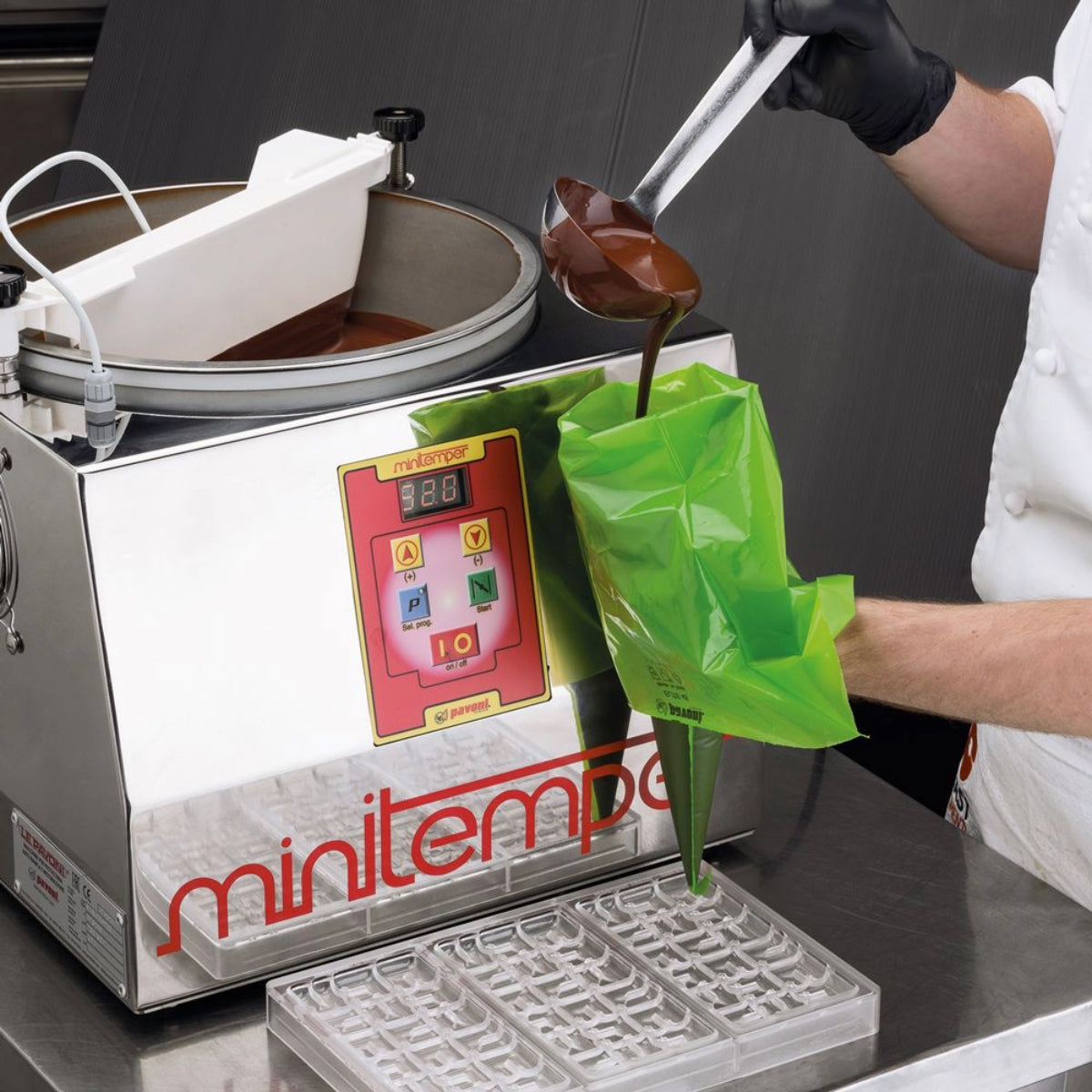
| 6 | Temper | Bilait Adam K6 / Pavoni MiniTemper / Pomati T5 |
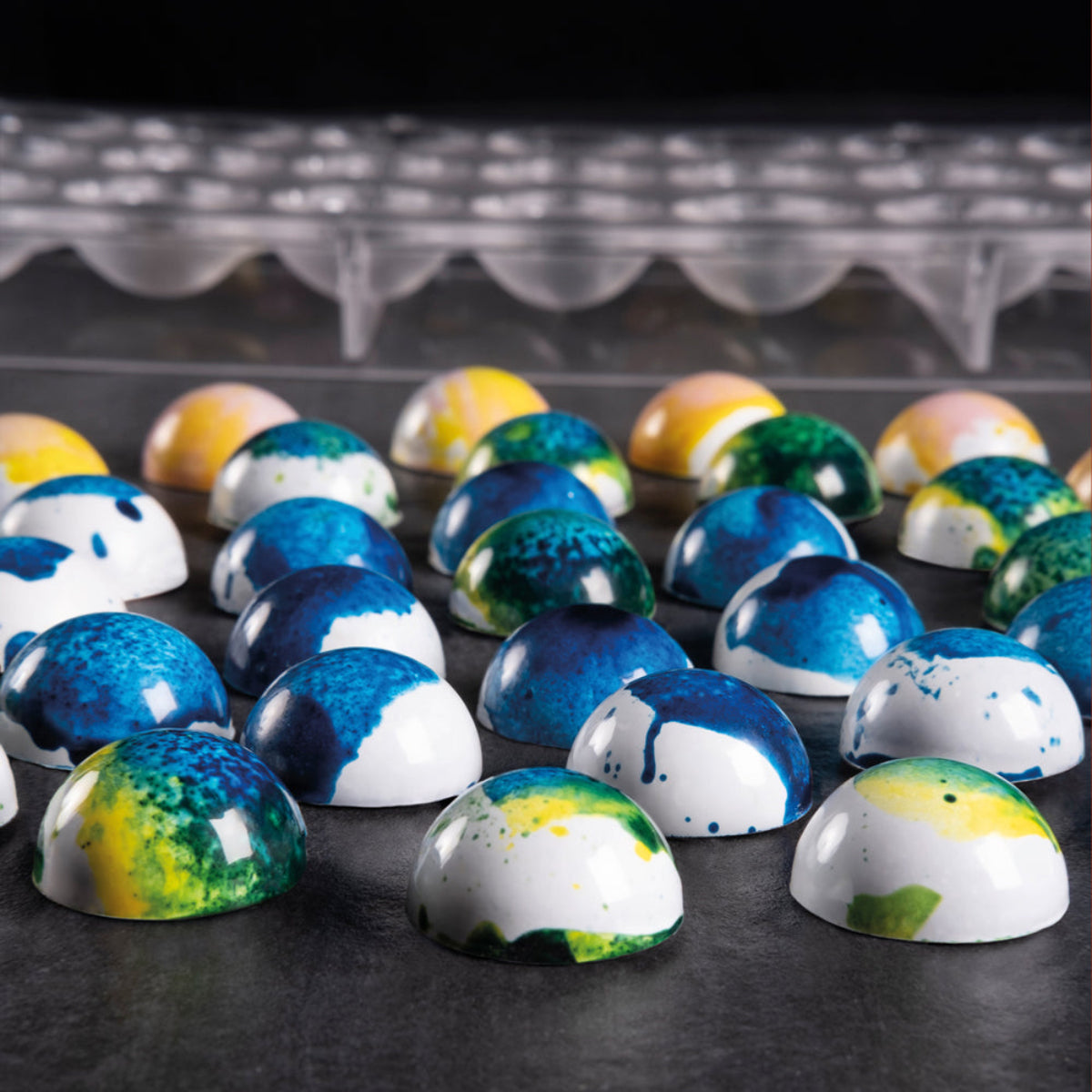
| 7 | Mold & cool | Chocolate molds + cooling |
Starting your bean-to-bar production in Canada
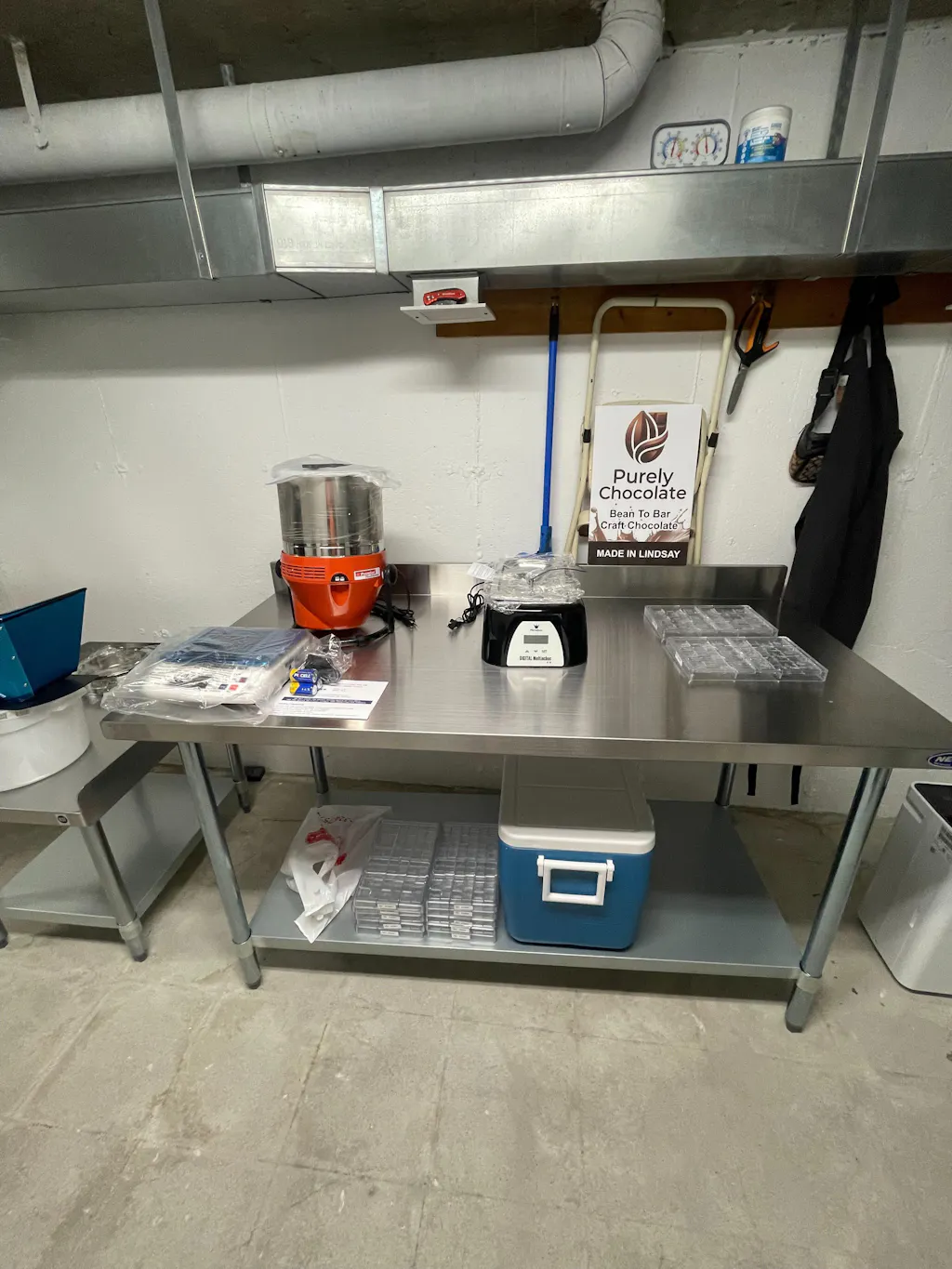
At Zucchero Canada, we are the authorized Canadian distributor for FBM Boscolo and Bilait. All equipment ships from our Calgary warehouse or direct from the manufacturer with Canadian support. We also supply the single-origin Venezuelan and Peruvian cacao beans that go into your production — so you can source beans and equipment from one place, with traceability documentation on every lot.
Whether you're developing your first bean-to-bar recipe or scaling an existing operation, contact our team — we work with craft chocolate producers across Canada and can help you spec the right equipment for your volume, space, and budget.
→ Browse single-origin cacao beans · → Browse tempering machines









Leave a comment
All comments are moderated before being published.
This site is protected by hCaptcha and the hCaptcha Privacy Policy and Terms of Service apply.