
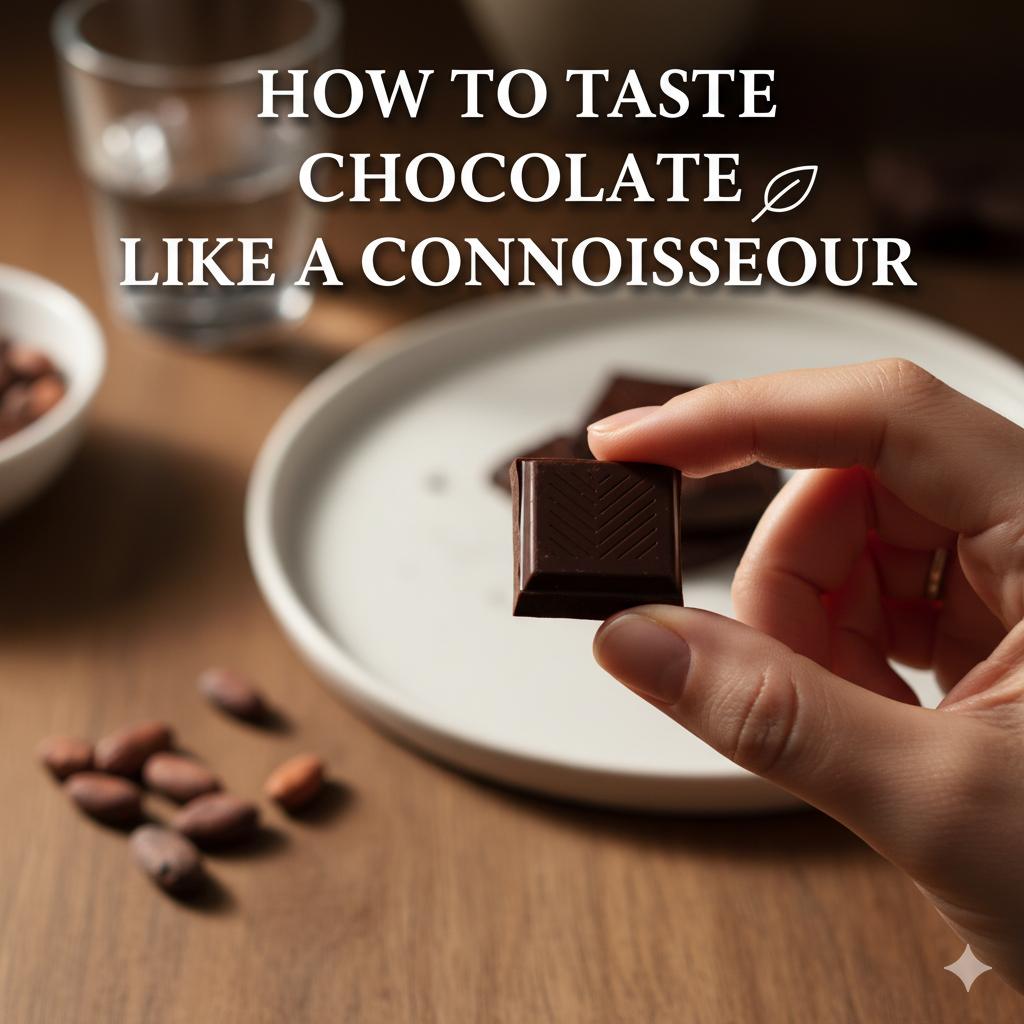
How to Taste Chocolate Like a Connoisseur: The Professional Method
Short answer: to taste chocolate like a professional, let it reach room temperature, smell it first, then let a 2–3 g piece melt slowly between your tongue and the roof of your mouth, breathing out gently through your nose. Note what you taste at the start, in the middle and in the finish, rinse with warm water and a plain water cracker between samples, and stop at six samples per session. This is the method in the Cacao of Excellence guide (Alliance of Bioversity International and CIAT, 2023), built on 12 years of evaluating cacao samples from around the world for the programme's awards.
The professional tasting method, step by step
Professional tasters smell first, melt slowly and score in three stages: start, middle and finish. The Cacao of Excellence protocol for dark chocolate runs like this:
- Start with a chocolate you already know well, as a reference to calibrate your palate.
- Break the piece in two and bring one half close to your nose.
- Smell it deeply while rubbing its surface with your fingers. Breathe out to clear your nose, then take several short sniffs and write down what you smell.
- Bite a piece and place it between your tongue and the roof of your mouth.
- Let it melt while you rub it gently against the palate with your tongue.
- Once it starts melting, spread it over your tongue and hold it there as long as you need.
- Draw in tiny sips of air through your mouth and breathe out through your nose, so the aroma reaches you fully.
- Notice the flavours at three moments: the start, the middle and the finish. Some appear and vanish quickly; others linger.
- Score each attribute from 0 to 10, then give the sample an overall quality score from 0 to 10. Spit out if you need to, and check the aftertaste before you finalise your notes.
Set up the room, and yourself
A quiet, odour-free room at 20–22°C, with neutral colours and good light, gives you the most reliable results.
| Condition | Cacao of Excellence guideline |
|---|---|
| Room temperature | 20–22°C (68–72°F) |
| Relative humidity | 45–55% |
| Lighting | Shadow-free; 300–500 lux in the room and 700–800 lux at the table surface |
| Room | Quiet, free of odours, neutral colours (off-white, light grey); odour-free cleaning products |
| Last meal | At least 2 hours before tasting |
| Coffee, cigarettes, spicy food, alcohol, hard exercise | At least 1 hour before tasting |
| Tasters | No perfume or aftershave; hands washed with scent-free soap; no tasting with a cold |
Prepare the samples
Serve every chocolate at room temperature, in the same size, on the same plates, so nothing but the chocolate changes.
- Temperature: take samples out of a cold room one hour before tasting. Frozen samples go to the fridge overnight, then one hour at room temperature.
- Size: cut 5 g pieces and break each in two; you taste 2–3 g at a time.
- Blind codes: label each plate with a random three-digit number, so the brand or origin cannot bias you, and avoid numbers that mean something.
- Order: change the serving order between tasters, so the same chocolate is not always tasted first.
What to look for: the tasting vocabulary
Every cacao has five core attributes; the complementary ones may or may not be there, and off-flavours point to a defect. The Cacao of Excellence flavour wheel groups them like this:
| Group | Attributes |
|---|---|
| Core (present in every cacao) | Cacao, acidity, bitterness, astringency, roast degree |
| Complementary | Fresh fruit (berry, citrus, dark, yellow/orange/white flesh, tropical), browned fruit (dried, browned, over-ripe), vegetal (grassy/green/herbal, earthy/mushroom/moss/woodsy), floral (orange blossom, flowers), woody (light wood, dark wood, resin), spice (spices, tobacco, savoury/umami), nutty (nut flesh, nut skin), caramel/panela; sweetness for chocolate only |
| Off-flavours (defects) | For example dirty/dusty, musty, mouldy, meaty/animal/leather, over-fermented/rotten fruit, putrid/manure, smoky |
Score each attribute in the order it appears; the order changes from one chocolate to the next. The intensity scale reads like this:
| Score | Meaning |
|---|---|
| 0 | Absent |
| 1 | Just a trace; you may not find it if you taste again |
| 2 | Present, at low intensity |
| 3–5 | Clearly characterises the sample |
| 6–8 | Dominates the sample |
| 9–10 | Maximum; overpowers other notes |
Look and snap: the first clues
Before you taste, look at the surface and listen to the break. In couverture, the extra cocoa butter combined with proper tempering gives more sheen and a firmer snap. Dull grey or white streaks can be bloom: our guide on chocolate bloom vs mould explains how to tell them apart.
Clean your palate between samples
Warm water and a plain cracker remove what the last chocolate left behind, so it does not colour the next one.
- Rinse your mouth with warm water at about 40–50°C (104–122°F), swish well and spit.
- Chew a 2 × 2 cm piece of unsalted, yeast-free water cracker (made only with flour and water) with your front teeth, move the crumbs around with your tongue and swallow.
- Rinse again and spit, then rinse a third time and swallow.
- Keep your mouth closed for 2–3 minutes before the next sample.
Apple, baby carrots and cucumber also work as palate cleansers. Keep the water in a thermos, and avoid chlorinated tap water or water with added salts. Spitting rather than swallowing reduces carry-over from one sample to the next.
How many chocolates can you taste in one session?
No more than six in a session and twelve in a day. Split a day's tasting into two sessions of six or three sessions of four, never straight after a meal. Tasters find chocolate more tiring than pure cacao mass, and fatigue blunts your perception; when reference samples are included, keep the total to ten per session.
For producers: taste your own cacao
If you make chocolate, tasting the cacao mass and the finished bar from the same lot tells you whether the beans, the roast or the recipe is speaking. The Cacao of Excellence guide tastes 1–2 g of cacao mass melted at 48–50°C (118–122°F), heated only once and kept there no more than five minutes. For comparing beans, it roasts test samples for 25 minutes at 112°C (234°F), 120°C (248°F) or 130°C (266°F), and makes its test chocolate with 70% cacao: 63% cacao mass, 7% cocoa butter and 30% sugar.
Build a tasting flight from our range. The flavour notes below are those the producers give for each product:
| Product | Origin | Producer's flavour notes | Price |
|---|---|---|---|
| Bassan Sur del Lago 71% dark couverture, 5 kg | Venezuela, made in Canada | Fruit, wood and nuts; low acidity and astringency | $273.00 |
| FCH 55% dark chocolate minibars, 10 kg | Venezuela, Trinitario | Tropical fruits, nuts, cacao, vanilla; lingering citrus aftertaste | $299.00 |
| Natural cocoa liquor wafers, 1 kg | Peru | 100% cacao mass, no added fat or sugar | $29.99 |
| Sur del Lago cacao beans, 1.5 kg | Venezuela, Trinitario with 10–30% ancestral Criollo lineage | Fruity, woody, nutty; low acidity and astringency | $80.00 |
| Ucayali cacao beans, 1.5 kg | Peru | Ripe fruit, spice, light wood; very low bitterness and astringency | $80.00 |
The beans are raw: roast and process them before tasting, never eat them raw. To start, read our guide on how to roast cacao beans.
View dark chocolate couverture →
Store tasting samples properly
Keep chocolate samples sealed, away from odours, sunlight and heat. The Cacao of Excellence guide stores chocolate at 10–18°C (50–64°F) for up to two years, and keeps cacao products at less than 70% relative humidity to prevent mould. More in our guide on the ideal humidity for storing chocolate.
A book for the chocolate professional
Ramon Morató's Chocolate (6th edition, 416 pages, 200 recipes) is organised in four sections: chocolate as a product, confectionery, chocolate making and restaurant applications. It is a solid next step once you can taste and describe a chocolate and want to work with it.
- View Chocolate, 6th Edition, by Ramon Morató → $160.00 CAD
How AI can help your production
Ask an AI assistant to generate random three-digit codes and a different serving order for each taster, and to build a score sheet with the five core attributes, the complementary attributes and an overall quality score from 0 to 10. After the session, paste in the scores and ask it to average them per sample and compare them with your previous lots, so you can see whether a new roast or a new bean lot changed the flavour.
AI organises the information; tasting and the final decision stay with your chef.
Cacao and couverture for tasting at Zucchero Canada
We supply Venezuelan and Peruvian cacao beans, cocoa liquor and single-origin couverture to chocolatiers, bean-to-bar makers and pastry kitchens across Canada. For a flight of contrasting origins, pair the Sur del Lago beans with the Ucayali beans; for finished chocolate, compare the Bassan Sur del Lago 71% with the FCH 55% from Venezuela. Food products ship within Canada only, and cacao and chocolate are not part of the free-shipping offer. Orders over CAD 500 get 5% off automatically at checkout.
Need a regular supply of one origin for your production? Contact us or call 587-774-8873 (toll free 877-741-8251).
Raw cacao beans | Dark couverture | What is single-origin chocolate | Chocolate percentages explained | How to roast cacao beans
This article is for information only. Every business is different: draw your own conclusions based on your own expectations, budget and goals, and talk to qualified experts before you decide or invest.
Sources: Cacao of Excellence, "Guide for the Assessment of Cacao Quality and Flavour" (Alliance of Bioversity International and CIAT with the ISCQF Working Group, 2023), chapters 2, 4, 16, 19 and 20; BC Cook Articulation Committee, "Understanding Ingredients for the Canadian Baker" (BCcampus), §7.4 "Couverture"; product data from Bassan Chocolate, FCH Origins and Canada Cacao Co. on zuccherocanada.ca; Vilbo, Ramon Morató "Chocolate", 6th edition.
Good to know
Frequently asked questions
How do you taste chocolate properly?
Bring it to room temperature, break a piece and smell it while rubbing the surface with your fingers, then let 2–3 g melt slowly between your tongue and the roof of your mouth. Draw in small sips of air and breathe out through your nose, and note the flavours at the start, in the middle and in the finish. This is the dark chocolate protocol of the Cacao of Excellence guide (2023).
How long should I let chocolate melt on my tongue?
As long as you need to identify and score what you taste. The Cacao of Excellence guide sets no fixed number of seconds: once the chocolate starts melting, spread it on the tongue and hold it in the mouth for the time necessary to score the attributes, then pay attention to the finish and aftertaste.
What should I eat between chocolate samples?
A small piece of unsalted, yeast-free water cracker, made only with flour and water, between rinses with warm water at about 40–50°C (104–122°F). Apple, baby carrots and cucumber also work as palate cleansers. Then keep your mouth closed for 2–3 minutes before the next sample.
How many chocolates can I taste in one session?
No more than six per session and twelve per day, for example two sessions of six or three sessions of four. When you include reference samples, keep the total to ten per session.
When is the best time to taste chocolate?
At least two hours after a meal and at least one hour after coffee, cigarettes, spicy food, alcohol or hard exercise. Do not taste with a cold, and avoid perfume. Note the date and time on your score sheet so you can compare sessions.
Can I buy cacao beans and couverture for tasting in Canada?
Yes. We sell Venezuelan and Peruvian cacao beans, Peruvian cocoa liquor wafers and Venezuelan-origin couverture. Food products ship within Canada only, and cacao and chocolate are excluded from free shipping. Orders over $500 CAD get 5% off automatically at checkout.
Shop this article
Products mentioned in this guide
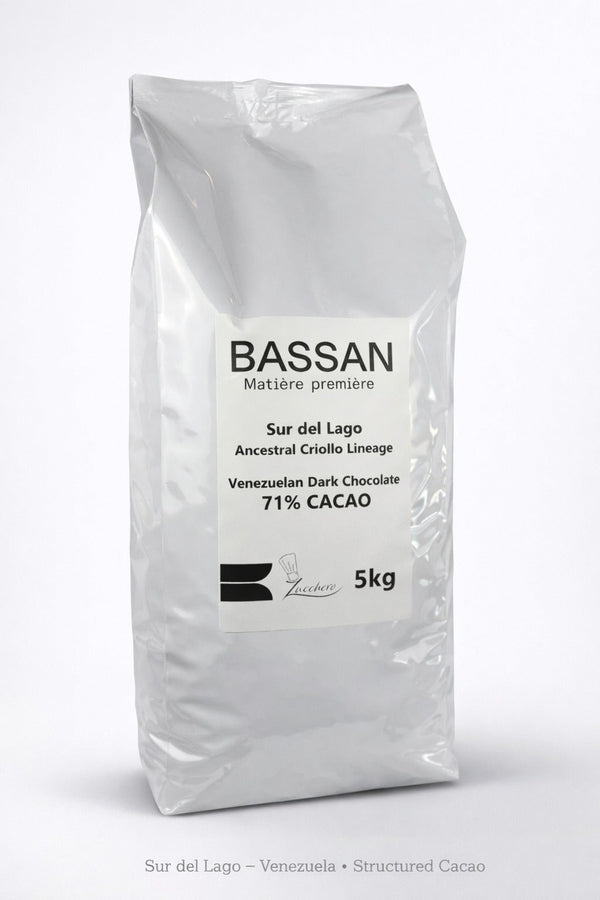 Bassan ChocolateSur del Lago Ancestral Criollo Lineage Dark Chocolate 71%From $69.95 CADView product →
 FCH Origins55% DARK CHOCOLATE MINIBARS 10 kg box - Origin Venezuela$299.00 CADView product →
 Canada Cacao Co.Natural Cocoa Liquor Wafers - 100% Peruvian Fine CocoaFrom $29.99 CADView product →
 Canada Cacao Co.Sur del Lago Ancestral Criollo Lineage Cocoa Beans · VenezuelaFrom $80.00 CADView product →
For professionals
Equipping a chocolate shop, bakery or kitchen?
Tell us what you produce and how much. We will recommend the right machine, moulds and ingredients, and send you a quote.
For home bakers
Professional tools for your own kitchen
The same European moulds, tools and ingredients the professionals use.
5% off orders over $500 CAD, applied automatically at checkout.
Keep reading


Leave a comment
All comments are moderated before being published.
This site is protected by hCaptcha and the hCaptcha Privacy Policy and Terms of Service apply.