




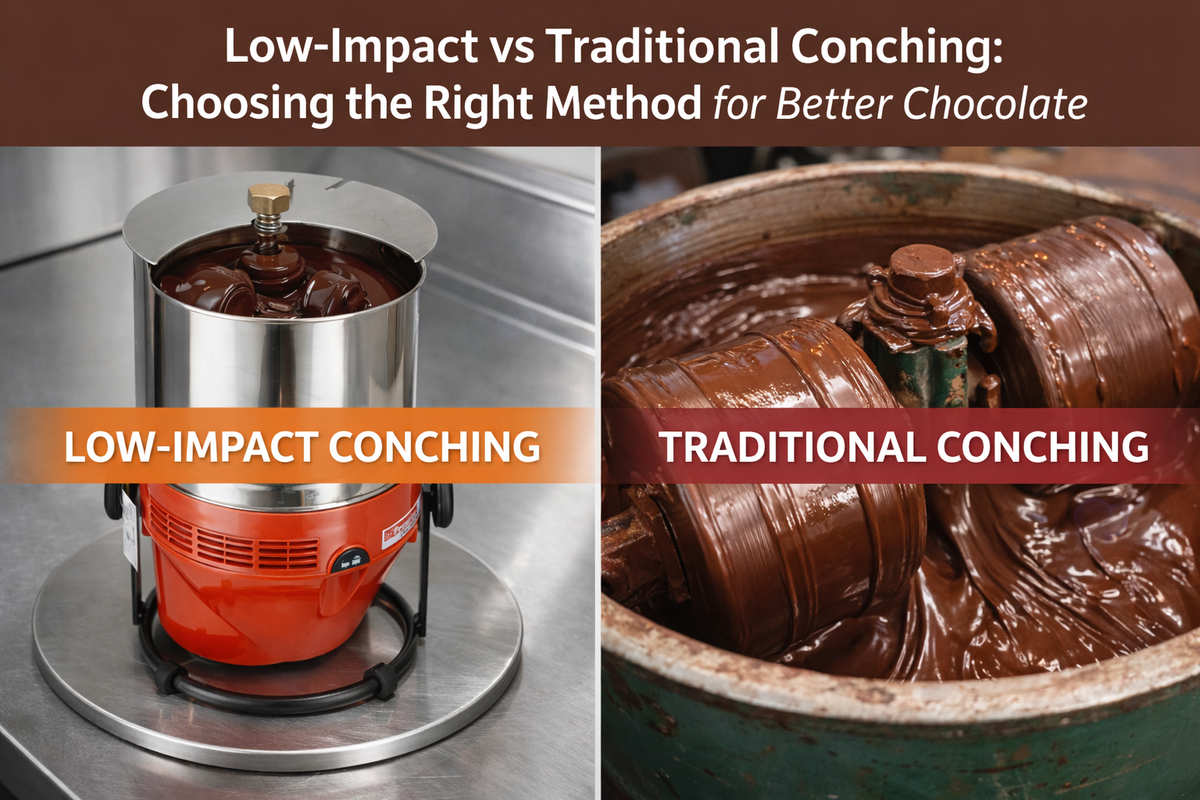
En bref : le conchage à faible impact travaille le chocolat avec moins de chaleur et une énergie mécanique plus douce, sur une durée plus longue, pour garder davantage l'arôme propre du cacao ; le conchage traditionnel à haute énergie utilise plus de chaleur et de cisaillement pour que la masse devienne fluide et perde son acidité plus vite, au prix d'une partie de l'arôme. Dans un essai publié sur une conche de 200 kg, le conchage plastique à 80 °C (176 °F) a réduit le composé aromatique linalol de 78,0 %, contre 15,8 % à 60 °C (140 °F). Choisissez le faible impact pour des fèves fines dont l'arôme est votre argument de vente, et plus d'énergie lorsque la fluidité et le temps comptent davantage.
Ce que signifie le « conchage à faible impact »
Le conchage à faible impact est une approche, pas une machine ni une recette fixe : on conche à des températures modérées et stables avec une énergie mécanique douce, et on donne plus de temps à la masse plutôt que plus de chaleur. Le Fraunhofer IVV nomme les paramètres entre lesquels vous choisissez : la température, l'apport d'énergie et la durée. Chocolate World décrit sa conche de table M1025 comme une « machine de conchage à faible impact ».
Quelle que soit la méthode, le conchage a les mêmes tâches. Il enrobe de matière grasse chaque particule de sucre et de cacao pour que le chocolat coule, élimine l'excès d'humidité, évapore les acides volatils, fixe la viscosité et développe la couleur (Barišić et al., 2019). Les composés indésirables comme l'excès d'acide acétique s'évaporent, mais des composés aromatiques recherchés se perdent aussi (Guckenbiehl et al., 2024). Cette double perte explique pourquoi la méthode compte. Pour le procédé complet, lisez notre guide qu'est-ce que le conchage.
Le conchage traditionnel à haute énergie
Le conchage à haute énergie accélère la fluidité en utilisant plus de chaleur et de cisaillement. Pendant le conchage, les forces de cisaillement peuvent produire des températures allant jusqu'à 90 °C (194 °F) (Fraunhofer IVV). Les recherches sur le chocolat noir montrent qu'une température de conchage plus élevée fait baisser la viscosité plus vite, mais réduit aussi le plus la concentration des composés aromatiques à valeur ajoutée (Guckenbiehl et al., 2024).
Ce que vous y gagnez : une masse qui atteint plus vite sa fluidité. Ce que cela coûte : une partie de l'arôme que les fèves avaient apporté. Pour un chocolat neutre et uniforme, ce compromis est acceptable ; pour une fève d'origine unique coûteuse, vous perdez une partie de ce que vous avez payé.
Le conchage à faible impact
Le conchage à faible impact garde une température modérée et laisse le temps faire le travail. Le coût, c'est le temps : à plus basse température, la viscosité baisse plus lentement. Une étude sur le chocolat au lait a montré que la durée de conchage (1 heure contre 3 heures) modifiait significativement la viscosité à 50 °C et 55 °C (122 °F et 131 °F), mais pas à 60 °C (140 °F), où la viscosité baissait plus vite (Urbańska et al., 2021, résumé par Guckenbiehl et al., 2024).
Le bénéfice, c'est l'arôme. La fermentation forme les précurseurs dont les réactions suivantes ont besoin, et les transformations chimiques les plus intenses ont lieu pendant la fermentation, la torréfaction et le conchage (Barišić et al., 2019). Si vous avez acheté des fèves fines bien fermentées pour leur arôme, une conche douce en garde davantage dans la tablette.
Ce que montrent les recherches : arôme contre fluidité
Les données les plus claires viennent d'un essai sur une conche industrielle de 200 kg avec un chocolat noir à 60 %. Le tableau compare la phase plastique menée de trois façons, toutes avec un résidu du lot précédent dans la conche, et indique de combien chaque composé a baissé dans la phase grasse entre la 1re et la 6e heure :
| Composé (phase grasse) | 60 °C (140 °F), sens avant | 60 °C (140 °F), cisaillement inversé | 80 °C (176 °F), sens avant |
|---|---|---|---|
| Acide acétique (indésirable) | −31,9 % | −40,1 % | −42,3 % |
| Linalol | −15,8 % | −9,0 % | −78,0 % |
| 2,3,5,6-Tétraméthylpyrazine | −19,6 % | −27,5 % (heures 2 à 6) | −70,7 % |
| 2-Phényléthanol | −19,8 % | −14,9 % | −47,1 % |
| Benzaldéhyde | −25,0 % | −32,6 % | −52,5 % |
| Viscosité après 3 et 6 heures | Plus élevée | La plus basse | La plus basse |
Deux lectures comptent pour un chocolatier. D'abord, passer de 60 °C à 80 °C n'a éliminé qu'un peu plus d'acide acétique, mais beaucoup plus de composés aromatiques recherchés. Ensuite, à 60 °C, inverser le sens de rotation des éléments de cisaillement a donné la même viscosité basse qu'à 80 °C et presque la même perte d'acide acétique, tout en gardant davantage la plupart des composés aromatiques. Les auteurs concluent qu'il faut trouver un compromis entre fluidité et saveur (Guckenbiehl et al., 2024).
Il s'agit d'un dispositif de recherche (phase sèche de 30 minutes à 50 °C, phase plastique à 1 200 tr/min, couvercle ouvert), pas d'une recette pour votre machine. Servez-vous-en pour décider quel levier actionner en premier : le temps et l'action mécanique avant la chaleur.
Comparaison côte à côte
| Critère | Conchage à faible impact | Conchage traditionnel à haute énergie |
|---|---|---|
| Température | Modérée et stable | Plus élevée |
| Énergie mécanique | Douce, contrôlée | Forte |
| Temps pour atteindre la fluidité | Plus long | Plus court |
| Composés aromatiques recherchés | Mieux conservés | Les plus fortes pertes dans les recherches |
| Élimination de l'acide acétique | Un peu plus lente dans les recherches | Plus rapide |
| Idéal pour | Bean-to-bar, origine unique, cacao fin | Masses qui doivent devenir très fluides rapidement ; saveur standardisée |
Quelle méthode pour quel atelier
Choisissez la méthode selon ce que vous vendez : l'arôme ou la rapidité.
| Votre activité | Approche |
|---|---|
| Bean-to-bar avec des fèves fines d'origine unique | Faible impact : chaleur modérée, plus de temps, dégustation au fil du conchage |
| Tablettes premium vendues sur leur histoire d'origine | Faible impact |
| Chocolat pour enrobage fin ou rotation rapide | Plus d'énergie ou plus de temps pour atteindre la fluidité voulue ; vérifiez ce que vous perdez en arôme |
| Une nouvelle origine que vous n'avez jamais travaillée | Commencez en douceur, prélevez et goûtez, puis ajustez un paramètre à la fois |
Conseils pratiques pour le conchage à faible impact
- Partez de fèves bien fermentées et bien torréfiées. Le conchage travaille sur ce que la fermentation et la torréfaction ont construit ; il conserve l'arôme, il ne le crée pas.
- Utilisez une machine à régulation active de la température. Dans les recherches, l'essai le plus chaud a perdu le plus d'arôme : réglez la température et maintenez-la.
- Allongez le temps avant d'augmenter la chaleur. Si la masse est encore trop épaisse ou trop vive, donnez-lui d'abord plus de temps.
- Goûtez à chaque prélèvement. Il n'existe pas de durée de conchage universelle : le Fraunhofer IVV avertit qu'un conchage trop long ou trop court nuit à la saveur.
- Notez tout. Lot de fèves, torréfaction, poids du lot, température, durée et notes de dégustation, pour pouvoir reproduire un bon lot.
L'équipement pour le conchage à faible impact
Chaque machine que nous proposons correspond à une échelle différente : le choix suit la taille de vos lots.
| Votre production | Machine | Pourquoi elle convient au faible impact |
|---|---|---|
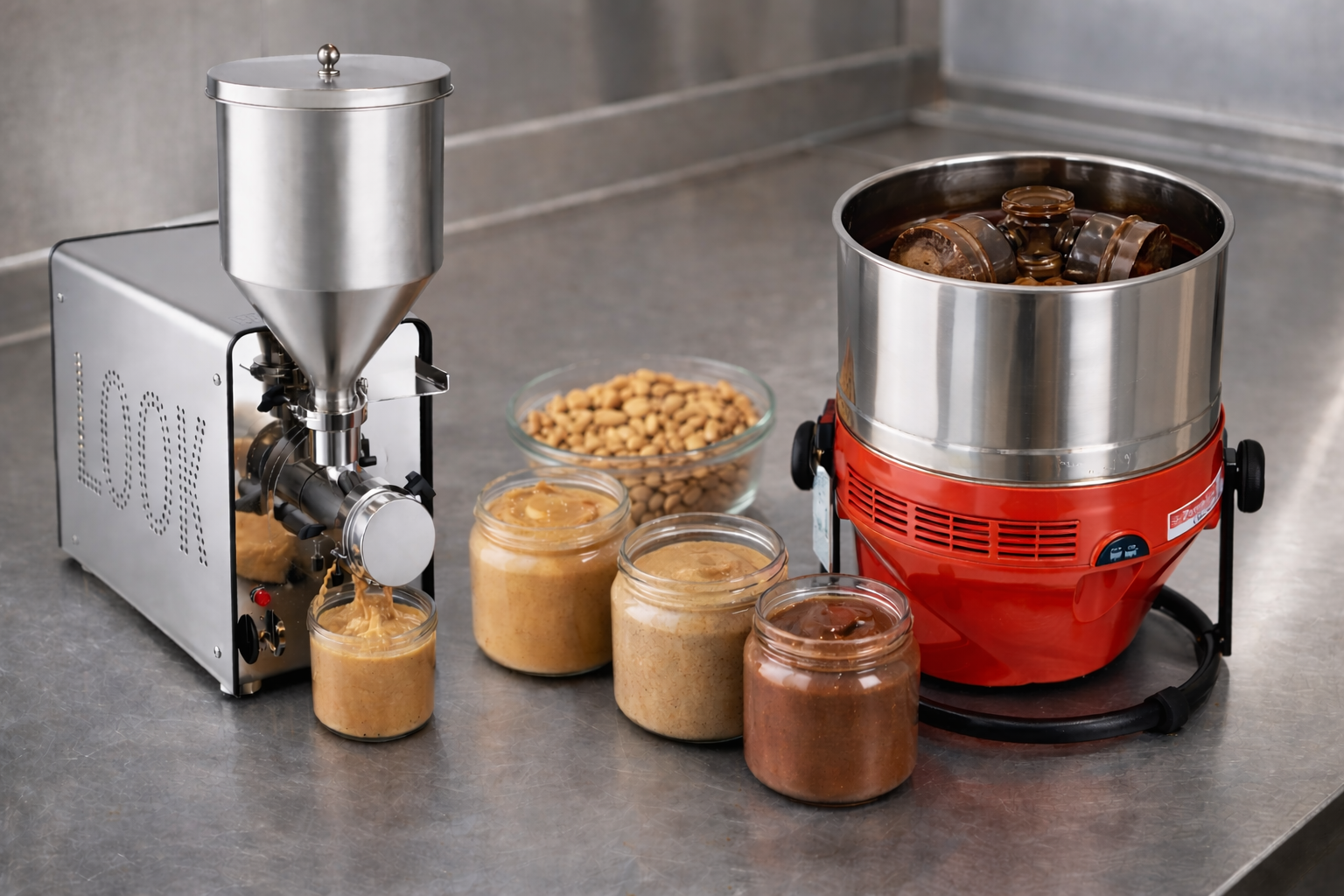
| Petits lots, de 1,3 à 4,5 kg | Chocolate World M1025 (110 V) | Décrite par Chocolate World comme une machine de conchage à faible impact ; meules en granit naturel, moteur prévu pour fonctionner jusqu'à 72 heures en continu, affine à moins de 20 µm |
| Affinage et conchage dans une même chambre, jusqu'à environ 15 kg | Affineuse Bilait R15 (Téflon) | Chambre fermée qui, selon Bilait, protège le lot des contaminations extérieures et conserve les arômes du cacao ; chauffe jusqu'à 70 °C (158 °F) et maintient la température ; ventilateur de conchage et couvercle en verre sur demande |
| Ligne en croissance qui alimente une tempéreuse | FBM KLEEGO 50 ou KLEEGO 100 | Cuve de fonte et conche (cuve de 50 kg avec conche de 35 kg, ou 100 kg avec 65 kg) ; commande électronique de la vitesse, du débit d'air et de la température, pour régler la douceur ou la rapidité de chaque lot ; pompe directement vers une tempéreuse |
- Chocolate World M1025 → 1 750,00 $
- Affineuse Bilait R15 → 12 370,00 $
- FBM KLEEGO 50 → 23 899,00 $
- FBM KLEEGO 100 → 36 500,00 $
Selon les données produit, la KLEEGO 100 réduit le temps de conchage à moins de 3 heures : lorsque le temps est la priorité, c'est la machine qui convient. Les machines FBM sont fabriquées sur commande en Italie.
Partir de fèves qui méritent d'être protégées
Le conchage à faible impact est rentable lorsque les fèves portent un arôme qui vaut la peine d'être gardé :
- Fèves de cacao Sur del Lago, lignée Criollo ancestrale, Venezuela → 80,00 $. Trinitario avec 10 à 30 % de lignée Criollo ancestrale, fermentées à une uniformité d'au moins 65 % et séchées au soleil pendant 7 jours ; notes fruitées, boisées et de noix, faible acidité et faible astringence. Chaque lot est accompagné d'un certificat d'origine et d'authenticité.
- Fèves de cacao fin d'Ucayali, Pérou → 80,00 $. Fermentées et séchées au soleil ; très faible amertume et astringence.
- Beurre de cacao naturel, 100 % cacao fin du Pérou, 8 kg → 550,00 $. Non désodorisé, il garde l'arôme du cacao, pour le beurre de cacao que vous ajoutez en phase liquide.
Vous ne fabriquez pas encore votre chocolat à partir de la fève ? La couverture noire Bassan Sur del Lago 71 %, 5 kg → 273,00 $ est faite à partir de la même origine vénézuélienne.
Pour la théorie derrière chaque étape, Chocolate de Ramon Morató → 160,00 $ comprend une section complète sur le chocolat en tant que produit.
Voir les fèves de cacao d'origine unique →
Comment l'IA peut aider votre production
Travaillez un même lot de fèves de deux façons, par exemple un lot plus doux et plus long et un lot plus chaud et plus court, et notez la température, la durée, les observations sur la viscosité et les notes de dégustation à chaque prélèvement. Collez ces relevés dans un assistant d'IA et demandez-lui de les aligner côte à côte, de repérer le moment où saveur et fluidité ont commencé à diverger, et de transformer le lot que vous avez préféré en procédure écrite. Il peut aussi estimer les heures-machine que chaque méthode coûte au kilo, pour fixer le prix de vos tablettes.
L'IA organise l'information ; la dégustation et la décision finale restent entre les mains de votre chef.
Équipement bean-to-bar et cacao chez Zucchero Canada
Nous sommes le distributeur exclusif de Bilait au Canada et un distributeur autorisé de FBM Boscolo et de Chocolate World. Les machines Bilait sont accompagnées d'une consultation avant l'achat et d'un soutien technique basé à Calgary. Nos fèves de cacao proviennent de Canada Cacao Co., et chaque lot Sur del Lago est accompagné de son certificat d'origine.
Une allocation prioritaire est offerte pour les commandes B2B régulières. Contactez notre équipe pour choisir une configuration de conchage adaptée à vos fèves et à la taille de vos lots.
Conches à chocolat | Bilait | Fèves de cacao | Qu'est-ce que le conchage ? | La viscosité du chocolat | Torréfier les fèves de cacao
Cet article est fourni à titre informatif seulement. Chaque entreprise est différente : tirez vos propres conclusions selon vos attentes, votre budget et vos objectifs, et consultez des experts qualifiés avant de décider ou d'investir.
Sources : Guckenbiehl Y. et al., « Conching of dark chocolate – Processing impacts on aroma-active volatiles and viscosity of plastic masses », Current Research in Food Science 9 (2024) 100909 ; Barišić V. et al., « The Chemistry behind Chocolate Production », Molecules 24 (2019) 3163 ; Fraunhofer IVV, « Model-based conching » ; catalogue d'équipement Chocolate World (M1025) ; catalogue Bilait 2026 (affineuse R15) ; données produit FBM Boscolo (KLEEGO 50 et 100) ; données produit Canada Cacao Co. et Bassan.






Laisser un commentaire
Tous les commentaires sont modérés avant d'être publiés.
Ce site est protégé par hCaptcha, et la Politique de confidentialité et les Conditions de service de hCaptcha s’appliquent.