




Réponse courte : le beurre de noix se fabrique en broyant des fruits à coque décortiqués (arachides, noix de cajou et noisettes torréfiées ; amandes crues ou torréfiées) jusqu'à obtenir une pâte, puis en affinant cette pâte jusqu'à la texture que vous vendez : lisse, moyenne ou croquante. En production, les vraies décisions portent sur la machine qui assure chaque étape (un broyeur continu pour le volume, un raffineur à meules ou à cylindres pour une pâte très fine, un broyeur à billes pour le gianduja et les pâtes à tartiner) et sur la maîtrise du sel, des stabilisants, de la température et de la sécurité alimentaire. Ci-dessous : les spécifications de référence, le procédé étape par étape et la machine adaptée à chaque production.
Réponse rapide : quelle machine pour quelle production de beurre de noix
| Votre production | Machine | Ce qu'elle fait (données du fabricant) | Prix |
|---|---|---|---|
| Mise au point de recettes et petits lots de beurre très lisse | Chocolate World M1025 (110 V) | 1,3 à 4,5 kg par lot ; meules en granit ; affine les particules sous 20 µm | 1 750,00 $ |
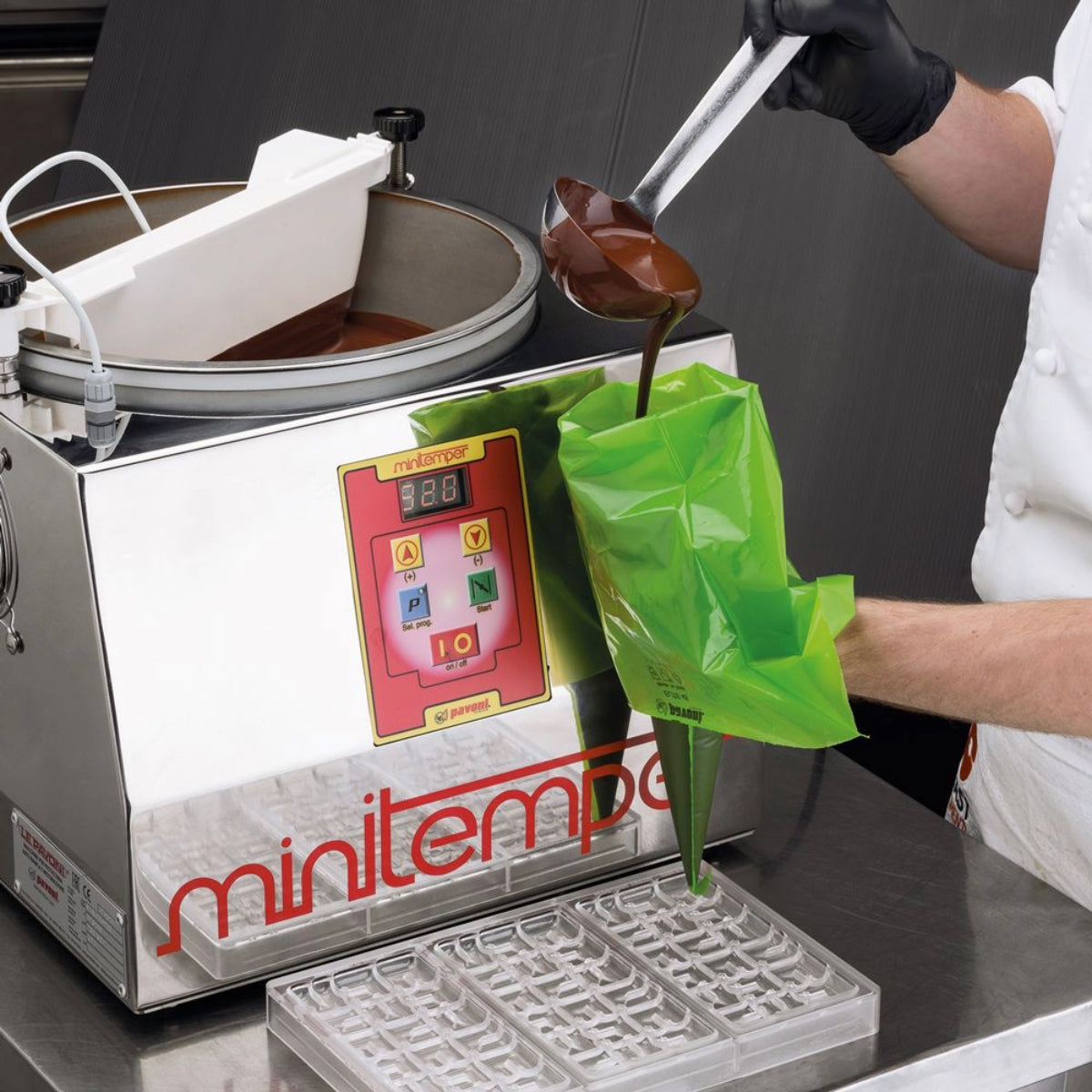
| Broyage continu d'arachides, de noix de cajou et de graines | Chocolate World Easy Paste M1970 | 80 à 100 kg/h d'arachides ; broie sous 40 °C (104 °F) ; sans ajout d'huile | 9 990,00 $ |
| Raffinage et conchage dans une même chambre fermée et chauffée | Raffineuse Bilait R15 (Téflon) | Jusqu'à environ 15 kg ; chauffe jusqu'à 70 °C (158 °F) et maintient la température | 12 370,00 $ |
| Gianduja et crèmes à tartiner | Broyeur à billes FBM TAO KID | Cuve de 15 kg ; 20 à 25 µm ; circuits de chauffe et de refroidissement séparés | 27 600,00 $ |
| Lots plus importants de pâtes de noix et de pâtes à tartiner | Broyeur à billes FBM TAOBROMA | Lot de 35 kg ; 20 à 25 µm ; pompe intégrée | 48 650,00 $ |
Voir les broyeurs à billes et raffineuses →
Ce qu'est un beurre de noix : les spécifications de référence
Les spécifications publiques les plus détaillées sont américaines, et elles constituent un repère utile pour tout producteur. La norme d'identité américaine du beurre d'arachide (21 CFR 164.150) et la spécification d'achat de l'USDA pour les beurres de noix (Commercial Item Description A-A-20328B) fixent ces limites :
| Point | Valeur de référence | Source |
|---|---|---|
| Base du beurre d'arachide | Arachides décortiquées et torréfiées, broyées, blanchies ou avec leur peau (non blanchies) | 21 CFR 164.150 |
| Assaisonnements et stabilisants dans le beurre d'arachide | Au total, pas plus de 10 % du poids du produit fini | 21 CFR 164.150 |
| Matières grasses du beurre d'arachide | Pas plus de 55 % | 21 CFR 164.150 |
| Interdits dans le beurre d'arachide | Arômes artificiels, édulcorants artificiels, agents de conservation chimiques, colorants | 21 CFR 164.150 |
| Beurre d'amande et beurre de noisette | Au moins 90 % d'amandes ou de noisettes | USDA A-A-20328B |
| Fruits à coque utilisés | Arachides, noix de cajou et noisettes torréfiées ; amandes crues ou torréfiées | USDA A-A-20328B |
Deux détails d'étiquetage de la règle américaine sont bons à connaître : de l'huile d'arachide peut être ajoutée ou retirée pour ajuster la teneur en huile, et un beurre fait d'arachides non blanchies doit porter la mention « prepared from unblanched peanuts (skins left on) » à côté de son nom. Si vous vendez au Canada, vérifiez auprès de l'Agence canadienne d'inspection des aliments les règles de composition et d'étiquetage qui s'appliquent à votre produit avant d'imprimer vos étiquettes.
Texture : lisse, moyenne ou croquante
La texture est la première chose que juge votre client, et la spécification de l'USDA en définit trois :
- Lisse : une texture très fine et très homogène, sans particules de noix granuleuses perceptibles.
- Moyenne : une texture nettement granuleuse, avec des particules de noix perceptibles d'environ 1/16 de pouce au plus dans n'importe quelle dimension.
- Croquante : une quantité importante de particules de noix de plus de 1/16 de pouce (environ 1,6 mm) dans n'importe quelle dimension.
La finesse atteignable dépend de la machine. Chocolate World indique que sa M1025 affine les particules sous 20 µm ; FBM annonce 20 à 25 µm pour les broyeurs à billes TAO KID et TAOBROMA. Le broyeur Easy Paste M1970 a une granulométrie réglable (grosse, moyenne, fine), ce qui convient aux textures moyennes et croquantes ou à un premier broyage avant raffinage.
Le procédé étape par étape
1. Choisir et contrôler les fruits à coque
Choisissez votre fruit à coque et votre torréfaction (ou des amandes crues pour le beurre d'amande), et achetez auprès de fournisseurs capables de documenter la qualité. La spécification de l'USDA rejette les fruits à coque crus dont un résultat d'aflatoxine n'est pas négatif, et limite le beurre fini à 15 parties par milliard. Demandez à votre fournisseur ses certificats d'analyse avant de bâtir un produit sur un lot.
2. Broyer
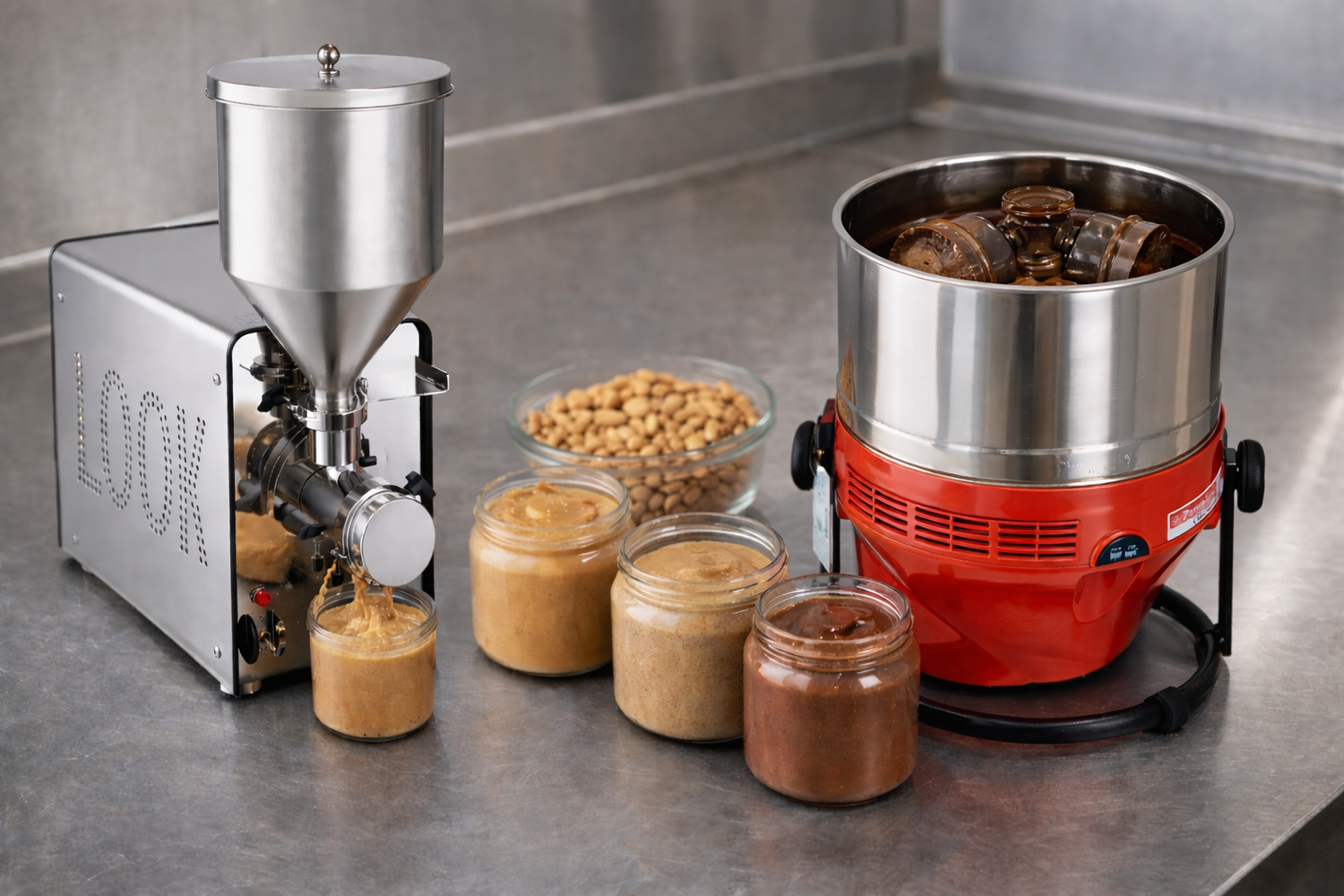
Le broyage transforme les fruits à coque entiers en pâte. Pour le volume, un broyeur continu le fait en un seul passage : l'Easy Paste M1970 de Chocolate World broie cacao, arachides, noix de cajou et sésame en une pâte 100 % naturelle sans ajout d'huile, sous 40 °C (104 °F), avec une trémie de 3,5 kg et 80 à 100 kg/h d'arachides. Ses pièces en inox 316 se démontent pour le lavage en environ trois minutes.
3. Raffiner pour un beurre lisse
Le raffinage réduit la taille des particules jusqu'à ce que la pâte soit lisse en bouche. Deux approches conviennent aux beurres de noix :
- Raffinage à meules en petits lots : la Chocolate World M1025 travaille avec des meules en granit naturel, de 1,3 à 4,5 kg par lot, et affine sous 20 µm. Son moteur est prévu pour fonctionner jusqu'à 72 heures en continu, et elle bascule pour verser.
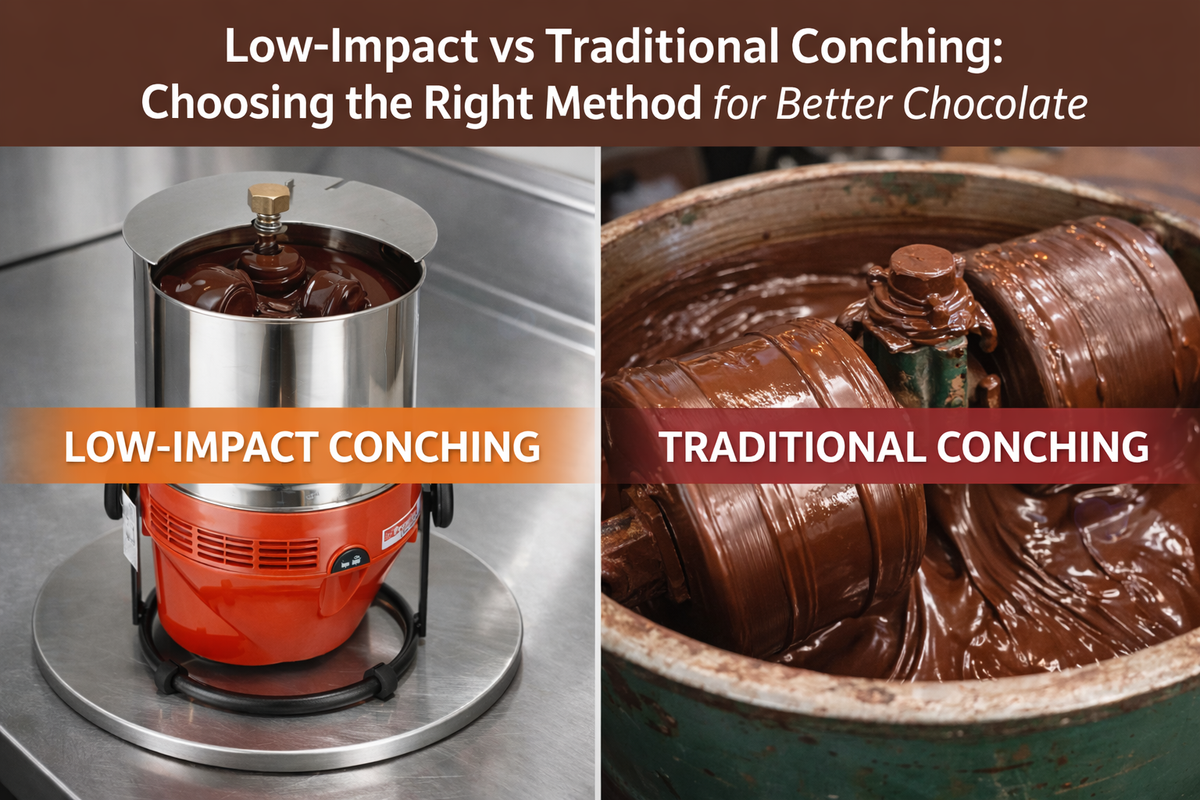
- Raffinage à cylindres en chambre fermée : Bilait indique que ses raffineuses traitent jusqu'à 2 kg par heure de fruits à coque (amandes, noisettes, pistaches et arachides). La R15 accepte de toutes petites quantités jusqu'à environ 15 kg, chauffe jusqu'à 70 °C (158 °F) et maintient cette température, si bien qu'un lot peut être raffiné et conché dans la même chambre fermée ; sa conception fermée protège la masse des contaminations extérieures et préserve ses arômes.
4. Assaisonner et décider des stabilisants
Le sel est facultatif pour la plupart des beurres de noix. À titre de repère, le beurre d'arachide américain de catégorie A de la spécification de l'USDA contient de 1,0 à 1,8 % de sel, et la tartinade d'arachide pas plus de 1,6 %. Décidez ensuite si votre beurre est stabilisé : la spécification attend des beurres stabilisés qu'ils ne présentent aucune séparation d'huile notable, tandis que les beurres non stabilisés peuvent demander un léger mélange pour disperser l'huile séparée. Selon la norme américaine du beurre d'arachide, les seuls stabilisants d'huile permis sont les huiles végétales hydrogénées, et assaisonnements et stabilisants restent sous 10 % du poids. Un beurre sans stabilisant, à étiquette épurée, est un produit légitime : indiquez au client de le remuer.
5. Contrôler et noter la température
Travaillez avec les températures données par le fabricant de votre machine : sous 40 °C (104 °F) pour le broyeur Easy Paste, jusqu'à 70 °C (158 °F) dans la Bilait R15. Mesurez la pâte elle-même plutôt que de vous fier à un cadran. Le thermomètre numérique 50T003 de Martellato a une sonde à immersion et une minuterie, et mesure de −32 °F à +482 °F (environ −36 °C à +250 °C).
- Voir le thermomètre à sonde Martellato 50T003 → 53,95 $
- Voir le thermomètre numérique Martellato 50T001 → 29,95 $
6. Planifier la sécurité alimentaire et les allergènes
La spécification de l'USDA indique les limites microbiologiques que les acheteurs attendent d'un beurre de noix fini :
| Analyse | Limite (USDA A-A-20328B) |
|---|---|
| Aflatoxine | Pas plus de 15 ppb |
| Numération sur plaque (flore totale) | Pas plus de 10 000 par g |
| Levures et moisissures | Pas plus de 100 par g |
| Salmonella | Négatif |
| E. coli | Négatif |
Les arachides, les noix et les graines de sésame figurent toutes sur la liste des allergènes alimentaires prioritaires de Santé Canada, avec le lait et le soja, que contiennent de nombreux chocolats. Si la même raffineuse traite du chocolat un jour et du beurre de noix le lendemain, inscrivez le nettoyage entre les produits dans votre procédure et prévoyez vos étiquettes en conséquence. La facilité de nettoyage est un critère d'achat : les cylindres de la R15 sont amovibles et lavables au lave-vaisselle, et l'Easy Paste se démonte en quelques minutes.
Quelle machine pour votre entreprise de beurre de noix
Ces machines font des travaux différents : le choix dépend de votre volume et de votre produit, pas de la marque.
- Pour démarrer, tester des recettes ou faire de petits lots haut de gamme : la Chocolate World M1025 fonctionne en 110 V et accepte de 1,3 à 4,5 kg ; vous pouvez ainsi tester fruits à coque, torréfactions et taux de sel sans engager de grandes quantités.
- Pour vendre du beurre d'arachide ou de graines en volume : l'Easy Paste M1970 broie en continu, à 80–100 kg/h d'arachides, au lieu de travailler lot par lot.
- Pour produire à la fois du chocolat et des pâtes de noix : la Bilait R15 raffine les graines oléagineuses et le cacao dans une même chambre fermée et chauffée, jusqu'à environ 15 kg. Un ventilateur de conchage et un couvercle en verre sont disponibles sur demande.
- Pour fabriquer du gianduja et des pâtes à tartiner chocolat-noisette : les broyeurs à billes FBM (TAO KID, 15 kg, ou TAOBROMA, 35 kg) affinent à 20–25 µm avec écran tactile et mémorisation des recettes.
Pour comparer les machines sur le coût, calculez vos propres chiffres : les kilos dont vous avez besoin par semaine, divisés par ce que chaque machine produit par lot ou par heure, donnent les heures de machine ; multipliez les heures où quelqu'un doit surveiller la machine par votre coût horaire de main-d'œuvre, et comparez ce chiffre, plus le prix de la machine, entre les options.
Voir toutes les machines bean-to-bar et de raffinage →
Comment l'IA peut aider votre production
Tenez un registre de lots simple (lot de fruits à coque, torréfaction, poids du lot, temps de broyage et de raffinage, température de la pâte, sel, texture obtenue) et collez-le dans un assistant d'IA : demandez-lui de repérer les réglages qui ont donné vos meilleurs lots et de les transformer en procédure écrite pour votre équipe. Il peut aussi adapter votre formule : pour un lot de 4,5 kg, la plage de 1,0 à 1,8 % de sel du beurre d'arachide américain de catégorie A représente 45 à 81 g. Demandez-lui de construire une fiche de coût par pot à partir de vos propres prix de fruits à coque, rendements et heures de travail.
L'IA organise l'information ; la dégustation et la décision finale restent entre les mains de votre chef.
Équipement pour beurre de noix chez Zucchero Canada
Nous sommes le distributeur exclusif de Bilait au Canada, et un distributeur autorisé des machines Chocolate World et FBM Boscolo. Les machines Bilait sont accompagnées d'une consultation avant achat et d'un soutien technique basé à Calgary. Les clients qui ont acheté leur machine chez nous obtiennent 15 % de rabais sur les pièces de rechange d'origine avec le code PARTS15, et les commandes de plus de 500 $ CA bénéficient automatiquement de 5 % de rabais au paiement. Les machines ne font pas partie de notre offre de livraison gratuite.
Vous planifiez une ligne de production ou l'achat de plusieurs machines ? Contactez notre équipe, écrivez à sales@zuccherocanada.ca ou appelez le 587-774-8873 (sans frais 877-741-8251).
Broyeurs à billes et raffineuses | Bilait | FBM Boscolo | Thermomètres et balances | Qu'est-ce que le conchage | Conchage à faible impact ou traditionnel | Enrober des boules au beurre d'arachide
Cet article est fourni à titre informatif seulement. Chaque entreprise est différente : tirez vos propres conclusions selon vos attentes, votre budget et vos objectifs, et consultez des experts qualifiés avant de décider ou d'investir.
Sources : Code of Federal Regulations des États-Unis, 21 CFR 164.150 « Peanut butter » (eCFR) ; USDA Commercial Item Description A-A-20328B « Nut Butters and Nut Spreads » (2011) ; Santé Canada, « Allergies alimentaires » (allergènes alimentaires prioritaires) ; catalogue Équipement Chocolate World, édition 9 (M1025, M1970) ; catalogue Bilait 2026 (raffineuses R7, R15, R60) ; fiches produits de Zucchero Canada (M1025, M1970, Bilait R15, FBM TAO KID et TAOBROMA, Martellato 50T003).







Laisser un commentaire
Tous les commentaires sont modérés avant d'être publiés.
Ce site est protégé par hCaptcha, et la Politique de confidentialité et les Conditions de service de hCaptcha s’appliquent.