


D'où vient la fève de cacao ? Origine, régions de culture et variétés
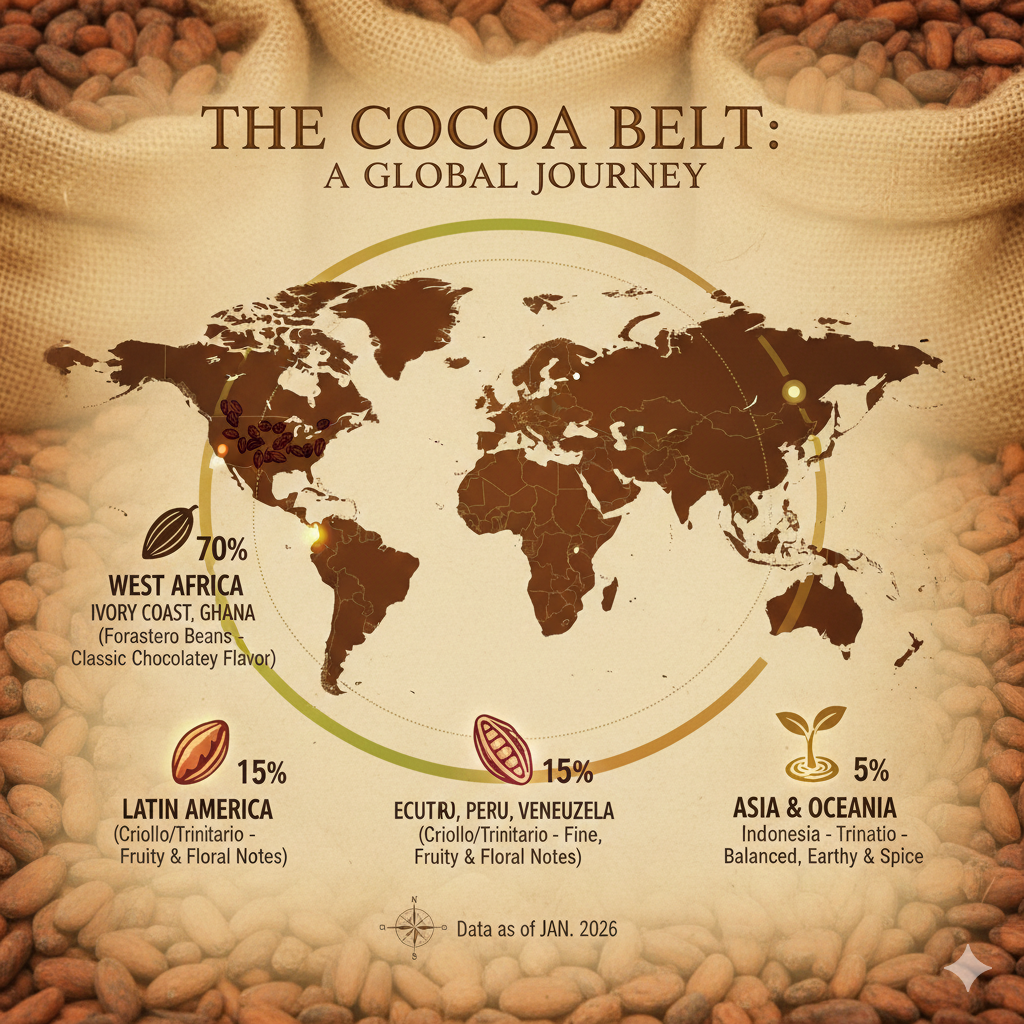
En bref : les fèves de cacao sont les graines du cacaoyer, Theobroma cacao, originaire d'Amérique du Sud, à l'est des Andes. Des découvertes archéologiques dans le sud de l'Équateur montrent que les fèves y étaient déjà utilisées il y a plus de 5 300 ans. Aujourd'hui, le cacao est cultivé dans une ceinture comprise entre 10° N et 10° S de l'équateur, et les trois premiers producteurs sont la Côte d'Ivoire, le Ghana et l'Équateur ; l'Afrique a fourni environ 71 % du cacao mondial lors de la campagne 2023/24, selon l'Organisation internationale du cacao (ICCO).
Réponse rapide : des fèves d'origine unique pour votre production
| Ce qu'il vous faut | Origine et fèves | Prix |
|---|---|---|
| Fèves fines vénézuéliennes de lignée Criollo | Sur del Lago, Venezuela | from $80.00 CAD |
| Fèves amazoniennes aux notes de fruits et d'épices | Ucayali, Pérou | from $80.00 CAD |
| Des grués plutôt que des fèves entières, pour le chocolat, la pâtisserie et les boissons | Grués de cacao vénézuéliens | from $69.95 CAD |
Voir toutes les fèves de cacao crues →
D'où vient le cacao
Le cacao est originaire d'Amérique du Sud. L'ICCO explique que le genre Theobroma, « nourriture des dieux » en grec, est apparu il y a des millions d'années en Amérique du Sud, à l'est des Andes, et que des découvertes archéologiques récentes dans le sud de l'Équateur montrent que les fèves de cacao y étaient déjà utilisées il y a plus de 5 300 ans.
Les graines de cacao ont ensuite été utilisées par plusieurs civilisations précolombiennes, dont les Mayas, les Incas et les Aztèques : comme ingrédient de boissons mêlées de farine de maïs et d'épices, comme monnaie d'échange et dans des rituels. Christophe Colomb a été le premier étranger à boire du chocolat, en 1502 ; Hernán Cortés a rapporté la boisson aztèque en Espagne en 1528, et elle n'est devenue populaire dans les cours européennes qu'une fois sucrée. Pour l'histoire complète, lisez notre histoire du cacao.
Comment le cacao s'est répandu dans le monde
Le cacao a quitté les Amériques avec les puissances coloniales, ce qui explique qu'il pousse aujourd'hui sur trois continents. Les étapes que retient l'ICCO :
- Amérique latine et Caraïbes : des frères capucins espagnols cultivaient du cacao Criollo en Équateur vers 1635. La France a introduit le cacao en Martinique et à Sainte-Lucie (1660), en République dominicaine (1665), au Brésil (1677), dans les Guyanes (1684) et à la Grenade (1714) ; l'Angleterre cultivait le cacao en Jamaïque dès 1670.
- Afrique de l'Ouest : le cacao Amelonado du Brésil a été planté à Príncipe en 1822, à São Tomé en 1830 et à Fernando Po en 1854, puis au Nigeria en 1874 et au Ghana en 1879. Au Cameroun, le cacao a été introduit entre 1925 et 1939.
- Asie : les Espagnols ont apporté les premiers arbres en Indonésie au XVIe siècle, mais le secteur ne s'est développé à grande échelle qu'à partir de 1970, surtout en Indonésie, en Malaisie et en Papouasie-Nouvelle-Guinée.
La ceinture du cacao : ce dont l'arbre a besoin
Le cacaoyer ne pousse que là où il fait chaud, humide et pluvieux toute l'année, ce qui limite la production commerciale à une bande autour de l'équateur. Son habitat naturel est l'étage inférieur de la forêt tropicale humide, et il est traditionnellement cultivé à l'ombre.
| Facteur | Besoins du cacaoyer (ICCO) |
|---|---|
| Latitude | Une ceinture comprise entre 10° N et 10° S de l'équateur |
| Température | Moyenne annuelle maximale de 30–32 °C (86–90 °F) ; moyenne minimale de 18–21 °C (64–70 °F) |
| Pluviométrie | 1 500–2 000 mm (environ 59–79 po) par an, bien répartis ; les périodes sèches de moins de 100 mm par mois ne doivent pas dépasser trois mois |
| Humidité | Souvent jusqu'à 100 % le jour, 70–80 % la nuit |
| Ombre | Indispensable pendant les premières années de l'arbre |
| Sol | Bien drainé, profond de 1,5 m pour les racines, pH 5,0–7,5, environ 3,5 % de matière organique dans les 15 premiers centimètres |
La pluie compte plus que tout : l'ICCO note que les variations de rendement d'une année à l'autre dépendent davantage de la pluviométrie que de tout autre facteur climatique.
D'où viennent les fèves de cacao aujourd'hui
La majorité du cacao mondial vient d'Afrique de l'Ouest, l'Amérique latine arrive deuxième et l'Asie-Océanie loin derrière. Voici les estimations de l'ICCO pour la campagne 2023/24, publiées en mai 2025 :
| Région / pays | Production 2023/24 (milliers de tonnes) | Part du total mondial |
|---|---|---|
| Afrique | 3 114 | 71,3 % |
| Côte d'Ivoire | 1 674 | environ 38 % |
| Ghana | 449 | environ 10 % |
| Nigeria | 350 | environ 8 % |
| Cameroun | 320 | environ 7 % |
| Amériques | 980 | 22,4 % |
| Équateur | 419 | environ 10 % |
| Brésil | 182 | environ 4 % |
| Asie et Océanie | 275 | 6,3 % |
| Indonésie | 180 | environ 4 % |
| Papouasie-Nouvelle-Guinée | 45 | environ 1 % |
| Monde | 4 368 | 100 % |
La production varie d'une année à l'autre : l'ICCO estimait 5 016 milliers de tonnes pour 2022/23 ; en février 2026, elle a révisé le total mondial 2023/24 à 4 362 milliers de tonnes et, dans son bulletin d'août 2026, elle a estimé 2024/25 à 4 733 milliers de tonnes, en hausse de 8,5 % sur un an.
Les variétés de cacao : Forastero, Criollo et Trinitario
Le cacao se divise traditionnellement en trois types, qui déterminent le goût possible d'une fève. L'ICCO les décrit ainsi :
- Le Forastero est un vaste groupe de populations cultivées, semi-sauvages et sauvages. Ses populations Amelonado sont les plus plantées et couvrent de grandes surfaces au Brésil et en Afrique de l'Ouest ; le cacao Nacional de l'Équateur appartient aussi à ce groupe.
- Le Criollo a dominé le marché jusqu'au milieu du XVIIIe siècle ; aujourd'hui, il ne reste que peu d'arbres Criollo purs, voire aucun.
- Le Trinitario descend d'un croisement entre Criollo et Forastero. Sa culture a commencé à Trinidad, puis s'est étendue au Venezuela, ensuite à l'Équateur, au Cameroun, aux Samoa, au Sri Lanka, à Java et en Papouasie-Nouvelle-Guinée.
Des chercheurs proposent désormais une classification plus fine en dix groupes génétiques (Amelonado, Criollo, Nacional, Contamana, Curaray, Guiana, Iquitos, Marañón, Nanay et Purús), mais ce sont toujours les trois noms historiques qu'utilise le commerce.
Cacao fin ou aromatique contre cacao ordinaire
Le marché distingue les fèves « fines ou aromatiques » des fèves « ordinaires » (bulk), et le cacao fin représente un peu moins de 5 % de la production mondiale, selon l'ICCO. En règle générale, les fèves fines proviennent d'arbres Criollo ou Trinitario et les fèves ordinaires de Forastero, avec des exceptions connues : les arbres Nacional de l'Équateur, de type Forastero, produisent du cacao fin, tandis que les fèves Trinitario du Cameroun sont classées comme ordinaires.
L'ICCO dresse la liste des pays exportateurs de cacao fin dans l'annexe C de l'Accord international sur le cacao de 2010. Sa révision de décembre 2020 comprend notamment l'Équateur et le Pérou (75 % de leurs exportations de cacao), la Papouasie-Nouvelle-Guinée (70 %), Madagascar et Trinité-et-Tobago (100 %), ainsi que le Venezuela, dont les exportations de cacao fin sont reconnues sans que le comité ait pu fixer de pourcentage.
De la cabosse à la fève : récolte, fermentation et séchage
Une fève de cacao n'est prête pour le chocolat qu'après avoir été fermentée et séchée à l'origine. C'est là que se joue une grande partie de son potentiel aromatique. L'ICCO décrit les étapes :
- Récolte. Les cabosses poussent directement sur le tronc et les branches. Elles sont coupées à la main, d'une coupe nette du pédoncule, avec un outil à long manche pour les cabosses hautes.
- Écabossage. Les cabosses sont ouvertes dans la semaine à dix jours suivant la récolte, idéalement avec un gourdin en bois pour ne pas abîmer les fèves, et les fèves fraîches sont retirées à la main.
- Fermentation. Les fèves et leur pulpe sont mises en tas couverts de feuilles de bananier, ou en caisses. Les levures transforment les sucres de la pulpe en alcool, puis des bactéries le transforment en acide acétique, ce qui fait monter la température à 40–45 °C (104–113 °F) pendant les 48 premières heures. La fève meurt dès le deuxième jour, ce qui déclenche les transformations chimiques qui développent la saveur et la couleur du chocolat. Les fèves Forastero demandent environ 5 jours, les Criollo 2 à 3 jours.
- Séchage. Les fèves sèchent lentement, au soleil ou en séchoir, d'environ 60 % à environ 7,5 % d'humidité. Un séchage trop rapide donne des fèves acides et amères ; trop lent, il laisse se développer moisissures et faux goûts. La température des fèves ne doit pas dépasser 65 °C (149 °F).
La torréfaction, le concassage, le broyage et le conchage se font ensuite chez le chocolatier. Consultez nos guides sur la torréfaction des fèves de cacao et le conchage.
Ce que l'origine change pour le chocolat que vous fabriquez
Pour un chocolatier, l'origine combine génétique, terroir et travail post-récolte, et la meilleure façon d'en juger reste les données de lot qui accompagnent les fèves. Voici ce que disent les données des producteurs pour les origines que nous vendons :
| Fèves | Génétique et lieu | Post-récolte | Notes aromatiques |
|---|---|---|---|
| Sur del Lago, Venezuela | Trinitario avec 10–30 % de lignée Criollo ancestrale ; bassin sud du lac de Maracaibo (Zulia et Trujillo) | Fermentation homogène à ≥ 65 % ; séchage au soleil sur 7 jours jusqu'à environ 5,4 % d'humidité ; sacs GrainPro | Fruité, boisé et de noix ; faible acidité et faible astringence |
| Ucayali, Pérou | Forêt amazonienne, cultivé par 140 producteurs entre 100 et 1 000 m sur des terres reboisées après l'exploitation minière | Fermenté et séché au soleil | Fruits mûrs, épices et bois léger ; très faible amertume et astringence |
| Hacienda Victoria, Équateur | 100 % Arriba Nacional d'un seul domaine sur la côte équatorienne | Au moins 75 % de fèves bien fermentées ; séchage lent au soleil pendant 7 jours ; 125–130 fèves pour 100 g | Notes de noix et de terre ; faible acidité |
Ces trois fèves sont des produits agricoles crus, non torréfiés, qui doivent être torréfiés et transformés avant usage. Si vous préférez des grués plutôt que des fèves entières, nos grués de cacao vénézuéliens, pour la chocolaterie, les desserts, la boulangerie-pâtisserie et les boissons, sont faits de fèves Carenero Superior, Río Caribe Superior et Sur del Lago, avec 54–56 % de matière grasse. Si vous achetez de la couverture plutôt que des fèves, notre chocolat noir FCH 55 % ($299.00 CAD les 10 kg) est fait de cacao Trinitario 100 % vénézuélien.
Voir les fèves de cacao vénézuéliennes →
Comment l'IA peut aider votre production
Donnez à un assistant d'IA les données de lot de chaque origine achetée (fermentation, humidité, nombre de fèves) ainsi que vos notes de torréfaction et de dégustation, et demandez-lui de bâtir un registre de lots qui relie chaque fournée de chocolat à ses fèves. Demandez-lui de comparer les origines côte à côte après chaque dégustation, de transformer vos journaux de torréfaction en profil de départ pour un nouveau lot et de calculer le coût d'une tablette à partir du prix des fèves, du rendement et de l'emballage. La traçabilité par lot permet aussi de dire précisément à vos clients d'où vient leur chocolat.
L'IA organise l'information ; la dégustation et la décision finale restent entre les mains de votre chef.
Les fèves de cacao chez Zucchero Canada
Zucchero Canada est le nom commercial de Canada Cacao Company, un importateur de Calgary qui est aussi courtier en cacao vénézuélien. Nous vendons des fèves du Venezuela, du Pérou et de l'Équateur ; les fèves vénézuéliennes et péruviennes sont offertes en sacs GrainPro de 1,5 kg et de 5 kg, et chaque fiche produit indique les formats disponibles. Chaque lot de fèves Sur del Lago est accompagné d'un certificat d'origine et d'authenticité, et une allocation prioritaire est offerte pour les commandes B2B régulières qui exigent un volume et une qualité constants toute l'année. Les produits alimentaires sont expédiés au Canada seulement ; le cacao est exclu de la livraison gratuite, et les commandes de plus de 500 $ CA obtiennent 5 % de rabais automatiquement à la caisse.
Vous montez une ligne bean-to-bar ? Parcourez nos machines bean-to-bar et lisez comment lancer une entreprise bean-to-bar au Canada. Pour des prix de volume ou de l'aide pour choisir une origine, contactez-nous, écrivez à sales@zuccherocanada.ca ou appelez le 587-774-8873 (sans frais 877-741-8251).
Fèves de cacao crues | Grués de cacao | Machines bean-to-bar | Qu'est-ce qu'un chocolat d'origine unique | Meilleures fèves d'origine unique | Cacao ou café
Cet article est fourni à titre informatif seulement. Chaque entreprise est différente : tirez vos propres conclusions selon vos attentes, votre budget et vos objectifs, et consultez des experts qualifiés avant de décider ou d'investir.
Sources : Organisation internationale du cacao (ICCO), « Growing cocoa » et « Harvesting & post-harvest » (icco.org) ; ICCO, Bulletin trimestriel de statistiques du cacao, « Production of cocoa beans », vol. LI n° 2 (publié le 30 mai 2025) et résumés des bulletins de février 2026 et d'août 2026 ; ICCO, révision de l'annexe C de l'Accord international sur le cacao de 2010, ED(MEM) 1145 (décembre 2020) ; données produit de Zucchero Canada pour Sur del Lago, Ucayali, Hacienda Victoria, les grués vénézuéliens et le FCH 55 %.
Good to know
Frequently asked questions
D'où vient la fève de cacao ?
Les fèves de cacao sont les graines du cacaoyer, Theobroma cacao. Elles poussent dans des cabosses qui se forment directement sur le tronc et les branches. L'arbre est cultivé dans une ceinture comprise entre 10° N et 10° S de l'équateur, surtout en Afrique de l'Ouest, en Amérique latine et en Asie-Océanie.
Quelle est l'origine du cacao ?
Selon l'Organisation internationale du cacao, le genre Theobroma est apparu en Amérique du Sud, à l'est des Andes, et des découvertes archéologiques dans le sud de l'Équateur montrent que les fèves y étaient utilisées il y a plus de 5 300 ans. Les Mayas, les Incas et les Aztèques ont ensuite utilisé le cacao comme aliment, comme monnaie et dans des rituels.
Quel pays produit le plus de cacao ?
La Côte d'Ivoire. L'ICCO a estimé sa production 2023/24 à 1 674 milliers de tonnes, soit environ 38 % du total mondial de 4 368 milliers de tonnes. Suivaient le Ghana (449) et l'Équateur (419).
Quelle est la différence entre les cacaos Criollo, Forastero et Trinitario ?
Le Forastero est le groupe le plus planté ; il comprend le cacao Amelonado du Brésil et d'Afrique de l'Ouest et le Nacional de l'Équateur. Le Criollo a dominé jusqu'au milieu du XVIIIe siècle, mais il ne reste que peu d'arbres Criollo purs, voire aucun. Le Trinitario est un croisement entre Criollo et Forastero né à Trinidad et répandu ensuite au Venezuela. En règle générale, le cacao fin provient d'arbres Criollo ou Trinitario, avec des exceptions comme le Nacional de l'Équateur.
Où acheter des fèves de cacao d'origine unique au Canada ?
Nous vendons des fèves crues et fermentées d'origine unique du Venezuela (Sur del Lago), du Pérou (Ucayali) et de l'Équateur (Hacienda Victoria), ainsi que des grués de cacao vénézuéliens, expédiés au Canada. Le cacao est exclu de la livraison gratuite ; les commandes de plus de 500 $ CA obtiennent 5 % de rabais automatiquement. Pour des volumes B2B réguliers, contactez-nous au sujet de l'allocation prioritaire.
Shop this article
Products mentioned in this guide
 Canada Cacao Co.Grains de cacao "Sur del Lago" – Cru, Fermenté, "Venezuela"From $80.00 CADView product →
 Canada Cacao Co.Fèves de cacao péruviennes - Origine "Pérou" - Crues, fermentées, véganesFrom $80.00 CADView product →
 Canada Cacao Co.Fèves de cacao - Origine unique "Venezuela"From $69.95 CADView product →
 FCH Origins55% CHOCOLAT NOIR MINIBARS 10 kg boîte - Origine Venezuela$299.00 CADView product →
For professionals
Equipping a chocolate shop, bakery or kitchen?
Tell us what you produce and how much. We will recommend the right machine, moulds and ingredients, and send you a quote.
For home bakers
Professional tools for your own kitchen
The same European moulds, tools and ingredients the professionals use.
5% off orders over $500 CAD, applied automatically at checkout.
Keep reading

Laisser un commentaire
Tous les commentaires sont modérés avant d'être publiés.
Ce site est protégé par hCaptcha, et la Politique de confidentialité et les Conditions de service de hCaptcha s’appliquent.