


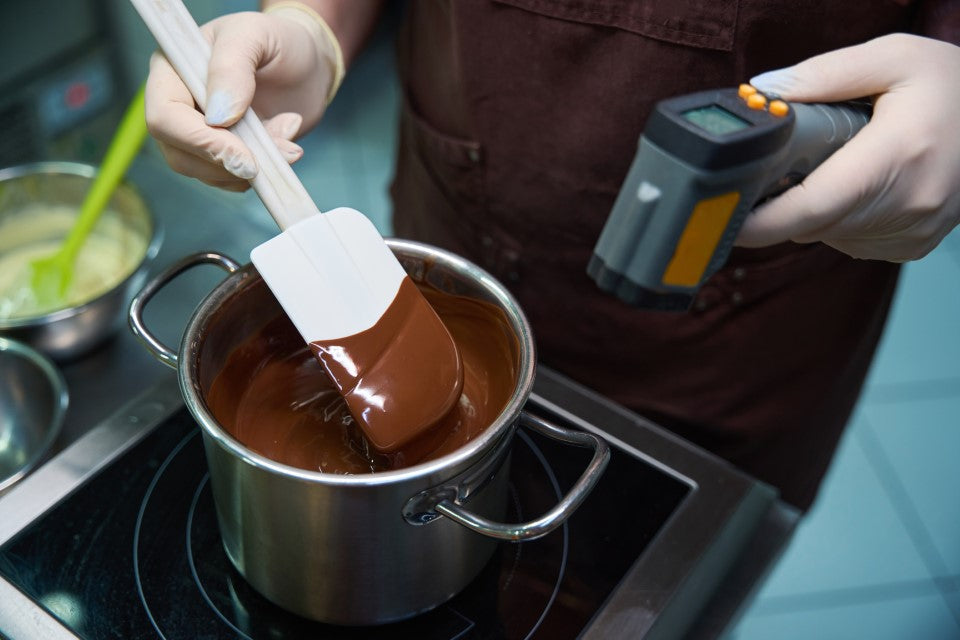
Chocolate Melting Tips: How to Melt Chocolate Without Burning or Seizing
Short answer: melt chocolate in small, even pieces over gentle heat, stir often, keep every drop of water and steam out of the bowl, and stay within the maker's figures: melt at 45–50°C (113–122°F) for the FCH 55% dark we stock, 50°C (122°F) at most for the Bassan 71%. A double boiler and a microwave both work for small batches; a dry melter such as the Martellato Meltinchoc holds the temperature for you. If the chocolate has to set glossy and snap on its own, temper it after melting. Below are the methods, the temperatures and the fixes.
| Your need | What we recommend | Price |
|---|---|---|
| Check the temperature of every batch | Martellato digital thermometer for chocolate 50T001 | $29.95 CAD |
| Melt small batches without water | Mini Meltinchoc dry melter, 1.8 L | from $390.00 CAD |
| Keep chocolate melted for a full shift | Meltinchoc analogue melter, 6 L | $925.00 CAD |
| Melt, seed and hold at the working temperature | Meltinchoc Digital melter, 3.6 L | $1,150.00 CAD |
| Couverture that melts with a clear technical curve | Bassan Sur del Lago 71% dark couverture, 5 kg | $273.00 CAD |
The five rules of melting chocolate
Almost every failed batch breaks one of these rules: too much heat, water in the bowl, or no thermometer.
- Start from small, even pieces. Tested methods from America's Test Kitchen start from chocolate chips or chopped bar chocolate, never a whole block.
- Use gentle heat and stir. The heat source lags behind the chocolate, so the chocolate keeps climbing after you think you have stopped (KREA Swiss). Stir regularly and scrape the sides of the bowl.
- Keep water out. A tiny amount of moisture forms a syrup with the sugar, the cocoa particles cling to it, and the chocolate turns stiff and grainy: it seizes (America's Test Kitchen). Steam from a bain-marie, condensation and a bowl that is not fully dry are the usual sources (KREA Swiss).
- Measure, do not guess. Every figure in this guide is a chocolate temperature; a thermometer is the only way to know where you are.
- Follow the maker's figures. Melting and working temperatures vary from one chocolate to the next, so the technical sheet of your couverture has the last word (KREA Swiss).
What temperature to melt chocolate at
The makers' figures we work with put melting at 45–50°C (113–122°F); compound coatings melt lower.
| Chocolate | Melt | Source |
|---|---|---|
| Dark, milk and white (Digital Meltinchoc programs) | 45°C (113°F) for all three, then held at 31°C (88°F) dark, 29°C (84°F) milk, 28°C (82°F) white after seeding | Martellato Digital Meltinchoc manual |
| FCH 55% dark, Venezuela | 45–50°C (113–122°F); tempering 31–32°C (88–90°F) | FCH technical data |
| Bassan Sur del Lago 71% dark | 50°C (122°F) maximum; working 30–32°C (86–90°F) | Bassan technical data |
| Compound coating (no cocoa butter) | Melts at about 35–37°C (95–99°F), coats best at about 40°C (104°F) | BCcampus, Understanding Ingredients for the Canadian Baker |
One warning for chocolate that is already tempered and that you only want to warm to working temperature: much above about 34°C (93°F) the stable crystals are destroyed and the temper is lost (KREA Swiss). Melting it fully and tempering again is then the only way back.
Method 1: double boiler (bain-marie)
The double boiler is gentle, but its steam is the main risk.
- Bring water to a near simmer over low heat.
- Set a large heatproof bowl over the pot with its edges overhanging and its bottom out of the water.
- Add the chocolate and stir now and then with a rubber spatula. America's Test Kitchen melts 8 oz (227 g) this way in about 10 minutes.
In America's Test Kitchen's own comparison, 4 oz (113 g) of chocolate took 6.5 minutes on the stovetop and 3.5 minutes in the microwave; they call the double boiler "fussy" and the microwave "just as effective". Compare both in our double boiler vs microwave guide.
Method 2: microwave
The microwave is the fastest home method, as long as you heat in short bursts and stir between them.
- Put 8 oz (227 g) of chips or chopped chocolate in a large microwave-safe bowl and heat 45 seconds.
- Stir, scraping the sides, then heat 30 seconds more.
- Continue in 15-second bursts, stirring each time, until smooth and glossy.
- For more or less chocolate, change the first heating time by 10 seconds per 2 oz (57 g).
- If the recipe has butter, add it only when the chocolate is almost melted, or it may splatter.
This is the America's Test Kitchen method, at full power. KREA Swiss warns that microwave heat is uneven and can bring moisture into the chocolate, so stir thoroughly between bursts.
Method 3: a dry melter (what professionals use)
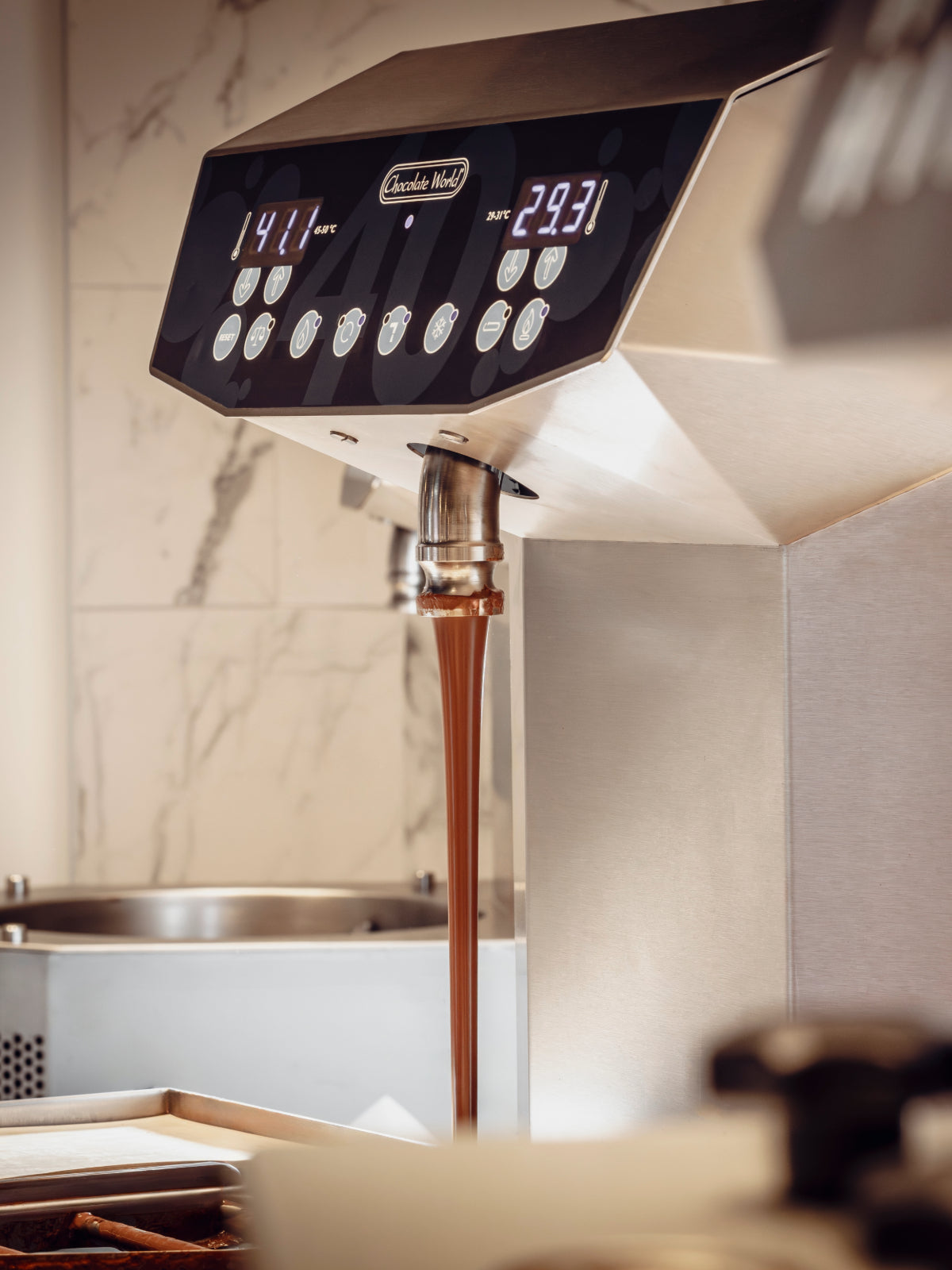
A melter heats the chocolate with dry heat and holds it at a set temperature, so there is no steam and no guessing.
As KREA Swiss explains, dry heat avoids the humidity of a bain-marie and the uneven heat of a microwave. Martellato's Meltinchoc melters are dry melters with a removable tank (stainless steel on the 6 L and 13.7 L analogue models and the Digital 3.6 L, anodised aluminium on the Mini and the Deep); the Mini and the 13.7 L analogue model have a manual thermostat up to 50°C (122°F). The Digital Meltinchoc goes further: it melts to 45°C, signals when to seed, then lowers to the working temperature of the program you chose and keeps it there. Martellato's manual adds two habits worth copying: never run the melter empty, and switch it off after each melting cycle.
| Method | Best for | Watch out for |
|---|---|---|
| Double boiler | Small batches, melting with butter | Steam and drips of water |
| Microwave | Small batches, fast | Hot spots; stir every burst |
| Dry melter | Daily production, holding chocolate for hours | Set the thermostat to your chocolate's sheet |
Melting chocolate chips
Chips melt with the same methods, but many are made to hold their shape in the oven.
Chips are developed to be more heat-stable so they stay whole in cookies, and some have another fat in place of cocoa butter (BCcampus). Check the ingredient list: our organic 70% dark chocolate chips ($45.95 CAD per kg) list cocoa butter in the ingredients and melt smoothly for dipping and coating fruit. For dipping step by step, read how to melt chocolate chips for dipping.
Seized, thick or overheated: what went wrong
Seized chocolate has met water; thick chocolate is too cold or over-crystallised; burnt chocolate was heated too far.
- Seized (stiff and grainy): America's Test Kitchen restores it by adding boiling water, 1 teaspoon at a time, stirring hard after each addition until smooth. The result is no longer chocolate for baking: use it for a sauce or hot chocolate.
- Melting with liquids on purpose: if the recipe contains melted butter, liqueur or water, melt the chocolate together with those ingredients from the start (America's Test Kitchen).
- Too thick to work: see how to make melted chocolate thinner.
- Overheated or burnt: see how to fix overheated, seized or burnt chocolate.
Melting is not tempering
Melted chocolate left to set on its own sets slowly, without shine or snap, and often blooms: if it must look and break like a finished chocolate, temper it.
Tempering guides the cocoa butter into its one stable crystal form, which gives gloss, a clean snap and longer shelf life (KREA Swiss; Greweling, Pastry Arts). Under-tempered chocolate often blooms in less than two days, with large white spots or white rings (Lonchampt and Hartel, 2004). Dipped fruit, bonbons and bars need tempered chocolate; read tempered vs untempered chocolate and how to temper chocolate.
Storing chocolate and leftovers
Let leftover chocolate set, then keep it cool, dry and away from odours; the refrigerator is not the ideal place.
BCcampus gives 18–20°C (64–68°F) at 60% relative humidity as ideal storage, with chocolate protected from odours and humidity in sealed containers or its original packaging. America's Test Kitchen also advises against the refrigerator and freezer: cocoa butter absorbs off-flavours, and temperature changes alter its crystal structure. More ideas in what to do with leftover melted chocolate.
How AI can help your production
Paste your couverture's technical sheet into an AI assistant and ask it to turn it into a one-page melting card for each chocolate you use: melt temperature, working temperature and the maximum never to exceed, in °C and °F. Ask it to build a temperature log your team fills in at every batch, and to scale your recipes when you change batch size. Written figures at the bench are what stop a shift from guessing.
AI organises the information; tasting and the final decision stay with your chef.
Melters and couverture at Zucchero Canada
We are an authorized distributor of Martellato and stock its Meltinchoc melters in 110 V, from the 1.7 L Deep Meltinchoc for dipping to the 13.7 L models for production. Each one has its job:
- Mini Meltinchoc 1.8 L → from $390.00 CAD: small batches, pralines and dipping.
- Deep Meltinchoc 1.7 L → $669.00 CAD: a deep bowl for dipping and coating on a stick.
- Meltinchoc analogue 6 L → $925.00 CAD: holds a full shift of couverture with a manual thermostat.
- Meltinchoc Digital 3.6 L → $1,150.00 CAD: three programs for dark, milk and white, with an integrated probe.
Martellato table-top melters come with a free spatula. For chocolate, the Bassan Sur del Lago 71% couverture, made in Canada from Venezuelan cacao, and the FCH 55% Venezuelan dark minibars ($299.00 CAD per 10 kg box) both come with their melting curve. For the full technique of working chocolate, Chocolate by Ramon Morató ($160.00 CAD) covers tempering, coating and glazing in 416 pages.
Buying for a bakery, hotel or chocolate shop? Contact us for volume orders, or call 587-774-8873 (toll free 877-741-8251).
Chocolate melters | Dark couverture | Best chocolate for melting | Melter or temperer? | How to temper chocolate
This article is for information only. Every business is different: draw your own conclusions based on your own expectations, budget and goals, and talk to qualified experts before you decide or invest.
Sources: America's Test Kitchen, "Two Ways to Melt Chocolate" and K. DeMichele, "How to Work with Chocolate" (2018); KREA Swiss Knowledge, "Tempering, what it really is and where it goes wrong"; Martellato, Digital Meltinchoc instruction manual, General Catalogue 2026 and product data; FCH and Bassan technical data; BC Cook Articulation Committee, Understanding Ingredients for the Canadian Baker (BCcampus), chapter 7; P. Greweling, "Tempering Chocolate", Pastry Arts Magazine (2024); P. Lonchampt and R. W. Hartel, Eur. J. Lipid Sci. Technol. 106 (2004).
Good to know
Frequently asked questions
How do you melt chocolate without burning it?
Use small, even pieces, gentle heat and a thermometer, and stir often. Stay within your chocolate's figures: melt at 45–50°C (113–122°F) for the FCH 55% dark we stock, 50°C (122°F) at most for the Bassan 71%. The heat source lags behind, so the chocolate keeps climbing after you stop: heat slowly.
What is the best way to melt chocolate?
It depends on the quantity. For small batches, the microwave in short bursts and the double boiler both work; America's Test Kitchen finds the microwave just as effective and faster (3.5 minutes against 6.5 minutes for 4 oz / 113 g). For daily production, or to keep chocolate melted for hours, a dry melter is the professional choice: dry heat, no steam and a set temperature. Whatever the method, use small pieces, keep water out and check the temperature.
Is it better to melt chocolate in the microwave or a double boiler?
Both work for small batches. In America's Test Kitchen's test, 4 oz (113 g) took 3.5 minutes in the microwave and 6.5 minutes on the stovetop. Use the microwave in short bursts, stirring each time; with a double boiler, keep the water at a near simmer and the bowl out of the water, because steam is the main risk. For daily production, a dry melter holds the temperature for you.
What temperature should chocolate be melted at?
Follow your chocolate's technical sheet; the makers' figures we work with sit at 45–50°C (113–122°F). Martellato's Digital Meltinchoc melts dark, milk and white at 45°C (113°F), then holds them at 31°C, 29°C and 28°C (88°F, 84°F, 82°F) after seeding. Compound coatings melt at about 35–37°C (95–99°F).
Why did my melted chocolate seize, and can I fix it?
A tiny amount of water or steam got in: it forms a syrup with the sugar and the cocoa particles clump. America's Test Kitchen restores seized chocolate by stirring in boiling water 1 teaspoon at a time until smooth; use the result for sauce or hot chocolate, not for baking.
Can you melt chocolate chips for dipping?
Yes, with the same methods, but check the label: some chips are made to hold their shape in baking and some replace cocoa butter with another fat. Our organic 70% dark chips contain cocoa butter and melt smoothly for dipping. For a glossy coating that sets on its own, temper the chocolate.
Do melters and chocolate qualify for free shipping?
No. Machines and chocolate are excluded from our free shipping on orders of $300 CAD or more. Orders over $500 CAD get 5% off automatically at checkout, and Martellato table-top melters come with a free spatula. Food products ship within Canada only.
Shop this article
Products mentioned in this guide
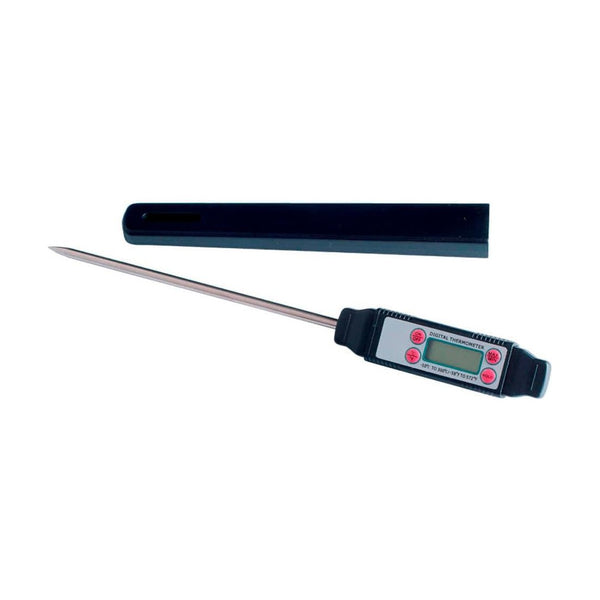 MartellatoDigital Thermometer for Chocolate 50T001$29.95 CADView product →
 Martellato"Mini Meltinchoc" Chocolate Melter 1.8 L – MC09GUSAFrom $390.00 CADView product →
 MartellatoMeltinchoc Analogue Melter 6 L – MC102110V$925.00 CADView product →
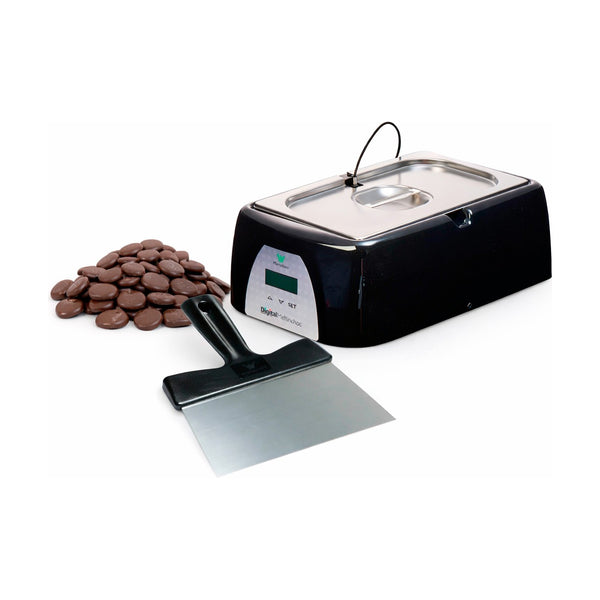 MartellatoMeltinchoc Digital Melter 3.6 L – MCD101110V$1,150.00 CADView product →
For professionals
Equipping a chocolate shop, bakery or kitchen?
Tell us what you produce and how much. We will recommend the right machine, moulds and ingredients, and send you a quote.
For home bakers
Professional tools for your own kitchen
The same European moulds, tools and ingredients the professionals use.
5% off orders over $500 CAD, applied automatically at checkout.
Keep reading



Leave a comment
All comments are moderated before being published.
This site is protected by hCaptcha and the hCaptcha Privacy Policy and Terms of Service apply.